
More project photos (2)
The problem
An aeroponics system grows plants with their roots suspended in air inside a dark chamber, misted at intervals with nutrient solution instead of sitting in soil or water. That air gap is the whole point: roots get oxygen freely between mists, and NASA reports aeroponic systems can cut water use by up to 98% versus soil farming. The trouble is that the same air gap makes the plants depend entirely on the misting cycle: if the pump stops, a nozzle clogs or the timer drifts, exposed roots begin drying within minutes. Manual misting cannot hold a steady rhythm day and night, and without sensing a grower cannot tell whether the chamber is too hot, too dry or running low on nutrient solution. This project closes that loop: an ESP32 runs the misting schedule through a relay and pump, a DHT22 sensor watches temperature and humidity, and a water-level sensor guards the reservoir.
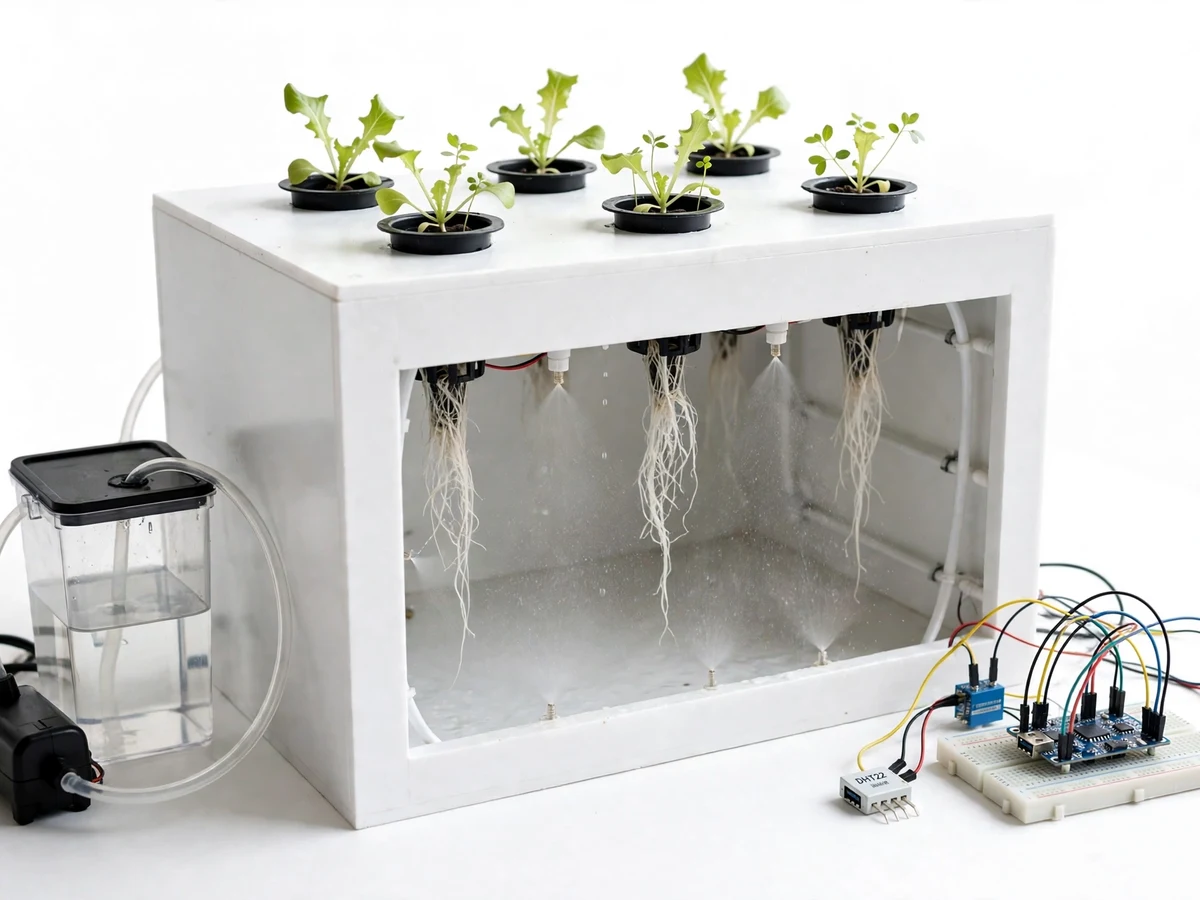
DHT22 reads temperature and humidity every 2 s; the water-level sensor guards the reservoir.
Follow the working sequence
How it works
The aeroponics system works as a closed loop around the root chamber. Plant roots hang in air inside a dark chamber while a nutrient solution waits in a reservoir tank below. On a timer the ESP32 closes a relay, a high-pressure pump pushes solution through misting nozzles, and a fine spray coats the roots for a set number of seconds before the pump stops and the roots breathe air again. Between mists a DHT22 sensor reads the chamber temperature and humidity and a water-level sensor checks the reservoir; the ESP32 serves those readings on a web dashboard with the countdown to the next mist, and it refuses to run the pump when the reservoir is low. The result is a steady wet–dry rhythm that keeps roots oxygenated and fed without soil and without the roots ever sitting in standing water.
- The ESP32 starts the misting schedule on power-up, with the shipped cycle set to 30 s of mist every 5 min.
- At each cycle the ESP32 closes the relay and the 12 V pump pushes nutrient solution through the misting nozzles as a fine spray over the hanging roots.
- After the mist-on time elapses the relay opens, the pump stops, and the roots remain in air until the next cycle.
- The DHT22 sensor is read every 2 s — its datasheet minimum interval — and temperature and humidity are updated on the dashboard.
- The water-level sensor checks the reservoir before every mist; if the level is low the pump stays off and the dashboard shows a low-level warning.
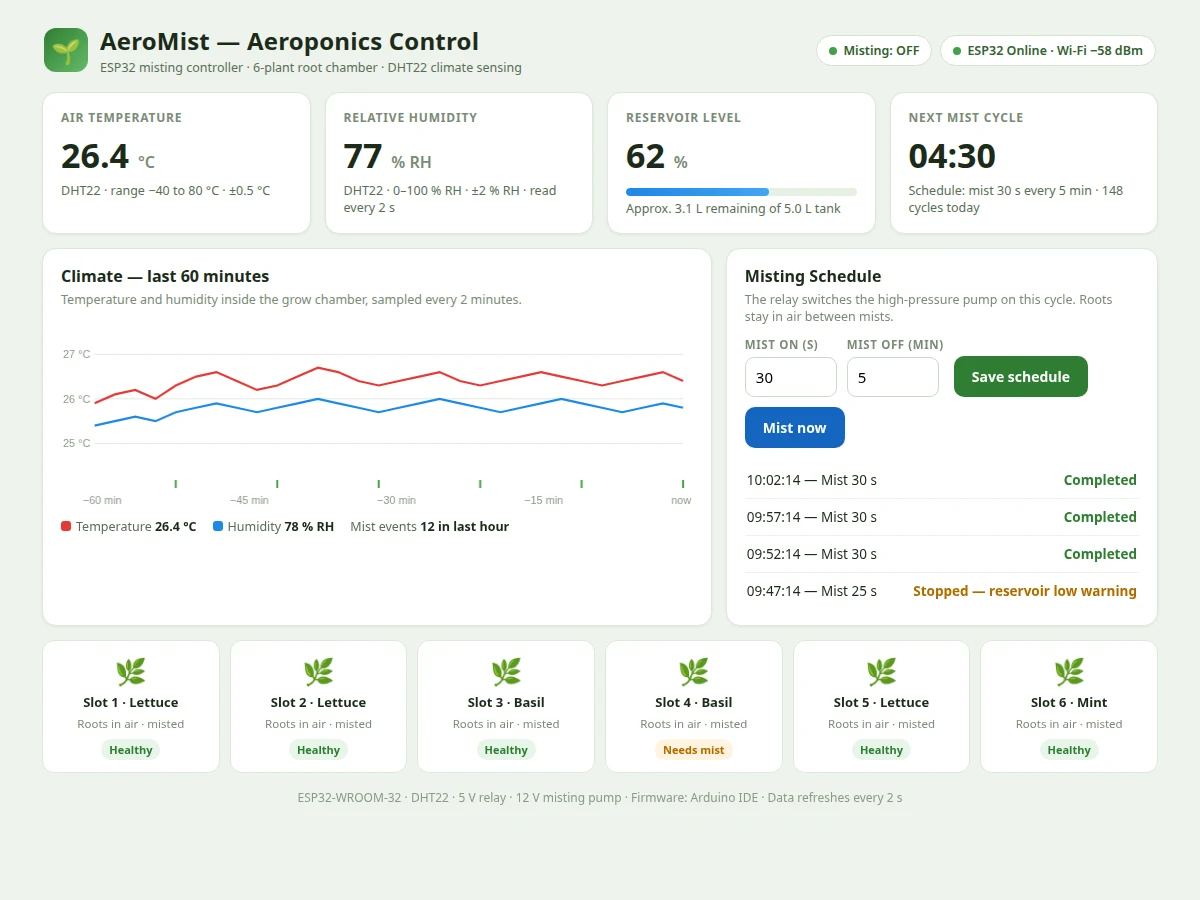
- The ESP32 serves the dashboard over Wi-Fi, showing live readings, reservoir level, the next-mist countdown and the misting cycle log.
Tech stack:
- ESP32-WROOM-32
- Arduino IDE (C++)
- DHT22 temperature and humidity sensor
- 12 V high-pressure misting pump
- 5 V relay module
- Water-level sensor
- ESP32 WebServer dashboard
- HTML, CSS and JavaScript (dashboard UI)
| Parameter | Value |
|---|---|
| Controller | ESP32-WROOM-32 (dual-core Xtensa LX6, up to 240 MHz, 520 KB SRAM — datasheet values) |
| Temperature sensor | DHT22: −40 to 80 °C, ±0.5 °C accuracy (datasheet value) |
| Humidity sensor | DHT22: 0 to 100 % RH, ±2 % RH accuracy (datasheet value) |
| Sensor read interval | 2 s minimum between DHT22 readings (datasheet value) |
| Misting pump | 12 V high-pressure pump (design target: mist droplets in the 5–50 μm range) |
| Misting schedule | 30 s mist every 5 min as shipped, adjustable from the dashboard |
| Reservoir | 5.0 L tank with water-level sensor (approximate capacity) |
| Plant slots | 6 net pots (lettuce, basil and mint as shipped) |
| Communication | Wi-Fi 802.11 b/g/n, dashboard served by the ESP32 |
| Power | 12 V DC for the pump, 5 V DC for the ESP32 and sensors (design target) |
Project features
The aeroponics system with misting control using ESP32 combines four capabilities: a timed misting cycle that keeps bare roots wet without drowning them, climate sensing that watches the chamber with a DHT22 sensor, a live dashboard showing temperature, humidity, reservoir level and the next mist, and a safety interlock that stops the pump when the reservoir runs low. Together they turn a passive grow box into a closed-loop system a student can explain end to end — sensing, timing, actuation and display — and the dashboard makes the invisible misting rhythm visible during a demonstration. The six-plant chamber holds lettuce, basil and mint, the schedule can be retuned from the dashboard without reflashing, and every misting event is logged with its time and duration so the report shows the schedule the chamber ran.
- [Timed misting control] The ESP32 switches a 12 V high-pressure pump through a relay on a configurable schedule — 30 s of mist every 5 min as shipped — so roots are wetted on a steady rhythm day and night without manual spraying.
- [DHT22 climate sensing] A DHT22 sensor measures chamber temperature and humidity and the firmware reads it every 2 s, the fastest the sensor's datasheet allows, so the dashboard always shows fresh readings.
- [Live monitoring dashboard] A web dashboard served by the ESP32 shows temperature, humidity, reservoir level, the countdown to the next mist and a 60-minute climate chart, with a Mist now button for demonstrations.
- [Reservoir level guard] A water-level sensor watches the nutrient tank and the firmware stops the pump and flags a low-level warning on the dashboard before the pump can run dry.
- [Six-plant root chamber] The chamber holds 6 net pots — lettuce, basil and mint as shipped — with roots hanging in air and mist nozzles aimed at the root zone, so each plant gets the same spray.
- [Adjustable schedule from the dashboard] Mist-on seconds and mist-off minutes can be changed from the dashboard without reflashing the firmware, so the cycle can be tuned for different crops.
- [Misting cycle log] Every misting event is recorded with its time and duration, so the report can show the actual schedule the chamber ran on instead of only the intended one.
What is included
- Working aeroponics prototype: root chamber, 6 net pots, reservoir tank, misting pump and nozzles
- ESP32 firmware with the misting schedule, DHT22 reading and reservoir guard
- Live monitoring dashboard (temperature, humidity, reservoir level, misting schedule, cycle log)
- Circuit and wiring diagram for the ESP32, relay, pump, DHT22 and water-level sensor
- Component list with part numbers and suppliers
- Setup and calibration guide, including how to set the misting schedule for different crops
- Project report PDF (background, aeroponics principle, methodology, results)
- PPT presentation for final review
- Viva Q&A preparation document (aeroponics vs hydroponics, misting timing, sensor limits)
Limitations & prerequisites
- Roots dry out quickly if the pump, a nozzle or the timer fails — the chamber needs power and a working pump at all times, so it is not a fit-and-forget system.
- The DHT22 reads temperature to ±0.5 °C and humidity to ±2 % RH (datasheet values), so the climate readings are indicative, not laboratory-grade.
- The dashboard is served over local Wi-Fi by the ESP32; remote monitoring from outside the network is not part of the base build.
- The 5.0 L reservoir (approximate capacity) needs refilling as plants drink and misting consumes solution; the build does not auto-refill.
- Nutrient strength is mixed by hand from a standard recipe; the build has no EC or pH sensor, so nutrient concentration is not measured automatically.
- The prototype is a tabletop academic build for leafy greens and herbs, not a certified commercial growing system.
Frequently Asked Questions
Is this project suitable for a final-year project?
Yes, for IoT, Embedded Systems and Electronics programs, because it combines sensing, actuation, timing and a live dashboard in one demonstrable build. It demonstrates closed-loop control with real hardware — a DHT22 sensor, a relay-driven pump and a web dashboard — and the aeroponics principle gives a strong technical story for the report and viva.
How is aeroponics different from hydroponics?
In aeroponics the roots hang in air and are misted with nutrient solution at intervals, while in hydroponics the roots sit in nutrient solution or a wet medium. The air gap is the key difference: aeroponic roots get oxygen freely between mists, whereas hydroponic roots rely on dissolved oxygen in the water. NASA describes aeroponics as growing plants in an air/mist environment without soil or aggregate media.
Which controller is used and why?
The ESP32-WROOM-32 is used because it combines a dual-core processor with built-in Wi-Fi in one module. One core can run the misting timer and sensor reads while the Wi-Fi stack serves the dashboard, and the 520 KB of SRAM (datasheet value) is ample for the schedule, readings and web server. An Arduino Uno would need a separate Wi-Fi module for the same dashboard.
Does it work without Wi-Fi?
Yes, the misting itself works without Wi-Fi because the schedule runs entirely on the ESP32 from its own timer. The DHT22 readings and reservoir guard also run locally, so the plants keep getting misted if the network drops, and the misting cycle never waits for a connection. Only the remote dashboard is unavailable without Wi-Fi; the misting cycle, the core of the system, never depends on the network.
What power supply is needed?
A 12 V DC supply powers the misting pump and a 5 V DC supply powers the ESP32, DHT22 and relay, both fed from one mains adapter as shipped. The pump is the main load, so a 12 V, 2 A adapter (design target) covers the shipped build. The system must stay powered continuously for the misting rhythm to hold.
Can more plants or sensors be added?
Yes, within limits: extra net pots can be added to a larger chamber with more nozzles, and extra sensors such as a pH or EC probe can be wired to the ESP32's spare pins. Each addition needs firmware changes and a bigger pump or reservoir if misting demand grows. The base build ships with 6 plant slots and the DHT22 plus water-level sensor.
Components & software requirements
- ESP32-WROOM-32
- Arduino IDE (C++)
- DHT22 temperature and humidity sensor
- 12 V high-pressure misting pump
- 5 V relay module
- Water-level sensor
- ESP32 WebServer dashboard
- HTML, CSS and JavaScript (dashboard UI)
Delivery information
Built-to-order project. Delivery timeline is shared after order confirmation based on current queue.
Support terms
Complete documentation, setup guide, and viva preparation included. Support for setup and explanation provided.
Download free synopsis (PDF)
Enter your name and WhatsApp number — the synopsis PDF downloads immediately. We may send occasional project updates on WhatsApp; no spam.