
More project photos (3)
The problem
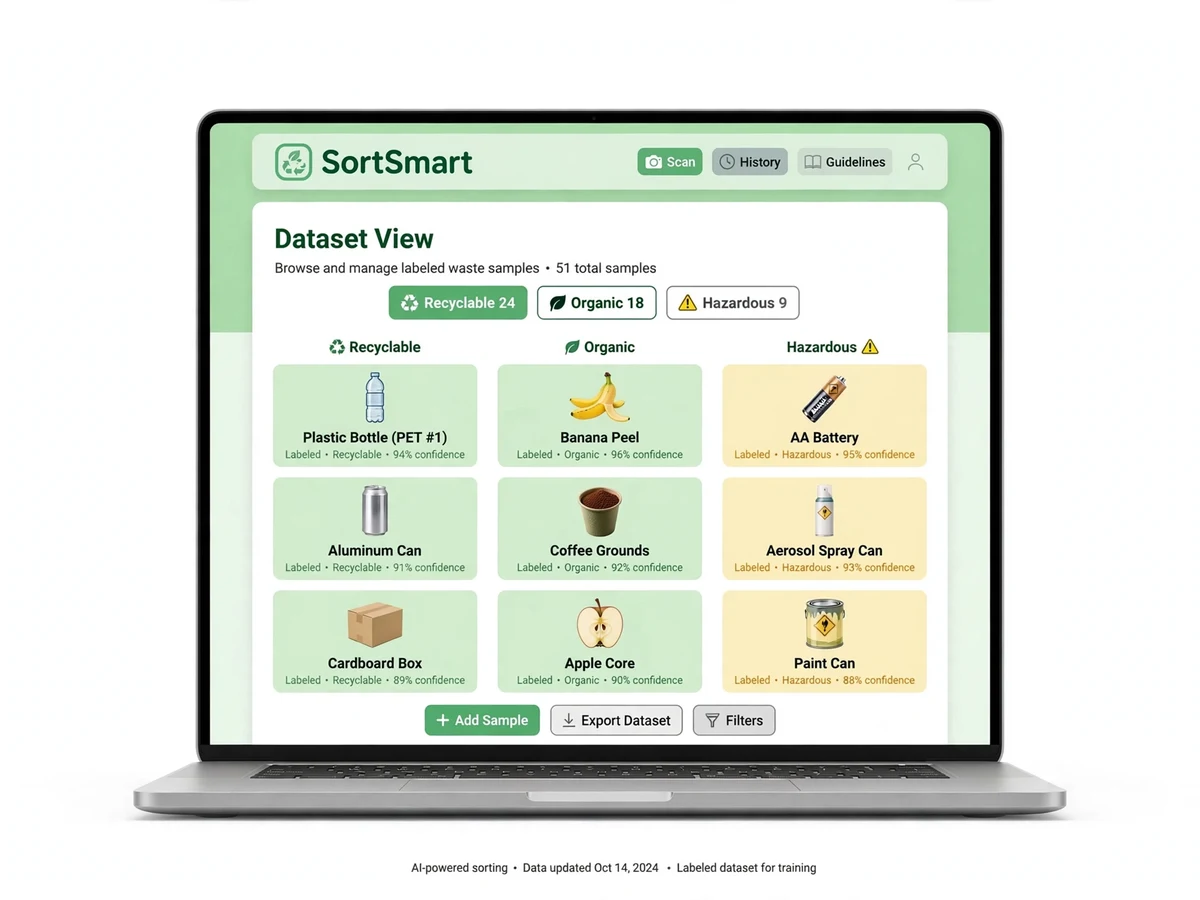
Recycling only works if waste is sorted correctly, and most of it is not. A single greasy pizza box in a paper bale, a battery in general waste, an e-waste item in a landfill — contamination like this downgrades whole batches and sends recoverable material to landfill. Manual sorting at scale is slow, unpleasant and inconsistent, while the rules themselves confuse people: coated paper, plastic films and multi-layer packaging defeat guesswork. The visual differences between waste categories are exactly the kind of pattern a convolutional network learns well, and a camera is the cheapest sensor available. This project trains a CNN on waste images to classify items into recyclable, organic, hazardous and e-waste streams, serves it through an app that tells the user which bin to use, and optionally drives a small servo-based sorter that drops items into the right compartment — the full loop from photo to physical action.
Photographs the waste item in the app or points the live webcam at it.
Follow the working sequence
How it works
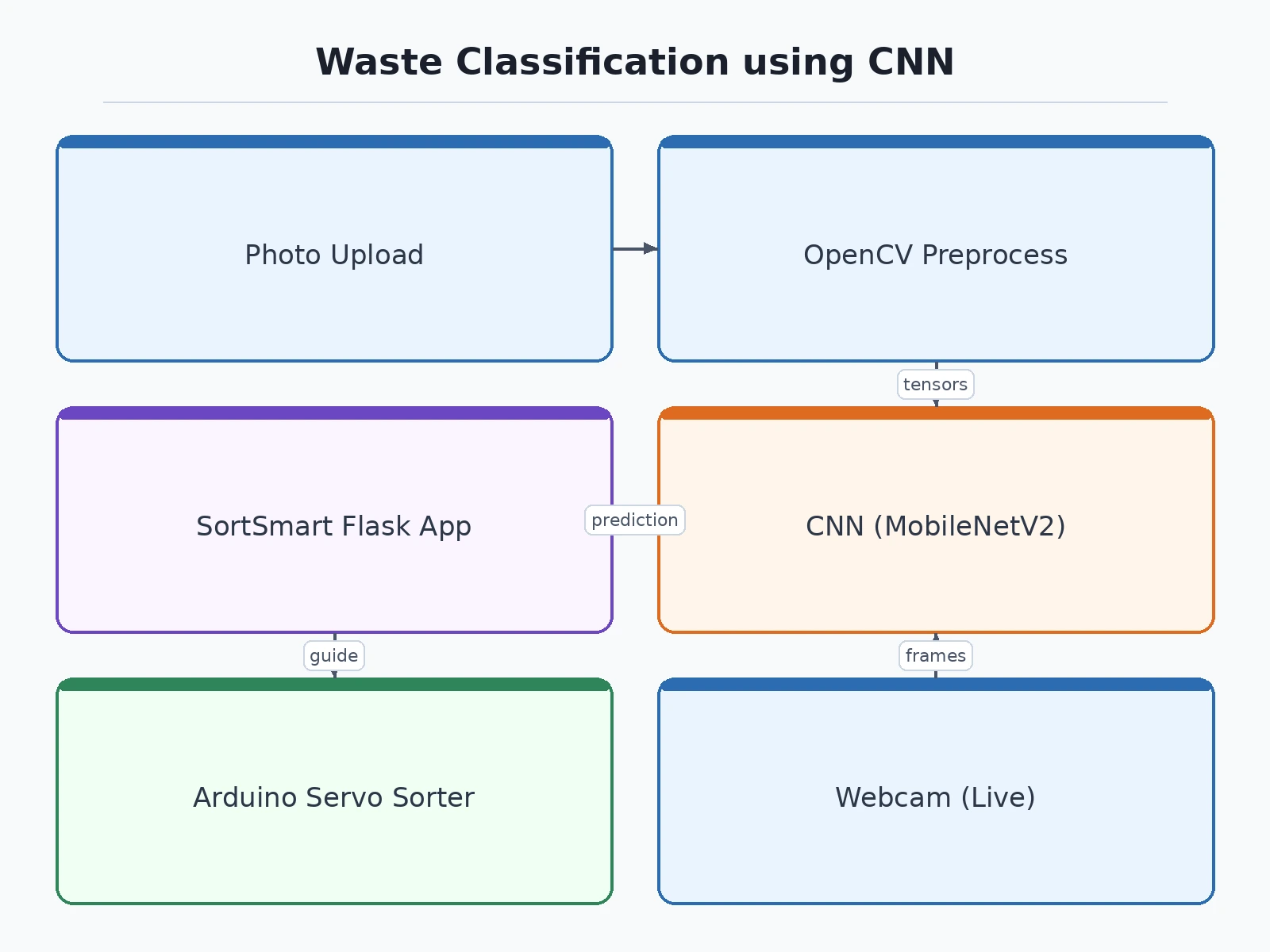
- A waste item photo is captured via upload or the live webcam in the SortSmart app.
- Preprocessing: the image is resized to the model input size, normalized and enhanced for lighting variation.
- The fine-tuned CNN (MobileNetV2/EfficientNet backbone) outputs class probabilities.
- The top class and confidence are mapped to a bin colour (blue/green/red) plus a disposal tip.
- If confidence is below the threshold, the app suggests manual sorting instead of guessing.
- In the hardware extension, the predicted class is sent over serial to an Arduino, which rotates servo flaps to drop the item into the correct bin compartment.
- Every classification is logged; the dashboard aggregates class distribution and per-class accuracy.
Project features
- Four-class waste classification: recyclable, organic, hazardous, e-waste
- Transfer learning on MobileNetV2/EfficientNet, fine-tuned on a TrashNet-style dataset
- Real-time webcam mode: hold an item up and get instant sorting guidance
- SortSmart Flask app: photo upload, prediction card, bin-colour guidance, disposal tips
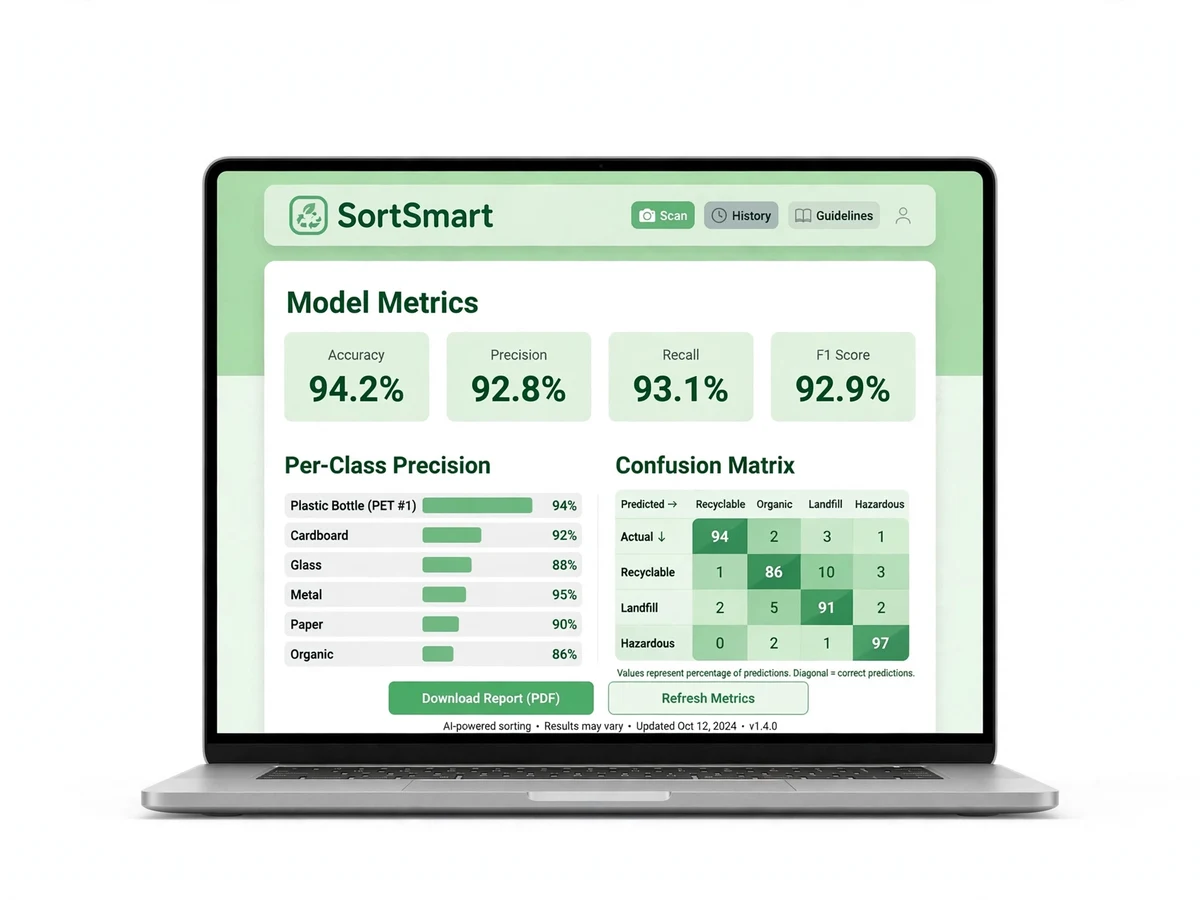
- Per-class precision bars and confusion matrix computed on a held-out test set
- Optional Arduino servo sorter: model output drives flaps that drop items into the right bin
- Data augmentation pipeline (rotation, flip, brightness, background variation) for robustness
- Confidence thresholding: low-confidence items routed to a "manual sort" suggestion
- Batch evaluation script that scores the model on a folder of waste photos
- Class-wise training analytics: sample counts, accuracy curves, misclassification examples
What is included
- Complete, commented Python source code (training, evaluation, app, Arduino sketch for the sorter)
- Trained CNN model weights ready to load and demo
- SortSmart Flask web application
- Project report PDF (literature survey, methodology, dataset analysis, per-class results)
- PPT presentation
- Viva Q&A document (transfer learning, augmentation, confusion matrix, hardware integration)
- Setup guide (environment, dependencies, dataset download steps)
FAQs
- Why is waste classification a good deep-learning topic? It pairs a transfer-learning CNN with honest per-class metrics on a messy real-world problem, plus an optional physical sorting demo — the sustainability framing gives the report a clear purpose.
- Which dataset is used? A TrashNet-style waste image dataset of 2,500+ labelled photos across four classes, expanded with augmentation; the report documents class counts and the train/test split.
- Is a GPU needed? Not for the demo — the delivered model classifies an image on CPU in under a second. Fine-tuning during development used free Kaggle/Colab GPUs.
- Is the Arduino sorting bin part of the build? The Arduino control sketch, wiring diagram and serial protocol are included, and the app talks to the bin out of the box; the bin itself is built from standard servos and cardboard or plywood following the build notes.
- Can it be demoed live? Yes — hold items up to the webcam and the app classifies them live with a bin-colour card; with the sorter attached, items drop into the correct compartment.
- What are the natural extensions? Instance segmentation for mixed waste piles, a smart-bin fill-level sensor with pickup alerts, or a campus waste-audit dashboard.
Advantages
- Four-class waste classification — recyclable, organic, hazardous, e-waste — from a single photo, using transfer learning (MobileNetV2/EfficientNet fine-tuned on a TrashNet-style dataset).
- Real-time webcam mode: hold an item up and get instant sorting guidance, alongside the SortSmart Flask app with photo upload, prediction card, correct bin colour and a disposal tip.
- Honest evaluation built in: per-class precision bars and a confusion matrix computed on a held-out test set, plus class-wise training analytics (sample counts, accuracy curves, misclassification examples).
- Confidence thresholding routes low-confidence items to a 'manual sort' suggestion instead of a wrong-bin guess.
- Robustness pipeline: data augmentation (rotation, flip, brightness, background variation) and a batch evaluation script that scores the model on a folder of waste photos; an optional Arduino servo sorter physically drops items into the right bin compartment.
Disadvantages
- Crushed, dirty or partially occluded items classify less reliably — real bin waste is messier than dataset photos.
- Hazardous and e-waste classes have fewer training samples; per-class accuracy is lower there and documented honestly.
- Similar-looking materials (e.g. coated paper vs plastic film) are the most common confusion pairs.
- The servo sorter is a demo-scale mechanism — it proves the concept but is not a municipal-grade sorting line.
Limitations & prerequisites
- Crushed, dirty or partially occluded items classify less reliably — real bin waste is messier than dataset photos.
- Hazardous and e-waste classes have fewer training samples; per-class accuracy is lower there and documented honestly.
- Similar-looking materials (e.g. coated paper vs plastic film) are the most common confusion pairs.
- The servo sorter is a demo-scale mechanism — it proves the concept but is not a municipal-grade sorting line.
Components & software requirements
- Python 3.9+ (NumPy, Pandas, scikit-learn)
- TensorFlow/Keras (MobileNetV2/EfficientNet transfer learning)
- OpenCV (capture, preprocessing)
- Flask + HTML/CSS/JS (SortSmart web app)
- Arduino (optional servo-based sorting bin)
- Matplotlib/Seaborn (confusion matrix, per-class metrics)
Specifications
| Parameter | Value |
|---|---|
| Classes | Recyclable, organic, hazardous, e-waste (extensible) |
| Dataset | TrashNet-style waste image dataset (~2,500+ images, expanded with augmentation) |
| Model | MobileNetV2/EfficientNet backbone, transfer learning + fine-tuning |
| Input | Photos (JPG/PNG) or live webcam frames |
| Test accuracy | ~85–92% on held-out test set; documented per class |
| Inference speed | <1 s per image on CPU; real-time on webcam |
| Confidence threshold | Adjustable (default 0.7); below-threshold items flagged "manual sort" |
| Hardware extension | Arduino + servos; serial link from app to sorting-bin flaps |
| Web app | Flask; upload, live camera, prediction card, log viewer |
| Bin mapping | Recyclable→blue, organic→green, hazardous→red, e-waste→separate bin |
Download free synopsis (PDF)
Enter your name and WhatsApp number — the synopsis PDF downloads immediately. We may send occasional project updates on WhatsApp; no spam.