
More project photos (2)

The problem
Small spice shops and home-based masala sellers buy ground spices from wholesalers or grind small lots in domestic mixer-grinders. A domestic mixer-grinder overheats on shop batches, gives one texture, and forces the seller to accept whatever fineness the jar produces. A spice grinding machine with adjustable fineness control solves that gap for a small shop: dried chillies, turmeric, coriander and similar whole spices are fed through a hopper into a hammer grinding chamber, and the operator sets how fine the powder comes out before the batch starts. The fineness control matters commercially because different preparations need different textures — coarse crushed chilli for pickles and tadka, a medium grind for everyday garam masala, and a fine powder for smooth curry bases. One machine covering that range lets a small shop grind fresh, in small lots, to a customer's order instead of stocking pre-ground varieties. The build demonstrates hammer-mill grinding, belt-drive transmission, sieve classification and food-contact fabrication in one compact prototype.
Builder note from the prototype build: chillies that are not fully sun-dried smear into a paste on the fine sieve instead of fracturing into powder, so the build specifies fully dried spice and a brush-down of the sieve between spice changes. Grinding turmeric after chilli also stains the batch, so the recommended changeover order runs pale spices before strong-coloured ones.
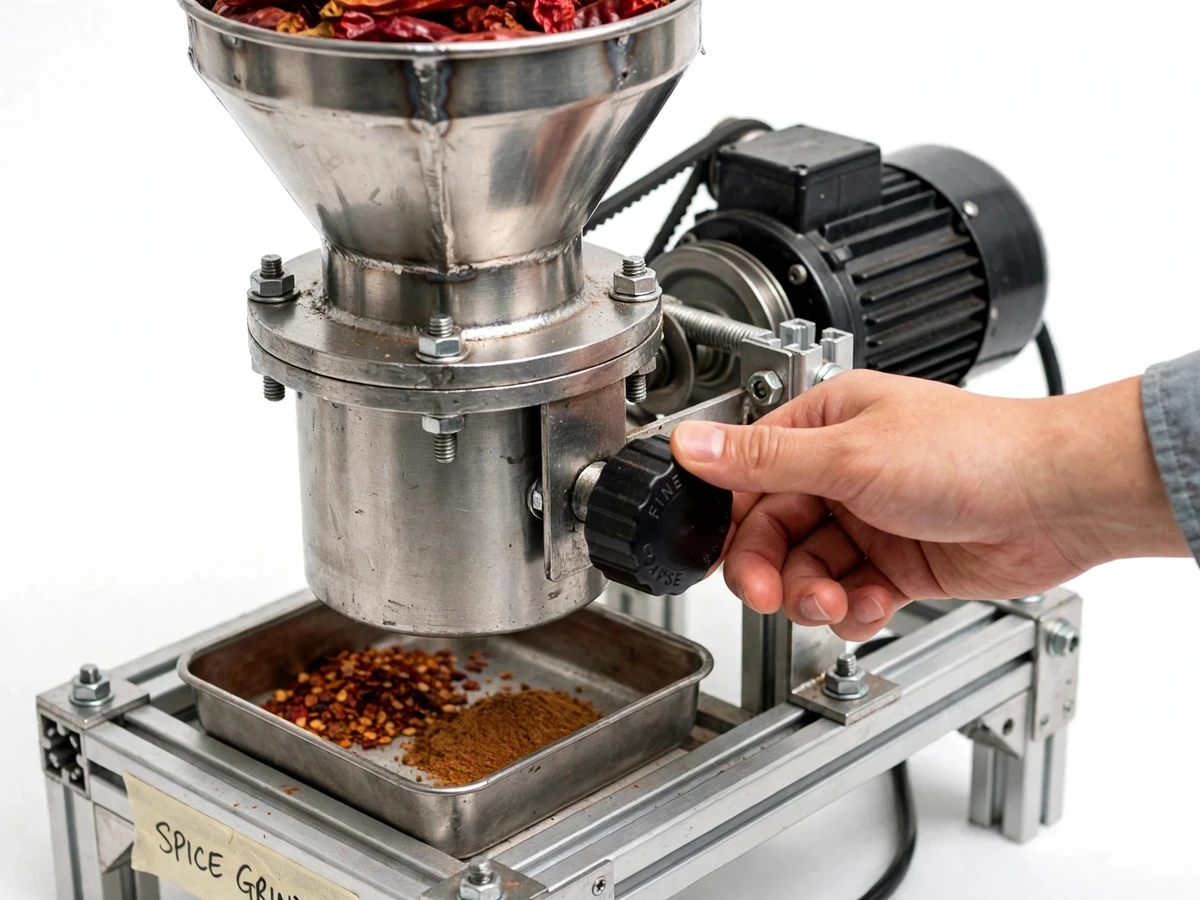
Fits the sieve, sets the handwheel gap, and feeds dried spice.
Follow the working sequence
How it works
The spice grinding machine turns dried whole spice into graded powder in four stages: feed, grind, sieve and collect. Dried spice is poured into the top hopper, which funnels it by gravity into the grinding chamber while a lid keeps fingers and dust away from the rotor. Inside the chamber, a motor-driven hammer rotor spinning at a datasheet speed of 1440 rpm strikes the spice pieces against the chamber wall and breaker plate, breaking them into smaller fragments. Each fragment stays in the chamber until it is small enough to pass through the fitted sieve screen, so the screen's opening size — together with the handwheel-set rotor gap — decides the final fineness. Ground powder falls through the screen into the collection tray below, where it can be weighed, packed or reground at a finer setting. The whole batch path is dry, gravity-fed and visible at the tray, which keeps the machine simple to run and clean between spice changes.
The first-principles rule behind the machine is simple: fineness is decided by two independent controls — the rotor gap sets the largest fragment that can escape the grinding zone, and the sieve opening sets the largest particle that can leave the machine.
- The operator fits the sieve screen for the grade wanted — coarse, medium or fine — and sets the handwheel gap before switching the machine on.
- Fully dried whole spice is poured into the hopper in small lots, and the lid is closed before the motor starts.
- The motor drives the hammer rotor through the belt drive, and the hammers strike the spice against the chamber wall and breaker plate.
- Fragments too large for the screen keep circulating in the chamber and are struck again until they are small enough to pass.
- Ground powder falls through the screen into the collection tray, while oversize material stays behind for further grinding.
- The operator stops the motor, slides out the tray, weighs and packs the powder, and brushes the screen clean before the next spice or grade.
Tech stack:
- 0.5 HP single-phase induction motor
- Hammer rotor · stainless steel grinding chamber
- Belt drive · pulley reduction
- Interchangeable sieve screens · 3 grades
- Food-grade stainless steel hopper · tray
- Mild steel angle frame · bolted assembly
- Single-phase starter · overload protection
- Fabrication · welding · fitting
| Parameter | Value |
|---|---|
| Motor | 0.5 HP single-phase induction motor (datasheet value) |
| Motor speed | 1440 rpm (datasheet value) |
| Rotor | 4-hammer rotor (design) |
| Sieve screens | 3 screens: coarse, medium, fine (design) |
| Coarse screen opening | Approximately 2 mm (design target) |
| Medium screen opening | Approximately 1 mm (design target) |
| Fine screen opening | Approximately 0.5 mm (design target) |
| Hopper capacity | Approximately 2 kg per load (design target) |
| Output per batch | Approximately 1–2 kg per batch (expected, spice-dependent) |
| Power supply | 230 V AC single-phase (design) |
| Overall size | Approximately 600 mm × 400 mm × 900 mm (design target) |
| Frame | Mild steel angle frame (design) |
Project features
The spice grinding machine's working core is a hammer rotor, a handwheel gap adjustment and a set of interchangeable sieve screens. The hammer rotor spins inside a stainless steel chamber and strikes dried spice pieces until they are small enough to pass the screen, which is the mechanism that turns whole chillies or turmeric fingers into powder. The handwheel moves the grinding plate to change the gap between rotor and chamber wall, giving the operator a coarse-to-fine control without opening the machine. The sieve screens complete the control: a coarse screen (approximately 2 mm openings, design target) holds back large flakes for crushed chilli, while a fine screen (approximately 0.5 mm openings, design target) produces smooth powder for curry bases. Together these three capabilities let one compact machine serve the range of textures a small shop sells daily, and they give the build its mechanical-engineering content: rotating machinery, adjustable clearances and particle classification in one prototype.
- [Adjustable fineness handwheel] A handwheel on the side of the chamber moves the grinding plate to change the rotor-to-wall gap, so the operator shifts between coarse and fine output without opening the machine or changing tools.
- [Interchangeable sieve screens] Three screens — coarse, medium and fine — swap in below the chamber, and each screen fixes the largest particle that can leave the machine, giving repeatable grades across batches.
- [Hammer rotor grinding chamber] A 4-hammer rotor (design) driven by the motor strikes dried spice against the chamber wall and breaker plate until fragments are small enough to pass the fitted screen.
- [Food-contact stainless steel chamber and hopper] The hopper, chamber and collection tray are stainless steel, so ground spice never touches painted or rust-prone surfaces and the parts can be brushed and washed between spice changes.
- [Belt-drive motor transmission] A belt and pulley drive links the motor to the rotor shaft, giving a simple, quiet transmission that slips under a jam instead of forcing the rotor through a blockage.
- [Removable collection tray] The ground powder falls into a tray that slides out for weighing and packing, and the open tray makes it easy to see the grade and to regrind a batch at a finer setting.
- [Overload protection and lid interlock] A motor overload cutout guards against stall current, and a lid switch stops the rotor circuit when the hopper lid is open, so the machine cannot run with the chamber exposed.
- [Optional customization: spice-specific sieve set] An extra sieve set cut for one shop's own blends (for example, a dedicated coarse chilli screen) can be supplied on request; it is not part of the base 3-screen set.
What is included
- Working benchtop spice grinding machine prototype
- Set of 3 interchangeable sieve screens (coarse, medium, fine)
- Fabrication drawings and component list
- Wiring diagram for motor starter and overload protection
- Setup and cleaning guide for changeover between spices
- Project report PDF (background, design, fabrication, working, results)
- PPT presentation for final review
- Viva Q&A preparation document (hammer-mill working, fineness control, sieve classification, safety)
Limitations & prerequisites
- The prototype is an academic and small-shop build, not a food-certified commercial mill — it carries no food-safety certification.
- Only fully dried spices grind cleanly; damp spice smears on the fine sieve instead of fracturing into powder.
- Oily seeds and wet pastes are out of scope; the machine is a dry-grinding design only.
- Output is batch-wise at approximately 1–2 kg per batch (expected), not continuous industrial throughput.
- Fine grinding in long runs warms the chamber, so batches need a cooling pause to protect aroma.
- Ground powder dust escapes around the tray during dry runs; the machine needs a ventilated spot and a dust wipe-down after use.
- Fineness grades are design targets (approximately 2 mm / 1 mm / 0.5 mm screens); the actual grade depends on spice dryness and feed rate.
Frequently Asked Questions
Which spices can this machine grind?
The machine grinds fully dried whole spices such as dried chillies, turmeric fingers, coriander seeds, cumin, black pepper and dry garam-masala ingredients. Each spice needs to be sun-dried and hard before grinding, because damp material smears rather than fractures. Oily seeds, fresh herbs and wet pastes are outside the dry-grinding design and are not supported. The report's spice table lists each supported spice with its recommended screen and gap setting.
How is the fineness adjusted?
Fineness is set in two steps before the batch starts: the handwheel moves the grinding plate to change the rotor-to-wall gap, and the operator fits one of the 3 sieve screens (coarse, medium or fine). The gap sets how aggressively the hammers break the spice, while the screen fixes the largest particle that can leave the chamber. Changing grade between batches means swapping the screen and resetting the handwheel. The changeover takes only a few minutes because the screen sits in a slide-in frame below the chamber.
What motor and power supply does it need?
The machine runs on a 0.5 HP single-phase induction motor (datasheet speed: 1440 rpm) connected to a standard 230 V AC single-phase shop supply. No three-phase connection is needed, and a starter with overload protection guards the motor against stall current. The belt drive between motor and rotor slips under a jam instead of forcing the rotor through a blockage. The wiring diagram shows the starter, overload cutout and lid switch as one simple control circuit.
Is the ground spice safe to eat from this machine?
The spice-contact parts — hopper, grinding chamber and collection tray — are stainless steel, and the chamber can be brushed and washed between spice changes. The prototype is still an academic and small-shop build with no food-safety certification, so it is not a certified commercial food-processing machine. Shops should follow their local food-handling rules before selling ground product. The setup guide covers the brush-down and wash routine that keeps flavours from carrying between batches.
Can a small shop run it all day?
The machine is built for shop batches of approximately 1–2 kg at a time (expected), with a pause between batches so the chamber cools and the sieve can be brushed clean. It is not a continuous industrial mill, and long fine-grinding runs warm the chamber and dull aroma. For a small shop grinding fresh lots to order through the day, batch working with changeover cleaning fits the workload. A second pass at the fine screen can rescue a batch that comes out coarser than the customer asked for.
Is this project suitable for a final-year project?
Yes — for Mechanical engineering programs. The build demonstrates hammer-mill grinding, belt-drive power transmission, adjustable-clearance design, sieve classification and food-contact fabrication, with drawings, a working prototype and graded output to show at review. It suits students who want a physical machine with measurable, demonstrable grades rather than a software-only submission. The review demonstration grinds two spices at two grades, so examiners see the fineness control working rather than described.
Components & software requirements
- 0.5 HP single-phase induction motor
- Hammer rotor · stainless steel grinding chamber
- Belt drive · pulley reduction
- Interchangeable sieve screens · 3 grades
- Food-grade stainless steel hopper · tray
- Mild steel angle frame · bolted assembly
- Single-phase starter · overload protection
- Fabrication · welding · fitting
Delivery information
Built-to-order project. Delivery timeline is shared after order confirmation based on current queue.
Support terms
Complete documentation, setup guide, and viva preparation included. Support for setup and explanation provided.
Download free synopsis (PDF)
Enter your name and WhatsApp number — the synopsis PDF downloads immediately. We may send occasional project updates on WhatsApp; no spam.