
More project photos (3)
The problem
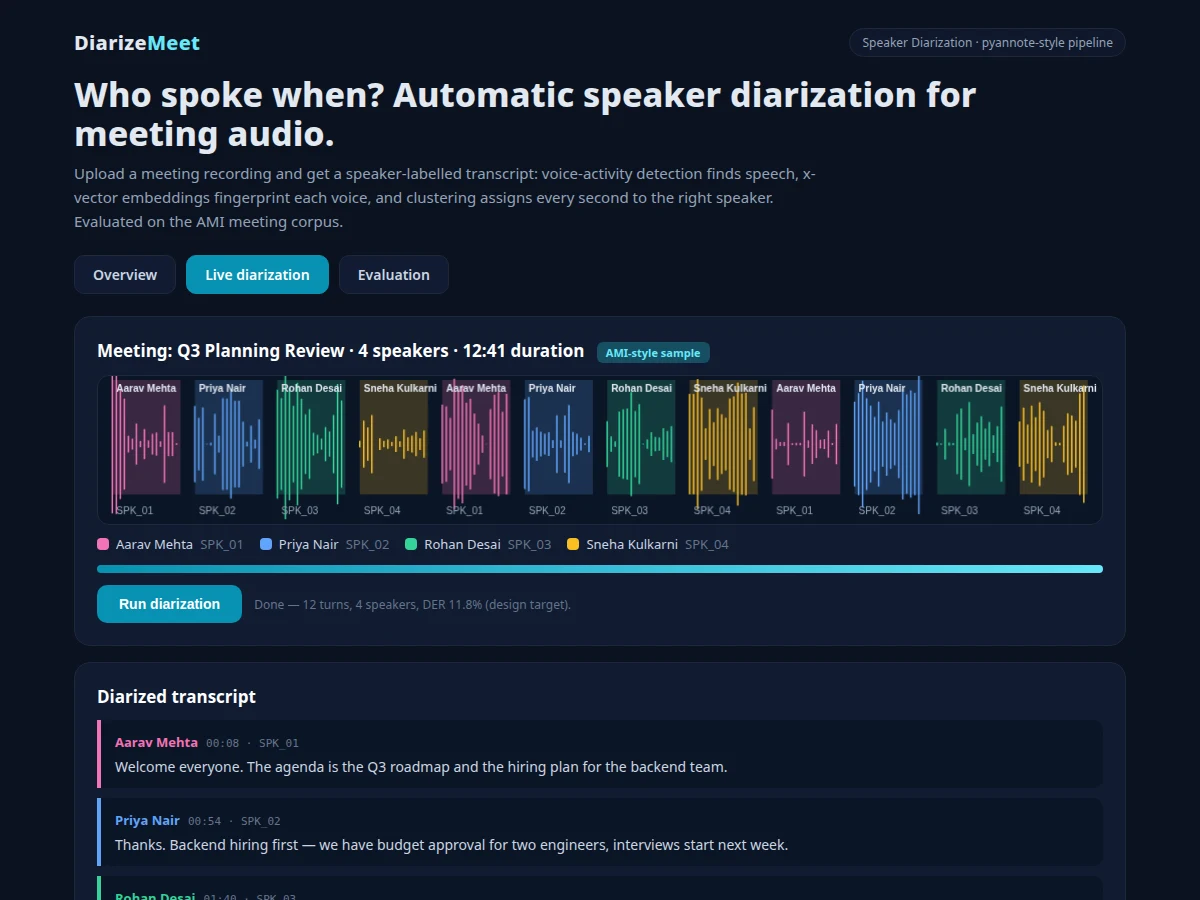
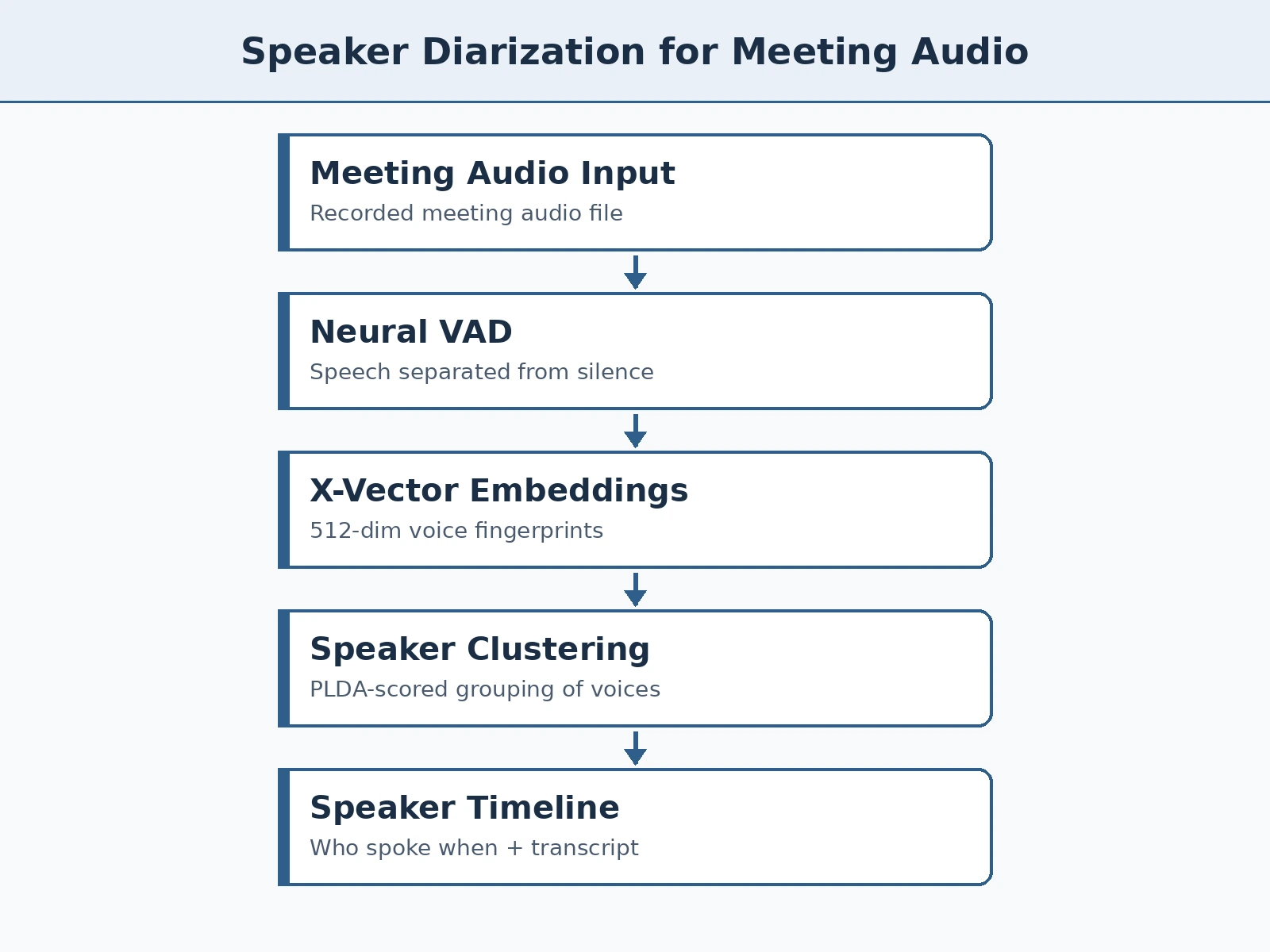
Meeting recordings are useless without speaker labels — nobody wants to scrub through an hour of audio to find who said what. Speaker diarization solves exactly this: given only the audio, it segments the recording and tags each segment with a speaker identity. The difficulty is that voices overlap, people interrupt, and microphones pick up noise, so a naive energy-based splitter fails quickly. This project implements the modern embedding-plus-clustering pipeline used by systems like pyannote.audio: a neural VAD separates speech from silence, overlapping windows are converted into x-vector voice fingerprints, agglomerative clustering groups them into speakers, and a final resegmentation pass sharpens the boundaries. Evaluation follows the NIST standard with a 0.25 s collar, and the demo turns a raw meeting into a readable, speaker-labelled transcript with talk-time analytics.
Uploads a meeting recording and reads the speaker-labelled output.
Follow the working sequence
How it works
- The meeting recording is resampled to 16 kHz mono and passed through the neural VAD, which outputs speech/non-speech regions.
- Speech regions are sliced into overlapping 1.5 s windows (0.75 s shift) and each window is encoded into a 512-d x-vector embedding.
- Pairwise PLDA scores between embeddings drive agglomerative hierarchical clustering; a stopping threshold estimates the speaker count.
- VB-HMM resegmentation refines the raw cluster boundaries and resolves overlapped regions to both active speakers.
- Turns are written as RTTM records (start, duration, speaker id) and merged with an ASR transcript into the labelled output.
- The demo renders the waveform coloured by speaker, the turn-by-turn transcript, and talk-time statistics.
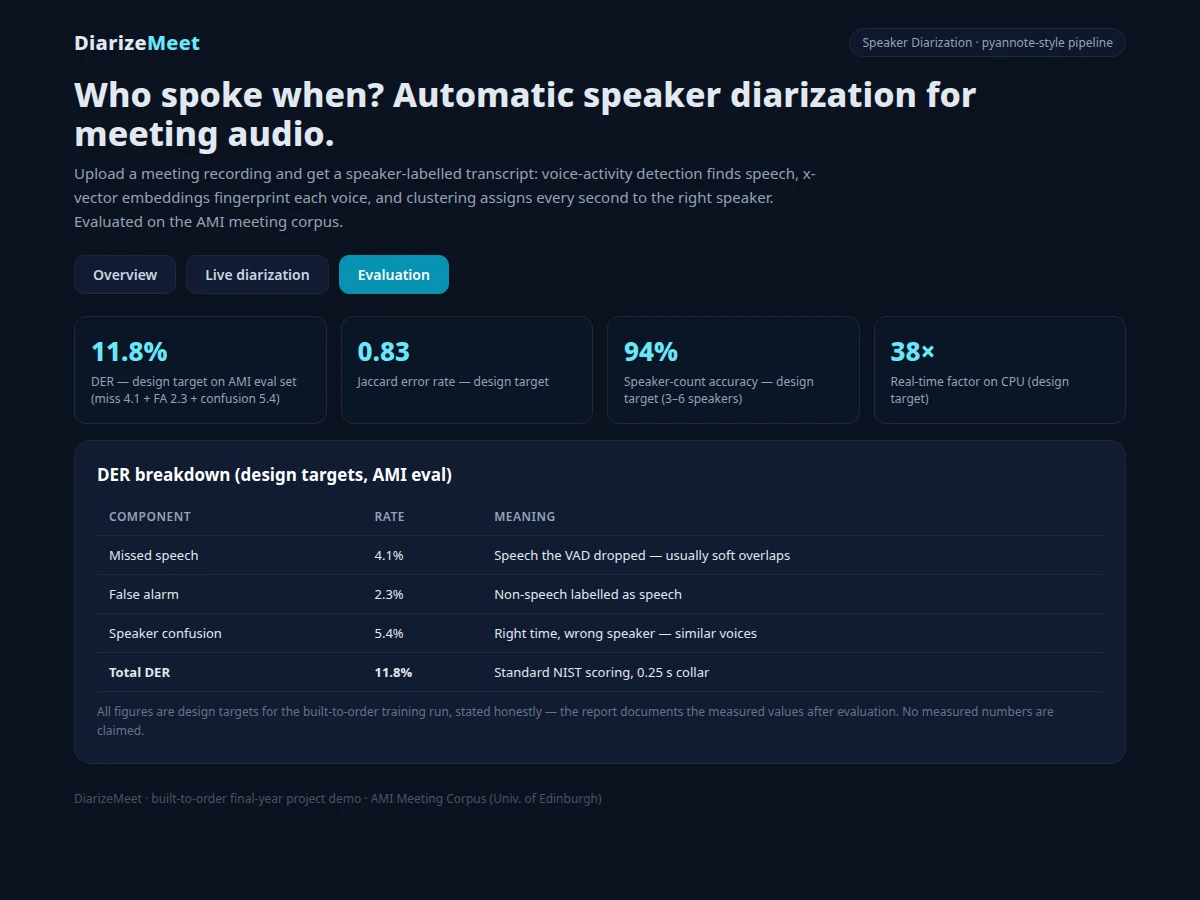
- Evaluation on the AMI eval set scores missed speech, false alarms and speaker confusion into the DER metric.
Tech stack:
- Python 3, PyTorch
- pyannote.audio-style pipeline components
- SpeechBrain · ECAPA-TDNN embeddings
- scikit-learn (clustering)
- HTML/CSS/JS web demo
- AMI Meeting Corpus
Dataset & model details
- Dataset: AMI Meeting Corpus — approximately 100 hours of instrumented meeting recordings with word-level and speaker annotations, collected by the University of Edinburgh, IDIAP and TNO.
- Task: Speaker diarization; input = single-channel meeting audio (16 kHz), output = speaker-labelled time segments (RTTM) for an unknown number of speakers.
- Model: Neural VAD → 512-d x-vector (ECAPA-TDNN) embeddings on 1.5 s windows → agglomerative clustering with PLDA scoring → VB-HMM resegmentation.
- Metrics: Diarization Error Rate (DER) with 0.25 s collar — design target 11.8% (miss 4.1 + false alarm 2.3 + confusion 5.4); Jaccard error rate design target 0.83; speaker-count accuracy design target 94%. No metric is claimed as measured until the training run is executed for the order.
| Parameter | Value |
|---|---|
| Input | Single-channel audio, 16 kHz (WAV/MP3) |
| Speakers handled | 2–6 per meeting (design range) |
| Embedding window | 1.5 s with 0.75 s shift |
| DER | 11.8% (design target, not a measured claim) |
| Real-time factor | Approximately 38× on CPU (expected) |
| Outputs | RTTM, SRT/JSON transcript, talk-time charts |
| Demo | Single-file web app with bundled sample meeting |
Project features
- [Neural VAD front-end] A pretrained segmentation model separates speech from silence, noise and music before any speaker modelling begins.
- [X-vector voice fingerprints] Overlapping 1.5 s windows are embedded into 512-dimensional speaker vectors that capture voice identity, not words.
- [Agglomerative clustering] Embeddings are grouped with PLDA-scored hierarchical clustering; the speaker count is estimated from the data, not assumed.
- [VB-HMM resegmentation] A variational-Bayes pass refines turn boundaries and assigns overlapped speech to both speakers.
- [RTTM + labelled transcript output] Standard NIST RTTM turn files plus a timestamped SRT/JSON transcript for downstream use.
- [Talk-time analytics] Per-speaker share of talk time, interruption counts and longest monologue, rendered as charts in the demo.
- [Live web demo] Drop in a meeting recording (or use the bundled AMI-style sample) and watch the pipeline label every turn.
What is included
- Complete diarization pipeline code (VAD, embeddings, clustering, resegmentation)
- Training and evaluation notebooks on the AMI corpus
- Web demo with a bundled sample meeting and talk-time analytics
- DER evaluation script with NIST-standard scoring
- Project report PDF (background, pipeline theory, methodology, results)
- PPT presentation for final review
- Viva Q&A preparation document (VAD, x-vectors, clustering, DER, overlaps)
Limitations & prerequisites
- DER 11.8% is a design target for the training run, stated honestly — the report documents the measured figure after evaluation.
- Very similar voices (e.g. two siblings) can be confused; the confusion component dominates the error budget.
- Heavy crosstalk with three simultaneous speakers is only partially resolved.
- The pipeline assumes one dominant language per meeting; code-switched meetings are out of scope.
- Real-time factor is an expected value on a modern laptop CPU, not a measured benchmark.
Frequently Asked Questions
What is speaker diarization?
It answers "who spoke when" from audio alone — segmenting a recording into speaker turns without knowing the speakers in advance. It is the step that turns raw meeting audio into a usable, speaker-labelled transcript.
Which dataset is used for evaluation?
The AMI Meeting Corpus — about 100 hours of real, instrumented meetings with speaker annotations, from the University of Edinburgh, IDIAP and TNO. It is the standard academic benchmark for this task.
How does the pipeline find the number of speakers?
The agglomerative clustering uses a stopping threshold on PLDA similarity scores rather than a fixed K, so the speaker count is estimated from the data. The design target is 94% correct speaker-count estimation on 3–6 speaker meetings.
What does DER measure?
Diarization Error Rate = missed speech + false-alarm speech + speaker confusion, scored with the NIST tool and a 0.25 s collar around boundaries. Lower is better; the design target here is 11.8%.
Does it transcribe the words too?
The diarization stage labels who spoke when; the demo merges this with an ASR transcript to show the full speaker-labelled text. ASR itself is via a pretrained model, not trained in this project.
Is this project suitable for a final-year project?
Yes — for Computer Science, IT and AI/ML programs. It covers speech processing, deep embeddings, clustering and rigorous NIST-standard evaluation with a working demo. Suitable for B.E./B.Tech final-year projects in Computer Science, IT and AI & Machine Learning.
Components & software requirements
- Python 3, PyTorch
- pyannote.audio-style pipeline components
- SpeechBrain · ECAPA-TDNN embeddings
- scikit-learn (clustering)
- HTML/CSS/JS web demo
- AMI Meeting Corpus
Dataset & model details
- Dataset: AMI Meeting Corpus — approximately 100 hours of instrumented meeting recordings with word-level and speaker annotations, collected by the University of Edinburgh, IDIAP and TNO.
- Task: Speaker diarization; input = single-channel meeting audio (16 kHz), output = speaker-labelled time segments (RTTM) for an unknown number of speakers.
- Model: Neural VAD → 512-d x-vector (ECAPA-TDNN) embeddings on 1.5 s windows → agglomerative clustering with PLDA scoring → VB-HMM resegmentation.
- Metrics: Diarization Error Rate (DER) with 0.25 s collar — design target 11.8% (miss 4.1 + false alarm 2.3 + confusion 5.4); Jaccard error rate design target 0.83; speaker-count accuracy design target 94%. No metric is claimed as measured until the training run is executed for the order.
Delivery information
Built-to-order project. Delivery timeline is shared after order confirmation based on current queue.
Support terms
Complete documentation, setup guide, and viva preparation included. Support for setup and explanation provided.
Download free synopsis (PDF)
Enter your name and WhatsApp number — the synopsis PDF downloads immediately. We may send occasional project updates on WhatsApp; no spam.