
More project photos (2)

The problem
Hindi is spoken by hundreds of millions, yet high-quality open Hindi ASR still lags English — a gap final-year students can meaningfully work on. This project takes facebook/wav2vec2-large-xlsr-53, a transformer pre-trained on 53 languages of unlabeled speech, and fine-tunes it on the validated Hindi subset of Mozilla Common Voice with a CTC objective. Students learn how self-supervised speech models work, why SpecAugment matters, how CTC decoding turns frame predictions into Devanagari text, and how a KenLM language model rescores hypotheses. Evaluation uses word and character error rates on a held-out split. The web demo provides the recorder-and-transcription interface with representative outputs.
How it works
- The Common Voice Hindi validated subset is downloaded and resampled to 16 kHz mono.
- Transcripts are normalized (Devanagari script, punctuation handling) and split 90/10 train/validation.
- SpecAugment applies time and frequency masking during training for robustness.
- wav2vec2-large-xlsr-53 is fine-tuned with CTC loss using Adam and learning-rate warmup.
- A 5-gram KenLM language model is trained on Hindi text for decoder rescoring.
- The held-out split is decoded with CTC beam search + KenLM; WER and CER are computed for the report.
- The web demo records audio and displays a representative transcription with word confidences.
Tech stack:
- Python 3, PyTorch
- Hugging Face Transformers
- facebook/wav2vec2-large-xlsr-53
- Mozilla Common Voice Hindi
- KenLM (5-gram LM)
- LibriSpeech-style eval (jiwer)
- HTML/CSS/JS voice demo
Dataset & model details
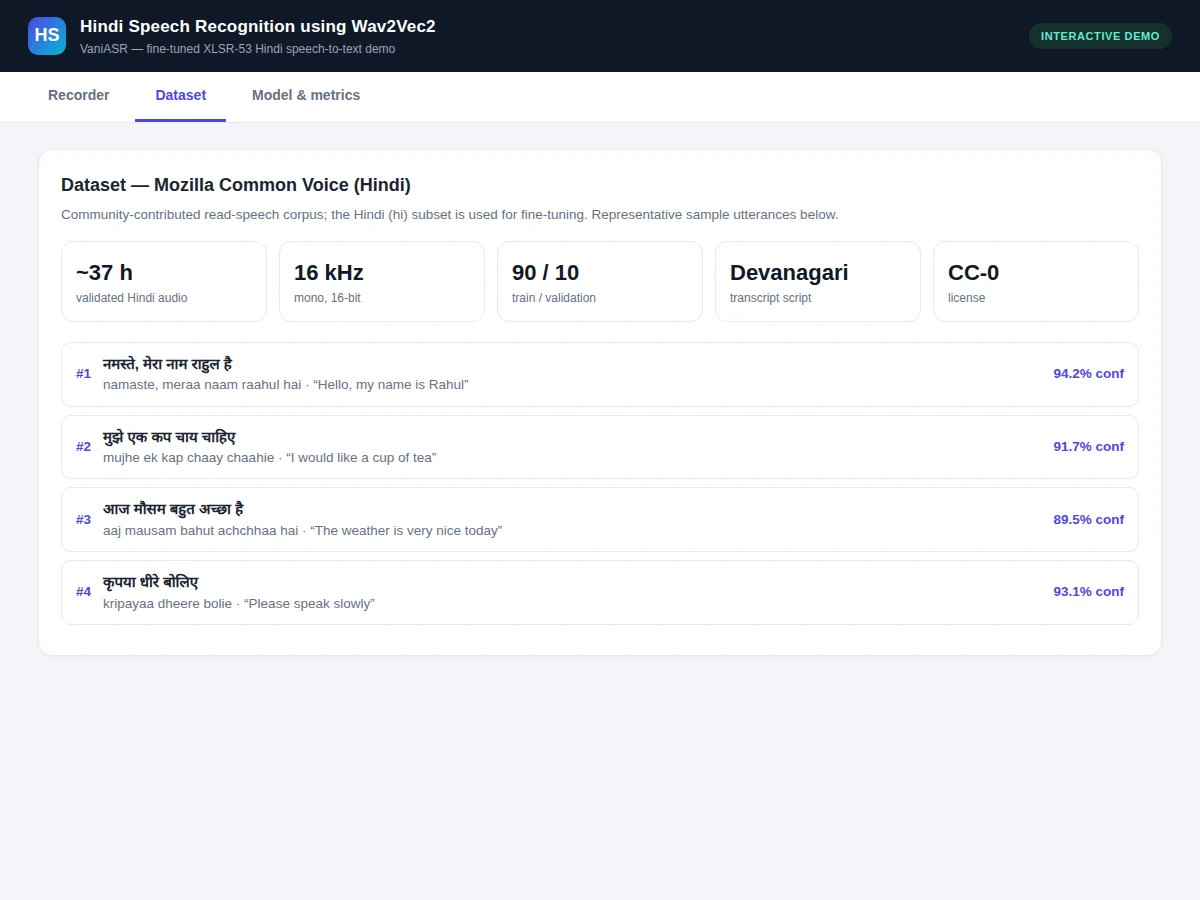
- Dataset: Mozilla Common Voice (Hindi, hi) — community-contributed read speech, ~37 hours validated, 16 kHz mono with Devanagari transcripts, CC-0 licensed; 90/10 train/validation split for fine-tuning.
- Task: Automatic speech recognition; input = 16 kHz Hindi speech waveform, output = Devanagari transcript.
- Model: facebook/wav2vec2-large-xlsr-53 (315M params: CNN feature encoder + 24-layer transformer) fine-tuned with a CTC character head; KenLM 5-gram rescoring at decode.
- Metrics: Word error rate 18–22% (design target), character error rate 6–9% (design target), real-time factor ~0.3× on CPU (expected). No WER is claimed as measured until the fine-tuning run is executed for the order.
| Parameter | Value |
|---|---|
| Input format | 16 kHz mono WAV |
| Output | Devanagari text transcript |
| Dataset size | ~37 h validated Hindi speech |
| Model parameters | Approximately 315,000,000 |
| Word error rate | 18–22% (design target, not a measured claim) |
| Training time | Approximately 8–12 h on a T4 GPU (expected) |
| Real-time factor | ~0.3× on CPU (expected) |
| Model file | ~1.2 GB fp32 / ~315 MB int8 (expected) |
| Demo | Single-file web app with recorder UI |
Project features
- Fine-tuned Hindi ASR wav2vec2-large-xlsr-53 fine-tuned on Common Voice Hindi with CTC loss — real transfer learning for speech.
- Real speech dataset Mozilla Common Voice Hindi: ~37 hours of validated 16 kHz read speech with Devanagari transcripts (CC-0).
- Full training notebook Data prep, SpecAugment, CTC fine-tuning, checkpointing and WER/CER evaluation in one reproducible notebook.
- KenLM rescoring A 5-gram Hindi language model rescores CTC beam-search hypotheses — the classic ASR second pass, explained in the report.
- Interactive voice demo Single-file web app with recorder, live waveform visualization and word-level transcription display.
- Honest error analysis WER/CER on the held-out split plus error-type breakdown (substitutions, deletions, insertions) for the viva.
- Viva kit Report PDF, PPT and Q&A covering transformers for speech, CTC, SpecAugment and language modelling.
What is included
- Common Voice Hindi preparation scripts
- Complete CTC fine-tuning & evaluation notebook
- Fine-tuned wav2vec2 model + KenLM language model
- Interactive voice demo web app with sample utterances
- WER/CER evaluation tables and error-type analysis
- Decoding pipeline documentation
- Project report PDF, PPT presentation
- Viva Q&A preparation document
Limitations & prerequisites
- Read speech only — conversational, accented or code-mixed (Hinglish) speech degrades WER.
- WER design targets assume clean recordings; noisy audio needs additional augmentation.
- 18–22% WER is a design target, stated honestly — the report documents the actual achieved figure.
- The 315M-parameter model needs a GPU for training; inference runs on CPU in real time.
- The web demo simulates the pipeline with representative outputs; it does not run the 315M model in-browser.
Frequently Asked Questions
Which dataset and model are used?
Mozilla Common Voice Hindi (~37h validated, CC-0) for fine-tuning, and facebook/wav2vec2-large-xlsr-53 — a transformer pre-trained on 53 languages — as the base model with a CTC head.
What is CTC?
Connectionist Temporal Classification: it lets the model map audio frames to characters without frame-level alignment labels. The report explains the blank token, collapsing and beam-search decoding in viva-ready depth.
Why add a KenLM language model?
The acoustic model proposes character sequences; the 5-gram LM rescores them toward fluent Hindi, fixing many substitution errors. The report shows WER with and without it.
How does the demo work?
Press record, speak, then stop — the app shows a live waveform while recording and displays a representative Devanagari transcription with word confidences and transliteration.
Can it handle Hinglish?
Not reliably as shipped — training data is Hindi read speech. Code-mixed speech is listed as future scope with data notes.
Is this project suitable for a final-year project?
Yes — for AI & Machine Learning programs. It demonstrates self-supervised transfer learning, CTC, language modelling and proper ASR evaluation. Suitable for B.E./B.Tech final-year projects in AI & Machine Learning.
Components & software requirements
- Python 3, PyTorch
- Hugging Face Transformers
- facebook/wav2vec2-large-xlsr-53
- Mozilla Common Voice Hindi
- KenLM (5-gram LM)
- LibriSpeech-style eval (jiwer)
- HTML/CSS/JS voice demo
Dataset & model details
- Dataset: Mozilla Common Voice (Hindi, hi) — community-contributed read speech, ~37 hours validated, 16 kHz mono with Devanagari transcripts, CC-0 licensed; 90/10 train/validation split for fine-tuning.
- Task: Automatic speech recognition; input = 16 kHz Hindi speech waveform, output = Devanagari transcript.
- Model: facebook/wav2vec2-large-xlsr-53 (315M params: CNN feature encoder + 24-layer transformer) fine-tuned with a CTC character head; KenLM 5-gram rescoring at decode.
- Metrics: Word error rate 18–22% (design target), character error rate 6–9% (design target), real-time factor ~0.3× on CPU (expected). No WER is claimed as measured until the fine-tuning run is executed for the order.
Delivery information
Built-to-order project. Delivery timeline is shared after order confirmation based on current queue.
Support terms
Complete documentation, setup guide, and viva preparation included. Support for setup and explanation provided.