
More project photos (3)
The problem
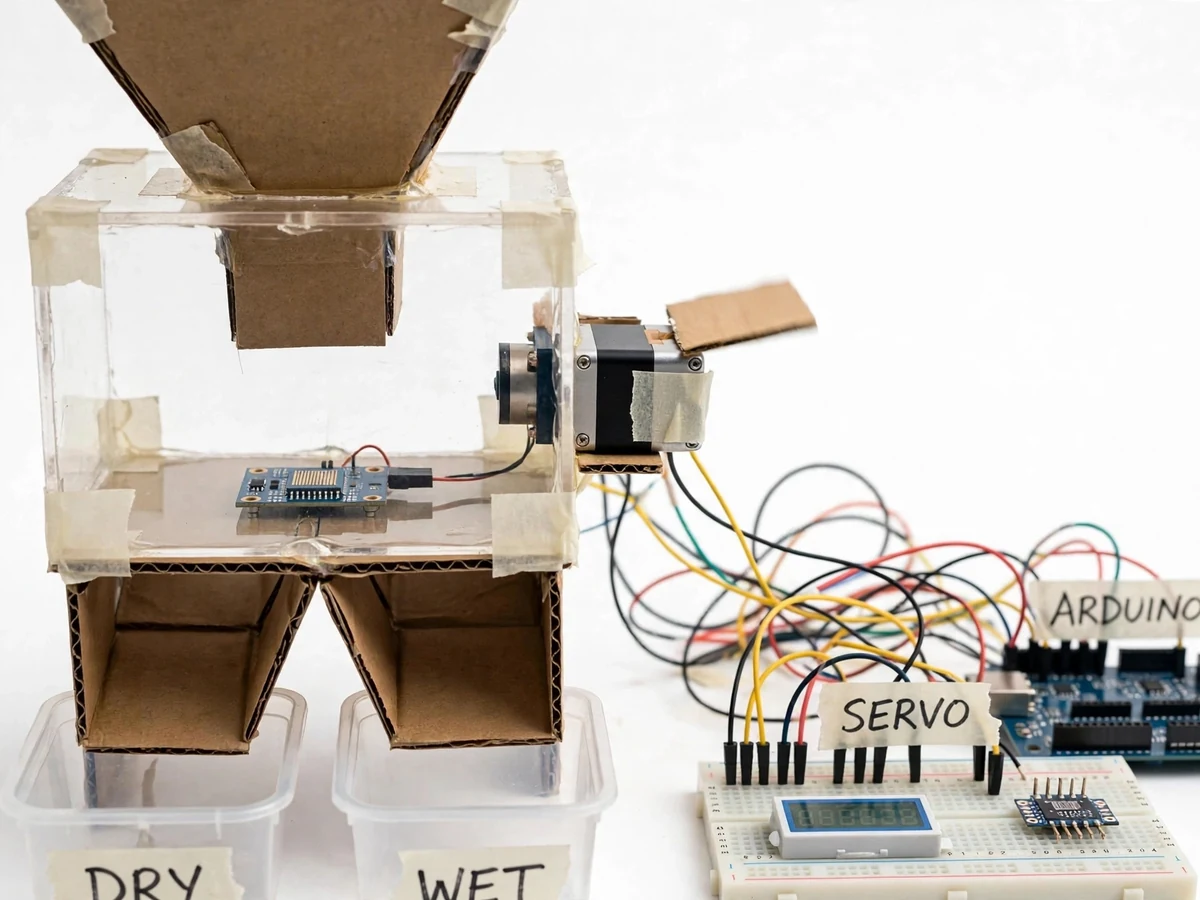
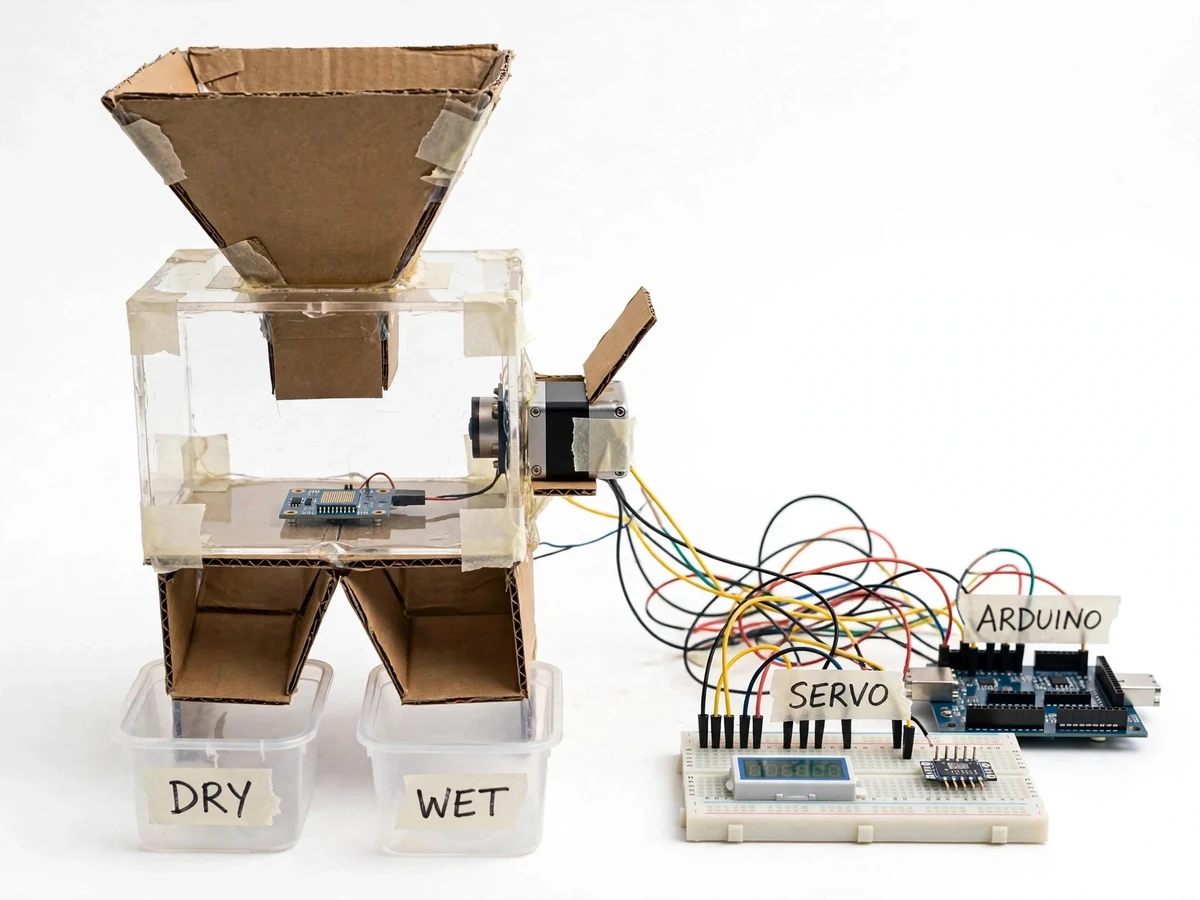
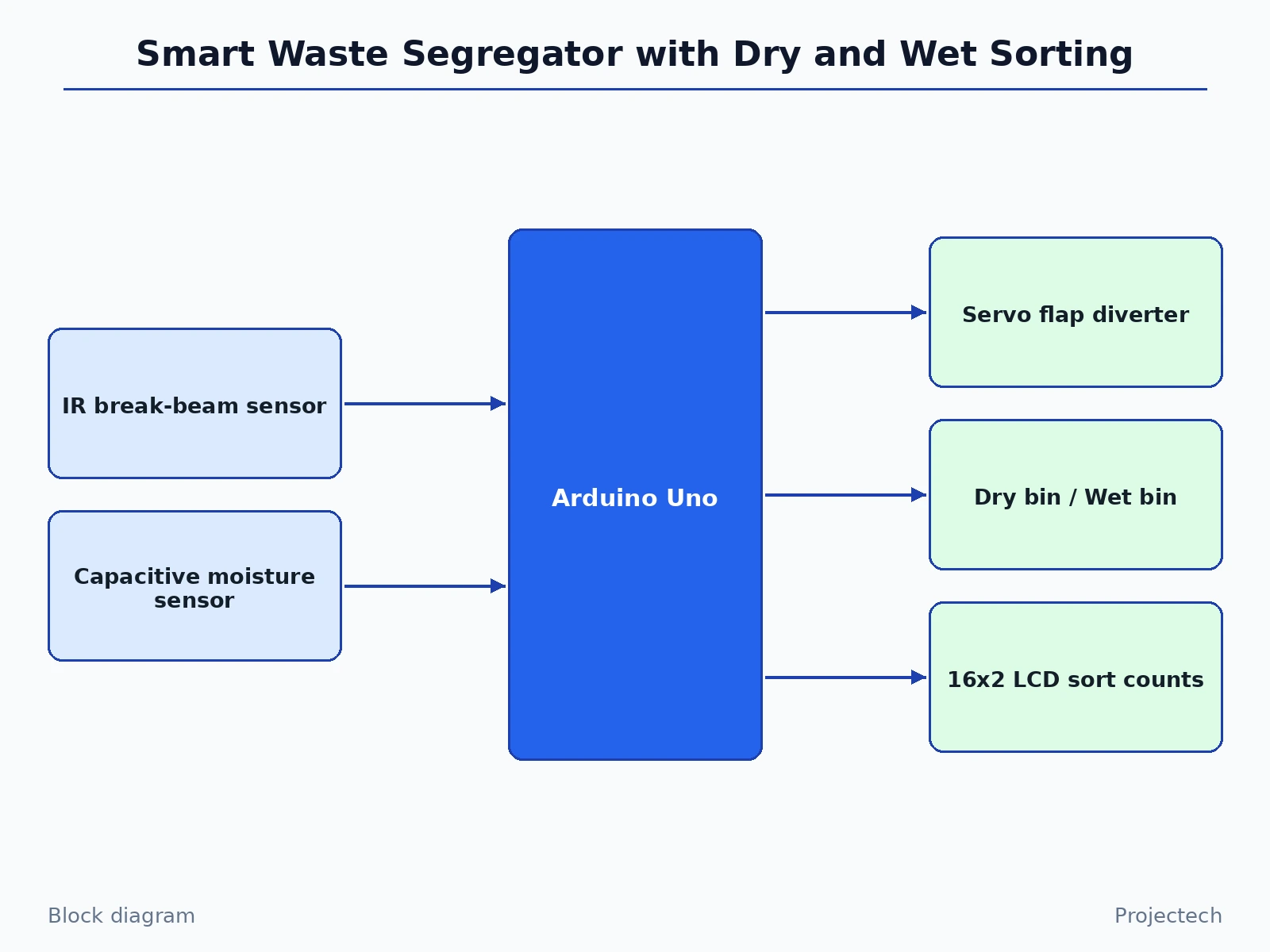
Source segregation is the single biggest bottleneck in municipal waste handling: mixed waste reaches processing plants because segregation at the bin depends on every user remembering the rules every time. Dry waste contaminated with wet waste loses recycling value, and wet waste mixed with plastic cannot be composted properly. This project attacks the problem at the point of disposal with a tabletop segregator: the user drops waste into one hopper, a capacitive soil-moisture-style sensor measures the item's moisture content as it passes the sensing chamber, and an Arduino classifies it as dry or wet and swings a servo flap to route it into the correct bin. An IR break-beam sensor counts each item and the LCD keeps running totals. The build demonstrates the complete sense–decide–actuate loop — capacitive sensing, threshold classification, servo control and event counting — on hardware a student can fully explain.
Detects an item dropped in the hopper and wakes the sensing sequence.
Follow the working sequence
How it works
- Waste is dropped into the single hopper; the IR break-beam sensor at the mouth detects the item and wakes the sensing sequence.
- The item rests briefly in the sensing chamber against the capacitive moisture sensor plate.
- The Arduino samples the sensor (typically 10 readings averaged) and compares the value against the calibrated dry/wet threshold.
- Based on the classification, the servo flap swings to the dry-bin or wet-bin position; a short delay lets the item fall through.
- The flap returns to neutral, the LCD counters increment, and the system arms for the next item.
- Items that fall in the ambiguous band around the threshold are routed to a default side and flagged on the LCD, so the student can demonstrate the edge case honestly.
- The threshold is set during calibration: the student records readings for known dry and known wet samples and picks the midpoint, documented in the calibration log.
Tech stack:
- Arduino Uno (ATmega328P)
- Capacitive moisture sensor module
- IR break-beam / proximity sensor
- High-torque servo motor (flap diverter)
- 16×2 character LCD
- Twin collection bins with sensing chamber
- Arduino IDE (C/C++ firmware)
| Parameter | Value |
|---|---|
| Controller | Arduino Uno |
| Sensing | Capacitive moisture sensor, chamber-mounted |
| Classification | Dry / wet by calibrated threshold |
| Sort time | Approximately 1–2 seconds per item (design target) |
| Actuation | Servo flap, approximately 15 kg·cm class (design target) |
| Item detection | IR break-beam at hopper mouth |
| Display | 16×2 LCD with dry/wet/total counters |
| Chamber capacity | Single items up to approximately 10 cm (design target) |
| Power | 12 V DC adapter (servo) + 5 V logic |
Project features
- [Capacitive moisture sensing] A capacitive sensor measures each item's moisture content in the sensing chamber — no contact corrosion issues, since the electrode never touches the waste directly through the chamber wall.
- [Automatic dry/wet classification] The Arduino compares the reading against a student-calibrated threshold and classifies the item as dry or wet within about a second of sensing (design target).
- [Servo flap diverter] A high-torque servo swings the sorting flap to route each item into the dry bin or the wet bin, then returns to neutral for the next item.
- [IR item detection] An IR break-beam sensor at the hopper mouth detects each dropped item, wakes the sensing sequence and increments the total count.
- [Live sort counters] A 16×2 LCD shows running counts of dry, wet and total items sorted, plus the current system state.
- [Student calibration procedure] The moisture threshold is set by the student using sample dry and wet items, with the procedure and a calibration log sheet included — so the classification boundary is measured, not guessed.
- [Twin-bin output] Two removable bins collect the segregated streams, ready to demonstrate handover to recycling and composting flows.
What is included
- Working prototype: hopper, sensing chamber, servo flap, twin bins, sensor set
- Complete firmware (sensing, classification, actuation, counting)
- Moisture-threshold calibration procedure with log sheet
- Wiring diagram and mechanical assembly guide
- Project report PDF (background, capacitive sensing theory, methodology, calibration results)
- PPT presentation for final review
- Viva Q&A preparation document
Limitations & prerequisites
- The unit classifies dry vs wet only — it does not separate metal, glass, e-waste or hazardous waste; those are out of scope and stated as future scope.
- Classification accuracy depends on the student's calibration with representative samples; items near the threshold (damp paper, for example) fall in the ambiguous band and are flagged, not force-classified.
- One item at a time — bulk dumping jams the chamber; the IR sensor ignores items dropped while the flap is moving.
- Very large or very heavy items (above approximately 10 cm / 500 g, design limits) are not handled by the tabletop build.
- The capacitive reading drifts with ambient humidity over long periods, so the report includes a re-calibration procedure rather than claiming a permanent factory threshold.
Frequently Asked Questions
How does it tell dry waste from wet waste?
A capacitive sensor in the chamber measures the item's moisture content — wet items raise the capacitance significantly. The Arduino compares the averaged reading against a threshold the student calibrates with known dry and wet samples, then routes the item with the servo flap.
What does it do with something in-between, like damp paper?
Readings near the threshold fall in an ambiguous band. The firmware routes these to a default side and flags the count on the LCD, so the edge case is demonstrated honestly instead of being silently misclassified.
Can it sort metal, glass or e-waste?
No — this build sorts dry vs wet only. Multi-class sorting (metal/glass/plastic) needs additional sensors and is listed as future scope in the report.
How is the threshold set?
By the student, during calibration: record sensor readings for a set of known dry items and known wet items, take the midpoint as the threshold, and log everything in the provided calibration sheet. The report documents the procedure and the student's own values.
What is the sorting speed?
Approximately one item every 1–2 seconds (design target) — sensing, flap swing and settle time. It is a tabletop demonstrator, not a conveyor-scale plant.
Is this project suitable for a final-year project?
Yes — for Electronics, Electrical and IoT & Embedded programs. It demonstrates capacitive sensing, threshold classification, servo actuation, a calibration methodology and a real environmental problem. Suitable for B.E./B.Tech final-year projects in Electronics, Electrical and IoT & Embedded Systems.
Components & software requirements
- Arduino Uno (ATmega328P)
- Capacitive moisture sensor module
- IR break-beam / proximity sensor
- High-torque servo motor (flap diverter)
- 16×2 character LCD
- Twin collection bins with sensing chamber
- Arduino IDE (C/C++ firmware)
Delivery information
Built-to-order project. Delivery timeline is shared after order confirmation based on current queue.
Support terms
Complete documentation, setup guide, and viva preparation included. Support for setup and explanation provided.
Download free synopsis (PDF)
Enter your name and WhatsApp number — the synopsis PDF downloads immediately. We may send occasional project updates on WhatsApp; no spam.