
More project photos (2)

The problem
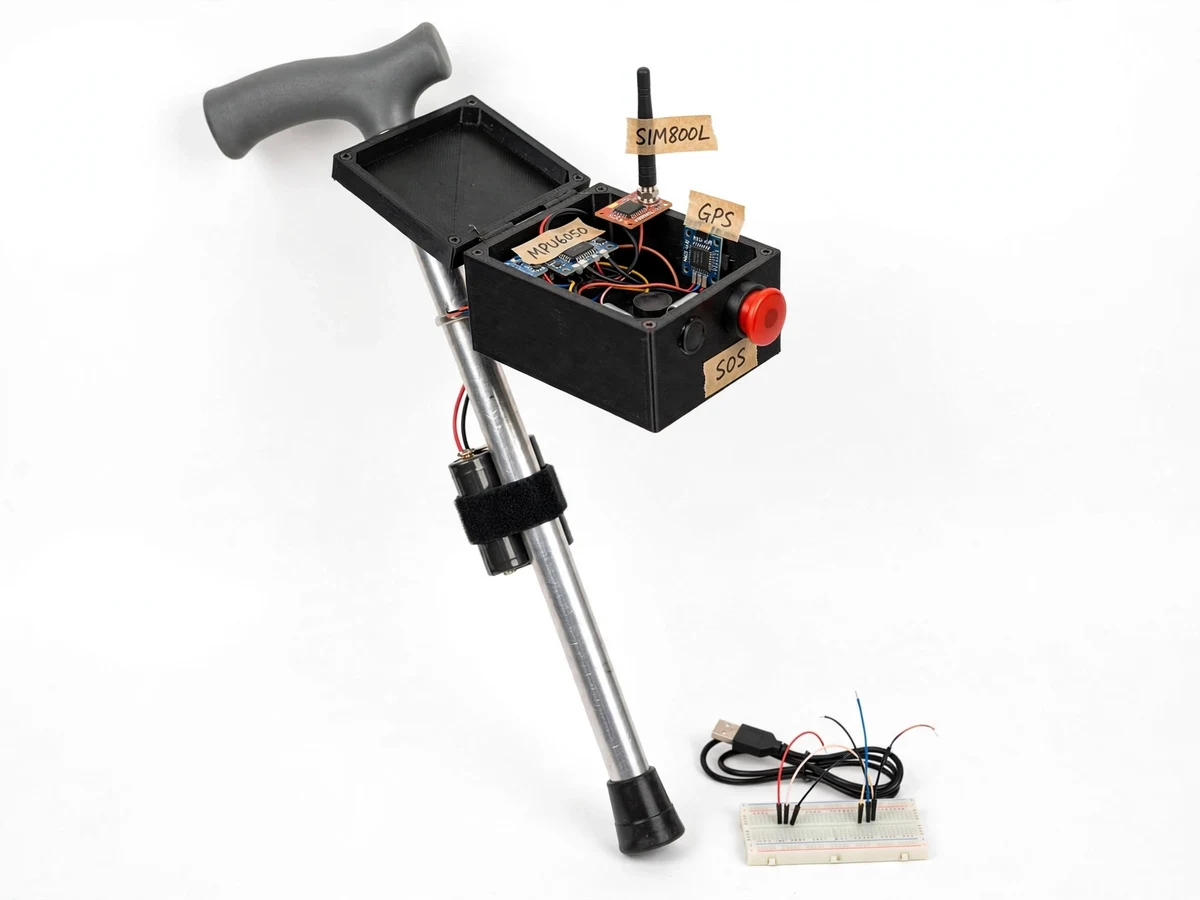
The Smart Walking Stick for Elderly with Fall Detection and GPS Tracking packs an MPU6050 accelerometer, a NEO-6M GPS module and a SIM800L GSM module into a control box below the handle: when the user falls, the stick recognises the fall and sends the user's location to a family member by SMS. Falls are the sharpest risk of living alone in old age: a person who cannot get up after a fall may lie for hours before anyone notices, and a phone in a pocket is often out of reach. Ordinary walking sticks give support but no way to call for help, and pendant alarms need a conscious wearer to press them. This project closes that gap with automatic detection: the stick judges a fall from the impact, the orientation change and the stillness that follows, then sends an SMS with a Google Maps link to the family's phones, while a red SOS button covers the falls the sensor misses.
The user walks with the stick as usual.
Follow the working sequence
How it works
The smart walking stick works by watching its own motion, judging a fall from a three-part sequence, and then sending help by SMS. The MPU6050 samples acceleration continuously and the firmware tracks the total acceleration magnitude, which stays near 1 g with small swings during normal walking. A sharp impact above approximately 3 g marks a candidate fall, and the firmware then checks the stick's orientation and waits through a stillness window: only if the stick has tilted from upright toward horizontal and then stays near-motionless for approximately 10 seconds is the fall confirmed. During that window the buzzer and vibration motor warn the user, and pressing the SOS button cancels the alert. On confirmation, the NEO-6M GPS module supplies the latest fix and the SIM800L GSM module sends an SMS with a Google Maps link to the stored family numbers. A family member can also text "LOC" to the stick at any time to receive its current location.
- The MPU6050 samples acceleration at 50 Hz (design value) and the firmware tracks the total acceleration magnitude, which stays near 1 g with small swings during normal walking.
- An impact spike above approximately 3 g (configurable threshold in firmware) marks a candidate fall and starts the confirmation sequence.
- The firmware checks orientation from the accelerometer and gyroscope: the stick must have tilted from upright toward horizontal, which separates a fall from a hard tap on the ground.
- The firmware then waits for approximately 10 seconds of stillness. During this window the buzzer sounds and the vibration motor runs; pressing the SOS button in this window cancels the alert.
- If the stick stays still and nobody cancels, the fall is confirmed and the NEO-6M GPS module supplies the latest latitude and longitude fix.
- The SIM800L GSM module sends an SMS containing a Google Maps link with that location to up to three stored family numbers, using AT commands over its UART link.
- At any other time, a family member can send the text "LOC" to the stick's number and receive the current GPS location back by SMS, while the battery monitor watches the cell voltage and raises an LED and SMS alert when the battery runs low.
Tech stack:
- Arduino Nano · ATmega328P
- MPU6050 accelerometer · gyroscope
- SIM800L GSM module · SMS alerts
- NEO-6M GPS module
- 18650 Li-ion battery · TP4056 charger
- Vibration motor · buzzer
- Aluminium walking stick · adjustable shaft
- Arduino IDE · C/C++ firmware
| Parameter | Value |
|---|---|
| Controller | Arduino Nano · ATmega328P · 16 MHz clock (datasheet value) |
| Fall sensor | MPU6050 3-axis accelerometer · ±2/±4/±8/±16 g ranges · 16-bit ADC (InvenSense datasheet values) · ±8 g range used in the build (design choice) |
| Gyroscope | MPU6050 3-axis gyroscope · ±250/±500/±1000/±2000 °/s (datasheet range) |
| Impact threshold | Approximately 3 g · configurable in firmware (design target) |
| Confirmation window | Approximately 10 s of stillness (design target) |
| GPS module | NEO-6M · 50 channels · up to 22 satellites · 2.5 m CEP horizontal accuracy (u-blox datasheet values) |
| GPS update rate | 1 Hz default · 5 Hz maximum (datasheet value) |
| GSM module | SIM800L · quad-band 850/900/1800/1900 MHz · 3.4–4.4 V supply · peak approximately 2 A during transmission (datasheet values) |
| SMS alert | Up to 3 stored family numbers (design value) |
| Battery | 2 × 18650 Li-ion cells · 2600 mAh each (design value) |
| Charging | TP4056 module · micro-USB input (design value) |
| Expected runtime | Approximately 24 h of typical use per charge (design target) |
| Stick height | Approximately 80–95 cm · adjustable (design value) |
| Weight | Approximately 700 g including battery (design target) |
| Alerts | Buzzer and vibration motor |
Project features
The smart walking stick is built around four capabilities that work together on every walk. Automatic fall detection is the core: the MPU6050 watches acceleration continuously and a fall is declared only when an impact spike, a change in orientation and a period of stillness all agree, so everyday use does not raise an alert. Automatic GPS and SMS SOS follows immediately: on a confirmed fall the NEO-6M GPS module fixes the location and the SIM800L GSM module sends an SMS with a Google Maps link to up to three family numbers, without the user touching anything. A large red SOS button lets the user call for help at any moment, while buzzer and vibration alerts warn the user during a short cancel window so a false alarm can be stopped. A rechargeable 18650 battery pack powers the stick, with a low-battery alert so it never silently runs flat.
- [Automatic fall detection] The MPU6050 accelerometer watches the stick's motion continuously, and a fall is declared only when three things agree: an impact spike above approximately 3 g, a change in orientation from upright toward horizontal, and about 10 seconds of stillness afterwards. The impact threshold and the stillness window are both configurable in firmware.
- [Automatic GPS and SMS SOS] On a confirmed fall, the NEO-6M GPS module supplies the current location and the SIM800L GSM module sends an SMS with a Google Maps link to up to three stored family numbers. The alert goes out by itself, so the user does not need to reach a phone or press anything.
- [Manual SOS button] A large red push button on the control box sends the same GPS location SMS immediately when pressed, for every situation the sensor cannot judge — feeling unwell, getting stuck, or a slow fall that never produced a sharp impact. During the warning window after a suspected fall, pressing the same button cancels the alert instead.
- [Pre-alert warning with cancel window] Before any SMS is sent, the buzzer sounds and the vibration motor runs for approximately 10 seconds, warning the user that an alert is about to go out. This window is what stops a hard drop of the stick from turning into a false alarm.
- [Location on demand by SMS] A family member can send the text "LOC" to the stick's number at any time and receive the stick's current GPS location back by SMS, so the user's whereabouts can be checked without waiting for a fall.
- [Rechargeable battery with low-battery alert] Two 18650 Li-ion cells power the stick and charge through a TP4056 module over micro-USB. When the battery runs low, an LED lights up and the stick sends a low-battery SMS to the family, so the stick never silently runs flat. During the build the SIM800L kept resetting on every SMS send until it was given its own 4.0 V supply with a bulk capacitor across it: the module pulls close to 2 A in transmit bursts (datasheet value), which no Arduino regulator pin can deliver, so the stick powers the GSM module straight from the battery through a dedicated buck converter.
- [Adjustable walking stick] The electronics mount on a height-adjustable aluminium shaft (approximately 80–95 cm) with a moulded rubber grip and a non-slip rubber ferrule, so the stick stays a usable walking aid first and an electronic device second.
What is included
- Working smart walking stick prototype with control box, sensors, SOS button and battery pack
- Arduino firmware with fall-detection logic, SMS routines and location-on-demand handling
- Circuit diagrams, wiring documentation and component list
- Fall-detection threshold tuning and drop-test procedure for the buyer to run on their own build
- Project report PDF, project abstract PDF and PPT presentation
- Viva Q&A preparation document covering IMU fall detection, GPS and GSM
Limitations & prerequisites
- GPS needs a view of the sky: indoors or underground the SMS carries the last known outdoor fix, which may be stale.
- SMS alerts need 2G GSM coverage and an active SIM with SMS balance; areas without 2G coverage cannot receive alerts, so check local 2G availability before ordering — 2G networks are being retired in some regions.
- Fall detection is threshold-based: a slow slide or gradual collapse may not cross the impact threshold and may go undetected.
- A hard drop of the stick followed by stillness can raise a false alert; the cancel window is the guard against this, and the user must be able to press the button.
- This is an academic prototype, not a certified medical device; it does not replace professional care, supervision or emergency services.
- Battery runtime depends on GSM signal strength and alert frequency; a weak signal makes the GSM module work harder and drain the battery faster.
Frequently Asked Questions
How does the stick tell a real fall from normal walking?
It does not alert on a single jolt: a fall is declared only when three things agree — an impact spike above roughly 3 g, a change in orientation from upright toward horizontal, and about 10 seconds of stillness afterwards. Normal walking, tapping the stick on the ground or setting it down hard produces at most one of these, so the three-part test keeps everyday use from sending alerts. The impact threshold and the stillness window are both configurable in firmware, and the tuning procedure shows the buyer how to set them for their own build.
What exactly happens when a fall is detected?
When the stick suspects a fall it first warns the user with its buzzer and vibration motor for about 10 seconds, so a false alarm can be cancelled by pressing the SOS button, and if nobody cancels, the fall is confirmed and the GPS module takes the current location and the GSM module sends an SMS with a Google Maps link to up to three stored family numbers. The message goes out automatically — the user does not have to press anything or reach a phone.
Can the user call for help without a fall?
Yes — a large red SOS button on the control box sends the same GPS location SMS immediately when pressed, whether or not a fall was detected, so the user can call for help for anything the sensor cannot judge, such as feeling unwell, getting stuck, or a slow fall that never produced a sharp impact. During the 10-second warning window after a suspected fall, pressing the same button cancels the alert instead, so one button covers both jobs.
Does the stick need internet, and does it work indoors?
No internet is needed: alerts travel as ordinary GSM SMS, which works wherever a 2G signal reaches, and the GPS fix comes from satellites rather than the internet, so the stick works in the open outdoors with no data connection at all. Indoors or underground, GPS cannot get a fresh fix, so the SMS carries the last known outdoor location and says so. Deep indoor use is a known limitation of any GPS device.
How long does the battery last and how is it charged?
The stick runs on two 18650 Li-ion cells (2600 mAh each) and is expected to last approximately 24 hours of typical use per charge — a design target that depends on GSM signal strength and how often alerts are sent. Charging is by micro-USB through a TP4056 module. When the battery runs low, an LED lights up and the stick sends a low-battery SMS to the family, so it never silently runs flat.
Is this project suitable for a final-year project?
Yes — for Electronics & Telecommunication, Electrical and IoT & Embedded programs, because it demonstrates IMU sensing, threshold-based event detection, GPS parsing, GSM AT-command control and battery-powered embedded design in one working build, with measurable fall-test behaviour the student can report and defend. The report, abstract, PPT and viva Q&A are prepared with the prototype.
Message Projectech on WhatsApp for a quotation: share the scope you want (stick height, alert numbers, extra sensors or a companion app), and you will receive the build scope, price and delivery timeline before any work starts.
Components & software requirements
- Arduino Nano · ATmega328P
- MPU6050 accelerometer · gyroscope
- SIM800L GSM module · SMS alerts
- NEO-6M GPS module
- 18650 Li-ion battery · TP4056 charger
- Vibration motor · buzzer
- Aluminium walking stick · adjustable shaft
- Arduino IDE · C/C++ firmware
Delivery information
Built-to-order project. Delivery timeline is shared after order confirmation based on current queue.
Support terms
Complete documentation, setup guide, and viva preparation included. Support for setup and explanation provided.
Download free synopsis (PDF)
Enter your name and WhatsApp number — the synopsis PDF downloads immediately. We may send occasional project updates on WhatsApp; no spam.