
More project photos (3)


The problem
Tomato flowers are self-fertile, yet in a closed greenhouse they still need a shake: the pollen sits inside an anther cone around the stigma and only releases when the flower is vibrated the way a bumblebee's wing muscles vibrate it on landing. Commercial greenhouses hire bumblebee colonies for this, but bees go quiet exactly when growers need them most — short winter days under supplementary LED lighting, energy-saving thermal screens that cut the light, or summer heat above 35 °C — and a missed pollination window means flowers that never set fruit. This Polly-inspired greenhouse pollination robot project answers that gap at student scale: a small row-following rover carries an ESP32-CAM that recognises ready tomato flowers by colour and shape, then fires a short air burst from a focused nozzle to shake the pollen loose, with DHT22 and BH1750 sensors logging the temperature, humidity and light that explain when bee activity would drop.
Polly, from Biobest (Belgium, part of BioFirst Group) and Arugga AI Farming, is an autonomous pollination robot for commercial tomato greenhouses, launched on 18 November 2026 after a five-year joint development (reported by The Robotics Media). One robot covers about 1 hectare without continuous human supervision, and trials across European and North American commercial greenhouses showed 2–6% yield gains, while about 1.5% is typically enough for a grower to recoup the cost. Its cameras and image recognition identify ready flowers, then a controlled air burst releases pollen, mimicking the vibration bumblebees create when they land and buzz. It is designed to work alongside bumblebee colonies, filling in when bees go quiet — short winter days under supplementary LED lighting, energy-saving thermal screens cutting light, or summer heat above 35 °C — and is offered via 12-month leasing or outright purchase, both including maintenance and warranty. This student build does not replicate Polly: it shrinks the idea to a bench-scale rover, an ESP32-CAM, a 12 V diaphragm air pump and a Wi-Fi dashboard, and every Polly figure on this page is labelled as reported, never as this build's result.
| This student build | Polly (Biobest + Arugga, reported) | IoT Smart Greenhouse Climate Control (live page) | Crop Disease Detection App using TensorFlow Lite (live page) | |
|---|---|---|---|---|
| What it is | Student rover that pollinates tomato flowers with air bursts | Commercial autonomous pollination robot for tomato greenhouses | ESP32 climate controller for a greenhouse | Android app that diagnoses crop disease from a leaf photo |
| Flower handling | ESP32-CAM recognises ready flowers by colour and shape; air burst shakes pollen loose | Cameras + image recognition identify ready flowers, then a controlled air burst releases pollen | None — monitors climate only, no flower work | Camera photographs leaves for disease classification, never flowers |
| Pollination method | Short air burst (design target ~0.3 s) from a focused nozzle; air only, no bees, no chemicals | Controlled air burst mimicking bumblebee buzz vibration | No pollination — runs exhaust fan, mister and irrigation valve | No pollination — diagnoses disease only, no actuators |
| Climate logging | DHT22 temperature/humidity + BH1750 light, logged to show when bee activity would drop (e.g. above 35 °C) | Works alongside bees, filling in when bees go quiet in heat, low light or under thermal screens | DHT22, soil moisture and LDR drive fan, mister and irrigation automatically | None — no climate sensors, no irrigation |
| Scale | One bench row of potted tomato plants (design target 8 plants) | About 1 hectare per robot without continuous human supervision (reported) | One demo greenhouse model | One Android phone app |
| Validation | Buyer-run procedure: fruit-set on robot row vs control row over 2–3 weeks; no yield claimed in advance | Trials across European and North American greenhouses showed 2–6% yield gains (reported) | Threshold automation demonstrated on the demo model | Disease classification demonstrated in the app on leaf photos |
| Honesty line | Lab-scale pollinator — does not replicate Polly's commercial vision stack; air-burst cannot match bee precision | Commercial product — this build does not reproduce it | Climate control only — a different job from pollination | Disease diagnosis only — a different job from pollination |
How it works
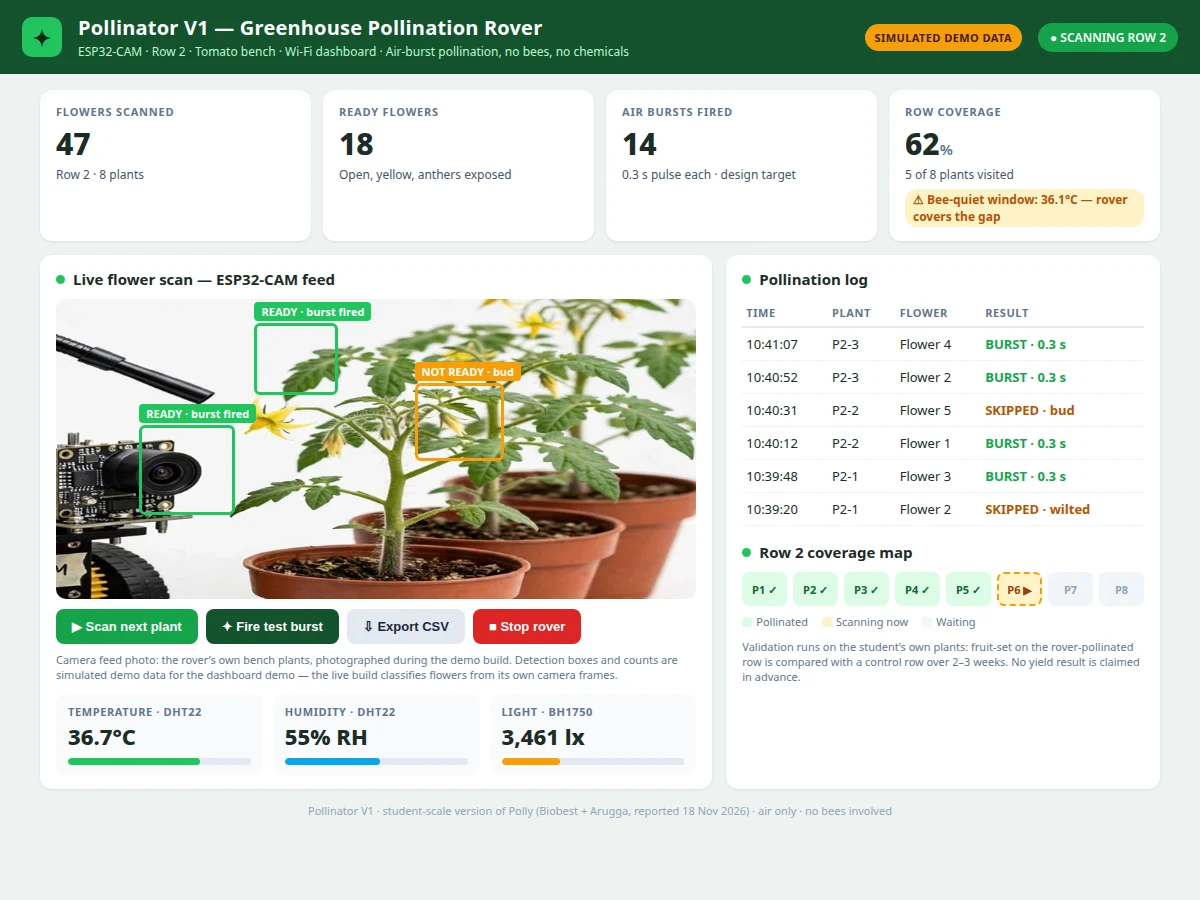
The rover, the camera and the dashboard form one working loop. The rover drives slowly along the bench row while the ESP32-CAM photographs each tomato flower it passes; OpenCV colour and shape rules on the device score each flower ready or not, and an optional TinyML classifier trained on the student's own flowers can replace the rules. On a ready flower the firmware opens the solenoid valve for a short pulse — design target about 0.3 seconds — and the 12 V diaphragm pump pushes a focused jet of air at the anther cone, shaking the pollen loose the way a bumblebee's buzz does. The DHT22 and BH1750 log temperature, humidity and light with every burst, the ultrasonic sensor stops the rover at the row end, and the Wi-Fi dashboard draws the live feed with detection boxes, the burst log and the row-coverage map, exporting the run as CSV for the report.
- The builder assembles the rover: a differential-drive chassis with two DC gear motors on a TB6612FNG driver, an ultrasonic module at the front for row-end stops, and a 12 V battery pack with a separate 5 V rail for the logic.
- The builder mounts the camera and nozzle: the ESP32-CAM faces the plants at flower height, and the air nozzle sits on a short gooseneck tube aimed at the same flowers, fed by the 12 V diaphragm pump through a solenoid valve.
- The builder wires the climate sensors: the DHT22 for temperature and humidity and the BH1750 for light, both read by the ESP32, with a 0.96-inch OLED showing flowers scanned, bursts fired and the current temperature.
- The builder writes the flower recognition: OpenCV colour and shape rules on the ESP32-CAM score each photographed flower ready or not, and an optional TinyML classifier trained on the student's own tomato flowers can be swapped in for the rules.
- The builder sets the burst: the solenoid opens for a design-target 0.3 s pulse per ready flower, with the nozzle aimed at the anther cone, not the petals — the single most common aiming mistake in the demo build, where a burst aimed high passed over the flower instead of shaking it.
- The builder runs the row: the rover follows the bench row, photographs and bursts flower by flower, stops at the row end, and the dashboard logs every flower, burst and climate reading with CSV export.
- The builder validates honestly: over 2–3 weeks the student counts fruit-set on the robot-pollinated row and on an untouched control row, and the report records the comparison as the student's own result, with no yield figure claimed in advance.
Tech stack:
- ESP32-CAM · OV2640 camera
- DHT22 · temperature and humidity
- BH1750 · light sensor
- TB6612FNG · dual DC motor driver
- 12 V diaphragm air pump · solenoid valve
- OpenCV · TinyML flower recognition
- HTML · CSS · JavaScript dashboard
- Arduino IDE · ESP32 firmware
How Polly works — and what this build does instead
- The Polly launch: Biobest (Belgium, part of BioFirst Group) and Arugga AI Farming launched Polly, an autonomous pollination robot for commercial tomato greenhouses, on 18 November 2026 after a five-year joint development (reported by The Robotics Media). One robot covers about 1 hectare without continuous human supervision, and trials across European and North American commercial greenhouses showed 2–6% yield gains, while about 1.5% is typically enough for a grower to recoup the cost. It is offered via 12-month leasing or outright purchase, both including maintenance and warranty.
- Why a shake pollinates a tomato: A tomato flower is self-fertile — its anthers form a cone around the stigma — but the pollen only releases when that cone is vibrated. A bumblebee landing on the flower vibrates its wing muscles without flying, and the buzz shakes the pollen loose onto the stigma. That is the whole mechanism Polly copies: find the ready flower, then vibrate it. This student build copies the same mechanism with a different tool — a short pulse of air aimed at the anther cone shakes the flower the same way, without the bee and without touching the plant.
- Working alongside bees, not replacing them: Polly is designed to work alongside bumblebee colonies, filling in when bees go quiet — short winter days under supplementary LED lighting, energy-saving thermal screens cutting light, or summer heat above 35 °C. The student build makes that boundary visible: its DHT22 and BH1750 log the temperature, humidity and light at every burst, so the dashboard shows the exact conditions under which the rover was doing the bees' job.
- What this build does instead: The student build replaces a commercial hectare-scale robot with a bench rover, replaces Polly's commercial vision stack with OpenCV colour and shape rules on an ESP32-CAM plus an optional TinyML classifier the student trains, replaces a precision air system with a 12 V diaphragm pump and a solenoid valve firing a design-target 0.3 s pulse, and replaces trial yield figures with a buyer-run fruit-set comparison on the student's own plants. The 2–6% yield gains are Polly's reported trial figures, never this build's.
| Parameter | Value |
|---|---|
| Camera controller | ESP32-CAM (AI-Thinker ESP32-S) · dual-core Xtensa LX6 up to 240 MHz · 520 KB SRAM · 4 MB PSRAM · 4 MB flash · Wi-Fi 802.11 b/g/n + Bluetooth 4.2 · 5 V supply · 40.5 × 27 mm (Datasheet values, AI-Thinker / Espressif) |
| Camera | OV2640 · 2 MP · up to 1600 × 1200 pixels · JPEG on-chip · image transfer 15–60 fps (Datasheet values, OmniVision) |
| Temperature and humidity | DHT22 (AM2302) · −40 to +80 °C ±0.5 °C · 0–100 %RH ±2 %RH (±5 %RH max) · 0.1 °C / 0.1 %RH resolution · new reading at most every 2 s (Datasheet values, Aosong) |
| Light | BH1750FVI · 1–65,535 lx (0.11–100,000 lx with measurement-time register) · 1 lx resolution in high-resolution mode · ~120 ms measurement time · I2C address 0x23 or 0x5C (Datasheet values, ROHM) |
| Motor driver | TB6612FNG · dual DC motor driver · VM up to 15 V · 1.2 A average / 3.2 A peak per channel · 0.5 Ω on-resistance (Datasheet values, Toshiba) |
| Drive motors | 2 × DC gear motors · differential drive · design-target rover speed ~10 cm/s along the row (design target) |
| Air system | 12 V mini diaphragm air pump (130-XA class) · 0.5–2.0 L/min flow · ≥80 kPa max pressure · ≤150 mA at 12 V (manufacturer listing value) · solenoid valve · focused nozzle on a gooseneck (design target) |
| Air burst | Design target ~0.3 s per ready flower · air only · no contact with the flower (design target) |
| Row-end detection | HC-SR04 ultrasonic module · rover stops at the row end · design-target stop distance 15 cm (design target) |
| Display | 0.96-inch OLED · 128 × 64 pixels · shows flowers scanned, bursts fired and temperature (design target) |
| Row scale | Design target 8 potted tomato plants per bench row · one row per run (design target) |
| Power | 12 V battery pack for motors and pump · separate 5 V rail for the ESP32-CAM and sensors (design target) |
| Trend reference | Polly (Biobest + Arugga): launched 18 November 2026 after five years of joint development · about 1 hectare per robot · 2–6% yield gains in trials across European and North American greenhouses · about 1.5% typically enough to recoup the cost · 12-month leasing or outright purchase, maintenance and warranty included (all reported by The Robotics Media). None of these figures describe this student build. |
| Builder note | A tomato flower is self-fertile: its anthers form a cone around the stigma, and pollen only releases when the cone is vibrated — a bumblebee does it with its wing muscles, this rover does it with a pulse of air. The single most common failure in the demo build was aiming: a nozzle pointed a few centimetres too high sends the burst over the flower instead of shaking it, so aim at the anther cone, not the petals, and check the aim on one flower before running a row. The second most common failure is power: the pump and the two drive motors together brown out the 5 V logic rail if they share it, so the motors and pump run from the 12 V pack and the ESP32-CAM from its own 5 V regulator. |
Project features
Four capabilities carry this build. First, camera flower recognition: the ESP32-CAM photographs each flower and scores it ready or not by colour and shape rules on-device, with an optional TinyML classifier trained on the student's own flowers, so the rover only fires at flowers that are actually open. Second, the air-burst pollinator: a 12 V diaphragm pump and solenoid valve drive a focused nozzle that fires a short air pulse at a recognised flower, shaking the anther cone like a buzzing bee, with air only and no contact with the plant. Third, bee-quiet climate logging: the DHT22 and BH1750 record temperature, humidity and light with every burst, so the dashboard shows the conditions — heat above 35 °C, dim light under screens — under which bees would have gone quiet. Fourth, the pollination dashboard: a Wi-Fi page shows the live camera feed with detection boxes, the burst log and a row-coverage map, with CSV export for the report.
- [Camera flower recognition] The ESP32-CAM photographs each tomato flower and scores it ready or not by OpenCV colour and shape rules on-device, with an optional TinyML classifier trained on the student's own tomato flowers — implemented in the base build.
- [Air-burst pollination] A 12 V diaphragm air pump and solenoid valve fire a short air pulse (design target ~0.3 s) through a focused nozzle at a recognised ready flower, shaking pollen loose from the anther cone — implemented in the base build.
- [Row-following rover] A differential-drive chassis with two DC gear motors follows the greenhouse bench row and stops at the row end on an ultrasonic sensor, so the rover works a whole row without being pushed — implemented in the base build.
- [Bee-quiet climate logging] A DHT22 logs temperature and humidity and a BH1750 logs light alongside every burst, so the dashboard shows the conditions under which bees would go quiet — implemented in the base build.
- [Pollination dashboard] A Wi-Fi dashboard shows the live camera feed with detection boxes, the burst log, a row-coverage map and temperature, humidity and light gauges, with CSV export of every run — implemented in the base build.
- [OLED status display] A 0.96-inch OLED on the rover shows flowers scanned, bursts fired and the current temperature, so the demo reads live even without the dashboard open — implemented in the base build.
- [Two-row fruit-set validation] The build is validated by a buyer-run procedure: fruit-set on the robot-pollinated row is counted against a control row over 2–3 weeks, with the result recorded, never claimed in advance — implemented in the base build.
- [Air only, no bees, no chemicals] The rover touches no flower, carries no bees and sprays nothing — the only thing it delivers to a flower is a pulse of air — implemented in the base build.
What is included
- Working prototype (row-following rover with ESP32-CAM, air-burst nozzle and 12 V diaphragm pump, DHT22 and BH1750 climate sensors, ultrasonic row-end detection, OLED display, battery pack, and a bench row of potted tomato plants for the demo)
- ESP32 firmware (flower recognition by OpenCV rules with optional TinyML classifier, burst control, climate logging, row following and row-end stop, Wi-Fi dashboard feed)
- Pollination dashboard (live camera feed with detection boxes, burst log, row-coverage map, temperature, humidity and light gauges, CSV export)
- Setup and validation guide (rover assembly and nozzle aiming, flower-recognition calibration on the student's own plants, the two-row fruit-set validation run, dashboard walkthrough)
- Project report PDF (Polly background with reported figures labelled as reported, buzz-pollination mechanism, rover design, recognition method, the student's own validation, honest limits)
- PPT presentation for final review
- Viva Q&A preparation document (how buzz pollination works, why bees go quiet, camera flower recognition, air-burst design, Polly vs the student build, limitations)
Work plan & timeline
Total work plan: 100 hours, split across six phases. Phase 1, background study and parts: 14 hours — reading the Polly launch coverage and the ESP32-CAM, DHT22, BH1750, TB6612FNG and pump datasheets, sourcing the rover chassis, camera, pump, valve and sensors, and setting up the tomato bench row. Phase 2, rover build: 22 hours — assembling the differential-drive chassis, mounting the camera and the gooseneck nozzle, wiring the motor driver, pump, valve and climate sensors, and the first bench-row drive test. Phase 3, recognition and burst: 24 hours — OpenCV flower-readiness rules on the ESP32-CAM, the solenoid burst timing, nozzle aiming trials on real flowers, and the optional TinyML classifier trained on the student's own tomato flowers. Phase 4, dashboard and logging: 16 hours — the Wi-Fi dashboard with live feed, detection boxes, burst log, row-coverage map and gauges, plus CSV export and the OLED status display. Phase 5, validation: 12 hours — the two-row fruit-set comparison run over 2–3 weeks, with counts recorded for the report. Phase 6, review preparation: 12 hours — presentation slides, a demo walkthrough, and the question-and-answer document for the review.
Support
Support covers setup help for the delivered rover, camera, air system and dashboard, a walkthrough of nozzle aiming, flower-recognition calibration and the two-row fruit-set validation, plus fixes for defects in the delivered code. Guidance is also provided for adapting the report and presentation to the student's college format and for answering guide questions about buzz pollination, greenhouse climate, camera recognition, air-burst design and the Polly launch. Support does not cover re-running the fruit-set validation beyond the setup walkthrough, and it does not invent results for runs or observations that were not made.
Limitations & prerequisites
- Not Polly: this build is a bench-scale rover inspired by the Biobest + Arugga robot launched on 18 November 2026, not a reproduction of it. Polly's hectare coverage, commercial vision stack and 2–6% trial yield gains are reported figures for the commercial robot, not this build's results, and must never be presented as such.
- Air-burst cannot match bee precision: a pulse of air shakes the whole flower, while a bee vibrates the anther cone directly. Some bursts will miss the cone, some ready flowers will be skipped by the recogniser, and the report records the miss rate instead of hiding it.
- Flower recognition accuracy depends on the student's own training set: the OpenCV rules and the optional TinyML classifier are tuned on the student's own tomato flowers under the student's own light. Different varieties, lighting or growth stages change the result, and the classifier must be re-tuned and its errors recorded.
- Indoor and bench-scale only: the rover follows one bench row of potted plants. It is not weatherproof, not built for a commercial greenhouse, and not designed for open-field use.
- No yield claim: the build makes no claim about yield gains. The two-row fruit-set comparison is the student's own validation, run over 2–3 weeks, and the report states the counts it actually measured.
- No bees involved: the rover does not use, replace or interact with live bees, and must never be presented as a bee substitute in a commercial setting — it demonstrates the pollination mechanism at student scale.
- Climate sensors measure the bench, not the greenhouse: the DHT22 and BH1750 read conditions at the rover, and the ±0.5 °C and ±2 %RH datasheet accuracies limit how precisely the bee-quiet thresholds can be stated.
Frequently Asked Questions
Is this project suitable for a final-year project?
Yes, for IoT and Embedded Systems, Electronics and Computer Engineering programmes, because it combines a camera-vision rover, air-burst actuation, climate sensing and a live Wi-Fi dashboard around a current robotics launch. The report documents the Polly launch with its figures labelled as reported, the buzz-pollination mechanism, the rover design and the student's own two-row fruit-set validation, so the work reads as engineering rather than a copy of a news story.
Is this the real Polly robot?
No — this build is a student-scale rover inspired by Polly, the Biobest and Arugga autonomous pollination robot launched on 18 November 2026. Polly covers about 1 hectare per robot and reported 2–6% yield gains in commercial greenhouse trials; this build works one bench row of potted tomato plants with an ESP32-CAM, a 12 V pump and a dashboard. The launch figures are background for the project, labelled as reported, not results of this build.
How does air-burst pollination actually work without bees?
A tomato flower is self-fertile: its anthers form a cone around the stigma, and pollen only releases when the cone is vibrated — a bumblebee does it with its wing muscles. This rover photographs each flower, and on a ready one fires a short air pulse at the anther cone that shakes the pollen loose the same way. No bee is involved, nothing touches the flower, and nothing is sprayed — the only thing delivered is air.
How is this different from the smart greenhouse and crop-disease projects already on the site?
The IoT Smart Greenhouse project controls climate — fan, mister and irrigation — and never touches a flower. The Crop Disease Detection App photographs leaves to classify disease on an Android phone and has no hardware at all. This build is the only one that pollinates: it recognises ready flowers and fires an air burst at them, with climate logging used to show when bees would go quiet, not to drive actuators.
What does the climate logging prove?
It shows the conditions under which the rover was working — for example heat above 35 °C or dim light under thermal screens, the exact conditions Polly's makers say bees go quiet in. The dashboard pairs every burst with its temperature, humidity and light reading, so the report can argue from the student's own data that the rover covered a bee-quiet window instead of asserting it.
What will I receive with the project?
You receive the working prototype — the row-following rover with ESP32-CAM, air-burst nozzle and pump, climate sensors, ultrasonic row-end detection and OLED display, plus the bench row of potted tomato plants — along with the firmware, the pollination dashboard with CSV export, the setup and validation guide, the report, presentation and Q&A document.
Components & software requirements
- ESP32-CAM · OV2640 camera
- DHT22 · temperature and humidity
- BH1750 · light sensor
- TB6612FNG · dual DC motor driver
- 12 V diaphragm air pump · solenoid valve
- OpenCV · TinyML flower recognition
- HTML · CSS · JavaScript dashboard
- Arduino IDE · ESP32 firmware
How Polly works — and what this build does instead
- The Polly launch: Biobest (Belgium, part of BioFirst Group) and Arugga AI Farming launched Polly, an autonomous pollination robot for commercial tomato greenhouses, on 18 November 2026 after a five-year joint development (reported by The Robotics Media). One robot covers about 1 hectare without continuous human supervision, and trials across European and North American commercial greenhouses showed 2–6% yield gains, while about 1.5% is typically enough for a grower to recoup the cost. It is offered via 12-month leasing or outright purchase, both including maintenance and warranty.
- Why a shake pollinates a tomato: A tomato flower is self-fertile — its anthers form a cone around the stigma — but the pollen only releases when that cone is vibrated. A bumblebee landing on the flower vibrates its wing muscles without flying, and the buzz shakes the pollen loose onto the stigma. That is the whole mechanism Polly copies: find the ready flower, then vibrate it. This student build copies the same mechanism with a different tool — a short pulse of air aimed at the anther cone shakes the flower the same way, without the bee and without touching the plant.
- Working alongside bees, not replacing them: Polly is designed to work alongside bumblebee colonies, filling in when bees go quiet — short winter days under supplementary LED lighting, energy-saving thermal screens cutting light, or summer heat above 35 °C. The student build makes that boundary visible: its DHT22 and BH1750 log the temperature, humidity and light at every burst, so the dashboard shows the exact conditions under which the rover was doing the bees' job.
- What this build does instead: The student build replaces a commercial hectare-scale robot with a bench rover, replaces Polly's commercial vision stack with OpenCV colour and shape rules on an ESP32-CAM plus an optional TinyML classifier the student trains, replaces a precision air system with a 12 V diaphragm pump and a solenoid valve firing a design-target 0.3 s pulse, and replaces trial yield figures with a buyer-run fruit-set comparison on the student's own plants. The 2–6% yield gains are Polly's reported trial figures, never this build's.
Delivery information
Built-to-order project. Delivery timeline is shared after order confirmation based on current queue.
Support terms
Complete documentation, setup guide, and viva preparation included. Support for setup and explanation provided.
Download free synopsis (PDF)
Enter your name and WhatsApp number — the synopsis PDF downloads immediately. We may send occasional project updates on WhatsApp; no spam.