
More project photos (2)
The problem
College students are surrounded by skills they need but cannot afford to pay for — a mechanical student who wants Python help, a CS student who wants to learn guitar, a design student who needs data-structures mentoring before placements. Paid tutoring platforms exist, but they charge per session and know nothing about campus life; college notice boards and WhatsApp groups try to fill the gap but their posts sink within hours and there is no structure for finding a complementary match. What is missing is a purpose-built board where a student posts what they can teach and what they want to learn in return, another student with the mirror image finds them, and the exchange itself is tracked to completion. This project builds exactly that: a peer-to-peer skill exchange platform with a searchable listing board, exchange requests with proposed plans, a dashboard that tracks pending, active and completed swaps session by session, and a rating step that keeps the community trustworthy.
College students who post skills they can teach, request exchanges and rate partners.
Follow the working sequence
How it works
- A student opens the board and searches or filters by category — e.g. "guitar" or Music — to find a skill they want to learn.
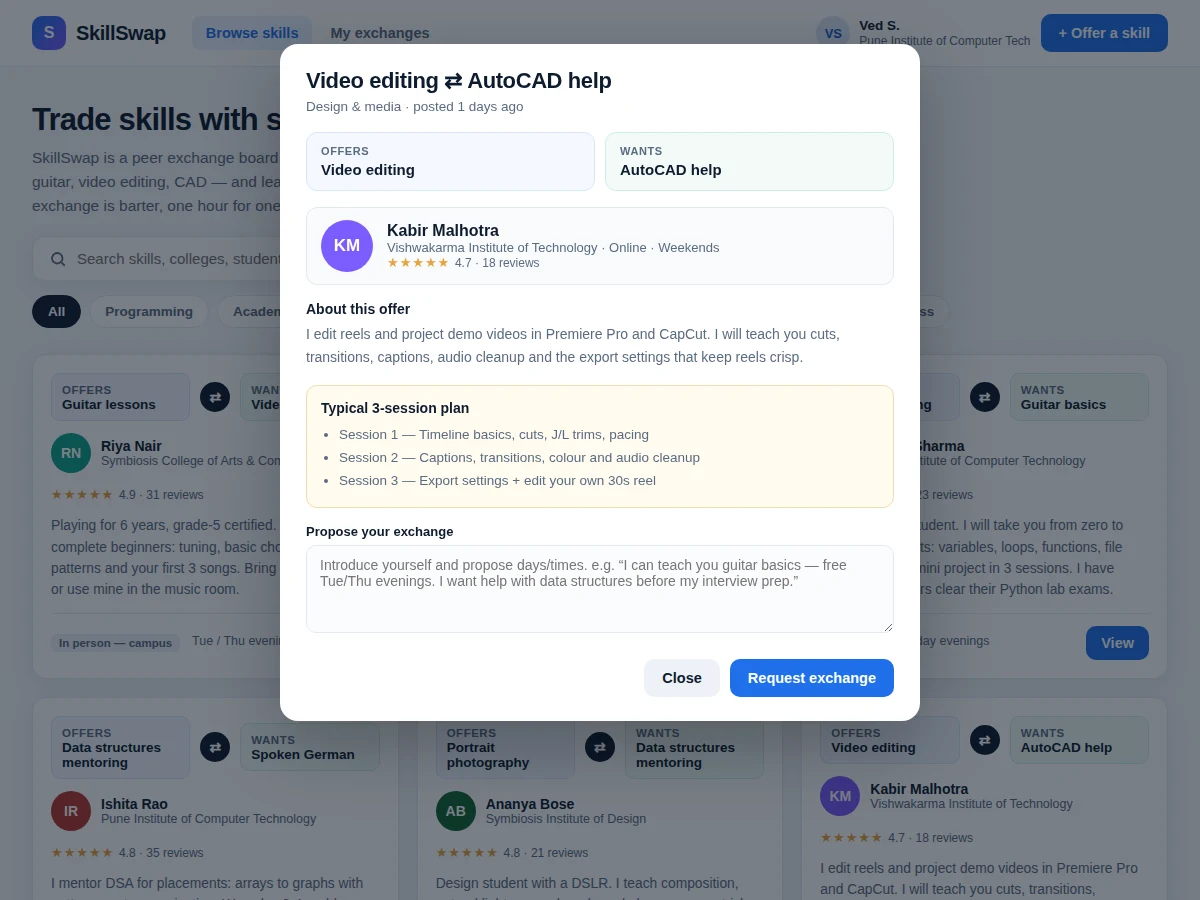
- Each listing shows the offer/ask pair (Offers Guitar lessons, Wants Video editing), the poster's college, rating and session format.
- Clicking a listing opens the detail view: what the partner teaches, the 3-session plan, availability, and a message box to propose the exchange.
- Sending the proposal creates a pending exchange on the dashboard; the partner sees the request with the student's name, college and message.
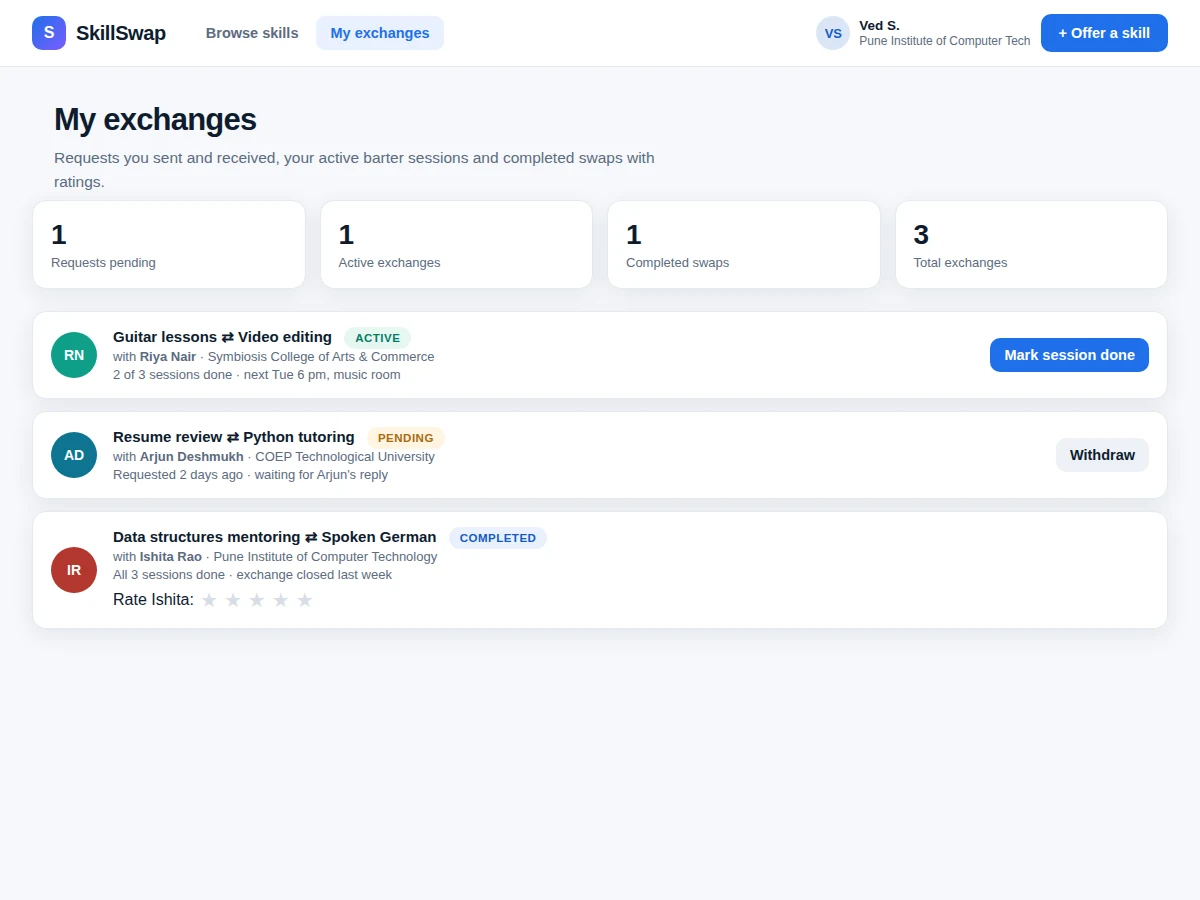
- Once accepted, the exchange becomes active; each completed session is marked done, advancing the plan until all sessions close the swap.
- On completion both partners rate each other, and the ratings update the averages shown on future listings.
Tech stack:
- React
- Node.js · Express
- MongoDB
- JWT authentication
- Socket.io chat
- Tailwind CSS
- REST API design
- Vercel · Render deployment
| Parameter | Value |
|---|---|
| Frontend | React single-page app (delivered); single-file demo prototype shown on this page |
| Backend | Node.js + Express REST API (delivered with the built-to-order source) |
| Database | MongoDB — 4 collections: users, listings, exchanges, ratings (design) |
| Authentication | JWT with bcrypt password hashing (design behavior in the delivered build) |
| Demo dataset | 9 complete listings with Indian-college data, pre-loaded |
| Search | Full-text search + category filter + rating/recency sort (implemented) |
| Messaging | Per-exchange chat thread with Socket.io (design behavior in the delivered build) |
| Deployment | Single-instance deploy on Vercel/Render-class hosting (design target); scaling is the buyer's deployment step |
Project features
- [Skill listing board] Students post what they can teach and what they want to learn, with category, session format (online / in-person), availability and a written session plan. Listings carry the poster's name, college, star rating and review count so requesters can judge before asking.
- [Search and category filters] Full-text search across skills, names, colleges and descriptions plus category chips (Programming, Music, Design & media, Language, Career prep and more) and top-rated / recently-posted sorting.
- [Skill detail pages] Every listing opens a detail view with the offer/ask pair, poster profile, a full description of what the three sessions cover, and a message box to propose the exchange with specific days and times.
- [Exchange request flow] Requesting sends the proposal to the partner and creates a pending exchange; withdrawing a request is one click from the dashboard.
- [My exchanges dashboard] Tracks every swap as pending, active or completed, with stat cards, partner and college details, session notes, and per-exchange actions (withdraw, mark session done).
- [Session tracking] Each exchange runs as a 3-session plan; marking sessions done updates the exchange's progress until it closes as completed.
- [Partner ratings] After an exchange completes, each student rates the other with a 5-star control; ratings feed the averages shown on listings.
- [Realistic demo dataset] Nine complete listings with Indian-college data — Python tutoring, guitar lessons, video editing, AutoCAD help, resume review, DSA mentoring, spoken German, baking, photography — so every screen is explorable immediately.
What is included
- Complete source code: React frontend, Node.js + Express backend, MongoDB data models, REST API
- The working single-file demo prototype shown on this page, with the full 9-listing dataset
- Project report PDF (system architecture, ER diagram, API specification, testing notes)
- PPT presentation for the final review
- Viva Q&A preparation document (React state management, REST design, JWT auth, MongoDB modeling, Socket.io)
- User manual: posting a skill, requesting an exchange, tracking sessions, rating partners
Limitations & prerequisites
- The demo prototype runs entirely in the browser with local state: there are no real accounts, persistence or backend in the demo itself; full accounts, database persistence and the chat layer ship in the built-to-order source.
- Matching is straightforward complementary-skill search, not a machine-learning recommender — a recommendation engine is documented as future scope.
- In-person sessions depend on both students being at nearby colleges; the delivered build filters by college and city.
- Chat and push-notification delivery require the deployed backend to be running; the demo shows the exchange flow locally.
- Trust and safety for stranger meetups is handled with in-app safety notices; ID verification is future scope, not included.
Frequently Asked Questions
How does a skill exchange actually work?
One student posts what they can teach and what they want to learn; another with the mirror image requests the swap with proposed days and times. Both teach one session and learn one session per round, track progress on the "My exchanges" dashboard, and rate each other when the swap closes. No money changes hands.
Is this a real website or just a demo page?
Both. The page you see is a working single-file prototype with a full dataset, so every screen is explorable. The built-to-order deliverable is the complete real application — React frontend, Node.js + Express backend, MongoDB database, JWT login and chat — plus report, PPT and viva kit.
Does the platform need the internet?
The delivered web application is an online platform: accounts, listings and chat need connectivity. The demo prototype on this page runs in your browser and works offline because its data is bundled in the page.
Can I customize this project?
Yes. Realistic customizations: college email-domain signup, admin moderation panel, a mobile app version, skill-verification badges, in-app chat notifications, or a paid premium tier alongside the free barter board.
What will I receive with the project?
The complete source (React + Express + MongoDB), the working demo prototype, project report PDF with architecture and API spec, PPT presentation, viva Q&A document and a user manual — prepared fresh for your order.
Is this project suitable for a final-year project?
Yes — for Computer Science and IT programs. It demonstrates a real client-server architecture, database modeling with relationships (users, listings, exchanges, ratings), REST API design, token-based authentication, real-time chat concepts and a polished, testable UI. Suitable for B.E./B.Tech final-year projects in Computer Science and IT.
Components & software requirements
- React
- Node.js · Express
- MongoDB
- JWT authentication
- Socket.io chat
- Tailwind CSS
- REST API design
- Vercel · Render deployment
Delivery information
Built-to-order project. Delivery timeline is shared after order confirmation based on current queue.
Support terms
Complete documentation, setup guide, and viva preparation included. Support for setup and explanation provided.
Download free synopsis (PDF)
Enter your name and email — the synopsis PDF downloads immediately. We may send occasional project updates; no spam, unsubscribe anytime.