
More project photos (3)
The problem
An online conference paper submission portal with review workflow and camera-ready upload is a web system that runs a college conference from the first paper submission to the final proceedings file. Most college conferences still collect papers by email, which creates lost attachments, unclear review status and decisions recorded in scattered spreadsheets. Authors cannot see where their paper stands, reviewers receive manuscripts with no structured scoring, and the programme chair has no single view of scores, assignments and deadlines. This portal replaces that ad-hoc process with three roles and one shared workflow: authors submit papers with metadata and an anonymised PDF, reviewers score each paper blind against five criteria, and the chair assigns reviewers, reads the averaged scores and records accept, revise or reject decisions. Accepted authors then upload a camera-ready PDF that is checked against the conference template and page limit. Every state change is logged and notified by email, so no paper is ever stuck without an owner.
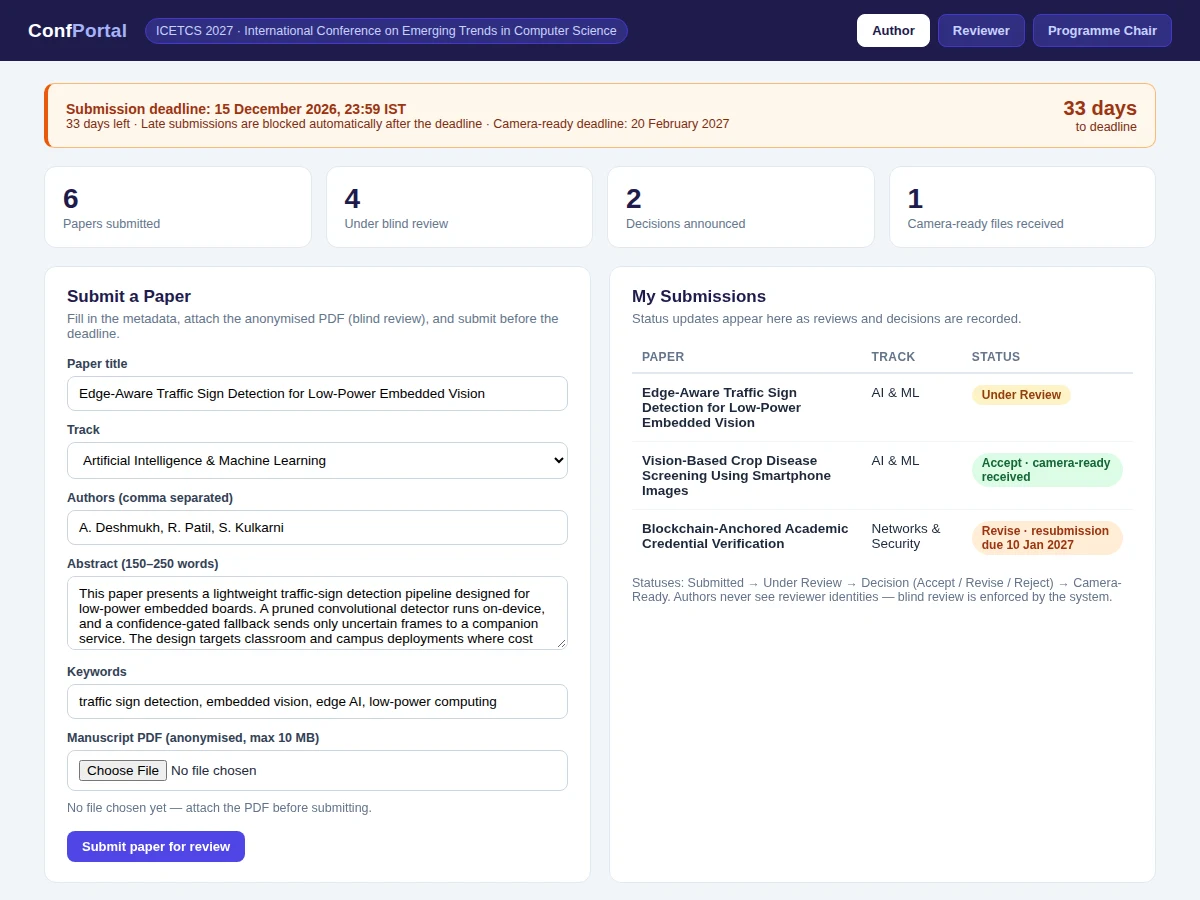
Submits a paper with metadata and an anonymised PDF.
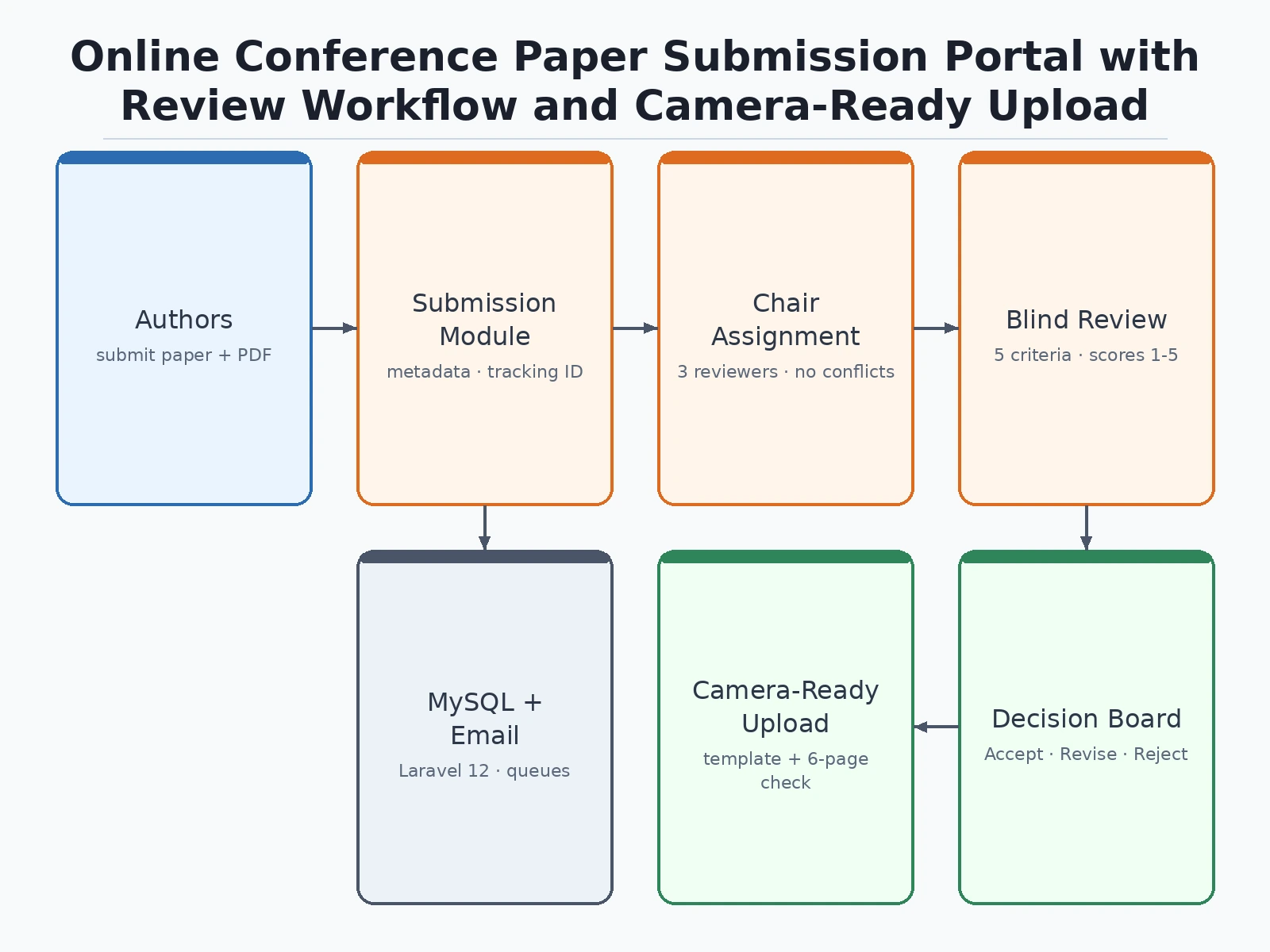
Follow the working sequence
How it works
The portal moves a paper through five stages: submit, assign, review, decide and camera-ready. An author registers, enters the paper title, track, authors, abstract and keywords, and uploads an anonymised PDF before the submission deadline; the system validates the file and issues a tracking ID. The programme chair then assigns three reviewers, with an automatic conflict check that excludes reviewers from the same institution as any author, and reviewers receive only the anonymised manuscript. Each reviewer scores originality, technical quality, clarity, relevance and experimental rigour from 1 to 5, adds anonymised comments for the authors and a confidential note for the chair, and selects an overall recommendation. The system averages the scores and, once at least two reviews are in, the chair records accept, revise or reject on the decision board; authors are notified by email. Accepted authors upload the camera-ready PDF, which is checked against the template and the six-page limit before the paper is marked proceedings-ready.
- The programme chair creates the conference, defines its tracks, sets the submission and camera-ready deadlines, and invites the reviewer pool.
- An author registers, fills in the paper metadata (title, track, authors, abstract, keywords) and uploads the anonymised PDF; the system validates the file and issues a tracking ID.
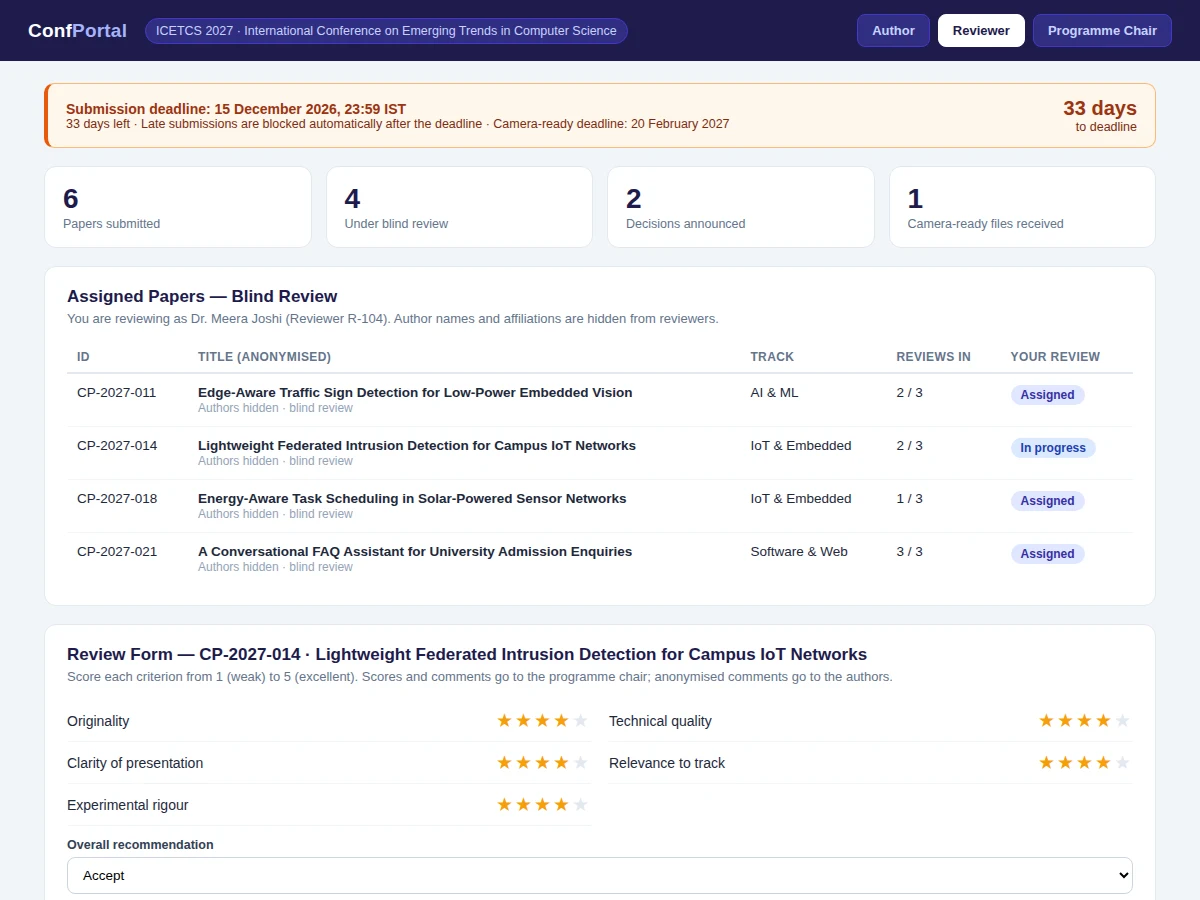
- The chair assigns three reviewers to each paper; the conflict check blocks any reviewer from the same institution as an author, and reviewers see only the anonymised manuscript.
- Each reviewer scores the five criteria from 1 to 5, writes anonymised comments for the authors and a confidential note for the chair, and picks an overall recommendation.
- The system averages the scores across submitted reviews and shows the recommendation summary on the decision board.
- The chair records Accept, Revise or Reject once at least two reviews are in; the author is notified by email with the anonymised reviewer comments.
- Accepted authors upload the camera-ready PDF; the system checks it against the conference template and the six-page limit, and the chair marks the paper proceedings-ready.
Tech stack:
- HTML5 · CSS3 · JavaScript
- PHP 8.3 · Laravel 12
- MySQL 8.4 LTS
- Blade templates
- Laravel queues · mail notifications
- PDF upload handling · MIME validation
- Composer · NPM
- Git · GitHub
| Parameter | Value |
|---|---|
| User roles | 3 roles: author, reviewer, programme chair |
| Review criteria | 5 criteria, each scored 1 to 5 |
| Reviewers per paper | 3 reviewers (design target) |
| Manuscript upload | PDF only, 10 MB maximum (design limit) |
| Camera-ready page limit | 6 pages (design target) |
| Decision-board re-render | 0.3 ms (demo-measured in this browser) |
| Seeded demo papers | 6 papers across 4 tracks |
| Framework | Laravel 12 on PHP 8.2 or newer (verified) |
| Database | MySQL 8.4 LTS (verified) |
| Deadline handling | Server-side cutoff, late submissions blocked |
| Demo | Single-file working web demo with role switcher |
Project features
The portal is built around four capabilities that together cover the whole conference workflow. First, multi-role access gives authors, reviewers and the programme chair separate dashboards, so each role sees only what it needs and blind review stays genuinely blind. Second, the submission module captures paper metadata and an anonymised PDF with format and size validation, assigning every paper a tracking ID on submission. Third, the review workflow assigns three reviewers per paper, blocks conflicts of interest, and collects five-criterion scores with anonymised comments for authors and confidential notes for the chair. Fourth, the decision board averages scores, gates decisions until at least two reviews are in, and tracks camera-ready uploads against the template and page limit. Deadline enforcement and email notifications run across all four, so the conference stays on schedule without manual chasing.
- [Multi-role dashboards] Separate author, reviewer and programme-chair dashboards with role-based access control, so reviewers never see author identities and authors never see reviewer identities.
- [Paper submission with metadata and PDF upload] Authors enter title, track, authors, abstract and keywords, then upload an anonymised PDF; the system validates the file type and size and issues a tracking ID.
- [Blind review workflow with five-criterion scoring] Reviewers score originality, technical quality, clarity, relevance and experimental rigour from 1 to 5, with anonymised comments for authors and a confidential note for the chair.
- [Reviewer assignment with conflict blocking] The chair assigns three reviewers per paper, and the system blocks reviewers from the same institution as any author of that paper.
- [Decision board] Average scores and recommendations are shown per paper, and the chair records Accept, Revise or Reject only once at least two reviews are in; authors are notified by email.
- [Camera-ready upload with template check] Accepted authors upload the camera-ready PDF, which is checked against the conference template and the six-page limit before the paper is marked proceedings-ready.
- [Deadline enforcement and status tracking] Submission and camera-ready deadlines are enforced server-side so late uploads are blocked, and every paper carries a visible status from submission to proceedings-ready.
Optional add-on (not in the base build): plagiarism-check integration for submitted manuscripts. Future scope: multi-conference support so one installation can run several conferences, and a reviewer-bidding stage where reviewers state interest before assignment.
What is included
- Complete portal source code (Laravel 12 backend, Blade frontend)
- Database schema and migrations with seeded demo data (6 papers, 4 tracks, 3 roles)
- Working single-file demo of the author, reviewer and chair views
- Setup and installation guide for local hosting
- Project report PDF (background, workflow design, database design, methodology, outcomes)
- PPT presentation for final review
- Viva Q&A preparation document (roles, blind review, state machine, deadlines)
Limitations & prerequisites
- No payment gateway is included; conference registration fees are out of scope for the base build.
- No plagiarism checker is bundled; manuscript originality checks are an optional add-on.
- Email notifications need valid SMTP credentials configured on the deployment server.
- Blind review depends on authors uploading genuinely anonymised PDFs; the system cannot detect author names hidden inside a file.
- The base build runs one conference at a time; multi-conference support is future scope.
- Seeded demo data is illustrative only and must be replaced with the real conference, tracks and reviewer list before use.
Requirements
- A computer or laptop with PHP 8.2 or newer, Composer, Node.js and MySQL 8.4 installed for local setup.
- A web server (Apache or Nginx) and a MySQL database for deployment.
- SMTP credentials for email notifications to authors and reviewers.
- A modern browser (Chrome, Edge or Firefox) to use the portal and demo.
Timeline
- Week 1–2: Requirements, database design (papers, users, reviews, decisions) and role model.
- Week 3–4: Submission module and blind review module with five-criterion scoring.
- Week 5: Decision board, camera-ready upload and deadline enforcement.
- Week 6: Testing across all three roles, including conflict blocking and late-submission cases.
- Week 7: Documentation, demo data, report and PPT preparation.
- Week 8: Review, fixes and final handover (approximate, 8 weeks total).
Support
- Installation and setup guidance for running the portal locally or on a shared host.
- A demo walkthrough of the author, reviewer and chair flows before handover.
- Doubt-clearing on the workflow, database design and code during the build period.
Frequently Asked Questions
How is this different from a simple idea-submission portal?
It is different because it models a full peer-review pipeline rather than a single approval step. Papers pass through submission, reviewer assignment, blind scoring against five criteria, a chair decision gated on at least two reviews, and a camera-ready upload with a template check, with a visible status at every stage.
How does blind review work in this portal?
Blind review works because reviewers only ever see the anonymised manuscript and a paper ID, never author names or affiliations. Authors upload the PDF themselves, the system stores it without author metadata in the review view, and the chair is the only role that can see both sides.
Can the chair change a decision after recording it?
Yes, the chair can revise a recorded decision from the decision board, and the change is logged with a timestamp and notified to the author by email. Decisions are only blocked, not locked, so a genuine correction is possible while the audit trail stays intact.
What happens if a reviewer does not submit on time?
If a reviewer misses the review deadline, the chair sees the paper flagged as short of reviews on the decision board and can reassign that slot to another reviewer. The decision stays blocked until at least two reviews are in, so no paper is decided on a single opinion.
Can it be hosted online for a real college conference?
Yes, it can be hosted on any shared host or VPS that runs PHP 8.2 or newer with MySQL 8.4, using the included setup guide. Email notifications need SMTP credentials, and the chair configures the conference tracks and deadlines from the admin panel before opening submissions.
Is this project suitable for a final-year project?
Yes, it fits Computer Science, IT and Web Development programs because it covers role-based access control, a multi-stage workflow state machine, relational database design, file handling and email notifications in one complete system. A team can demonstrate every stage live, from submission to decision to camera-ready upload, which gives reviewers plenty to examine.
Components & software requirements
- HTML5 · CSS3 · JavaScript
- PHP 8.3 · Laravel 12
- MySQL 8.4 LTS
- Blade templates
- Laravel queues · mail notifications
- PDF upload handling · MIME validation
- Composer · NPM
- Git · GitHub
Delivery information
Built-to-order project. Delivery timeline is shared after order confirmation based on current queue.
Support terms
Complete documentation, setup guide, and viva preparation included. Support for setup and explanation provided.
Download free synopsis (PDF)
Enter your name and WhatsApp number — the synopsis PDF downloads immediately. We may send occasional project updates on WhatsApp; no spam.