
More project photos (3)
The problem
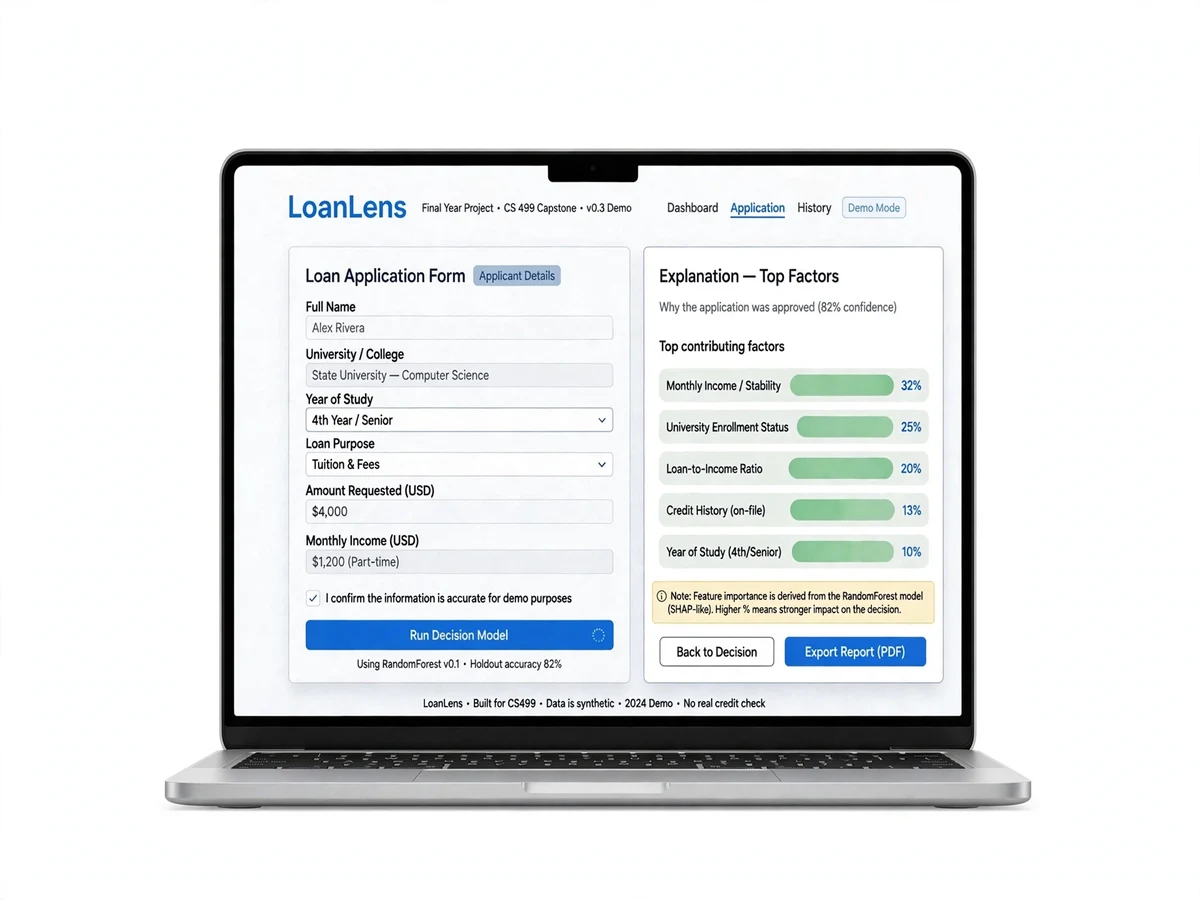
Loan Approval Prediction using Machine Learning is a fintech final year project that predicts whether a loan application would be approved, from applicant income, credit history, employment status, dependents, loan amount, loan term and property area. An XGBoost classifier learns approval patterns from historical application data, and every decision is explainable: the Flask app branded LoanLens shows approve/reject with a confidence score plus the key deciding factors (SHAP-ranked), so no prediction is a black box. Unusually for a student project, it also ships a fairness check that compares approval rates across applicant groups and flags disparities — exactly the kind of responsible-AI depth that makes viva examiners lean in. Credit risk, imbalanced outcomes, explainability and bias auditing in one pipeline: this is finance-ML with real discussion value.
This is a built-to-order project: the code, trained models, report, PPT and viva Q&A are prepared and quality-checked for your order.
Enters income, credit history, employment, and loan details.
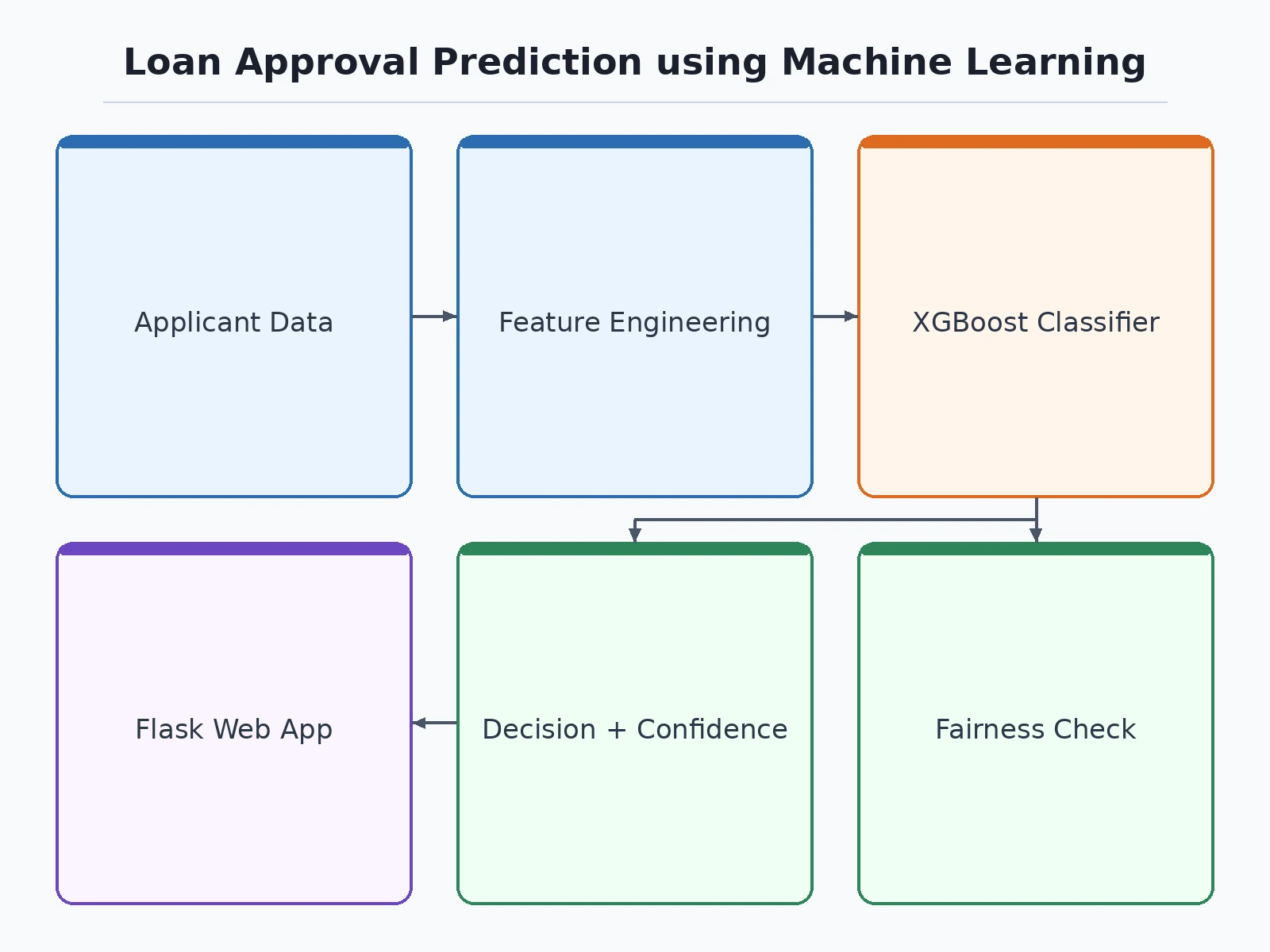
Follow the working sequence
How it works
- The applicant's details — income, credit history, employment, dependents, loan amount and term, property area — are entered in the LoanLens form.
- A preprocessing pipeline imputes missing values, encodes categoricals and builds derived features (loan-to-income ratio, total income).
- The tuned XGBoost classifier outputs an approval probability; a tuned threshold converts it to an approve/reject decision with a confidence score.
- SHAP values rank the deciding factors for that specific application, displayed as an intuitive bar chart.
- A fairness panel aggregates decisions across applicant groups, flagging any group whose approval rate diverges materially — with the caveat, documented in the report, that historical data can bake in historical bias.
Project features
- Approve/reject prediction with calibrated confidence score per application
- SHAP-ranked deciding factors for every decision — e.g. credit history, applicant income, loan-to-income ratio
- Fairness check: approval rates compared across applicant groups (gender, marital status, property area) with disparity flags
- Missing-data strategy for absent credit history — imputation vs. "unknown" category, compared explicitly
- Full classification metrics: accuracy, precision, recall, F1, ROC-AUC and confusion matrix, computed per class during your build.
- Threshold analysis: how moving the approval cutoff trades approval volume against default risk
- Feature engineering: loan-to-income ratio, total household income, term buckets, EMI-style derived features
- Clean Flask app (LoanLens): application form, decision card with confidence bar and factor chart
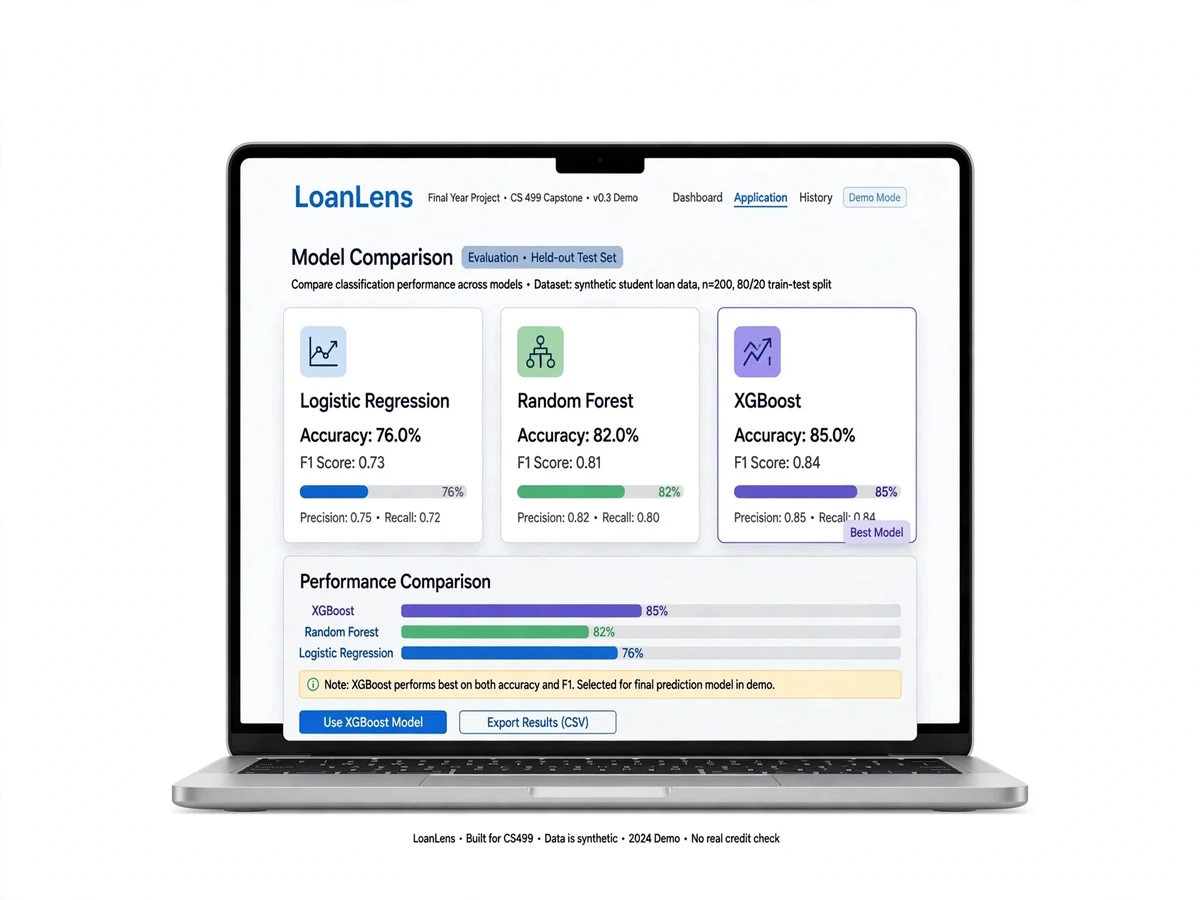
- Training notebook with EDA, correlation analysis and model comparison (Logistic Regression vs. Random Forest vs. XGBoost)
What is included
- Full source code (training notebooks + Flask app, well-commented)
- Trained model files (.pkl) — the app runs without retraining
- Project report PDF (synopsis, literature survey, methodology, results, fairness discussion, conclusion)
- PPT presentation for the final review
- Viva Q&A preparation document (credit-risk framing, XGBoost internals, SHAP, fairness/bias questions)
- Setup guide (environment, dependencies, running the app locally)
FAQs
- What makes this loan approval project more than a basic classifier? Three things examiners probe: per-decision SHAP explanations (no black box), an explicit fairness audit across applicant groups, and threshold analysis linking the cutoff to business risk. The viva Q&A prepares you on all three.
- How does the fairness check work? The app aggregates predicted approval rates by group (e.g. gender, property area) and flags material gaps. The report discusses why this is detection, not correction — fixing bias needs re-weighting or constrained optimization, which is scoped as an extension.
- Why isn't accuracy enough here? Approval datasets are imbalanced, and in lending the two error types have asymmetric costs: approving a defaulter versus rejecting a good customer. The project reports precision, recall, F1 and ROC-AUC per class and tunes the threshold on business trade-offs.
- How is missing credit history handled? Two strategies are implemented and compared — median/mode imputation versus keeping "unknown" as its own category — so you can defend the choice with results in the viva.
- Can I demo it offline? Yes — trained .pkl models ship with the project and the Flask app runs locally, so the full demo works without internet on review day.
- What are strong extensions? Probability calibration (reliability curves), a profit-curve threshold optimizer, or a bias-mitigation experiment with re-weighting. Ask us and we will scope it for your review.
Advantages
- Approve/reject prediction with a calibrated confidence score per application, plus SHAP-ranked deciding factors for every decision — e.g. credit history, applicant income, loan-to-income ratio.
- Built-in fairness check: approval rates compared across applicant groups (gender, marital status, property area) with disparity flags — rare in student builds.
- Honest missing-data strategy: imputation versus an 'unknown' category for absent credit history, compared explicitly in the notebook.
- Threshold analysis shows how moving the approval cutoff trades approval volume against default risk — real lending intuition.
- Full model comparison (Logistic Regression vs Random Forest vs XGBoost) with EDA and correlation analysis; clean Flask app (LoanLens) with a decision card, confidence bar and factor chart.
Disadvantages
- This is an educational model trained on historical application data — not a licensed credit-scoring system, and its decisions must not be used for real lending.
- Historical approvals can embed historical bias; the fairness check surfaces disparities but does not fix the underlying data.
- Missing credit history is common in the data; the chosen imputation strategy is documented but remains an approximation.
- The model does not see documents, collateral quality or fraud signals that real underwriters use.
Limitations & prerequisites
- This is an educational model trained on historical application data — not a licensed credit-scoring system, and its decisions must not be used for real lending.
- Historical approvals can embed historical bias; the fairness check surfaces disparities but does not fix the underlying data.
- Missing credit history is common in the data; the chosen imputation strategy is documented but remains an approximation.
- The model does not see documents, collateral quality or fraud signals that real underwriters use.
Components & software requirements
- Python 3, pandas, NumPy for data wrangling and EDA
- scikit-learn: pipelines, stratified splits, LogisticRegression / RandomForest baselines, classification metrics
- XGBoost (XGBClassifier) as the primary tuned model
- SHAP for per-decision explanations
- Flask + HTML/CSS for the LoanLens web app
- Matplotlib / Seaborn for EDA, confusion matrices and fairness charts
- Jupyter notebooks for the full training workflow
| Parameter | Value |
|---|---|
| Problem type | Binary classification (approve / reject) |
| Dataset | Historical loan-application records: income, credit history, employment, dependents, loan amount/term, property area |
| Models compared | Logistic Regression, Random Forest, XGBoost |
| Primary model | XGBoost classifier, tuned via cross-validation (max_depth, learning_rate, min_child_weight, scale_pos_weight) |
| Key predictors | Credit history, applicant income, loan-to-income ratio (per SHAP analysis) |
| Metrics | Accuracy, Precision, Recall, F1, ROC-AUC, confusion matrix — reported from the actual run |
| Explainability | SHAP per-decision factor ranking |
| Fairness audit | Group approval-rate comparison with disparity flags (illustrative, documented limits) |
| Web app | Flask (LoanLens): application form + decision card with confidence and factors |
Download free synopsis (PDF)
Enter your name and WhatsApp number — the synopsis PDF downloads immediately. We may send occasional project updates on WhatsApp; no spam.
Lessmann, Baesens, Seow & Thomas (2015), European Journal of Operational Research, vol. 247, no. 1