
More project photos (3)
The problem
Cold storage rooms protect dairy, pharma and food inventories, but most are watched manually — a thermometer is glanced at a few times daily. A compressor that dies quietly overnight, a door left ajar during loading, or an unreported power cut can warm a whole chamber for hours, and spoiled stock is found only at the next check. Commercial cold-chain loggers exist, but they are expensive closed boxes that teach nothing. Student builds usually stop at one breadboard temperature sensor and never complete the real loop: multi-zone sensing, per-zone thresholds, door and power awareness, cloud logging, alerts that reach someone, and a summary of the day's exposure. This project completes that loop. An ESP32 node watches two zones with waterproof DS18B20 probes, reads humidity from a DHT22, tracks the door with a reed switch and senses mains power — evaluating every reading on-device, buzzing locally, logging to the cloud, and pushing alerts when anything crosses your thresholds. The dashboard shows live gauges, 24-hour temperature curves with threshold bands, and a daily cold-chain risk score from time spent out of range.
How it works
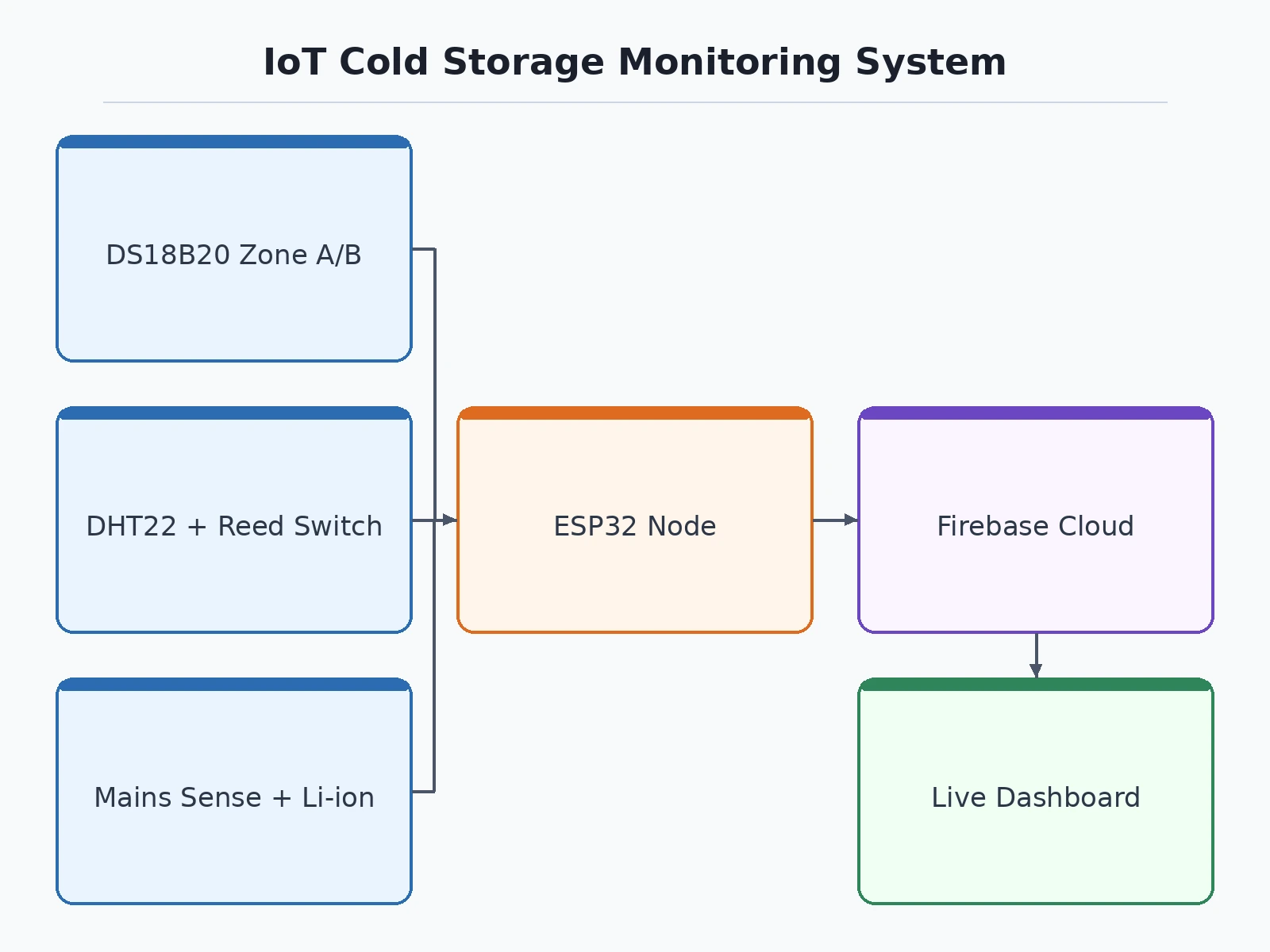
- A waterproof DS18B20 probe is placed in each of the two storage zones; the DHT22 sits in the main chamber; a reed switch mounts on the door and a sense tap watches mains power.
- The ESP32 samples all sensors every 10 seconds (design target) and compares each reading against the configured per-zone thresholds.
- Any breach — temperature, humidity, door open beyond the grace period, or power loss — immediately sounds the buzzer, updates the OLED, and fires a push notification.
- Every 60 seconds the node POSTs a JSON sample over Wi-Fi to the cloud backend; samples buffer in RAM during Wi-Fi outages and backfill on reconnection.
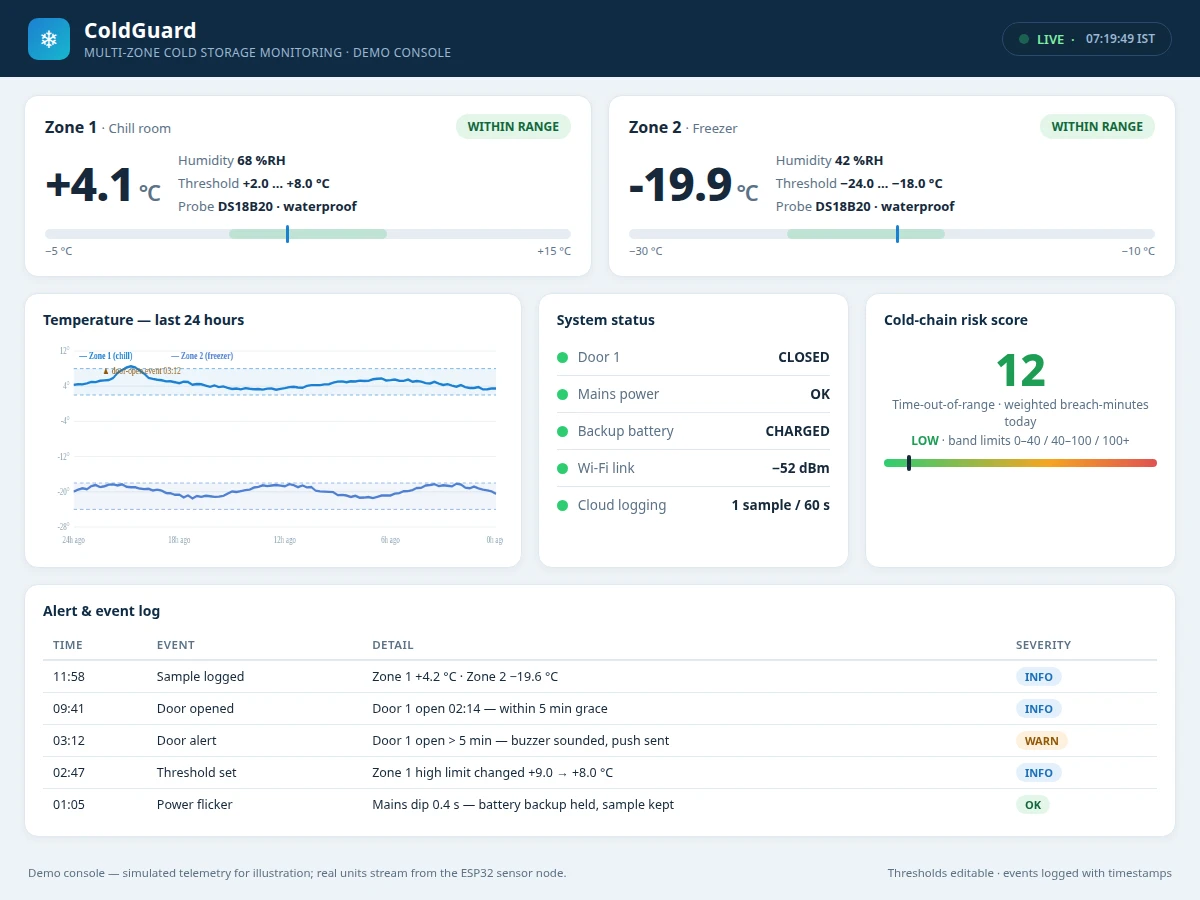
- The dashboard renders live gauges, the 24-hour temperature curves with threshold bands, system status and the alert event log.
- Firmware accumulates weighted breach-minutes per zone into the daily cold-chain risk score shown on the dashboard.
- Once, at installation, the owner runs the documented calibration procedure against an ice-point reference and records the correction offsets used in displayed readings.
Tech stack:
- ESP32 (Wi-Fi sensor node)
- DS18B20 waterproof probes · 1-Wire bus
- DHT22 temperature-humidity module
- Reed switch door sensor
- Arduino firmware (C++)
- Wi-Fi telemetry · JSON over HTTP
- Firebase-class cloud logging
- HTML/CSS/JS dashboard demo
| Parameter | Value |
|---|---|
| Controller | ESP32-WROOM-32 module (Datasheet value) |
| Temperature probes | 2 × DS18B20 waterproof, −55 to +125 °C, ±0.5 °C in −10 to +85 °C (Datasheet value) |
| Probe resolution | 12-bit, approximately 0.0625 °C steps (Datasheet value) |
| Humidity | DHT22, 0–100 %RH at ±2–5 %RH, −40 to +80 °C at ±0.5 °C (Datasheet value) |
| Door sensor | Magnetic reed switch, open/closed state (Datasheet value) |
| Display + alert | 0.96-inch OLED + 5 V buzzer (Datasheet value) |
| Default zone thresholds | Chill +2 to +8 °C; freezer −24 to −18 °C (Configurable design target) |
| Door-open grace period | 5 min before alert (Configurable, design target) |
| Sample interval | 10 s local; cloud push every 60 s (Design target) |
| Power backup | 3.7 V Li-ion module, approximately 4–6 h node runtime (Design target) |
| Alert channels | Buzzer + OLED + Wi-Fi push webhook (Implemented) |
Project features
- [Dual-zone temperature sensing] Two waterproof DS18B20 probes on one 1-Wire bus — one per storage zone — with per-zone high/low thresholds you configure; datasheet ±0.5 °C accuracy in −10 to +85 °C.
- [Humidity, door and power sensing] A DHT22 watches chamber humidity, a magnetic reed switch reports door open/closed with a configurable grace period, and a mains-sense line with a Li-ion backup keeps the node logging and alerting through power cuts.
- [Live cloud dashboard] The working single-file dashboard demo: per-zone live gauges, 24-hour temperature curves with threshold bands, door/power/Wi-Fi status cards, a cold-chain risk score, and a timestamped alert log.
- [Three alert channels] Threshold breaches, door-left-open and power events fire a local buzzer, an on-device OLED message, and a Wi-Fi push notification via an HTTP webhook (e.g. Telegram or Blynk) — SMS through a SIM800L module is an optional customization, not in the base build.
- [Cold-chain risk scoring] Firmware accumulates weighted breach-minutes per zone — time outside thresholds multiplied by a severity weight — into a daily Low/Moderate/High risk score, presented honestly as a simplified exposure proxy, not a certified food-safety metric.
- [Cloud data logging with buffering] One sample per 60 seconds posted as JSON over Wi-Fi to a Firebase-class backend; when Wi-Fi drops, the ESP32 buffers readings in RAM and backfills them on reconnection.
- [Buyer-run calibration procedure] An ice-point and reference comparison procedure for the probes is documented step by step, so the viva discussion on accuracy is concrete instead of quoted from a datasheet.
What is included
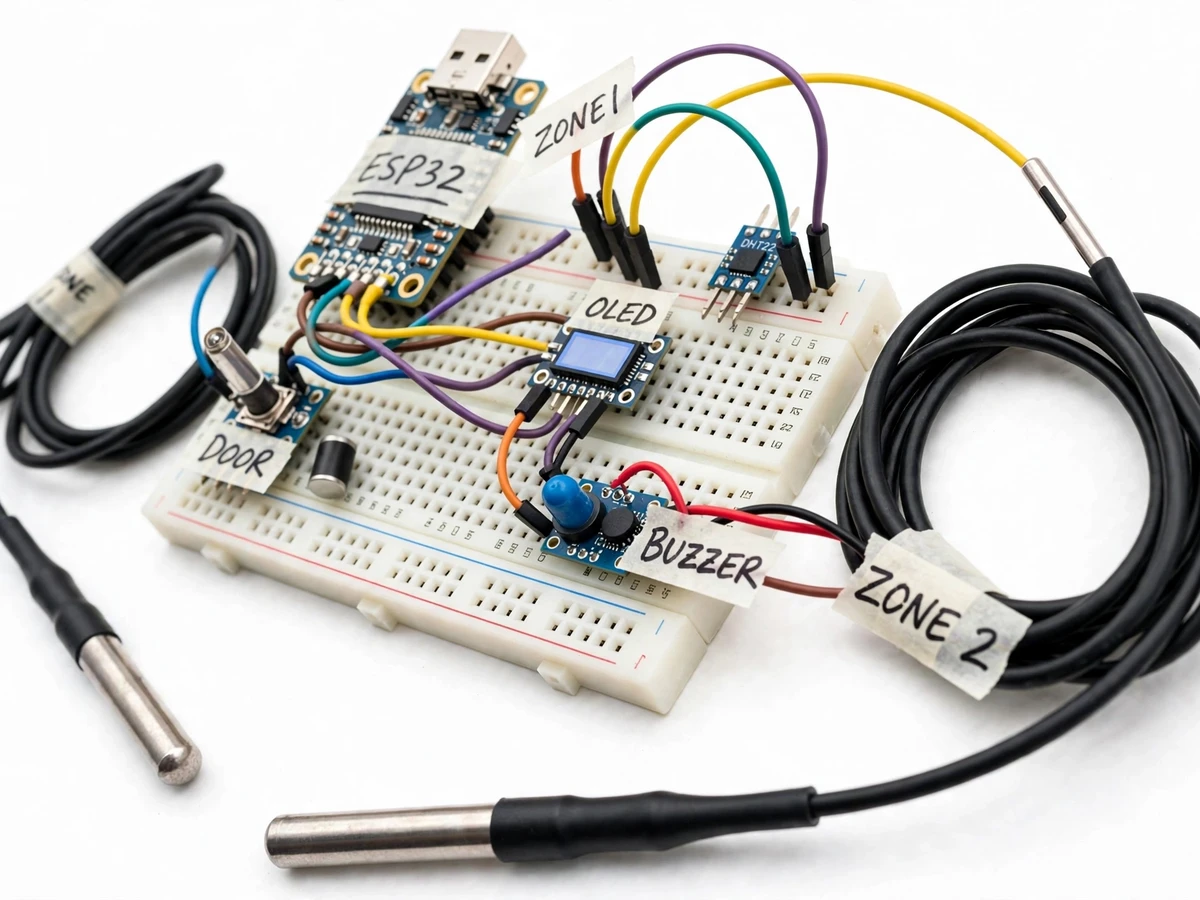
- Assembled prototype: ESP32 board, 2 × waterproof DS18B20 probes, DHT22 module, reed-switch door sensor, buzzer, OLED, Li-ion backup module, wiring
- Firmware source code with threshold logic, risk scoring, buffering and Wi-Fi telemetry
- Working single-file dashboard demo (the exact app shown in the gallery screenshot)
- Wiring diagram and sensor placement guide
- Buyer-run calibration procedure document
- Project report PDF (background, DS18B20/DHT22 datasheet analysis, methodology, results)
- PPT presentation for final review
- Viva Q&A preparation document (1-Wire, thresholds, risk scoring, accuracy limits)
Limitations & prerequisites
- Academic prototype, not a food-safety certified cold-chain system — the risk score is a simplified exposure proxy, never a certified spoilage metric.
- DS18B20 ±0.5 °C applies only from −10 to +85 °C; at freezer temperatures near −20 °C the datasheet allows ±2 °C — the report states the achieved error honestly after calibration instead of quoting the best figure.
- The datasheet accuracies are component values, not measured results; the report documents the calibration offsets found during the buyer-run procedure.
- Cloud logging and push alerts need Wi-Fi; without it the node keeps sensing and buzzing locally but no remote alert is delivered.
- The DHT22 samples every 2 seconds and drifts with condensation — humidity is indicative, not lab-grade.
- SMS alerts are NOT in the base build; they need the optional SIM800L customization.
- Probes read the air where they sit — placement away from door draughts and evaporator blast is part of the installation procedure.
Frequently Asked Questions
Which controller is used and why?
The ESP32. It has built-in Wi-Fi for cloud logging and push alerts, 1-Wire support for the DS18B20 bus, and enough GPIO for the reed switch, buzzer and OLED — one board does sensing, evaluation and telemetry where an Arduino would need an add-on Wi-Fi module.
How does the cold-chain risk score work?
Firmware tracks minutes each zone spends outside its thresholds and multiplies them by a severity weight (freezer breaches weight more), summing a daily score in Low/Moderate/High bands. It is a simplified exposure proxy designed to make neglect visible — not a certified food-safety spoilage metric, and the page says so.
What happens during a power cut?
The mains-sense line detects the loss instantly, the node sends a "power outage" push alert while Wi-Fi is still up, and the Li-ion backup keeps sensing and logging for approximately 4–6 hours — a design target, tested by the buyer during calibration.
Does it work without Wi-Fi?
The sensing, thresholds, buzzer and OLED keep working fully offline — only cloud logging and push notifications need Wi-Fi. Samples buffer in RAM and backfill to the cloud automatically when the link returns.
Is the freezer probe really accurate enough?
The DS18B20's ±0.5 °C figure holds only from −10 to +85 °C; at −20 °C the datasheet permits ±2 °C. The documented ice-point calibration procedure tightens the actual offset, and the report states the calibrated error honestly rather than quoting the datasheet as a result.
Is this project suitable for a final-year project?
Yes — for Electronics, Electrical and IoT programs. It combines real multi-sensor embedded design (1-Wire, humidity, door and power sensing), threshold and scoring logic, cloud telemetry with offline buffering, and a working dashboard, with honest calibration and accuracy limits that make strong viva material.
Components & software requirements
- ESP32 (Wi-Fi sensor node)
- DS18B20 waterproof probes · 1-Wire bus
- DHT22 temperature-humidity module
- Reed switch door sensor
- Arduino firmware (C++)
- Wi-Fi telemetry · JSON over HTTP
- Firebase-class cloud logging
- HTML/CSS/JS dashboard demo
Delivery information
Built-to-order project. Delivery timeline is shared after order confirmation based on current queue.
Support terms
Complete documentation, setup guide, and viva preparation included. Support for setup and explanation provided.
Download free synopsis (PDF)
Enter your name and WhatsApp number — the synopsis PDF downloads immediately. We may send occasional project updates on WhatsApp; no spam.