
More project photos (2)
The problem
A slow water leak under a sink, behind a washing machine or at a pipe joint can run for hours before anyone notices it, because the leak is hidden and the water spreads across the floor rather than pooling in one visible place. By the time it is found, flooring, furniture and stored belongings are soaked, and in flats the water can drip into the home below. Manual checks do not help: nobody inspects pipe joints every day, and a leak that starts while the house is empty keeps flowing until someone returns. This project addresses that gap with an ESP32-based water leak detector that watches three separate zones with conductivity probes, confirms a real leak before acting, closes a motorised ball valve on the water inlet to stop the flow at its source, and sends a Telegram alert that names the exact zone so the owner knows where to look first.
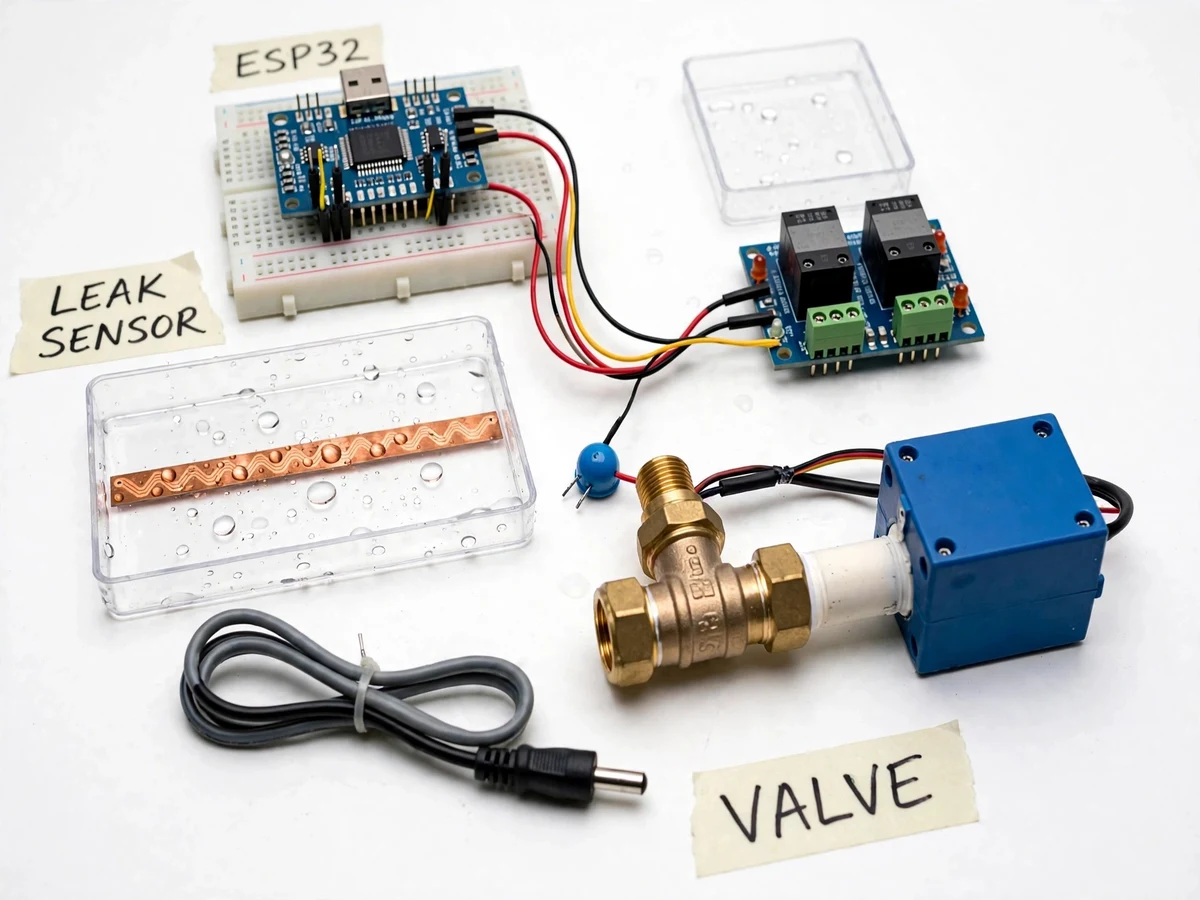
Conductivity probe strip on the floor at a pipe joint or under an appliance.
Follow the working sequence
How it works
Water conducts electricity because dissolved salts in tap water carry charge, so when water touches the interdigitated copper traces of a probe strip it bridges the traces and the resistance between them falls sharply — that resistance drop is the physical signal this project measures, not a guess from humidity or temperature. The ESP32 reads each of the three probe strips in turn, compares the reading with a threshold set during calibration, and requires 3 consecutive wet readings before declaring a leak, which rejects brief condensation and splashes. On a confirmed leak the ESP32 energises the relay module, the 12 V motorised ball valve rotates closed to cut the inlet supply, the buzzer sounds, and the ESP32 sends a Telegram alert naming the wet zone. The valve stays closed and the alert stays latched until the owner dries the probe and presses reset.
- Three conductivity probe strips sit on the floor at leak-prone points: under the kitchen sink, near the bathroom WC and at the utility inlet joint.
- The ESP32 samples each probe in turn and compares the reading with the calibrated wet threshold.
- A wet reading must repeat for 3 consecutive samples before it counts as a leak, rejecting condensation and splashes.
- On a confirmed leak, the ESP32 energises the 2-channel relay module, which powers the 12 V motorised ball valve.
- The brass ball valve rotates closed and cuts the water supply at the inlet, while the buzzer and zone LED warn anyone on site.
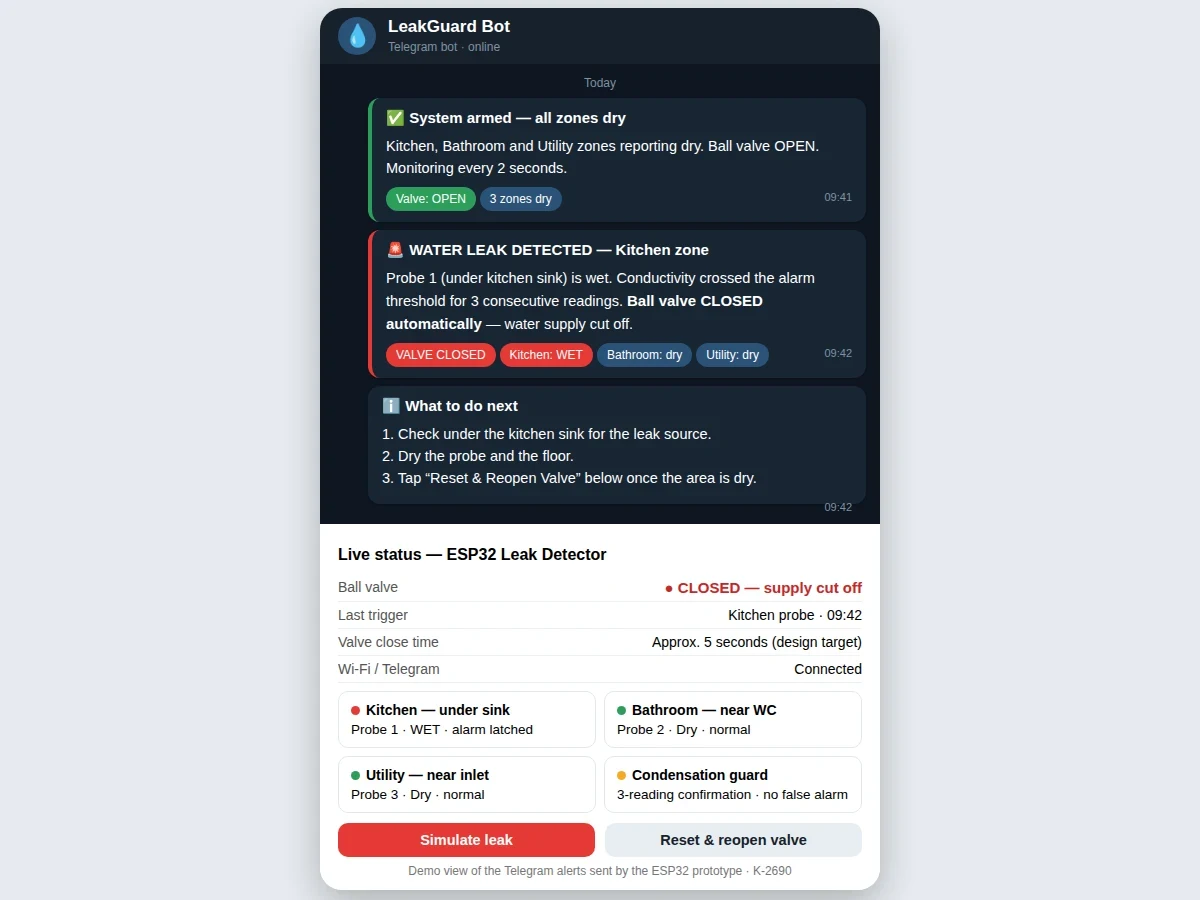
- The ESP32 sends a Telegram alert through the Bot API naming the wet zone, the time and the valve state.
- The valve stays closed until the owner dries the probe and presses the reset button, which reopens the valve and re-arms monitoring.
Tech stack:
- ESP32-WROOM-32 development board
- Arduino IDE
- Water-leak sensor probe strips
- 12 V motorised brass ball valve
- 2-channel relay module
- Telegram Bot API
- Wi-Fi
- 12 V DC power supply
| Parameter | Value |
|---|---|
| Controller | ESP32-WROOM-32, dual-core, up to 240 MHz (datasheet value) |
| ADC resolution | 12-bit (datasheet value) |
| Leak zones | 3 zones (design target) |
| Probe type | Conductivity probe strip with interdigitated copper traces |
| Valve | 1/2-inch brass motorised ball valve, 12 V DC (datasheet value) |
| Valve close time | Approximately 5 seconds (design target) |
| Relay module | 2-channel, 5 V, 10 A contacts (datasheet value) |
| Confirmation | 3 consecutive wet readings required (design target) |
| Sampling interval | Approximately 2 seconds per zone cycle (design target) |
| Alerts | Telegram Bot API over Wi-Fi (HTTPS) |
| Local alarm | Buzzer + zone LEDs |
| Power | 12 V DC adapter for valve, 5 V for ESP32 via regulator |
Project features
The ESP32-based water leak detector is built around three capabilities that work as one loop: water-specific sensing that tells a real leak apart from condensation, a motorised ball valve that physically cuts the water supply instead of only sounding an alarm, and Telegram alerts that name the leak zone and report the valve position. The sensing uses conductivity probes placed on the floor at pipe joints and under appliances, so each zone is monitored where water first collects. The shutoff uses a 12 V motorised ball valve on the inlet pipe, driven through a relay module, so the water stops even when nobody is at home. The alerts use the Telegram Bot API, so the owner receives the leak message on a phone they already carry, with the zone name, the time and the valve state in the same message.
- [Water-leak sensing across 3 zones] Three conductivity probe strips monitor the kitchen, bathroom and utility zones, so a leak is located by zone instead of only being reported as a general alarm.
- [Motorised ball-valve shutoff] A 12 V motorised brass ball valve on the water inlet closes automatically on a confirmed leak, physically stopping the flow at its source rather than only sounding a buzzer.
- [Telegram alerts with leak-location tagging] The ESP32 sends a Telegram message through the Bot API naming the wet zone, the time and the valve state, so the owner knows exactly where to look.
- [False-alarm rejection from condensation] A leak is confirmed only after 3 consecutive wet readings, so a single damp reading from condensation or a splash does not close the valve.
- [Local buzzer and status LEDs] A buzzer and zone LEDs give an immediate on-site warning for anyone in the house, even if the phone is not checked.
- [Manual reset and reopen] After the leak is fixed and the probe is dry, a reset button reopens the valve and re-arms the system; the valve stays closed until the owner deliberately resets it.
- [Live zone status view] A companion status view shows each zone as dry or wet, the valve position and the last trigger time, for demonstration and viva walkthroughs.
What is included
- Working hardware prototype: ESP32 board, 3 probe strips, motorised ball valve, relay module, buzzer and wiring
- ESP32 firmware with zone sampling, 3-reading confirmation, valve control and Telegram alerts
- Telegram bot setup guide with step-by-step bot creation and chat ID configuration
- Circuit and wiring documentation with a zone placement diagram
- Project report PDF (background, sensing principle, methodology, results)
- PPT presentation for final review
- Viva Q&A preparation document (conductivity sensing, valve actuation, false-alarm rejection, Telegram API)
Limitations & prerequisites
- The prototype monitors 3 zones; covering a whole house needs additional probes and a longer sensor bus.
- The valve closes only the inlet it is fitted on; leaks downstream of a second branch or from a neighbour's pipe are out of scope.
- Telegram alerts need Wi-Fi and internet; the valve still closes on a leak without internet, but no remote message is sent.
- Probe calibration depends on local tap-water conductivity, so the wet threshold must be set on the student's own water supply.
- The ball valve is rated for clean cold water; it is not suitable for hot water lines or dirty water with grit.
- The prototype is an academic build, not a certified plumbing safety device, and must not replace a plumber's inspection of a damaged pipe.
Frequently Asked Questions
How does the water-leak sensor actually detect water?
It measures conductivity, not humidity. Each probe strip has interdigitated copper traces; dry air between the traces has very high resistance, but water bridges the traces because dissolved salts in tap water carry charge, so the resistance falls sharply and the ESP32 reads the change. That is why the sensor reacts to real water on the floor and not to a humid day.
How is this different from a gas-leak detector with a shutoff valve?
The sensing and the shutoff are both different. A gas detector senses gas concentration in air and closes a gas solenoid; this project senses liquid water on floors and pipe joints with conductivity probes and closes a motorised ball valve on the water inlet. The valve, the probe placement and the false-alarm logic are all designed for water, not gas.
Why does the valve close instead of only sounding an alarm?
An alarm only helps if someone is at home to hear it and act on it. A leak that starts while the house is empty keeps flowing until someone returns, so this project closes the motorised ball valve at the inlet as soon as a leak is confirmed, stopping the flow at its source. The Telegram alert then tells the owner which zone leaked and that the supply is cut off.
Will condensation or a splash trigger a false alarm?
No, not on a single damp reading. The firmware requires 3 consecutive wet readings before declaring a leak, so a brief splash or a damp patch from condensation is rejected. A real leak keeps the probe wet across all 3 samples, so it is confirmed and the valve closes.
Does it work without Wi-Fi or internet?
Yes, for the safety action. Leak sensing, confirmation and valve shutoff all run locally on the ESP32, so the water supply is cut even with no internet. Only the Telegram alert needs Wi-Fi and internet; without it, the local buzzer and zone LEDs are the warning.
Is this project suitable for a final-year project?
Yes — for Electronics, Electrical and IoT & Embedded programs. It demonstrates sensor interfacing, ADC thresholding, relay-driven actuation, false-alarm rejection logic and a real Telegram IoT alert pipeline in one working prototype, and each of those blocks gives the student something concrete to explain and demonstrate in the viva.
Components & software requirements
- ESP32-WROOM-32 development board
- Arduino IDE
- Water-leak sensor probe strips
- 12 V motorised brass ball valve
- 2-channel relay module
- Telegram Bot API
- Wi-Fi
- 12 V DC power supply
Delivery information
Built-to-order project. Delivery timeline is shared after order confirmation based on current queue.
Support terms
Complete documentation, setup guide, and viva preparation included. Support for setup and explanation provided.
Download free synopsis (PDF)
Enter your name and WhatsApp number — the synopsis PDF downloads immediately. We may send occasional project updates on WhatsApp; no spam.