
More project photos (2)
The problem
An ESP32-C5 LoRa gateway with Wi-Fi 6 backhaul is a small base station that collects short radio packets from battery-powered sensor nodes spread across a campus or farm and forwards them to the internet over Wi-Fi 6. The ESP32-C5 is Espressif's first dual-band Wi-Fi 6 chip, in mass production since May 2025, and it pairs with Semtech's SX1262 LoRa radio, which hears signals as weak as −148 dBm (Datasheet value). Nodes send temperature, soil-moisture, tank-level or motion readings on the 865–867 MHz band, the gateway checks each packet and publishes it to an MQTT broker, and a dashboard shows every node with its signal strength and packet count. Because LoRa reaches far on very little power while Wi-Fi 6 carries the traffic to the cloud, the gateway suits places where sensors are scattered but Wi-Fi is nearby. The student build proves the idea with 6 sensor nodes, a live dashboard and a store-and-forward buffer that holds packets when Wi-Fi drops.
Most LoRa gateways students build still use the older ESP32 with 2.4 GHz Wi-Fi only, a single-band radio link that congests quickly in a hostel or college building full of access points. The ESP32-C5 changes that trade-off: its 5 GHz Wi-Fi 6 radio moves the backhaul onto the emptier band with OFDMA and target wake time, while the SX1262 replaces the older SX1276 with about 11 dB better sensitivity and a +22 dBm transmit ceiling. The result is a gateway that is genuinely current hardware rather than a re-run of a five-year-old design, and the report can show the comparison with datasheet numbers instead of marketing claims. The build also teaches the two skills a gateway project is really about: radio link budgeting on the LoRa side and reliable store-and-forward software on the Wi-Fi side.
| This student build | Classic ESP32 LoRa gateway | Raspberry Pi LoRa gateway | |
|---|---|---|---|
| Controller | ESP32-C5 · 240 MHz RISC-V · 384 KB SRAM | ESP32 · 240 MHz dual-core Xtensa · 520 KB SRAM | Raspberry Pi 4/5 · quad-core ARM · 2–8 GB RAM |
| Backhaul | Dual-band Wi-Fi 6 (2.4 + 5 GHz, 802.11ax) | 2.4 GHz Wi-Fi 4 only | Wi-Fi 5/6 or Ethernet, needs an OS |
| LoRa radio | SX1262 · −148 dBm sensitivity · +22 dBm TX | Usually SX1276 · −137 dBm sensitivity · +20 dBm TX | SX1262 or SX1302 concentrator via SPI/USB |
| Power | Approximately 420 mA at 5 V (expected) | Approximately 300–400 mA at 5 V (expected) | Approximately 600–900 mA at 5 V (expected) |
| Nodes in the build | 6 sensor nodes with a live dashboard | Usually 2–4 nodes, often no dashboard | 8 or more nodes, heavier software stack |
| Store-and-forward | Packets buffered in SRAM when Wi-Fi drops | Rarely implemented in student builds | Buffering via SD card and database |
| Good fit | A current-hardware gateway a student can build and explain | The cheapest first LoRa experiment | A multi-channel concentrator or LoRaWAN server |
| Honesty line | Single-channel gateway — not a LoRaWAN concentrator | Single-channel too, on older silicon | Overkill for 6 nodes; needs Linux care |
Six battery nodes send short LoRa packets
Follow the working sequence
How it works
A sensor node wakes up, reads its sensor, packs the reading into a short LoRa packet and transmits it on the 865 MHz band, then goes back to sleep. The SX1262 on the gateway hears the packet, the ESP32-C5 checks its CRC and device address, and a valid packet is published to an MQTT broker over the Wi-Fi 6 link within about a second. The dashboard subscribes to the same broker, so the node table, the hourly chart and the packet log all update live. If Wi-Fi is down when a packet arrives, the packet is held in SRAM and forwarded when the link returns, and the dashboard shows the buffered count. LoRa trades data rate for range by design: each step up in spreading factor roughly doubles the airtime of a packet and buys about 2.5 dB of extra link budget, which is why the farthest node runs SF12 while the nearest runs SF7.
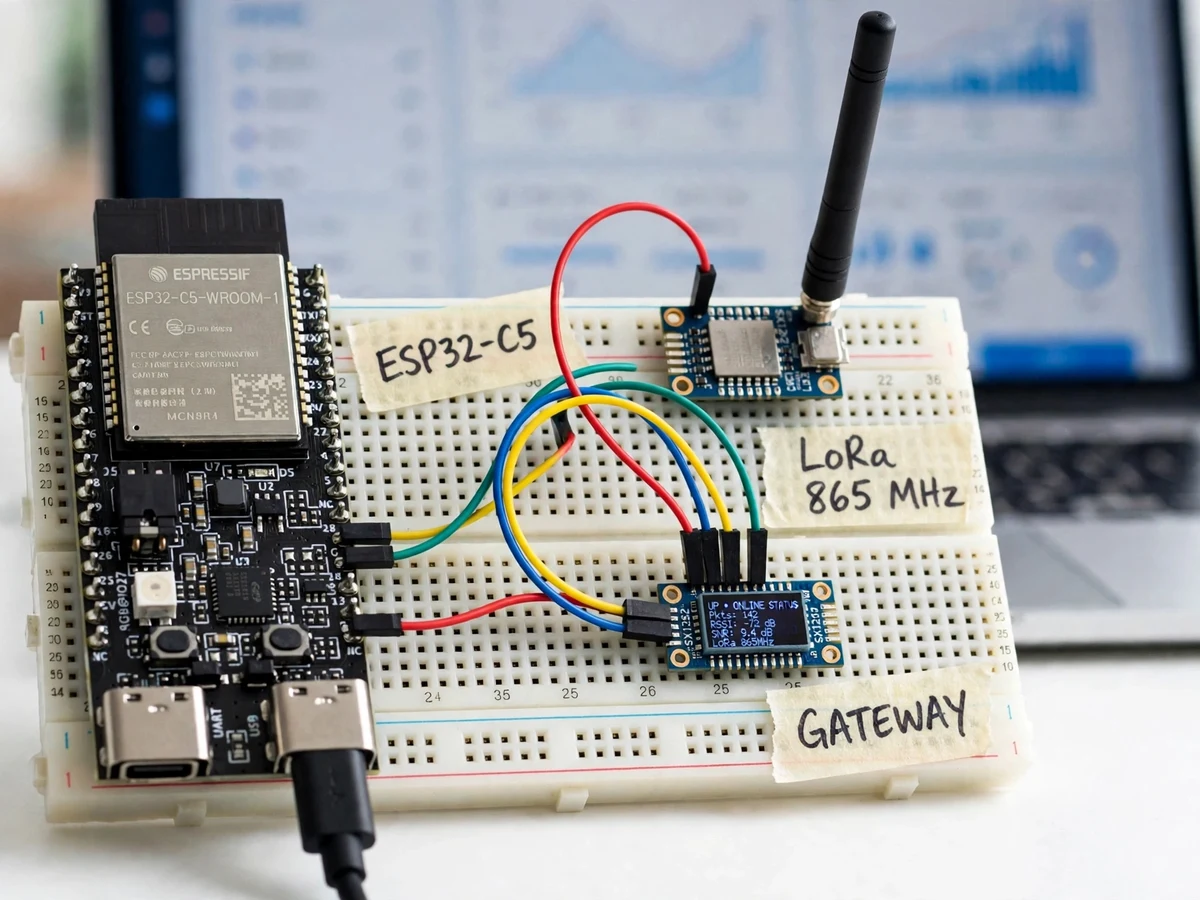
- The builder wires the gateway: an ESP32-C5-DevKitC-1 board, an SX1262 LoRa module on SPI with its DIO1 interrupt line to a GPIO, a 0.96 inch OLED display and an 865 MHz antenna, all on one breadboard with a 5 V USB-C supply.
- The builder configures the radio: the SX1262 is set to the 865–867 MHz India ISM band, 125 kHz bandwidth, +14 dBm transmit power (design target) and a coding rate of 4/5, with one channel plan shared by all 6 nodes.
- The builder writes the gateway firmware in ESP-IDF: it receives LoRa packets by interrupt, checks CRC and device address, and publishes valid packets to the MQTT broker over Wi-Fi 6 with QoS 1.
- The builder adds store-and-forward: packets arriving while Wi-Fi is down are queued in the 384 KB SRAM, the buffered count is shown on the OLED, and the queue drains automatically when the link returns.
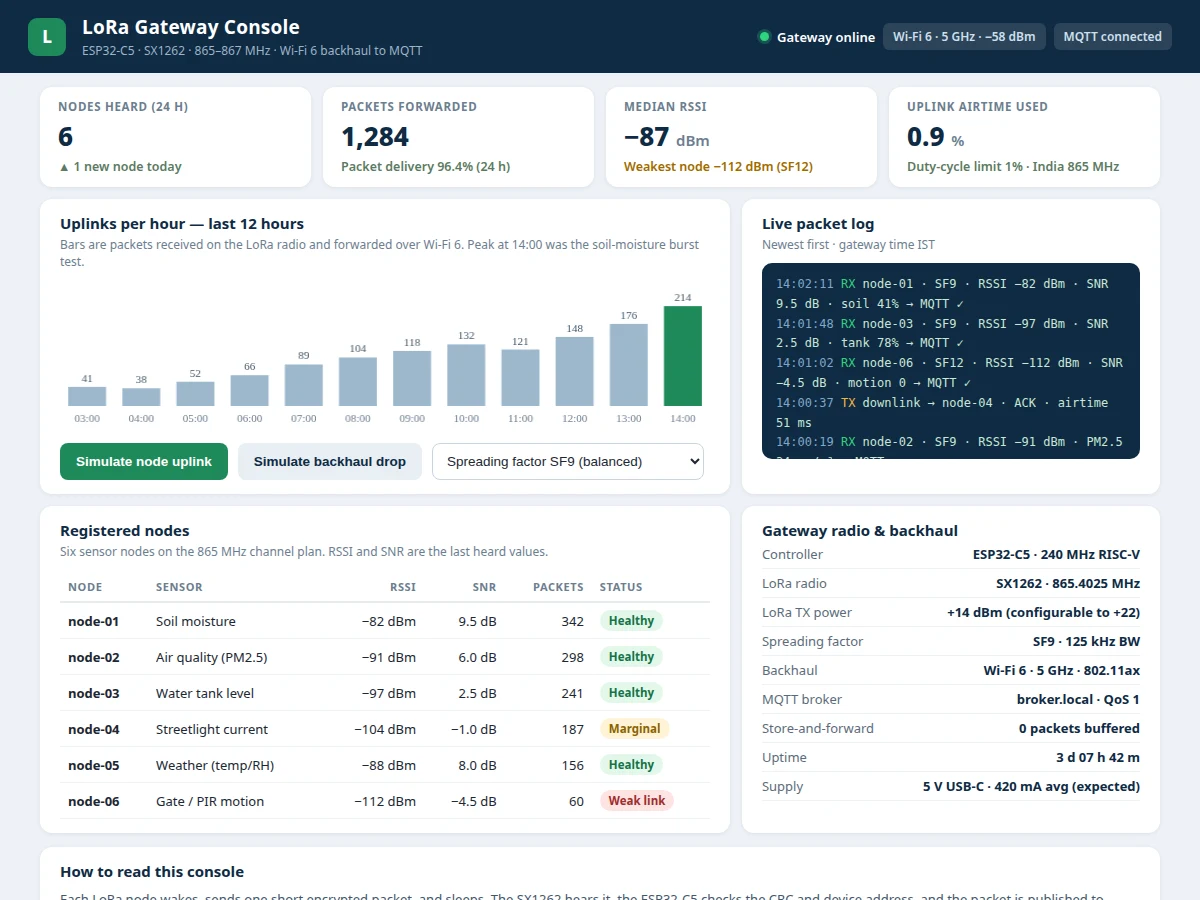
- The builder builds the dashboard: a single-file web app that subscribes to the MQTT topics and shows the node table, RSSI and SNR, the hourly uplink chart, the live packet log and the backhaul status.
- The builder runs the 6-node bench test: all 6 nodes transmit on schedule for 24 hours, and the dashboard records packets received, packets forwarded and the delivery rate for the report.
- The builder runs the range walk: one node is carried to marked distances from the gateway in open ground, RSSI and SNR are recorded at each mark, and the results go into the report as the build's own range table.
Tech stack:
- ESP32-C5 · DevKitC-1 board
- SX1262 LoRa radio · 865 MHz module
- ESP-IDF · C firmware
- MQTT · Mosquitto broker
- HTML · CSS · JavaScript dashboard
- Arduino IDE · node firmware
- 0.96 inch OLED display · SSD1306
- Python · range-test logger
How LoRa range works — and what this gateway does with it
- The first-principles mechanism: LoRa spreads each bit across a wide chirp, so the receiver can pull a signal out of noise far below the level a normal radio needs. Raising the spreading factor from SF7 to SF12 stretches each symbol to 32 times its length, which buys roughly 11 dB of extra sensitivity at the cost of 32 times the airtime — that is the whole range-versus-speed trade-off, and it is why the farthest node in this build runs SF12 while the nearest runs SF7. The SX1262's −148 dBm sensitivity (Datasheet value, Semtech) against a +22 dBm transmit ceiling (Datasheet value) gives a 170 dB maximum link budget (Datasheet value), which is the number the range walk is checked against.
- Why Wi-Fi 6 matters on the backhaul: A gateway's backhaul carries every node's traffic, so a congested 2.4 GHz band is the bottleneck long before the LoRa side is. The ESP32-C5's 5 GHz Wi-Fi 6 radio moves that traffic onto the emptier band, and OFDMA lets the access point serve the gateway alongside other clients instead of making it wait for a clear channel. Target wake time also lets the radio sleep between bursts, which is what keeps the gateway's expected average draw near 420 mA at 5 V.
- Builder note from the build: Wire the SX1262 DIO1 interrupt line to a GPIO and receive by interrupt — without it the firmware must poll the radio, and polling at the wrong moment misses the RX-done flag and drops packets silently with no error anywhere. The second most common failure is a mismatched antenna: a 915 MHz antenna on the 865 MHz band looks fine and still hears nearby nodes, then fails at distance, so the report records the antenna's marked band.
- What this build does not claim: This is a single-channel gateway that hears one spreading factor on one channel at a time, not an 8-channel LoRaWAN concentrator, and the 170 dB link budget is the radio's datasheet ceiling, not a measured range. The range walk reports the build's own RSSI table at marked distances, and the 24-hour bench test reports the build's own delivery rate — nothing else is presented as measured.
| Parameter | Value |
|---|---|
| Controller | ESP32-C5 · HP 32-bit RISC-V up to 240 MHz · LP 32-bit RISC-V up to 48 MHz · 384 KB HP SRAM · 16 KB LP SRAM · 320 KB ROM · 29 GPIOs · QFN48 6×6 mm package (Datasheet values, Espressif) |
| Wireless | Dual-band Wi-Fi 6 802.11ax 2.4 GHz + 5 GHz · Bluetooth LE 5 · Zigbee 3.0 · Thread 1.4 · 2× CAN FD controllers (Datasheet values, Espressif) |
| LoRa radio | Semtech SX1262 · 150–960 MHz synthesizer range · +22 dBm maximum TX power · −148 dBm sensitivity · 170 dB maximum link budget · 4.6 mA RX current · SPI up to 16 MHz (Datasheet values, Semtech) |
| LoRa channel plan | 865–867 MHz India ISM band · 125 kHz bandwidth · spreading factors SF7–SF12 · coding rate 4/5 · TX power +14 dBm (design target) |
| Nodes | 6 sensor nodes: soil moisture, air quality (PM2.5), water tank level, streetlight current, weather (temperature/humidity), PIR motion (design target) |
| Backhaul | Wi-Fi 6 802.11ax · 5 GHz preferred · MQTT QoS 1 · Mosquitto broker · store-and-forward buffer in 384 KB SRAM (design target) |
| Dashboard | Single-file web app · node table with RSSI/SNR · hourly uplink chart · live packet log · simulate-uplink and backhaul-drop controls (design target) |
| Display | 0.96 inch OLED · SSD1306 · gateway state, packets forwarded, last RSSI, backhaul status (design target) |
| Power | 5 V USB-C · approximately 420 mA average (expected) · operating voltage 3.0–3.6 V at the chip · −40 to 85 °C operating range (Datasheet values, Espressif) |
| Range | Open-ground range walk with RSSI recorded at marked distances (student-measured procedure) · no range figure is claimed before the walk is run |
| Builder note | Wire the SX1262 DIO1 interrupt line to a GPIO and receive by interrupt — polling misses the RX-done flag and drops packets silently. Use an 865 MHz antenna, not a 915 MHz one: the wrong band still hears nearby nodes and fails at distance. |
Project features
Four capabilities carry this build. First, the dual-radio gateway itself: the SX1262 hears LoRa packets on 865 MHz while the ESP32-C5's Wi-Fi 6 radio forwards them, so long-range sensing and high-speed backhaul run on one board. Second, store-and-forward: when Wi-Fi drops, packets are buffered in the chip's 384 KB SRAM and published when the link returns, so a short outage loses nothing, and the buffered count stays visible on the dashboard. Third, the live dashboard: every node shows RSSI, SNR, packet count and health status, with an hourly uplink chart and a packet log, so the review panel can watch the gateway work. Fourth, the range validation: a 6-node bench test plus a range walk with recorded RSSI at marked distances turns "long range" from a claim into a table in the report that the panel can check.
- [Dual-radio gateway] The SX1262 LoRa radio receives sensor packets on 865–867 MHz while the ESP32-C5 forwards them over dual-band Wi-Fi 6, so one board covers both the long-range sensor side and the high-speed cloud side — implemented in the base build.
- [Store-and-forward buffer] Packets received while Wi-Fi is down are held in the 384 KB SRAM and published to MQTT when the link returns, with the buffered count shown on the dashboard — implemented in the base build.
- [Live gateway dashboard] The dashboard shows all 6 nodes with RSSI, SNR, packet counts and health badges, an hourly uplink chart, a live packet log and working simulate-uplink and backhaul-drop controls — implemented in the base build.
- [Six sensor nodes] Soil moisture, air quality, water tank level, streetlight current, weather and PIR motion nodes, each sending short encrypted packets on the 865 MHz channel plan — implemented in the base build.
- [Downlink acknowledgements] The gateway can send short downlinks back to a node, such as an acknowledgement or a new reporting interval, with the airtime of each downlink shown in the packet log — implemented in the base build.
- [Spreading-factor control] The spreading factor is selectable from SF7 to SF12 per node, so a far node trades airtime for range while a near node stays fast — implemented in the base build.
- [OLED status display] A 0.96 inch OLED on the gateway shows gateway state, packets forwarded, last RSSI and backhaul status at a glance, so the hardware demo works without opening the dashboard — implemented in the base build.
- [Optional LoRaWAN packet forwarder] Forwarding to a LoRaWAN network server instead of plain MQTT can be added on request, with the gateway acting as a single-channel forwarder — optional customization, not in the base build.
What is included
- Working prototype (ESP32-C5-DevKitC-1 gateway board with SX1262 LoRa module, 865 MHz antenna, 0.96 inch OLED display and 6 sensor nodes, wired and labelled)
- Gateway firmware (ESP-IDF C code: LoRa receive by interrupt, CRC and address check, MQTT publish over Wi-Fi 6, store-and-forward queue)
- Node firmware (Arduino IDE code for all 6 sensor nodes with spreading-factor and reporting-interval settings)
- Live gateway dashboard (node table, RSSI/SNR, hourly uplink chart, live packet log, simulate-uplink and backhaul-drop controls)
- Setup and validation guide (wiring, radio configuration, MQTT broker setup, the 6-node bench test and the range walk)
- Project report PDF (ESP32-C5 and SX1262 datasheet background with figures labelled as datasheet values, gateway design, link-budget method, the build's own bench-test and range-walk results, honest limits)
- PPT presentation for final review
- Viva Q&A preparation document (how LoRa spreading factors trade airtime for range, why Wi-Fi 6 helps the backhaul, single-channel vs concentrator gateways, store-and-forward, the range walk)
Work plan & timeline
Total work plan: 100 hours, split across six phases. Phase 1, background study and parts: 14 hours — reading the ESP32-C5 and SX1262 datasheets, sourcing the DevKitC-1 board, LoRa module, antenna, OLED and 6 sensor nodes, and confirming the 865 MHz channel plan. Phase 2, gateway build: 22 hours — wiring the SX1262 on SPI with the DIO1 interrupt line, the OLED and the antenna, and mounting the 6 nodes. Phase 3, firmware and MQTT link: 24 hours — ESP-IDF gateway firmware, node firmware, the MQTT bridge and the first forwarded packet on the dashboard. Phase 4, dashboard and store-and-forward: 16 hours — the live dashboard with node table and packet log, the SRAM buffer and the backhaul-drop test. Phase 5, validation: 12 hours — the 24-hour 6-node bench test and the range walk, repeated, with results recorded for the report. Phase 6, review preparation: 12 hours — presentation slides, a demo walkthrough, and the question-and-answer document for the review.
Support
Support covers setup help for the delivered gateway board, LoRa module and dashboard, a walkthrough of radio configuration, MQTT broker setup, the 6-node bench test and the range walk, plus fixes for defects in the delivered code. Guidance is also provided for adapting the report and presentation to the student's college format and for answering guide questions about LoRa, spreading factors, Wi-Fi 6 backhaul and gateway design. Support does not cover re-running the bench test or range walk beyond the setup walkthrough, and it does not invent results for tests or observations that were not run.
Get this project
To request a quotation for this project, message Projectech on WhatsApp with the project name, your college and branch, and your deadline. The quotation covers the built-to-order scope in What's included above, the price for that scope, and the delivery timeline for the working prototype with report, PPT and viva kit.
Limitations & prerequisites
- Single-channel gateway, not a LoRaWAN concentrator: it hears one spreading factor on one channel at a time. Two nodes transmitting on different spreading factors at the same moment will collide, and the report states this plainly.
- No range figure is claimed before the range walk: the 170 dB link budget is the SX1262 datasheet ceiling, not a measured result. The build's own range table comes from the walk at marked distances, and indoor or built-up range will be shorter.
- Wi-Fi dependent for live forwarding: the dashboard and MQTT forwarding need the Wi-Fi 6 backhaul. When it drops, packets are buffered in SRAM only — a long outage or a power cut loses the buffer, and the report says so.
- 6 nodes by design: the bench test validates 6 nodes. Adding many more nodes raises collision rates on a single channel and needs a channel plan change, listed as future scope.
- ESP-IDF 5.5 or later is required for the ESP32-C5, and Arduino support for the chip is newer than for older ESP32 boards — the setup guide covers the toolchain versions used in the build.
- Antenna and placement matter: the wrong antenna band or a gateway buried behind metal will cut range sharply. The build guide covers antenna choice and gateway placement, and the range walk is run in open ground first.
- Not a certified device: the gateway is a student prototype for campus, farm or building sensing, not a certified metering or safety system, and it must never be presented as one.
Frequently Asked Questions
Is this project suitable for a final-year project?
Yes, for IoT and Embedded Systems, Electronics and Computer Engineering programmes, because it combines a current dual-band Wi-Fi 6 chip, a LoRa radio, MQTT messaging, a live dashboard and a measured range validation in one build that a student can explain end to end. The report documents the ESP32-C5 and SX1262 datasheets with their figures labelled as datasheet values, the gateway design, the link-budget method and the build's own bench-test and range-walk results, so the work reads as engineering rather than a re-run of an older gateway design.
Why use the ESP32-C5 instead of a plain ESP32?
Because the ESP32-C5 is Espressif's first dual-band Wi-Fi 6 chip, with a 5 GHz radio that moves the backhaul off the congested 2.4 GHz band, plus a 240 MHz RISC-V core, 384 KB of SRAM and two CAN FD controllers. A plain ESP32 only has 2.4 GHz Wi-Fi 4, so in a hostel or college building full of access points its backhaul is the bottleneck. The SX1262 pairing also beats the older SX1276 by about 11 dB of sensitivity, which is the difference the range walk measures.
Does the gateway need the internet to work?
The LoRa side works without the internet — nodes keep transmitting and the gateway keeps hearing them — but live forwarding to the dashboard needs the Wi-Fi backhaul and the MQTT broker, so during an outage packets are buffered in the chip's SRAM and forwarded when Wi-Fi returns. A long outage or a power cut loses the buffer, which is why the build keeps the buffer visible on the dashboard and the OLED.
How far can the LoRa nodes reach?
That is exactly what the range walk measures, and no distance is claimed before it is run, because real range depends on the antenna, gateway height, buildings and interference rather than on the radio's datasheet ceiling, which describes the chip and not the site. The SX1262 datasheet gives a 170 dB maximum link budget from its +22 dBm transmit ceiling and −148 dBm sensitivity, but the walk records RSSI and SNR at marked distances in open ground, and the report presents that table — not the datasheet ceiling — as the build's range.
What will I receive with the project?
You receive the working prototype — the ESP32-C5 gateway board with SX1262 radio, antenna and OLED display, plus all 6 sensor nodes — the ESP-IDF gateway firmware, the node firmware, the live dashboard, the setup and validation guide, the report, presentation and Q&A document. The quotation covers that full scope, and the optional LoRaWAN forwarder is quoted separately if you ask for it.
Components & software requirements
- ESP32-C5 · DevKitC-1 board
- SX1262 LoRa radio · 865 MHz module
- ESP-IDF · C firmware
- MQTT · Mosquitto broker
- HTML · CSS · JavaScript dashboard
- Arduino IDE · node firmware
- 0.96 inch OLED display · SSD1306
- Python · range-test logger
How LoRa range works — and what this gateway does with it
- The first-principles mechanism: LoRa spreads each bit across a wide chirp, so the receiver can pull a signal out of noise far below the level a normal radio needs. Raising the spreading factor from SF7 to SF12 stretches each symbol to 32 times its length, which buys roughly 11 dB of extra sensitivity at the cost of 32 times the airtime — that is the whole range-versus-speed trade-off, and it is why the farthest node in this build runs SF12 while the nearest runs SF7. The SX1262's −148 dBm sensitivity (Datasheet value, Semtech) against a +22 dBm transmit ceiling (Datasheet value) gives a 170 dB maximum link budget (Datasheet value), which is the number the range walk is checked against.
- Why Wi-Fi 6 matters on the backhaul: A gateway's backhaul carries every node's traffic, so a congested 2.4 GHz band is the bottleneck long before the LoRa side is. The ESP32-C5's 5 GHz Wi-Fi 6 radio moves that traffic onto the emptier band, and OFDMA lets the access point serve the gateway alongside other clients instead of making it wait for a clear channel. Target wake time also lets the radio sleep between bursts, which is what keeps the gateway's expected average draw near 420 mA at 5 V.
- Builder note from the build: Wire the SX1262 DIO1 interrupt line to a GPIO and receive by interrupt — without it the firmware must poll the radio, and polling at the wrong moment misses the RX-done flag and drops packets silently with no error anywhere. The second most common failure is a mismatched antenna: a 915 MHz antenna on the 865 MHz band looks fine and still hears nearby nodes, then fails at distance, so the report records the antenna's marked band.
- What this build does not claim: This is a single-channel gateway that hears one spreading factor on one channel at a time, not an 8-channel LoRaWAN concentrator, and the 170 dB link budget is the radio's datasheet ceiling, not a measured range. The range walk reports the build's own RSSI table at marked distances, and the 24-hour bench test reports the build's own delivery rate — nothing else is presented as measured.
Delivery information
Built-to-order project. Delivery timeline is shared after order confirmation based on current queue.
Support terms
Complete documentation, setup guide, and viva preparation included. Support for setup and explanation provided.
Download free synopsis (PDF)
Enter your name and WhatsApp number — the synopsis PDF downloads immediately. We may send occasional project updates on WhatsApp; no spam.