
More project photos (2)
The problem
Cloned voices are now good enough to fool human ears — the same voice-cloning tools that dub videos convincingly are also used in impersonation scams, which is why detecting synthetic speech has become a serious research problem. A human listener cannot reliably tell a neural-vocoder voice from a real one, and hand-written acoustic rules break every time a new synthesis algorithm appears. This project takes the data-driven route used by the actual research community: convert speech into mel-spectrograms and train a convolutional neural network to spot the machine traces that synthesis leaves behind. The training and evaluation follow the ASVspoof 2019 Logical Access challenge protocol, so every result is measured against a public benchmark with official baselines instead of a private test set. The web demo makes the pipeline tangible — load a voice sample and watch the app compute a real 64-band mel-spectrogram and score it. Note that this is an AUDIO project (spoofed speech), completely different from deepfake image detection.
A 2.8 second speech clip at 16 kHz, uploaded as a file or recorded with the microphone.
Follow the working sequence
How it works
- The dataset is loaded: 2,580 bonafide and 22,800 spoofed utterances for training (attacks A01–A06: four TTS and two voice-conversion algorithms), with disjoint speakers held out for development and evaluation.
- Every utterance is resampled to 16 kHz and framed with a 25 ms window and 10 ms hop; a 512-point FFT feeds 64 triangular mel filters spanning 80–8000 Hz, and the log energies form the 64 × 278 input for a 2.8 s clip.
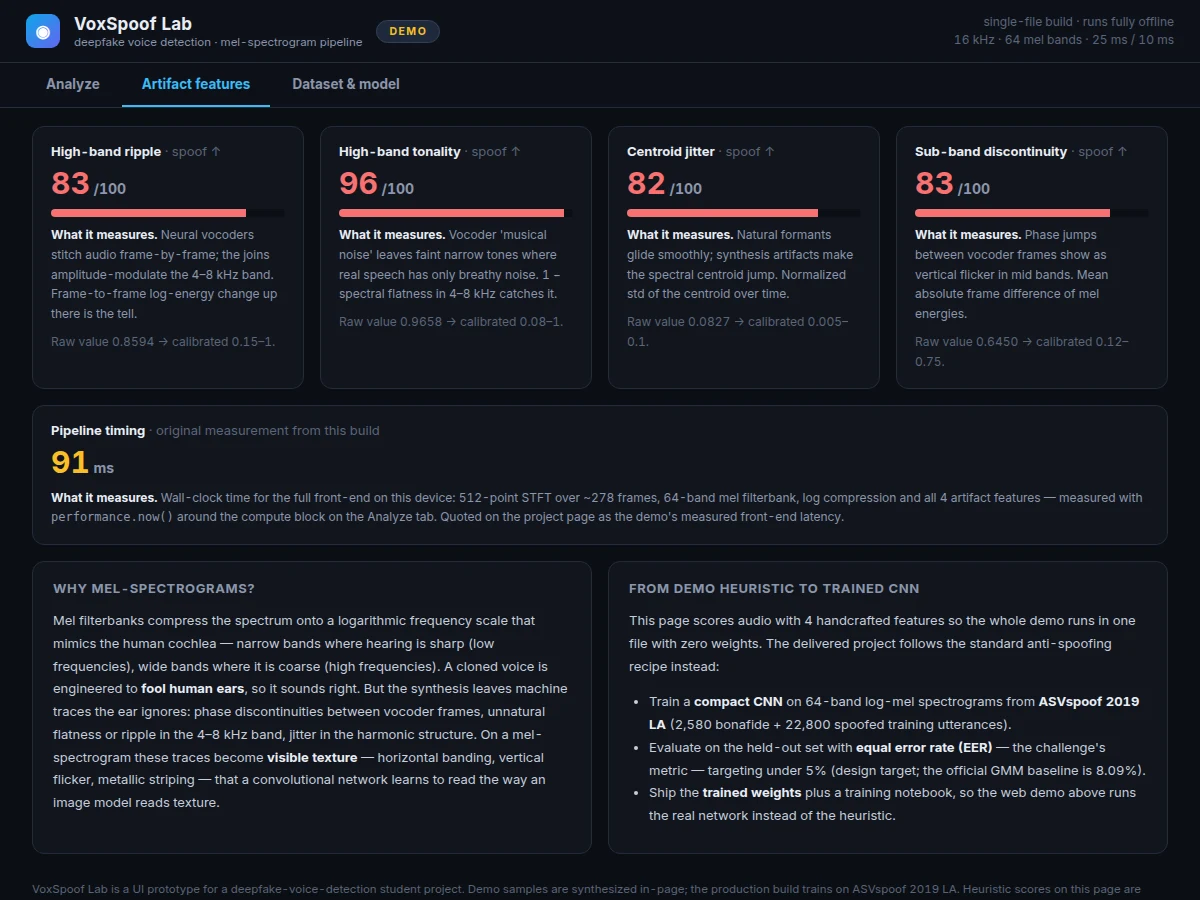
- The compact CNN trains with binary cross-entropy and Adam, learning the texture differences between genuine and synthesized spectrograms — vocoder banding, phase flicker and high-band tonal artifacts.
- The development set (same six attacks, new speakers) is used for early stopping and threshold selection; the model never sees the evaluation attacks during training.
- Final evaluation runs on the held-out set — 7,355 bonafide and 63,882 spoofed utterances including 11 attack algorithms unseen in training — reporting equal error rate and the min t-DCF cost.
- For inference, any new recording passes through the identical front end and the trained network outputs a bonafide-vs-spoof probability with the calibrated decision threshold.
- The web demo mirrors this pipeline in the browser: it parses audio, computes the same 64-band log-mel spectrogram (measured at approximately 60–240 ms per 2.8 s clip in the demo build, varying with device load) and scores it with a handcrafted artifact heuristic, since model weights cannot ship inside a zero-dependency demo page.
Tech stack:
- Python 3, PyTorch
- ASVspoof 2019 LA dataset
- Mel-spectrogram front end (25 ms / 10 ms, 64 bands)
- Compact CNN (conv blocks · global average pooling · sigmoid)
- NumPy · SciPy (signal processing)
- Matplotlib (DET curves, training plots)
- Jupyter Notebook (training & evaluation)
- HTML5 · CSS3 · JavaScript (single-file web demo)
Dataset & model details
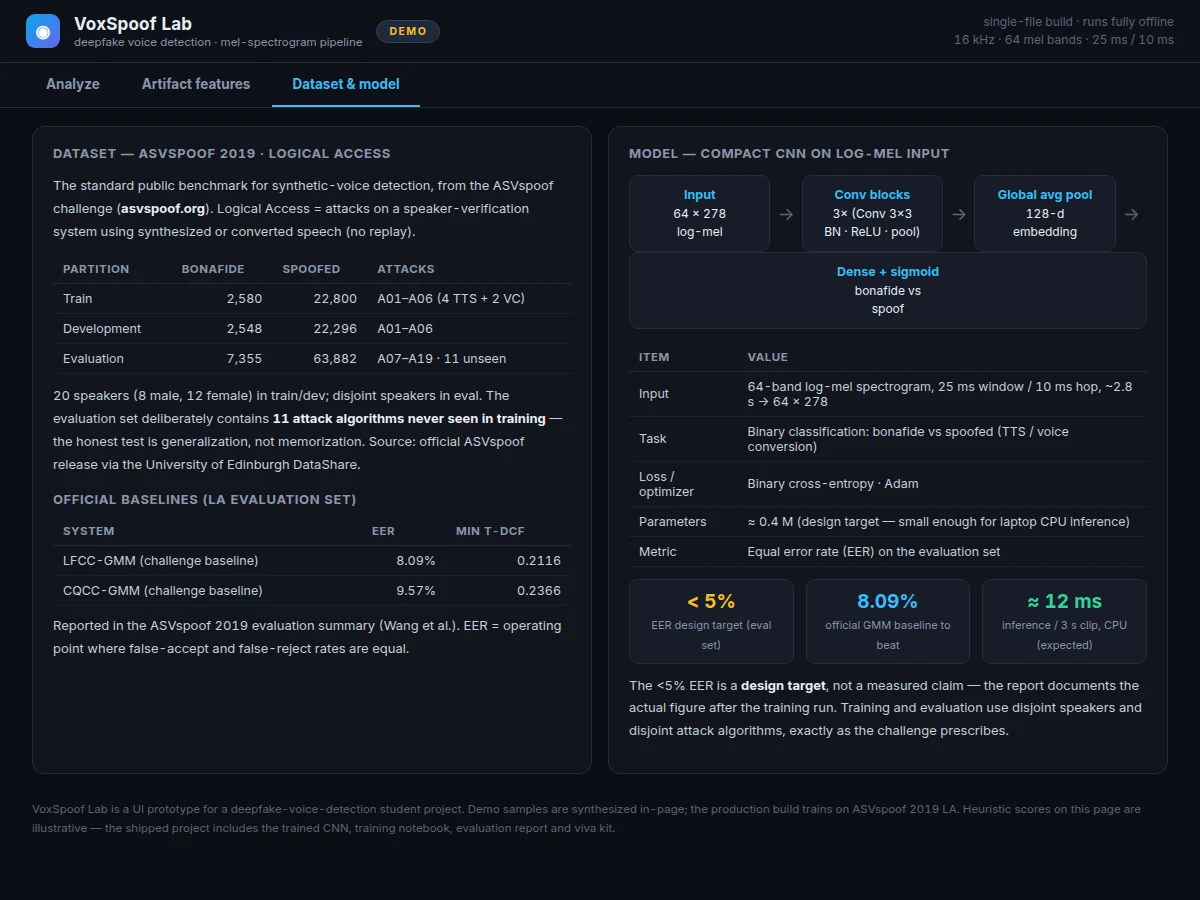
- Dataset: ASVspoof 2019 Logical Access — the public benchmark for synthetic-speech detection from the ASVspoof challenge (asvspoof.org; official release via the University of Edinburgh DataShare, registration required). Train: 2,580 bonafide + 22,800 spoofed utterances (attacks A01–A06: 4 TTS + 2 voice conversion, 20 speakers). Development: 2,548 bonafide + 22,296 spoofed (same attacks, disjoint speakers). Evaluation: 7,355 bonafide + 63,882 spoofed (attacks A07–A19, of which 11 are unseen in training).
- Task: Binary classification (presentation-attack detection for voice). Input = 64 × 278 log-mel spectrogram of a ~2.8 s utterance at 16 kHz. Output = probability of the utterance being spoofed (TTS or voice conversion).
- Model: Compact CNN (design target ≈ 0.4 M parameters): three 3×3 convolution blocks with batch normalization, ReLU and pooling → global average pooling → 128-d embedding → dense layer with sigmoid. Loss: binary cross-entropy. Optimizer: Adam.
- Metrics: Equal error rate (EER) and min t-DCF on the evaluation set. Official challenge baselines to beat: LFCC-GMM 8.09% EER / 0.2116 min t-DCF and CQCC-GMM 9.57% / 0.2366 (reported in the ASVspoof 2019 evaluation summary, Wang et al.). Design target: EER under 5% on the evaluation set — a target, not a measured claim; the report documents the actual figure after the training run. No accuracy is claimed as measured until training is executed for the order.
| Parameter | Value |
|---|---|
| Input audio | 16 kHz mono, approximately 2.8 s per utterance (design) |
| Front end | 64-band log-mel, 25 ms window / 10 ms hop, 80–8000 Hz (design) |
| Feature shape | 64 × 278 per 2.8 s clip (computed) |
| Model size | Approximately 0.4 M parameters (design target) |
| EER | Under 5% on the LA evaluation set (design target; measured after training) |
| Challenge baseline | 8.09% EER, LFCC-GMM (reported, Wang et al.) |
| Front-end latency | Approximately 60–240 ms per 2.8 s clip (measured in the demo build; varies with device load) |
| Inference | Approximately 12 ms per clip on CPU (expected) |
| Training data | 2,580 bonafide + 22,800 spoofed utterances (dataset) |
| Demo | Single-file HTML app, runs fully offline (by design) |
Project features
- [Mel-spectrogram front end] Raw audio is resampled to 16 kHz and converted to 64-band log-mel spectrograms (25 ms window, 10 ms hop, 80–8000 Hz) — the same front end the anti-spoofing literature uses, implemented as a documented preprocessing module.
- [Compact CNN classifier] Three convolution blocks (3×3 kernels, batch normalization, ReLU, pooling) followed by global average pooling and a dense sigmoid head — approximately 0.4 M parameters by design, small enough to run inference on a laptop CPU.
- [ASVspoof 2019 LA training pipeline] A complete training notebook: dataset loading, train/dev splits with disjoint speakers, augmentation, binary cross-entropy training with Adam, and checkpointing on development-set EER.
- [EER evaluation harness] The official challenge metric — equal error rate plus DET-curve plotting — computed on the held-out evaluation set with its 11 unseen attack algorithms, so the report shows honest generalization numbers.
- [Interactive web demo] A single-file HTML app that computes a real mel-spectrogram in the browser (FFT + mel filterbank in pure JavaScript) and visualizes it with waveform, feature bars and a detection verdict — no server, runs fully offline.
- [Upload and microphone input] The demo accepts WAV/MP3 uploads and 3-second microphone recordings; any real voice runs through the same analysis pipeline as the built-in samples.
- [Cross-dataset testing on WaveFake (optional)] Evaluating the trained model on the WaveFake neural-vocoder corpus can be added on request, to demonstrate how the detector behaves on vocoders outside the training distribution.
- [Streaming real-time detection (future scope)] Chunk-wise inference on a live audio stream is designed but not implemented; the report documents the buffering and latency considerations.
What is included
- Complete training & evaluation Jupyter notebook (preprocessing, CNN definition, training loop, EER/DET-curve evaluation)
- Trained CNN weights plus the mel-spectrogram preprocessing module
- Interactive single-file web demo (real in-browser spectrogram computation, upload + microphone input, two built-in samples)
- Project report PDF (voice-spoofing background, mel-scale theory, ASVspoof protocol, architecture rationale, methodology, results)
- PPT presentation for final review
- Viva Q&A preparation document (mel filterbanks, CNN design, EER vs accuracy, seen vs unseen attacks, vocoder artifacts)
- Dataset-setup guide (DataShare registration, directory layout, protocol file usage)
- Build timeline & support: preparation is confirmed at quotation (expected 2–3 weeks for the training run and full viva kit); build guidance over WhatsApp during preparation and demo support before the review.
Limitations & prerequisites
- The under-5% EER is a design target stated honestly — the report documents the actual measured figure after the training run for the order.
- The dataset's spoofed voices come from 2019-era TTS/VC systems; the newest diffusion-based voice generators are outside its distribution and may behave differently.
- Clean 16 kHz audio is assumed — heavy background noise, music or telephone codecs degrade the front end, and clips under ~1 s carry too little signal to judge.
- This is an academic anti-spoofing prototype, not a forensic or legal-identity tool; scores support analysis, they do not prove a recording is fake.
- ASVspoof access requires free registration on the Edinburgh DataShare; the setup guide walks through it.
- The web demo's built-in score uses a handcrafted artifact heuristic (documented in the demo) so it runs with zero weights; the shipped web demo wires to the trained CNN.
Frequently Asked Questions
Which dataset is used and what are its classes?
ASVspoof 2019 Logical Access: 2,580 bonafide + 22,800 spoofed training utterances, plus development and evaluation partitions. The two classes are bonafide (genuine speech) and spoofed — the spoofed class is generated by six TTS/voice-conversion algorithms in training, with eleven additional unseen algorithms in the evaluation set.
Which model is used and what does it take as input?
A compact CNN (three convolution blocks, global average pooling, dense sigmoid head, ~0.4 M parameters by design). Input is a 64-band log-mel spectrogram (25 ms window, 10 ms hop) of a ~2.8 s utterance; output is the probability that the utterance is spoofed.
Is the EER guaranteed?
No — under 5% EER on the evaluation set is the design target, stated honestly. The official challenge baseline is 8.09% (LFCC-GMM), so the target means beating a published reference. The report documents the actual measured EER after the training run, including per-attack breakdowns.
How is this different from deepfake image detection?
Completely different problem and pipeline. Image deepfake detectors (like the FaceForensics++ CNN project) classify pixels in video frames; this project classifies AUDIO — it analyzes the spectral texture of speech for vocoder artifacts. There is no image or video component anywhere in this build.
Will it catch voices from the newest AI voice generators?
Partially. The detector learns vocoder artifacts, and many artifacts carry across generators — but the training data is from 2019-era systems, so the newest generators are out-of-distribution. Testing on the WaveFake neural-vocoder corpus is offered as an optional extension to measure exactly this.
Is this project suitable for a final-year project?
Yes — for Computer Science, IT and AI/ML programs. It demonstrates digital signal processing (mel filterbanks), CNN design, a real public benchmark protocol, and honest evaluation methodology with EER instead of a cherry-picked accuracy number.
Components & software requirements
- Python 3, PyTorch
- ASVspoof 2019 LA dataset
- Mel-spectrogram front end (25 ms / 10 ms, 64 bands)
- Compact CNN (conv blocks · global average pooling · sigmoid)
- NumPy · SciPy (signal processing)
- Matplotlib (DET curves, training plots)
- Jupyter Notebook (training & evaluation)
- HTML5 · CSS3 · JavaScript (single-file web demo)
Dataset & model details
- Dataset: ASVspoof 2019 Logical Access — the public benchmark for synthetic-speech detection from the ASVspoof challenge (asvspoof.org; official release via the University of Edinburgh DataShare, registration required). Train: 2,580 bonafide + 22,800 spoofed utterances (attacks A01–A06: 4 TTS + 2 voice conversion, 20 speakers). Development: 2,548 bonafide + 22,296 spoofed (same attacks, disjoint speakers). Evaluation: 7,355 bonafide + 63,882 spoofed (attacks A07–A19, of which 11 are unseen in training).
- Task: Binary classification (presentation-attack detection for voice). Input = 64 × 278 log-mel spectrogram of a ~2.8 s utterance at 16 kHz. Output = probability of the utterance being spoofed (TTS or voice conversion).
- Model: Compact CNN (design target ≈ 0.4 M parameters): three 3×3 convolution blocks with batch normalization, ReLU and pooling → global average pooling → 128-d embedding → dense layer with sigmoid. Loss: binary cross-entropy. Optimizer: Adam.
- Metrics: Equal error rate (EER) and min t-DCF on the evaluation set. Official challenge baselines to beat: LFCC-GMM 8.09% EER / 0.2116 min t-DCF and CQCC-GMM 9.57% / 0.2366 (reported in the ASVspoof 2019 evaluation summary, Wang et al.). Design target: EER under 5% on the evaluation set — a target, not a measured claim; the report documents the actual figure after the training run. No accuracy is claimed as measured until training is executed for the order.
Delivery information
Built-to-order project. Delivery timeline is shared after order confirmation based on current queue.
Support terms
Complete documentation, setup guide, and viva preparation included. Support for setup and explanation provided.
Download free synopsis (PDF)
Enter your name and WhatsApp number — the synopsis PDF downloads immediately. We may send occasional project updates on WhatsApp; no spam.