
More project photos (3)
The problem
Everyone knows something someone nearby wants to learn, and wants to learn something a neighbor could teach — but the exchange never happens because there is no trusted way to find each other and agree on fair terms. Tutoring marketplaces solve this with money; a skill-swap solves it with reciprocity, which needs different mechanics: matching complementary teach/learn pairs, session scheduling both sides honor, and reputation that reflects teaching quality rather than payment. This project builds that platform: member profiles with teach/learn skill tags, search and category filters, swap requests that become scheduled session plans, in-thread messaging, post-session ratings, and fair-swap rules (alternating teach/learn halves, show-up tracking) that keep exchanges balanced.
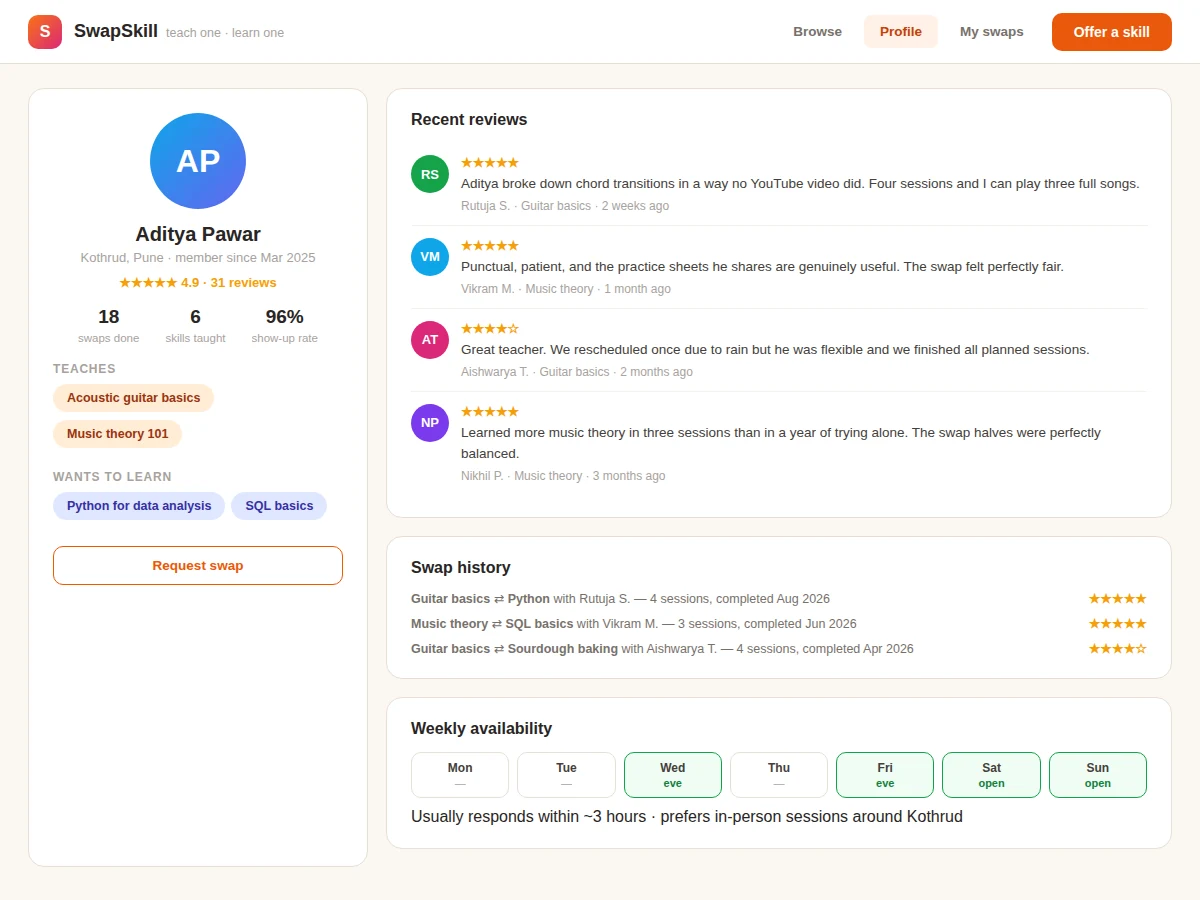
Teaches one skill and learns another.
Follow the working sequence
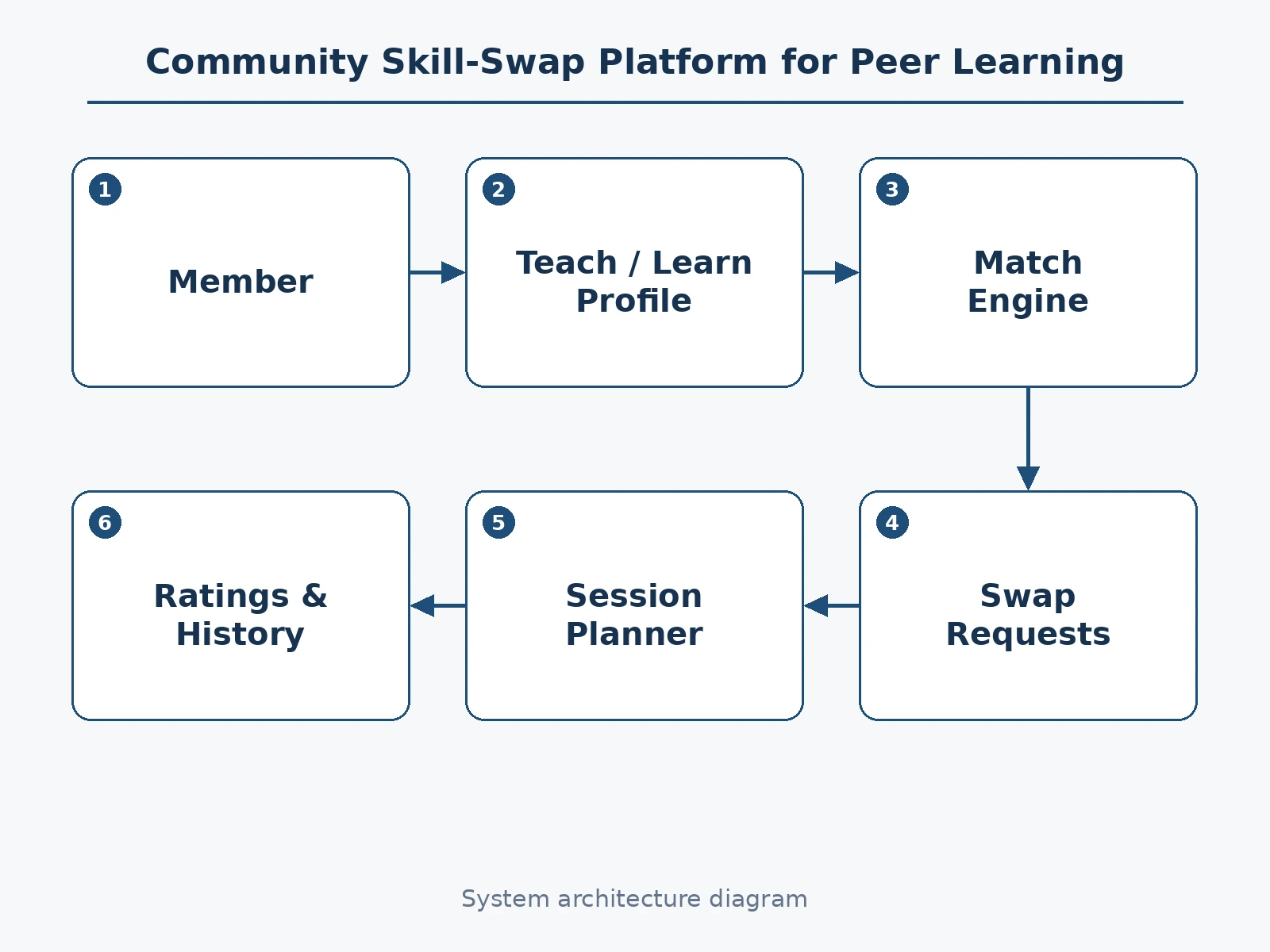
How it works
- A member creates a profile with teach skills, learn interests, location and availability.
- Searching a skill returns complementary members — people who teach what you want and want what you teach — ranked by a transparent score.
- The requester proposes a swap (skill pair, number of sessions); the other member accepts, declines or counters.
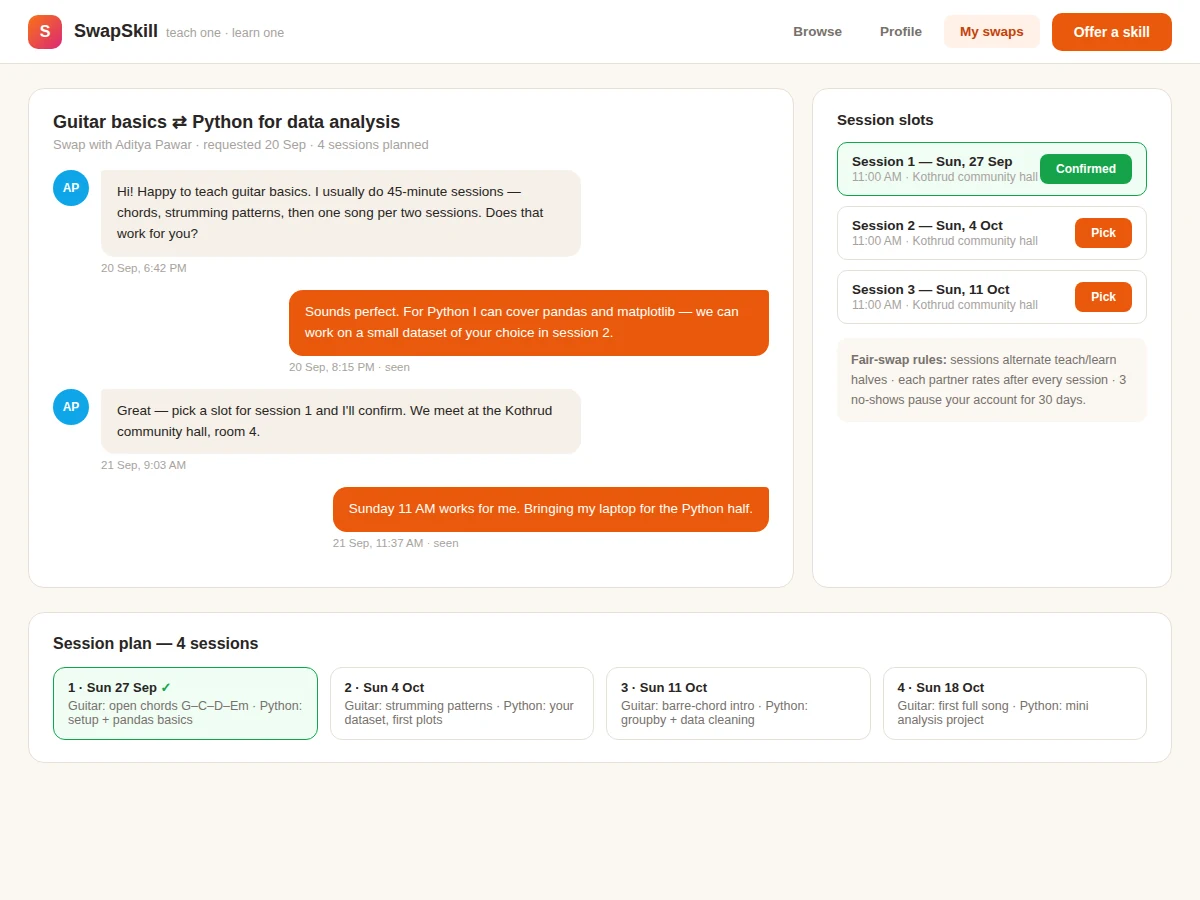
- Acceptance opens a swap thread with messaging and a session planner; slots are proposed, confirmed and reminded.
- After each session both sides mark attendance and leave a rating with a short review.
- Completed swaps, ratings and show-up rates accumulate on profiles, feeding future match rankings.
- Community rules enforce fair exchange: alternating halves per session and no-show penalties.
Tech stack:
- Python 3 with Django (profiles, swaps, reviews)
- PostgreSQL with PostGIS (location-aware search)
- HTML, CSS and JavaScript (browse, profile, thread UI)
- Django Channels (in-thread messaging)
- Celery with Redis (reminders and digest emails)
- Pillow (profile media handling)
- Docker (one-command deployment)
| Parameter | Value |
|---|---|
| Match ranking | Rating 40%, distance 25%, responsiveness 20%, completion 15% (design weights) |
| Search radius | Configurable 5–50 km, default 10 km |
| Session length | 45–90 minutes, configurable per swap |
| Ratings | 1–5 stars with text review per session |
| No-show policy | 3 no-shows pause account for 30 days (configurable) |
| Messaging | In-thread, per swap |
| Deployment | Single Docker container |
Project features
- [Teach/learn profiles] Members list skills they can teach and want to learn, with levels, past swap counts and response-time stats.
- [Complementary matching] Search surfaces members whose "teaches" overlaps your "wants" and vice versa, ranked by rating, distance and responsiveness.
- [Swap requests with session plans] Requests propose a skill pair and a session count; acceptance opens a thread with a shared plan.
- [Session scheduling] Per-session slots with venue, confirmation states and reminders keep both sides coordinated.
- [Ratings and show-up rate] Post-session reviews and attendance tracking build a reputation that reflects reliability, not just friendliness.
- [Fair-swap rules] Sessions alternate teach/learn halves by rule, and repeated no-shows pause accounts — documented in the community guidelines.
- [Category browsing] Music, languages, tech, cooking, fitness and art categories with skill-level filters.
What is included
- Platform source code (profiles, matching, swaps, reviews, messaging)
- Match-ranking logic with documented weights
- Database schema with PostGIS location search
- Seed dataset of members and swaps for the viva demo
- Community guidelines and fair-swap rules document
- Project report PDF (background, matching design, trust mechanics, methodology)
- PPT presentation for final review
- Viva Q&A preparation document (matching algorithms, reputation systems, location search)
Limitations & prerequisites
- Match quality depends on member density — the demo seeds a realistic dataset, but a fresh city starts sparse (cold-start is discussed honestly in the report).
- Identity verification is profile-level (phone OTP); background checks are out of scope.
- The platform facilitates meetings; it cannot guarantee session quality or safety — meeting guidelines are documented.
- Payments are out of scope by design; this is a reciprocity platform, not a tutoring marketplace.
- Ranking weights are design choices documented for the viva, not tuned on production data.
Frequently Asked Questions
How is this different from a tutoring marketplace?
No money changes hands. Matching is complementary — each side teaches and learns — and reputation tracks teaching quality and reliability rather than transactions.
How does matching work?
Search finds members whose teach-skills overlap your learn-interests and vice versa, then ranks them by a documented blend of rating, distance, responsiveness and completion history.
What keeps swaps fair?
Sessions alternate teach/learn halves by rule, attendance is tracked per session, and repeated no-shows pause the account. The rules are visible to both sides before accepting.
What if nobody near me teaches what I want?
The radius filter widens the search and an "online session" option matches beyond geography; the report discusses the cold-start problem openly.
Can I see someone's track record before requesting?
Yes — profiles show completed swaps, per-session reviews, show-up rate and average response time.
Is this project suitable for a final-year project?
Yes — for Computer Science, IT and Web Development programs. Matching logic, reputation design and location search give it real technical depth. Suitable for B.E./B.Tech final-year projects in Computer Science, IT and Web Development.
Components & software requirements
- Python 3 with Django (profiles, swaps, reviews)
- PostgreSQL with PostGIS (location-aware search)
- HTML, CSS and JavaScript (browse, profile, thread UI)
- Django Channels (in-thread messaging)
- Celery with Redis (reminders and digest emails)
- Pillow (profile media handling)
- Docker (one-command deployment)
Delivery information
Built-to-order project. Delivery timeline is shared after order confirmation based on current queue.
Support terms
Complete documentation, setup guide, and viva preparation included. Support for setup and explanation provided.
Download free synopsis (PDF)
Enter your name and WhatsApp number — the synopsis PDF downloads immediately. We may send occasional project updates on WhatsApp; no spam.