
More project photos (2)
The problem
Millions of readable books sit idle on shelves while other readers buy new copies — a waste of money and paper. Informal giveaways on society chat groups don't scale: no catalog, no condition information, no logistics, and no incentive to keep donating. This project formalizes giving as a circular library: a searchable catalog of donated books with condition grades, volunteer pickup scheduling within 48 hours, hub-based quality checks, 30-day lending cycles with due-date reminders, and a karma system where donations and on-time returns earn priority on popular titles. Books keep moving instead of gathering dust, and donors can watch their impact grow.
How it works
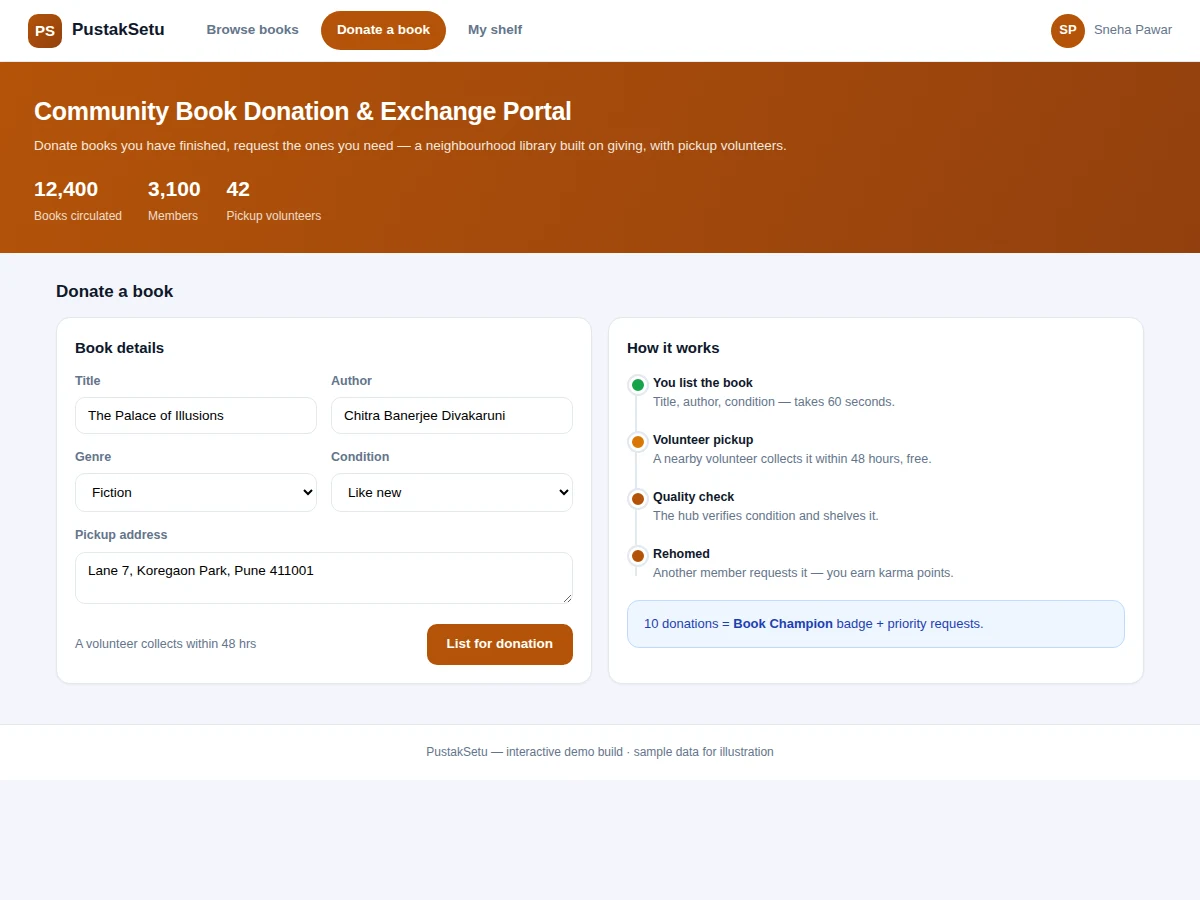
- A donor lists a book with title, author, genre, condition and pickup address.
- The matcher assigns the nearest available volunteer, who collects the book within 48 hours.
- The hub verifies condition and shelves the book; it appears in the catalog with its grade badge.
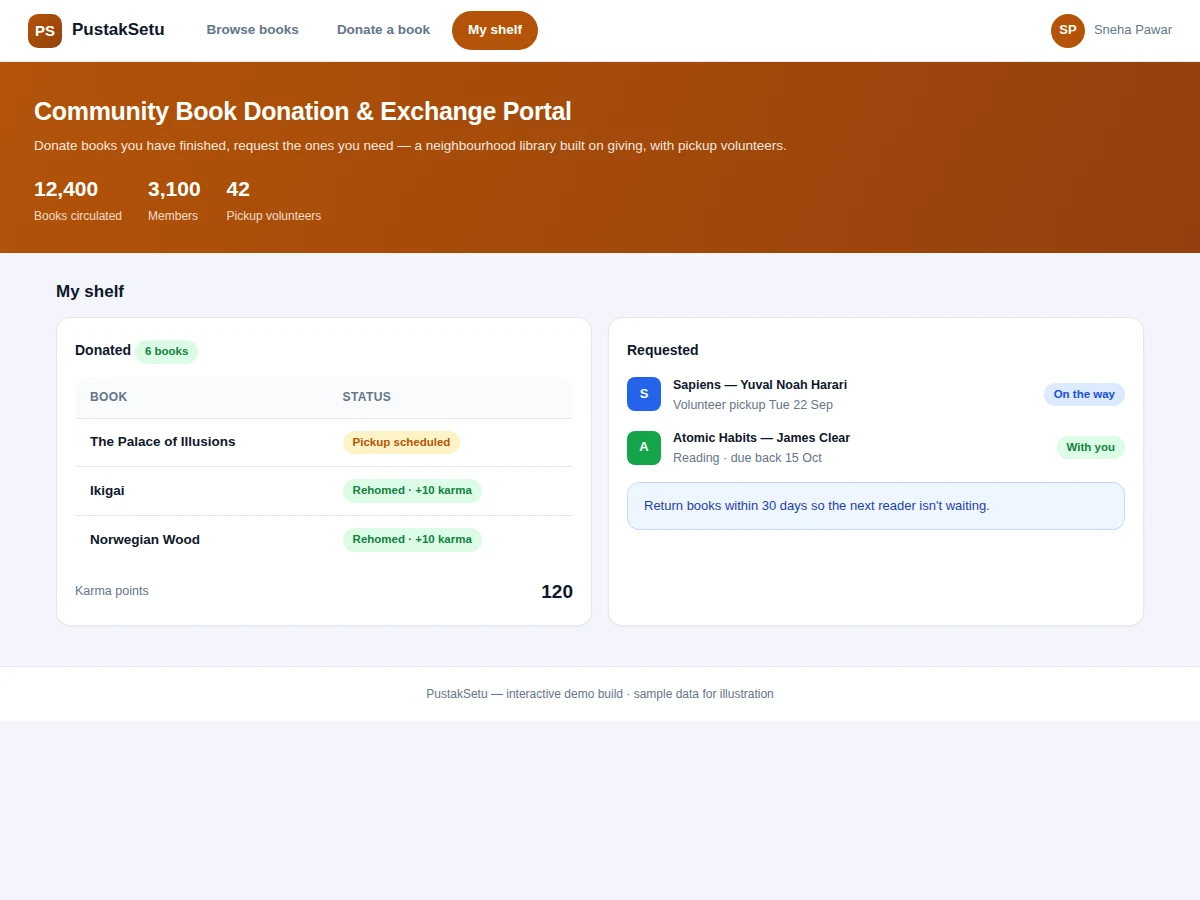
- A requester browses or searches and requests the book, creating a 30-day loan with a due date.
- Volunteers handle the delivery leg; reminders go out before the due date.
- On-time returns re-enter the catalog; karma accrues to donor, returner and volunteer.
Tech stack:
- Python (Django/Flask) or Node.js web application
- MySQL/PostgreSQL for books, members, loans, karma ledger
- HTML5, CSS3, JavaScript mobile-friendly frontend
- Maps integration for volunteer-to-donor matching
- Email/SMS reminders for pickups, due dates and overdues
| Parameter | Value |
|---|---|
| Loan period | 30 days, configurable |
| Pickup SLA | Within 48 hours of listing |
| Condition grades | Like new, Good, Acceptable |
| Karma | +10 donation, +5 on-time return, +15 volunteering |
| Priority | Request queue for popular titles sorts by karma |
| Roles | Member, volunteer, hub coordinator, admin |
| Demo data | 6 books, sample loans and karma ledger |
Project features
- [60-second donation listing] Title, author, genre, condition and pickup address — done in a minute.
- [Volunteer pickup matching] Nearest available volunteer assigned; pickup within 48 hours.
- [Condition grading] Hub verifies Like-new / Good / Acceptable before cataloging.
- [Searchable catalog] Filter by genre, condition and area; request in one click.
- [Lending lifecycle] 30-day loans with due-date reminders, returns and overdue handling.
- [Karma engine] Donations, on-time returns and volunteering earn points that prioritize popular-title requests.
- [Impact dashboards] Books rehomed, karma balance and community stats per member.
What is included
- Complete circulation portal (member, volunteer, hub modules)
- Lending-lifecycle logic with due-date and overdue handling
- Karma points engine with priority queues
- Volunteer matching workflow
- Project report PDF (circular-economy workflow design)
- PPT presentation for final review
- Viva Q&A preparation document (matching, lifecycle states, incentives)
Limitations & prerequisites
- Volunteer availability in the demo is simulated; real operations need a volunteer roster.
- Maps-based matching needs a maps API key at deployment.
- The karma economy is indicative; point values are configurable, not empirically tuned.
- Rare or high-value books may need deposit handling, which is out of scope.
- Inter-city hub transfers are future scope; the build is single-hub.
Frequently Asked Questions
How do books get from donor to requester?
Listing → nearest-volunteer pickup (48 hrs) → hub condition check → catalog → request → volunteer delivery → 30-day loan → return. Volunteers handle both logistics legs.
What are karma points for?
They reward circulation: donations, on-time returns and volunteering earn points, and the request queue for popular titles sorts by karma — active givers get first pick.
What if a book isn't returned?
Due-date reminders go out automatically; overdue loans flag the member's account, pausing new requests until the book is returned or resolved with the hub.
Who grades the condition?
The hub coordinator verifies each book on receipt against the donor's stated grade before it enters the catalog, keeping requester expectations honest.
Is this project suitable for a final-year project?
Yes — for Computer Science, IT and Web Development programs. It demonstrates lifecycle modeling, matching logic and incentive design. Suitable for B.E./B.Tech final-year projects in Computer Science, IT and Web Development.
Components & software requirements
- Python (Django/Flask) or Node.js web application
- MySQL/PostgreSQL for books, members, loans, karma ledger
- HTML5, CSS3, JavaScript mobile-friendly frontend
- Maps integration for volunteer-to-donor matching
- Email/SMS reminders for pickups, due dates and overdues
Delivery information
Built-to-order project. Delivery timeline is shared after order confirmation based on current queue.
Support terms
Complete documentation, setup guide, and viva preparation included. Support for setup and explanation provided.