
More project photos (2)
The problem
College admission in most institutes still runs on paper forms, spreadsheets and notice-board merit lists, and that is exactly what this College Admission Management Portal replaces. The portal is a PHP and MySQL web application that takes an applicant from the online application form through document verification, merit-list publication, seat allotment and fee payment to a confirmed admission, with every step recorded against one application number. Applicants fill one form, choose course preferences, upload marksheets and certificates, and watch their status move from submitted to verified to merit-listed to seat-allotted without visiting the campus or calling the office. Admission officers verify documents in a queue, generate merit lists ranked by entrance-exam percentile with a deterministic tie-break, allot seats against course preferences and track fee collection in one dashboard. Because the merit ranking, seat counts and payment records all come from the same database, the list an applicant sees is the same list the officer works from, and no seat is ever allotted twice.
Applies online and uploads documents for verification.
Follow the working sequence
How it works
An admission moves through the portal in one continuous flow from the applicant's browser to the institute's database and back again. The applicant registers, fills the online form with personal and academic details, selects course preferences and uploads documents; the server validates the form, stores the application in MySQL and assigns an application number the applicant uses to track everything. An admission officer works through the verification queue, approving or rejecting each document, and only verified applications enter the merit-list run. The merit engine sorts verified applicants per course by entrance-exam percentile, applies the tie-break chain, and publishes ranked lists the applicants can see. Seat allotment then walks the ranked list in order, matching each applicant to their highest available preference, and the allotted applicant pays the fee through the payment gateway; on payment confirmation the portal issues a receipt and marks the admission confirmed.
- The applicant registers with name, email and mobile, verifies the account by email, and opens the online application form.
- The form captures personal details, HSC and entrance-exam marks, category and up to 6 course preferences, and accepts document uploads in PDF, JPG or PNG.
- Server-side validation checks required fields, mark ranges and file types before the application is stored in MySQL with a unique application number.
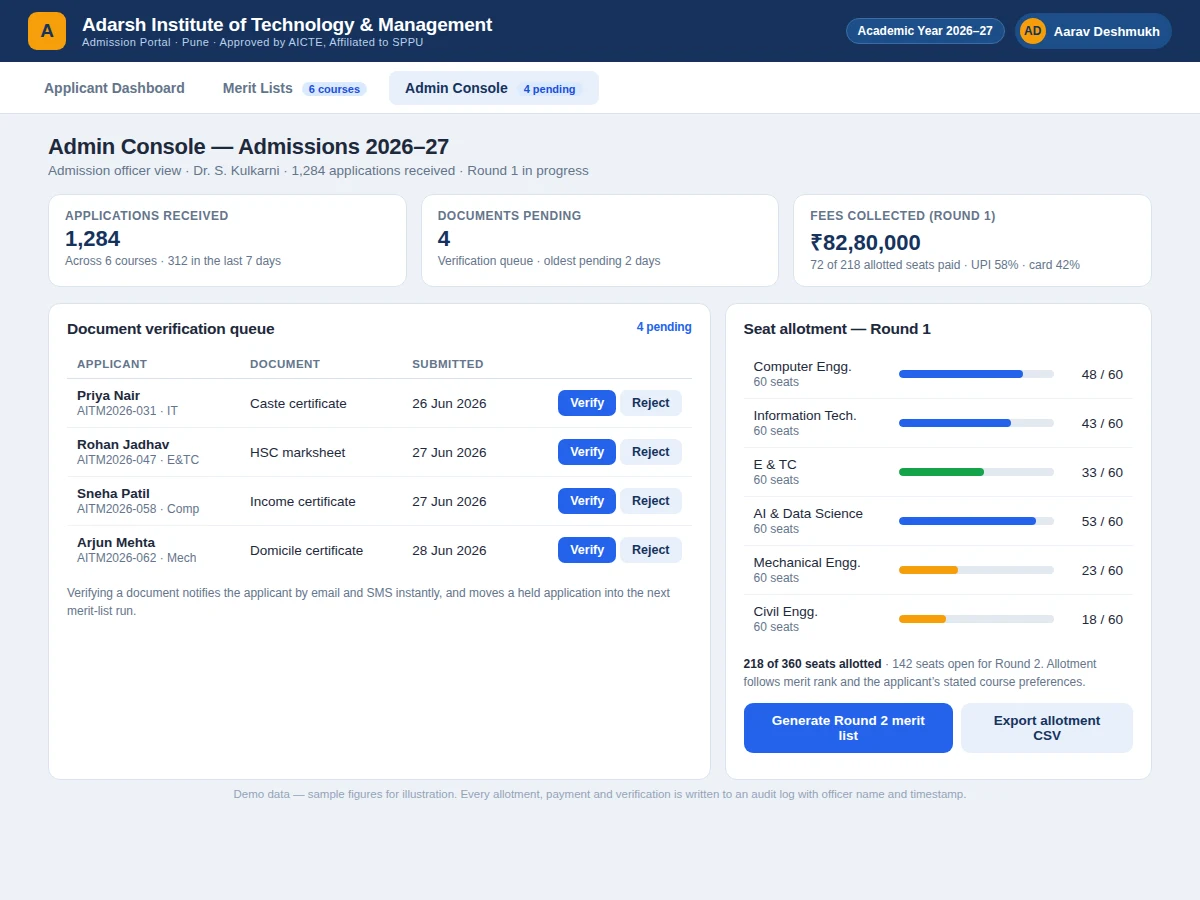
- An admission officer reviews each document in the verification queue and approves or rejects it; the applicant is notified by email and SMS at each decision.
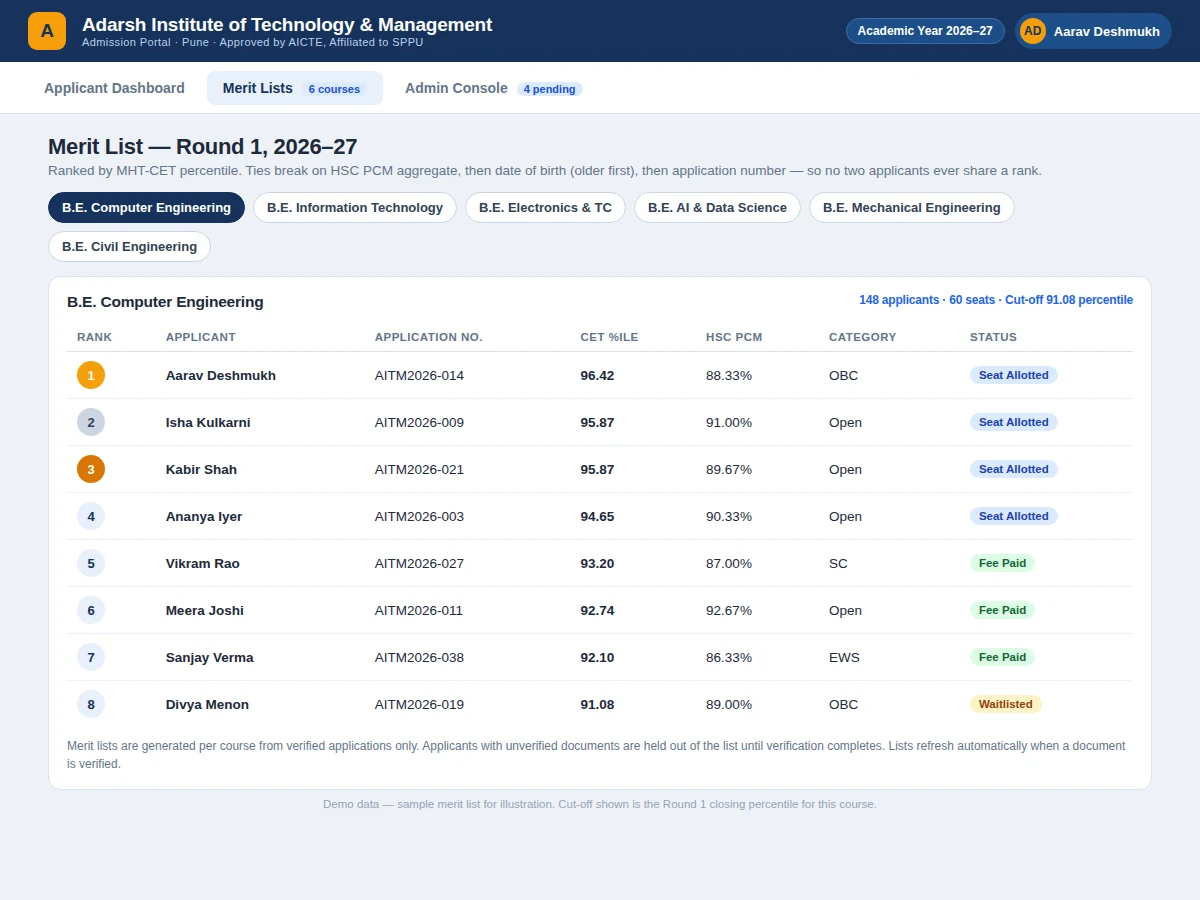
- The merit-list engine ranks verified applicants per course by entrance-exam percentile, breaking ties on HSC PCM aggregate, then date of birth, then application number, and publishes the ranked list.
- Seat allotment walks the ranked list in order and assigns each applicant their highest-preference course with a free seat, recording the allotment and notifying the applicant.
- The applicant pays the tuition fee by UPI, card or netbanking through the Razorpay gateway; on confirmation the portal issues a fee receipt and marks the admission confirmed.
Tech stack:
- PHP 8 · MySQL 8
- HTML5 · CSS3 · JavaScript
- Apache web server
- Razorpay payment gateway
- PHPMailer · SMTP email alerts
- SMS gateway API
- MySQL prepared statements
- Git version control
| Parameter | Value |
|---|---|
| User roles | 3 — applicant · admission officer · admin |
| Courses managed | 6 (design target) |
| Application form fields | 18 (design target: personal, academic and preference sections) |
| Merit-list ranking | MHT-CET percentile, then HSC PCM aggregate, then date of birth |
| Seats per course | 60 (design target) |
| Document upload | PDF · JPG · PNG, up to 2 MB per file (design target) |
| Fee payment | UPI · credit/debit card · netbanking via Razorpay (test mode in demo) |
| Notifications | Email via SMTP + SMS gateway at every status change |
| Database tables | 12 (design target) |
| Merit-list generation | Approximately under 1 second for 500 applicants (design target) |
Project features
The portal's core is the admission pipeline itself: one application record travels from submission to confirmed admission, and the three capabilities that carry it are the online application with document upload, the merit-list engine, and the fee-payment flow. Applicants complete a single form with course preferences and upload their marksheets and certificates, so the office stops re-keying paper forms and chasing missing documents. The merit-list engine ranks verified applicants per course by entrance-exam percentile with a deterministic tie-break on HSC PCM aggregate and date of birth, which means two applicants can never share a rank and the published list is reproducible from the same data. Once seats are allotted, the fee-payment flow collects tuition through UPI or card via the payment gateway and issues a receipt, while email and SMS notifications keep every applicant informed at each status change.
- [Online application form] A single form captures personal details, HSC and entrance-exam marks, category and up to 6 course preferences, with server-side validation on required fields, mark ranges and file types before anything is stored.
- [Document upload & verification] Applicants upload marksheets and certificates as PDF, JPG or PNG, and admission officers approve or reject each document from a verification queue, with the decision recorded against the application.
- [Merit list generation] Verified applicants are ranked per course by entrance-exam percentile, with ties broken on HSC PCM aggregate, then date of birth, then application number, so the published list is deterministic and reproducible.
- [Seat allotment] Allotment walks the ranked list in order and assigns each applicant their highest-preference course with a free seat, recording the allotment and preventing any seat from being allotted twice.
- [Fee payment via payment gateway] Allotted applicants pay tuition by UPI, credit/debit card or netbanking through the Razorpay gateway, and the portal issues a fee receipt on payment confirmation.
- [Application status tracking] Every applicant sees a live six-stage timeline — submitted, documents verified, merit-listed, seat allotted, fee paid, admission confirmed — against their application number.
- [Email & SMS notifications] The portal sends an email and an SMS at every status change: document decisions, merit-list publication, seat allotment and payment confirmation.
What is included
- Complete PHP + MySQL source code for all three roles (applicant, admission officer, admin)
- MySQL database schema with sample applicant, course, merit-list and payment data
- Working single-file demo of the applicant dashboard, merit lists and admin console
- Setup and hosting guide (Apache + PHP 8 + MySQL)
- Project report with methodology, merit-ranking logic and screenshots
- Project abstract PDF (10-section structure)
- PPT presentation for final review
- Viva Q&A preparation document (database design, ranking logic, payment flow, security)
Limitations & prerequisites
- The payment gateway runs in test mode in the demo; live payments need production approval and KYC from the gateway provider.
- Email and SMS need valid SMTP and SMS-gateway credentials, which are not bundled with the project.
- Merit rules (percentile vs marks weightage, category cut-offs) are configurable and must match the institute's own admission norms; the demo uses MHT-CET percentile as the primary ranking key.
- Fee figures in the demo (₹1,15,000 per year) are sample values, not any real institute's fee structure.
- Document verification is manual by an admission officer; the portal does not check document authenticity automatically.
- The portal is built for a single institute; centralised multi-institute admission would need additional work.
Frequently Asked Questions
Is this project suitable for a final-year project?
Yes — it fits Computer Science, IT and Web Development final-year projects because it covers the full stack of a real administrative system: database design with 12 related tables, role-based access for three user types, a deterministic merit-ranking algorithm, file uploads and a payment-gateway integration. The merit-list logic and live demo give concrete material to explain and defend in the viva.
How are merit lists generated, and what happens when two applicants tie?
The portal ranks verified applicants per course by entrance-exam percentile, highest first. When two applicants share a percentile, the tie breaks on HSC Physics-Chemistry-Maths aggregate, then on date of birth with the older applicant ranked first, then on application number. The ranking is fully deterministic, so no two applicants ever share a rank and the same data always produces the same list.
Is the fee payment live, or does it run in test mode?
The demo integrates the Razorpay payment gateway in test mode, so no real money moves and the full flow — pay, verify, receipt — can be demonstrated safely. For a live deployment, the institute must complete the gateway's production approval and KYC, then swap the test keys for live keys; no code change is needed beyond the key configuration.
Can the portal handle multiple courses and reservation categories?
Yes — the demo manages 6 courses with 60 seats each, and every applicant record carries a category (Open, OBC, SC, ST, EWS). Merit lists are generated per course, and category-wise lists and cut-offs can be produced from the same ranking data by filtering on the category field.
How do applicants know when their status changes?
The portal sends an email and an SMS at every status change: document approval or rejection, merit-list publication, seat allotment and payment confirmation. The applicant dashboard also shows a live six-stage timeline, so the current stage is visible any time the applicant signs in.
What will I receive with the project?
The complete PHP + MySQL source code, the database schema with sample data, the working demo, a setup and hosting guide, the project report, the abstract PDF, a PPT for the final review and a viva Q&A document covering database design, the merit-ranking logic, the payment flow and security.
Components & software requirements
- PHP 8 · MySQL 8
- HTML5 · CSS3 · JavaScript
- Apache web server
- Razorpay payment gateway
- PHPMailer · SMTP email alerts
- SMS gateway API
- MySQL prepared statements
- Git version control
Delivery information
Built-to-order project. Delivery timeline is shared after order confirmation based on current queue.
Support terms
Complete documentation, setup guide, and viva preparation included. Support for setup and explanation provided.
Download free synopsis (PDF)
Enter your name and WhatsApp number — the synopsis PDF downloads immediately. We may send occasional project updates on WhatsApp; no spam.