
More project photos (3)


The problem
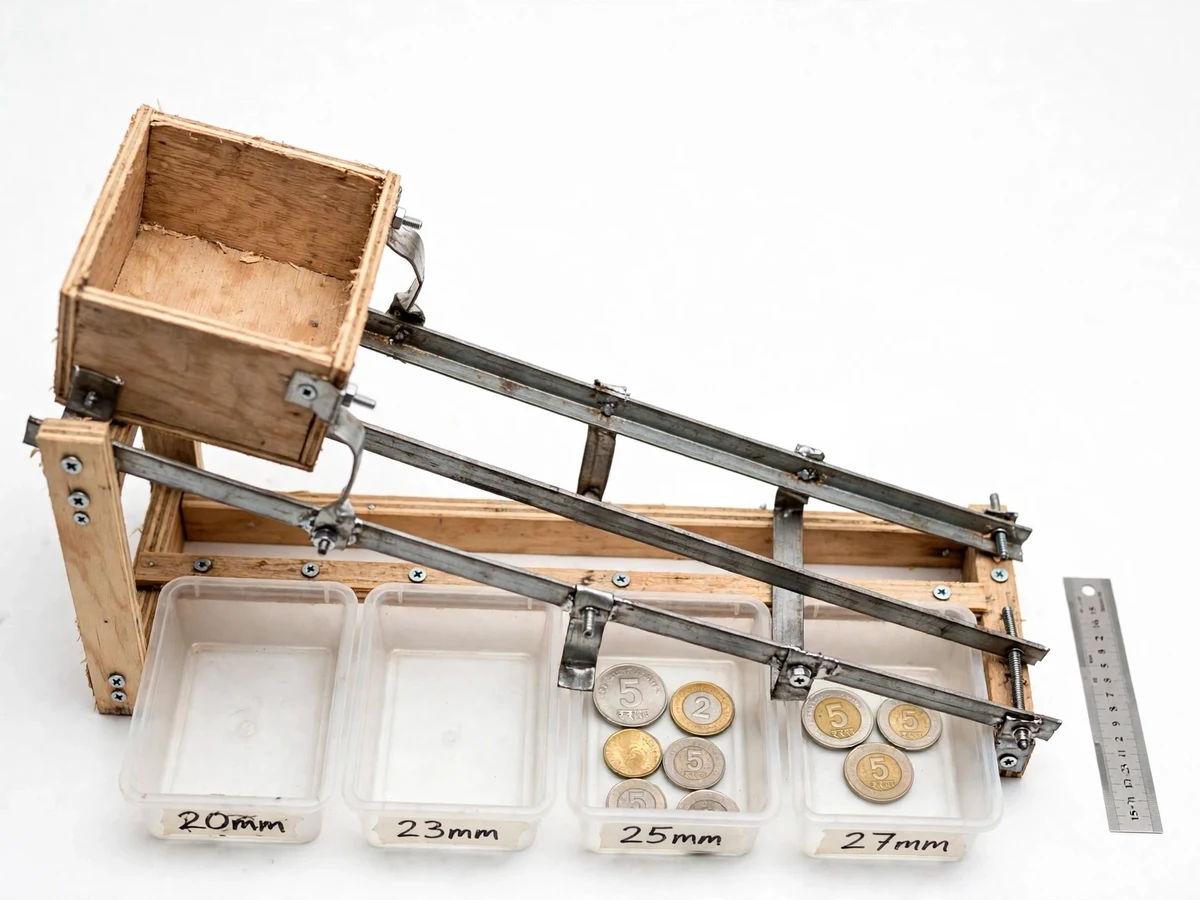
A coin sorter with calibrated inclined rails is a gravity-powered machine that separates mixed Indian coins by diameter. Coins are poured into a plywood hopper, pass a hand-operated anti-jam gate, and roll one at a time down steel rails set at an 8–12 degree incline. The rail gap widens in stepped stages — about 20.5, 22.5, 23.5, 25.5 and 27.5 mm — each roughly half a millimetre wider than a nominal 2019-series Indian coin diameter (₹1 at 20 mm to ₹10 at 27 mm). A coin rolls downhill until it reaches the first stage whose gap is wider than its own diameter, then falls into the tray below that stage. The entire sorting decision is made by one physical number: the rail gap. Because the 2011 and 2019 series are both legal tender and share diameters across denominations, the machine honestly separates diameter classes, and that clash is documented as a design constraint.
Mixed Indian coins are poured into the plywood hopper, which holds about 50 coins.
Follow the working sequence
How it works
The coin sorter works on a single rule: a coin falls through the rails at the first stage where the rail gap is wider than the coin's diameter. The operator pours mixed coins into the plywood hopper and nudges the anti-jam gate so coins enter the rail channel one at a time, each riding on the two rail edges as it rolls down the 8–12 degree incline. The rail gap widens in five calibrated steps, so the smallest coins meet a wider-than-themselves gap early and drop into the first tray, while larger coins keep rolling past the narrow stages to their own stages further downhill. Because the stages are ordered small-to-large with no two sharing a gap, a coin can only ever fall at one stage, which makes the sorting deterministic. The whole cycle needs only gravity and a hand on the feed gate — no sensor to misread and no code to debug.
- Mixed coins are poured into the feed hopper, which holds approximately 50 coins.
- The operator nudges the anti-jam gate, releasing coins onto the rails one at a time.
- Each coin rolls down the 8–12 degree incline, riding on both rails with its diameter bridging the gap.
- At the first stage where the rail gap exceeds the coin's diameter, the coin drops through into the tray below.
- Larger coins roll past the narrow stages and drop at their own wider stage further downhill.
- Coins matching no stage (foreign or oversized) roll off the open end of the rails into a reject area.
- Rail gaps are re-checked with feeler gauges before each demonstration, since clamp bolts can drift.
Tech stack:
- Mild steel rails
- 12 mm plywood frame
- Feeler gauge set
- M6 bolts · nuts · washers
- Plastic collection trays
- Hand tools · drilling · cutting
- Steel ruler · vernier caliper
- Wood screws · brackets
| Parameter | Value |
|---|---|
| Sorting principle | Diameter-based rail-gap separation, gravity fed |
| Reference coin series | 2019 new series + 2011 series (both legal tender) |
| Rail gap stages | 20.5 / 22.5 / 23.5 / 25.5 / 27.5 mm (design target, ~0.5 mm above nominal) |
| 2019 series diameters | ₹1: 20 mm, ₹2: 23 mm, ₹5: 25 mm, ₹10: 27 mm (official Gazette G.S.R. 184(E), 2019) |
| 2019 series weights | ₹1: 3.09 g, ₹2: 4.07 g, ₹5: 6.74 g, ₹10: 7.74 g (official Gazette G.S.R. 184(E), 2019) |
| Rail incline | 8–12° (design target) |
| Rail length | ~600 mm total, ~120 mm per stage (approximate) |
| Throughput | 10–15 coins/min single channel (design target, feed-rate dependent) |
| Hopper capacity | ~50 coins (approximate) |
| Tray capacity | ~40–50 coins per tray (approximate) |
| Frame material | 12 mm plywood, 25 × 3 mm MS flat rails |
| Fasteners | M6 bolts with washers at each rail clamp |
| Electronics | None — purely mechanical in the base build |
| Footprint | ~650 × 250 × 300 mm (approximate) |
| Build weight | ~2.5–3 kg (approximate) |
Project features
The coin sorter's capabilities are the calibrated stepped rail gaps that make the sorting decision, the gravity-fed inclined rails that move coins without motors, the feeler-gauge calibration procedure that sets every gap against official mint diameters, and the anti-jam feed gate that keeps coins entering the channel one at a time. Together these give a purely mechanical machine that takes a mixed handful of Indian coins and returns them grouped into diameter trays, with every set dimension recorded on a calibration sheet. The prototype is a genuine workshop build — plywood, mild-steel flats, M6 bolts — so the review discussion can stay on tolerance design, measurement and fabrication rather than on borrowed electronics. There is deliberately no sensor, microcontroller or code in the base build; the mechanism is the whole point, and an optional coin counter exists only as a separate customization.
- [Calibrated stepped rail gaps] The rails are bolted in five gap stages (20.5, 22.5, 23.5, 25.5, 27.5 mm design target) matched to official mint diameters plus a half-millimetre clearance, so each coin drops exactly at its stage.
- [Gravity-fed inclined rails] A single pair of mild-steel rails at an 8–12 degree incline moves coins from hopper to trays with no motor, belt or vibration source.
- [Feeler-gauge calibration procedure] Every gap is set with feeler gauges in 0.5 mm steps and verified with real coins before delivery; the set values are recorded on the calibration sheet.
- [Anti-jam feed gate] A hinged plywood flap at the hopper exit, nudged by hand, metres coins into the channel one at a time and breaks up coin bridges.
- [Collection tray set] Five labelled trays (20, 22, 23, 25, 27 mm diameter classes) park under the rail stages and catch each sorted group.
- [Adjustable rail clamps] Slotted brackets with M6 bolts let every gap be re-set, so the machine can be reconfigured for foreign coins or tokens later (configurable).
- [Coin-twirl verification test] Each denomination is dropped by hand through every stage during build sign-off to confirm it falls at exactly its intended stage (implemented build test).
- [Plywood feed hopper] A simple four-sided hopper holding approximately 50 coins feeds the rails without spilling.
What is included
- Working mechanical coin sorter prototype (rails, plywood frame, feed hopper, five trays)
- Rail-gap calibration record sheet with the set value at each stage
- Component and fastener list with sizes
- Assembly and calibration guide (feeler-gauge procedure + coin-twirl test)
- Project report PDF (background, mechanism theory, fabrication, calibration data, results)
- PPT presentation for final review
- Viva Q&A preparation document (tolerance design, calibration, limitations)
- Demonstration guidance for feeding coins during the review
Limitations & prerequisites
- The machine sorts by diameter, not denomination: the 2011 and 2019 series are both legal tender and share diameters (2011 ₹5 = 23 mm = 2019 ₹2; 2011 ₹2 = 25 mm = 2019 ₹5), so those pairs land in the same tray and cannot be separated by this machine.
- ₹10 and ₹20 coins share the 27 mm diameter in the 2019 series, so the base build does not separate them; a thickness-based stage is a customization.
- Worn, bent or edge-damaged coins deviate from nominal diameters and may drop at the wrong stage; the machine assumes near-mint coin geometry.
- Throughput is limited by manual feeding (10–15 coins/min design target) — this is a demonstration prototype, not a production coin-processing machine.
- Rail gaps can drift if clamp bolts loosen in transport, so gaps must be re-checked with feeler gauges before each demonstration.
- Polygonal coins such as the 12-edged ₹20 roll unevenly and may jam between the rails.
- The prototype is an academic demonstration build and is not an industrial or bank-grade sorting device.
Frequently Asked Questions
Is this project suitable for a final-year project?
Yes. It suits Mechanical, Mechatronics and Production/Industrial Engineering final-year projects, demonstrating tolerance design, a documented calibration procedure, workshop fabrication with hand tools, and honest treatment of measurement limits. The mechanism is simple enough to explain completely in a viva, yet the calibration data, cross-series diameter clash and anti-jam design give genuine depth for the report and discussion.
Which coin dimensions does the design use?
The 2019 new series from the official Gazette notification G.S.R. 184(E) (2019): ₹1 at 20 mm (3.09 g), ₹2 at 23 mm (4.07 g), ₹5 at 25 mm (6.74 g), and ₹10 at 27 mm (7.74 g). The 2011 series is also referenced because both series are legal tender — its ₹1 is 22 mm, ₹2 is 25 mm, ₹5 is 23 mm and ₹10 is 27 mm.
Does it need electricity, sensors or programming?
No. The base build is purely mechanical — gravity moves the coins, the rail gap makes the sorting decision, and a hand-operated gate controls feeding. There is deliberately no microcontroller, sensor or code, which keeps fabrication and debugging entirely in the mechanical domain. An IR beam coin counter per tray is available as a separate customization if counting is required.
How are the rail gaps calibrated?
Each gap is set with feeler gauges in 0.5 mm steps to sit about half a millimetre above its nominal coin diameter, then locked with M6 clamp bolts and recorded on the calibration sheet. After setting, every denomination is dropped by hand through every stage — the coin-twirl verification test — to confirm it falls at exactly its intended stage before the build is signed off.
Can it count the coins as well as sort them?
Not in the base build — it separates coins into trays but keeps no totals. An IR beam sensor mounted across each tray throat with an LCD total is available as a customization, developed separately with its own wiring and code. The report lists this honestly under future scope rather than implying it is already built.
What will I receive with the project?
The working prototype with its five collection trays, the rail-gap calibration record sheet, a component and fastener list, an assembly and calibration guide, the project report PDF, a review PPT and a viva Q&A document. Everything is prepared fresh for the order, and the report's calibration table carries the actual gap values set on the delivered build.
Components & software requirements
- Mild steel rails
- 12 mm plywood frame
- Feeler gauge set
- M6 bolts · nuts · washers
- Plastic collection trays
- Hand tools · drilling · cutting
- Steel ruler · vernier caliper
- Wood screws · brackets
Delivery information
Built-to-order project. Delivery timeline is shared after order confirmation based on current queue.
Support terms
Complete documentation, setup guide, and viva preparation included. Support for setup and explanation provided.
Download free synopsis (PDF)
Enter your name and WhatsApp number — the synopsis PDF downloads immediately. We may send occasional project updates on WhatsApp; no spam.