
More project photos (2)
The problem
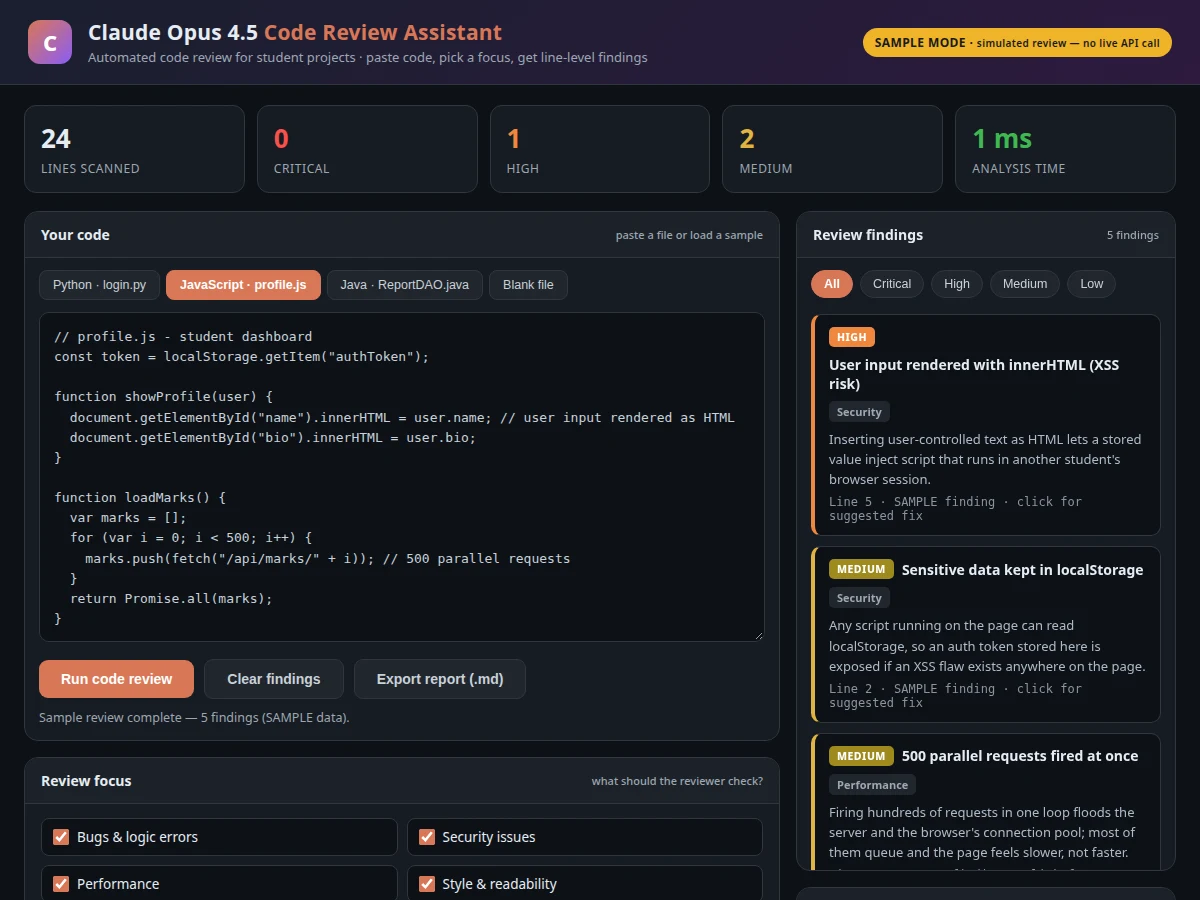
The Claude Opus 4.5 Based Automated Code Review Assistant for Student Projects is a web application that sends a student's project code to Anthropic's Claude Opus 4.5 model through the API and returns line-level review findings, each with a severity, a category and a suggested fix. Student teams usually review each other's code informally or not at all: a tired teammate misses a SQL injection, a hard-coded password or a database connection that is never closed, and the problem surfaces only during the demonstration or the viva. Manual review also depends entirely on who happens to be available, so the same file gets a careful read one week and a glance the next. This project replaces that uneven process with a repeatable one: the student uploads a file, picks review focus areas such as security, bugs and performance, and receives the same structured findings every time, with every review saved so the team can check whether earlier findings were fixed.
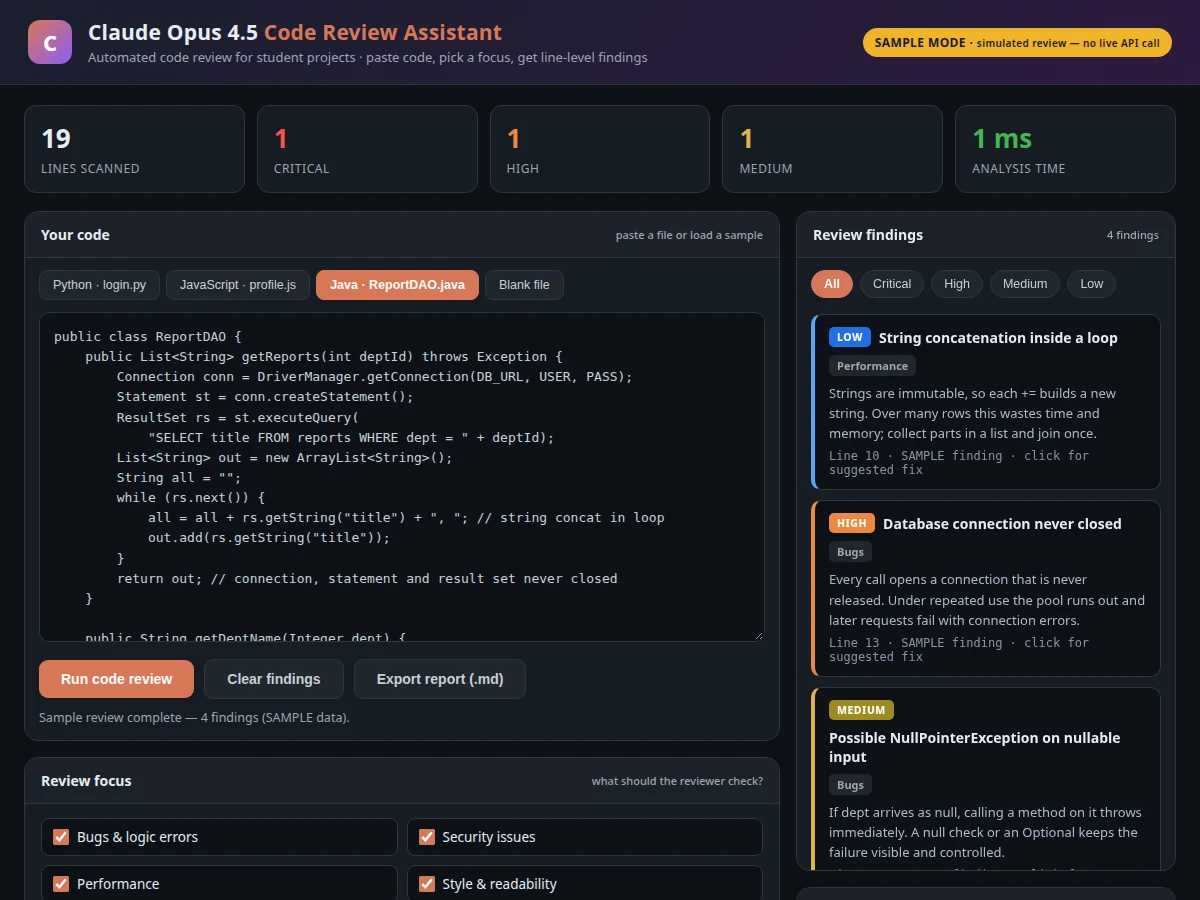
The student pastes a Python, JavaScript or Java file, or loads one of the three sample files.
Follow the working sequence
How it works
Code flows from the student's file through the web app to Claude Opus 4.5 and back as a structured findings report. The student pastes or uploads a source file and selects review focus areas; the backend checks the file size against the model's 200,000-token context window, builds a prompt that includes the code, the chosen focus areas and a small set of labelled review examples, and sends it to the Anthropic API. The model returns findings as structured data — line number, severity, category, explanation and suggested fix — which the backend validates, stores in the review history, and renders in the browser as a filterable list. The student applies the fixes, uploads the file again, and the new review shows which findings disappeared and which are new, closing the loop between review and repair.
- The student pastes or uploads a Python, JavaScript or Java file and selects focus areas (security, bugs, performance, style, best practices, testing).
- The backend validates the file size and language, then builds the review prompt from the code, the focus areas and few-shot examples drawn from the CodeSearchNet subset.
- The prompt is sent to Claude Opus 4.5 (model id claude-opus-4-5-20251101) through the Anthropic API, and the model returns findings as structured data.
- The backend parses and validates the findings, assigns severity levels, and stores the review with file name, focus areas and timestamp in SQLite.
- The browser shows the findings as a filterable list — severity filters, line numbers, explanations and suggested fixes — with a one-click Markdown report export.
- The student fixes the code, re-uploads the file, and the new review is compared with the previous one so fixed and new findings are visible side by side.
Tech stack:
-
Claude Opus 4.5 API (Anthropic)
-
Python 3 with Flask
-
Anthropic API client
-
HTML · CSS · JavaScript
-
CodeSearchNet corpus
-
SQLite review history
-
Markdown report export
-
Git
-
Dataset: CodeSearchNet corpus — about 2.3 million documented function pairs (about 6.45 million functions in total) across Go, Java, JavaScript, PHP, Python and Ruby, collected from public open-source GitHub repositories by GitHub and Microsoft Research (Husain et al., 2019, arXiv:1909.09436). This project uses a selected Python and JavaScript subset to supply few-shot review examples for the prompt.
-
Classes: None — this is not a classification task, so there is no fixed class list. The corpus is organised by programming language (6 languages), not by defect class; findings are categorised by the reviewer into security, bugs, performance, style, best practices and testing.
-
Task: Code review finding generation; input = source file text plus selected review focus areas; output = a list of findings, each with line number, severity (Critical, High, Medium, Low), category, explanation and suggested fix.
-
Model: Claude Opus 4.5 via the Anthropic API (model id claude-opus-4-5-20251101; 200,000-token context window; released 24 November 2025). The model is not fine-tuned in this project; it is prompted with the code, the focus areas and labelled examples from the CodeSearchNet subset.
-
Metrics: Finding precision and false-positive rate measured on a labelled sample of student code files, plus severity agreement against a human reviewer. No accuracy figure is claimed: the report records the values measured in the buyer's own evaluation run. Anthropic's published 80.9% on SWE-bench Verified is the model's own coding benchmark, not a measurement of this project's review accuracy.
| Parameter | Value |
|---|---|
| Model | Claude Opus 4.5 via Anthropic API |
| Model ID | claude-opus-4-5-20251101 |
| Context window | 200,000 tokens (Anthropic) |
| Anthropic benchmark | 80.9% on SWE-bench Verified (Anthropic's published result, not this project's accuracy) |
| Languages reviewed | Python, JavaScript, Java (3 languages) |
| Review focus areas | 6 (security, bugs, performance, style, best practices, testing) |
| Severity levels | 4 (Critical, High, Medium, Low) |
| Demo sample result | Python sample, 30 lines, 5 findings: 1 Critical, 3 High, 1 Low (measured in the demo build) |
| Demo analysis time | 1 ms for in-browser rule-matching on the 30-line sample (measured in the screenshot run; live API reviews take longer) |
| Review response | Design target under 60 seconds per file (expected; depends on file size and API load) |
| Review storage | SQLite, one record per review with file name, focus areas and timestamp |
| Demo | Single-file web app; sample mode runs offline with no API key |
Project features
The assistant's strongest capabilities are its line-level findings, its severity ranking, its review-focus selection and its review history. Every finding points at an exact line, explains why the code is a problem in plain language, and shows a corrected version the student can paste back, so the review teaches as well as checks. Findings are ranked Critical, High, Medium or Low, so a team with one evening before the demo knows to fix the SQL injection first and the style nits last. The reviewer can be steered: security, bugs, performance, style, best practices and test coverage are separate focus areas, and the review only reports what was asked for. Finally, every review is stored with the file name, focus and date, so the team can prove that findings from the last upload were actually addressed.
- [Line-level findings with suggested fixes] Every finding names the exact line, explains the problem in plain language and shows corrected code, so the student learns the fix instead of just receiving a warning.
- [Severity ranking] Findings are ranked Critical, High, Medium or Low, so the team fixes security and crash-causing issues first and treats style notes as lower priority.
- [Review focus selection] Six focus areas — security, bugs, performance, style, best practices and test coverage — can be switched on or off per review, so a security pass and a style pass are separate, readable reports.
- [Review history and fix tracking] Every review is saved with file name, focus areas and timestamp, and a re-uploaded file is compared with its previous review so fixed and new findings are visible side by side.
- [Multi-language support] Python, JavaScript and Java files are reviewed in the base project, with the language detected from the uploaded file.
- [Severity and category filters] The findings list filters by severity and category in the browser, so a team can work through all Critical security items before looking at anything else.
- [Markdown report export] Any review can be downloaded as a Markdown report listing every finding with its line, severity, explanation and suggested fix, ready to attach to the project documentation.
What is included
- Complete Flask web application source code (file upload, prompt builder, Anthropic API client, review history)
- Working single-file demo with labelled sample reviews in Python, JavaScript and Java
- Prompt templates and the CodeSearchNet subset selection used for few-shot review examples
- SQLite review-history database schema and setup instructions
- Project report PDF (background, model and dataset details, methodology, evaluation procedure)
- PPT presentation for final review
- Viva Q&A preparation document (LLM prompting, API integration, evaluation limits, SWE-bench context)
Limitations & prerequisites
- Review findings are model suggestions, not guarantees — false positives and missed defects both occur, so every finding needs human verification before a fix is applied.
- Live reviews need internet and a paid Anthropic API key; usage is billed per token by Anthropic, so cost grows with file size.
- The model cannot run the code, so runtime-only defects such as race conditions and environment-specific failures are out of scope.
- A single review is bounded by the 200,000-token context window; prompt plus code plus response must fit inside it, so very large files must be split.
- Review quality depends on the prompt examples; languages without labelled examples in the CodeSearchNet subset give weaker results.
- The demo's sample findings are simulated in the browser and labelled SAMPLE — they are not live API results.
- The project does not replace a human reviewer or a test suite; it finds likely issues, it does not prove code correct.
Frequently Asked Questions
Which model is used and how is it called?
Claude Opus 4.5 is the review model, called through the Anthropic API with the model id claude-opus-4-5-20251101 and a 200,000-token context window, as published by Anthropic. The backend sends the code, the selected focus areas and a few labelled examples in one prompt and receives structured findings back. The model is not fine-tuned; the project uses prompt design, and a valid Anthropic API key is required for live reviews.
Which dataset is used and what is it for?
The CodeSearchNet corpus, released by GitHub and Microsoft Research, supplies the review examples: about 2.3 million documented function pairs across six languages, from which a Python and JavaScript subset is selected. It grounds the review prompt with real code instead of invented examples. The dataset is not used to train or fine-tune any model; it only provides the few-shot examples in the prompt.
Is the review accuracy guaranteed?
No, review accuracy is not guaranteed: findings are suggestions from a language model, and the model can miss real defects or flag correct code, so every finding must be checked by a human before a fix is applied. Anthropic's published 80.9% on SWE-bench Verified is the model's own coding benchmark, not a measurement of this project's review accuracy. The report documents precision and false-positive rate measured on a labelled sample of student code instead.
Does the project need internet and an API key?
Yes, live reviews need internet and a valid Anthropic API key, because the code is sent to Claude Opus 4.5 through the API and usage is billed per token. The web demo's sample mode runs entirely offline in the browser, which is how the review flow is demonstrated without a key. The key is stored in an environment variable on the server, never in the source code.
Can it review other languages or add new checks?
Yes, within limits: Python, JavaScript and Java are supported in the base project, and a new language or check is added by extending the prompt template and the labelled example set, without changing the review pipeline. Languages far from the example set need their own examples first, because review quality depends on the prompt examples the model is shown. The demo already shows the same pipeline working across three languages.
Is this project suitable for a final-year project?
Yes, for Computer Science, IT and AI & Machine Learning students, because it combines API integration with a current frontier model, prompt design, structured output handling and a working web application in one build. It also gives the student an honest evaluation task: measuring the reviewer's precision and false-positive rate and explaining where the system fails. The viva discussion can cover why a model suggestion is not a proof, how the evaluation was run, and where the system fails.
Components & software requirements
- Claude Opus 4.5 API (Anthropic)
- Python 3 with Flask
- Anthropic API client
- HTML · CSS · JavaScript
- CodeSearchNet corpus
- SQLite review history
- Markdown report export
- Git
Delivery information
Built-to-order project. Delivery timeline is shared after order confirmation based on current queue.
Support terms
Complete documentation, setup guide, and viva preparation included. Support for setup and explanation provided.
Download free synopsis (PDF)
Enter your name and WhatsApp number — the synopsis PDF downloads immediately. We may send occasional project updates on WhatsApp; no spam.