
More project photos (2)
The problem
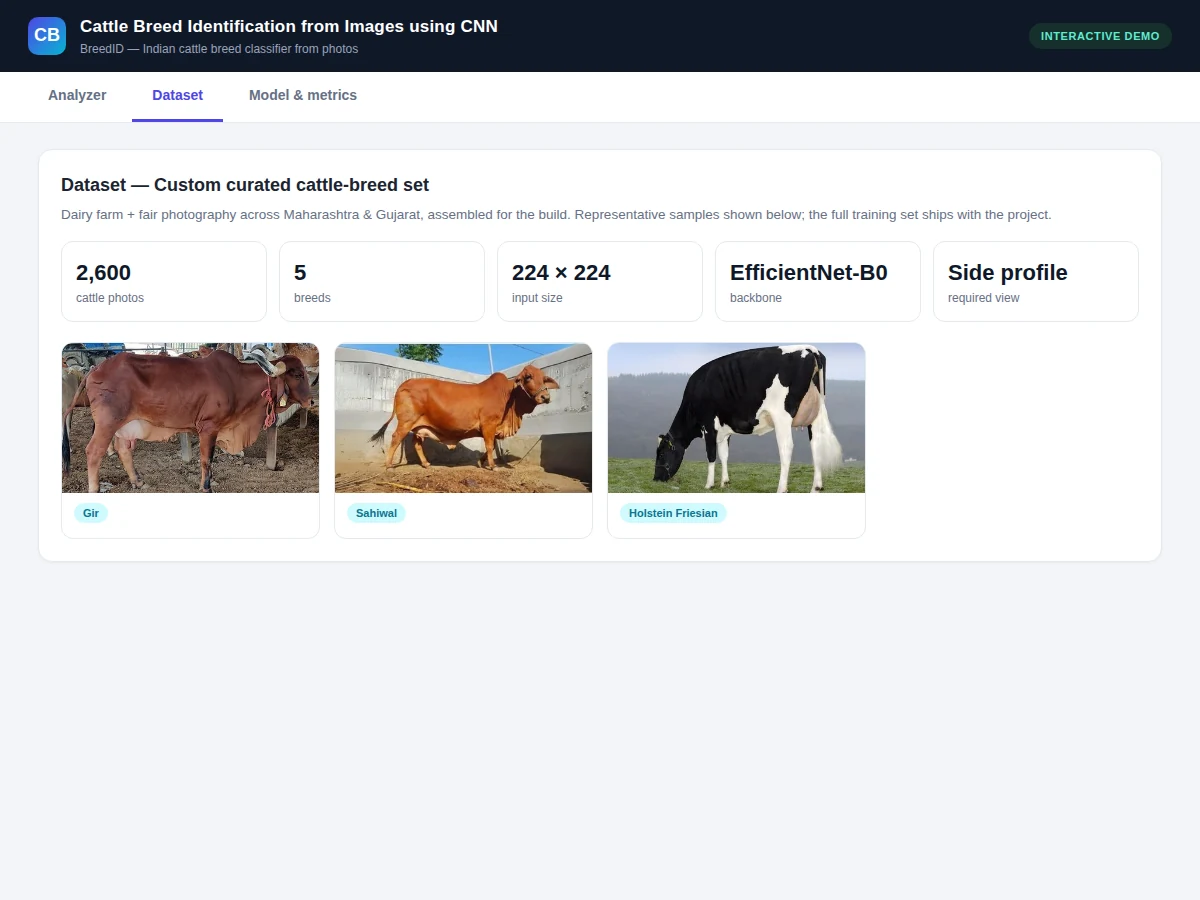
Breed identification matters for dairy management, insurance, breeding programs and cattle fairs — yet it still relies on expert eyes, and crossbred animals confuse even experienced judges. This project trains an EfficientNet-B0 classifier on about 2,600 cattle photographs across five breeds, with a YOLOv8n animal detector cropping the animal first so the classifier learns breed features instead of backgrounds. Students learn a practical two-stage pipeline, the importance of consistent viewpoints in fine-grained classification, and how to evaluate where visually similar breeds (Gir vs Sahiwal) get confused. The demo identifies sample cattle photos with representative predictions and breed trait cards.
How it works
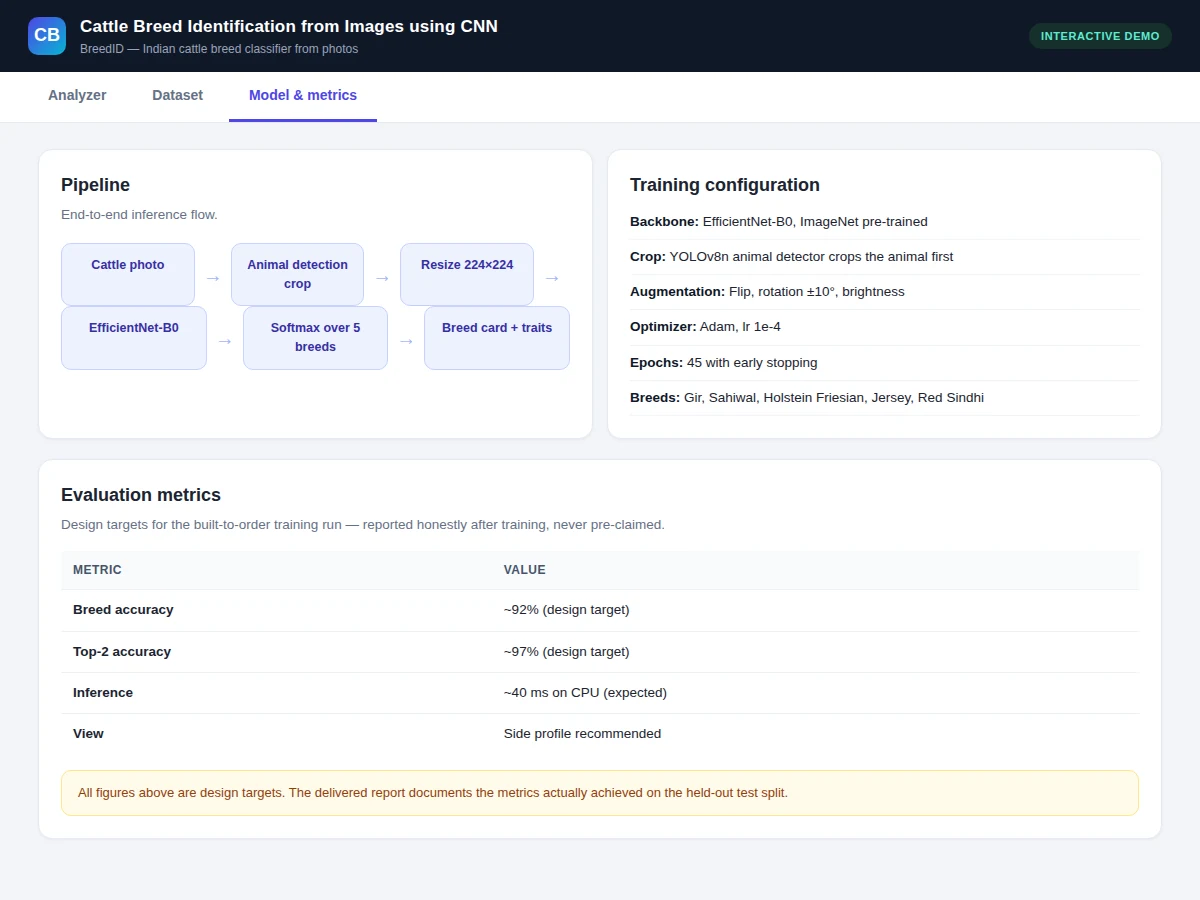
- Cattle photographs are collected from dairy farms and fairs and labelled by breed; side profiles are preferred.
- A YOLOv8n animal detector crops the animal region from each photo to remove background bias.
- Crops are resized to 224×224, normalized and split into stratified train/validation sets.
- EfficientNet-B0, pre-trained on ImageNet, is fine-tuned with a new classification head.
- Training uses Adam with early stopping; the held-out split gives accuracy and per-breed metrics.
- The web demo identifies sample cattle photos through the same pipeline with representative predictions.
- Breed trait cards (origin, coat, yield traits) accompany each prediction in the demo.
Tech stack:
- Python 3, TensorFlow/Keras
- EfficientNet-B0 (transfer learning)
- YOLOv8n (animal crop)
- NumPy, Matplotlib, scikit-learn
- Jupyter Notebook (training)
- HTML/CSS/JS identification demo
- Pillow
Dataset & model details
- Dataset: Custom curated cattle-breed set — ~2,600 cattle photographs from dairy farms and fairs across Maharashtra and Gujarat, labelled into 5 breeds: Gir, Sahiwal, Holstein Friesian, Jersey, Red Sindhi; side-profile views preferred; stratified 80/20 split.
- Task: 5-class fine-grained image classification; input = 224×224×3 animal crop, output = breed probabilities.
- Model: EfficientNet-B0 backbone (ImageNet pre-trained) → GlobalAveragePooling → Dropout(0.3) → Dense(5, softmax); ~5.3M parameters; YOLOv8n cropper upstream.
- Metrics: Breed accuracy ~92% (design target), top-2 accuracy ~97% (design target), per-breed precision/recall. No accuracy is claimed as measured until the training run is executed for the order.
| Parameter | Value |
|---|---|
| Input format | 224 × 224 RGB animal crop |
| Classes | 5 cattle breeds |
| Dataset size | Approximately 2,600 labelled photos |
| Model parameters | Approximately 5,300,000 |
| Breed accuracy | ~92% (design target, not a measured claim) |
| Training time | Approximately 1–2 h on a free GPU (expected) |
| Inference | Approximately 40 ms per image on CPU (expected) |
| Model file | Approximately 21 MB (.h5) |
| Demo | Single-file web app, runs offline after download |
Project features
- Five-breed classifier Gir, Sahiwal, Holstein Friesian, Jersey, Red Sindhi — the breeds most relevant to Indian dairy, with per-breed metrics.
- Animal-crop preprocessing A YOLOv8n detector crops the animal before classification, so backgrounds don't leak into breed features.
- Curated breed dataset About 2,600 cattle photographs from dairy farms and fairs, labelled by breed with side-profile views preferred.
- Breed trait cards Each prediction shows origin, coat, and typical milk-yield traits — useful context beyond the label.
- Interactive identification demo Single-file web app: pick a sample cattle photo and see the predicted breed with probability bars.
- Fine-grained evaluation Confusion matrix highlights Gir/Sahiwal confusion — the honest hard case, documented for the viva.
- Viva kit Report PDF, PPT and Q&A covering fine-grained classification, transfer learning and detector-crop pipelines.
What is included
- Curated, labelled cattle-breed dataset with split files
- Animal-crop + training Jupyter notebooks
- Trained EfficientNet-B0 model with preprocessing code
- Interactive identification web demo with sample photos
- Confusion matrix and per-breed metrics
- Breed trait reference cards
- Project report PDF, PPT presentation
- Viva Q&A preparation document
Limitations & prerequisites
- Crossbred animals fall between classes; the model reports the closest breed with lower confidence.
- Side-profile photos are recommended — head-on or partial views degrade accuracy.
- 92% is a design target, stated honestly — the report documents the actual achieved figure.
- Trait cards are reference information, not veterinary advice.
- Only the five covered breeds are supported; new breeds need new labelled data.
Frequently Asked Questions
Which dataset is used?
A custom curated set of about 2,600 cattle photographs from dairy farms and fairs in Maharashtra and Gujarat, labelled Gir, Sahiwal, Holstein Friesian, Jersey or Red Sindhi, with side-profile views preferred and a stratified split.
Why crop the animal first?
Backgrounds (sheds, fields, fairs) correlate with breeds in farm photos; without cropping the model can learn the background instead of the animal. The report shows this bias analysis.
Which breeds confuse it most?
Gir vs Sahiwal — both reddish indigenous breeds with similar build. The confusion matrix documents this honestly and it makes a strong viva discussion on fine-grained classification.
How does the demo work?
Pick a sample cattle photo and press run; the app shows the predicted breed with probability bars and a trait card — representative of the trained model on these samples.
Can it identify crossbred cattle?
It reports the closest matching breed with lower confidence. True crossbreed quantification would need a different labelling scheme, listed as future scope.
Is this project suitable for a final-year project?
Yes — for AI & Machine Learning programs. It demonstrates fine-grained classification, detector-crop pipelines and honest evaluation on a real dairy-management problem. Suitable for B.E./B.Tech final-year projects in AI & Machine Learning.
Components & software requirements
- Python 3, TensorFlow/Keras
- EfficientNet-B0 (transfer learning)
- YOLOv8n (animal crop)
- NumPy, Matplotlib, scikit-learn
- Jupyter Notebook (training)
- HTML/CSS/JS identification demo
- Pillow
Dataset & model details
- Dataset: Custom curated cattle-breed set — ~2,600 cattle photographs from dairy farms and fairs across Maharashtra and Gujarat, labelled into 5 breeds: Gir, Sahiwal, Holstein Friesian, Jersey, Red Sindhi; side-profile views preferred; stratified 80/20 split.
- Task: 5-class fine-grained image classification; input = 224×224×3 animal crop, output = breed probabilities.
- Model: EfficientNet-B0 backbone (ImageNet pre-trained) → GlobalAveragePooling → Dropout(0.3) → Dense(5, softmax); ~5.3M parameters; YOLOv8n cropper upstream.
- Metrics: Breed accuracy ~92% (design target), top-2 accuracy ~97% (design target), per-breed precision/recall. No accuracy is claimed as measured until the training run is executed for the order.
Delivery information
Built-to-order project. Delivery timeline is shared after order confirmation based on current queue.
Support terms
Complete documentation, setup guide, and viva preparation included. Support for setup and explanation provided.