
More project photos (2)
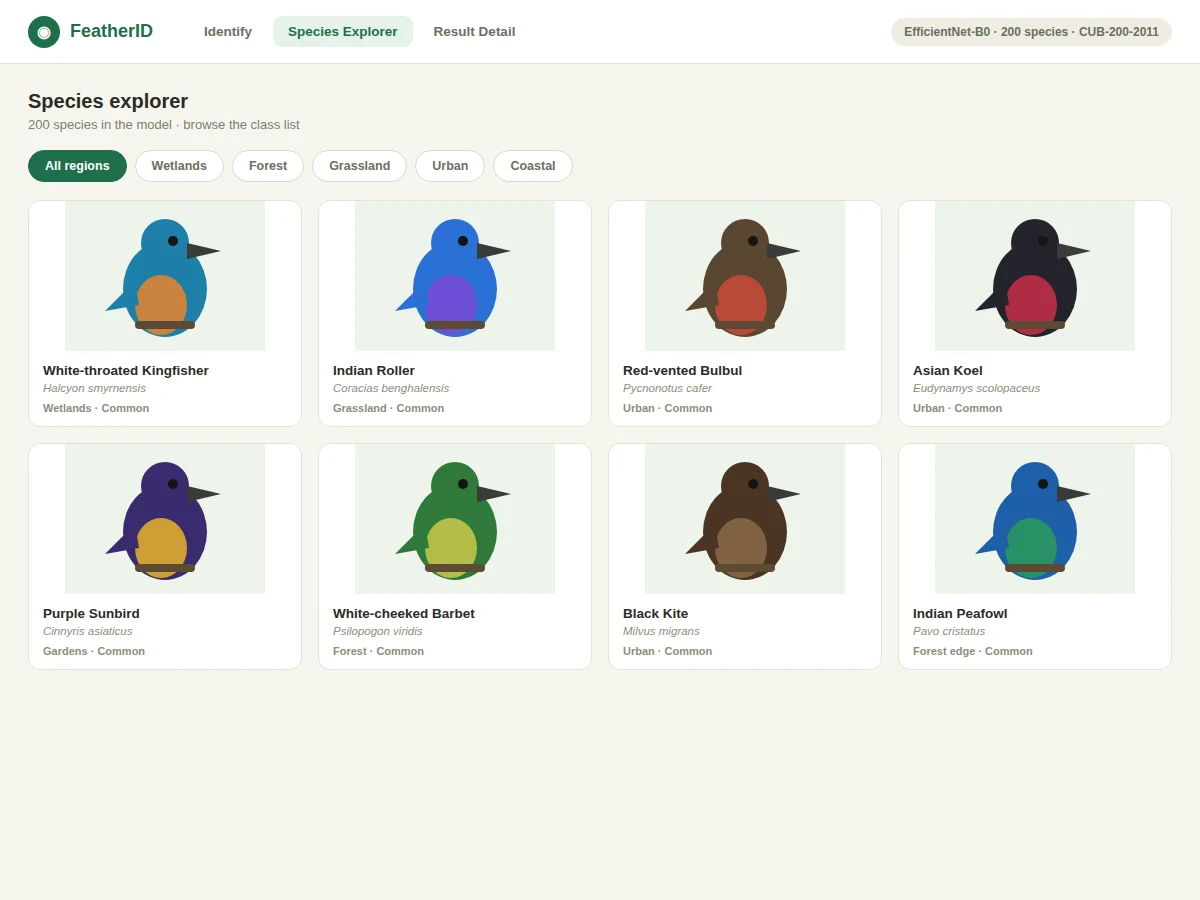

The problem
Telling 200 similar-looking bird species apart takes years of field practice: a sparrow is not a wren, and the differences hide in beak shape, wing bars and posture. Beginners, students and citizen scientists lack an accessible tool that identifies a bird from a photograph and shows how confident it is. Generic image search is inconsistent, and manual identification from field guides is slow and error-prone for non-experts. This is exactly the fine-grained classification problem — one of the hardest in computer vision — where classes differ only in subtle visual cues and the training strategy matters as much as the model. An automated classifier trained on a large annotated set closes the gap: upload a photo, get ranked species predictions with confidence, and learn what distinguishes them. For students, the project is valuable precisely because it is difficult — transfer learning, augmentation and gradual unfreezing become genuinely necessary, and the per-class error analysis gives examiners plenty to discuss.
Frequently asked questions
- Which dataset is used? CUB-200-2011 (Caltech-UCSD Birds-200-2011): 11,788 annotated photographs across 200 species, the standard academic benchmark for fine-grained classification. The report documents the split and class distribution used in the build.
- Which model is used? EfficientNet-B0, fine-tuned from ImageNet weights with the classifier head replaced by a 200-way output layer and deeper blocks gradually unfrozen at a lower learning rate.
- Is the accuracy guaranteed? No. The design target is roughly 75-80% top-1 accuracy; the training notebook computes the actual top-1 and top-5 accuracy on a held-out split, and the report documents the procedure and error analysis honestly.
- Why EfficientNet-B0 instead of a bigger model? Compound scaling gives the best accuracy-per-parameter of its generation, so B0 trains fast, fits on modest GPUs and infers in well under a second on CPU — practical for a student build and demo.
- Is this project suitable for a final-year project? Yes. It suits B.E./B.Tech students in Computer Science, AI/ML and Data Science, demonstrating transfer learning, fine-grained classification, augmentation, top-k accuracy evaluation and a Flask deployment.
- What will I receive? Complete source code, trained .pth weights, dataset preparation and stratified-split scripts, project report PDF, PPT presentation, viva Q&A document and a setup guide.
How it works
Dataset & model:
Dataset name: CUB-200-2011 (Caltech-UCSD Birds-200-2011).
Source: publicly released academic benchmark for fine-grained classification.
Task: 200-class fine-grained image classification.
Classes: 200 North American bird species (11,788 images total), each with common and scientific names.
Model: EfficientNet-B0, fine-tuned from ImageNet transfer learning with gradual unfreezing.
Input: bird photograph, resized to 224x224 and normalized.
Prediction: 200-way softmax over species classes.
Output: top-5 ranked species with confidence bars, plus the predicted bird's fact card.
Evaluation metrics: top-1 and top-5 accuracy, loss curves, confusion matrix, per-class accuracy report — computed by the training notebook on the held-out split during the build.
Design target: ~75-80% top-1 accuracy on the held-out split. This is a design target, not a measured claim; the notebook computes the actual scores during the build.
Working:
- Training phase: CUB-200-2011 images are split into train, validation and held-out splits with stratified sampling; training images are augmented each epoch with random crops, horizontal flips and color jitter.
- An EfficientNet-B0 pre-trained on ImageNet is loaded and its classifier head is replaced with a 200-way output layer; the new head is trained first, then deeper blocks are gradually unfrozen with a lower learning rate.
- Evaluation phase: the training notebook computes top-1 and top-5 accuracy on the held-out split, logs loss curves and builds a confusion matrix with a per-class accuracy report.
- Inference phase: the Flask app resizes each uploaded photo to 224x224, normalizes it and runs one forward pass through the trained model.
- The top-5 species with confidence bars are displayed alongside a fact card (common name, scientific name) for the predicted bird.
- Photos similar to the training data (daylight, reasonably full bird in frame) classify best; blurry or partial birds are reported honestly as less reliable in the demo guidance.
Specifications:
Model | EfficientNet-B0, fine-tuned (ImageNet transfer learning)
Dataset | CUB-200-2011: 11,788 images, 200 species
Metric | Top-1/top-5 accuracy — logged by the training notebook on the held-out split during the build
Design target | ~75-80% top-1 accuracy (design target, not a measured claim)
Input | User-uploaded bird photo, auto-resized to 224x224
Inference | Well under a second per image on CPU (design target)
Demo app | Flask web app with upload UI and top-5 results
Weights | .pth file shipped with the build
Project features
[200-Class Bird Species Classification] (implemented) — The fine-tuned EfficientNet-B0 classifier predicts the species of any uploaded bird photo across all 200 CUB-200-2011 classes.
[Top-1 and Top-5 Predictions] (implemented) — The demo shows the single best guess plus the top-5 ranked species with confidence scores, which is more informative when near-identical species compete.
[Prediction Visualization] (implemented) — The top-5 species are ranked with confidence bars and the predicted bird's fact card (common name, scientific name) from the class list.
[Species Fact Cards] (implemented) — Each predicted species displays its common and scientific name drawn from the dataset's class list, making the demo informative for non-experts.
[Data Augmentation Pipeline] (implemented) — Random crops, horizontal flips and color jitter are applied to training images each epoch to reduce overfitting on the fine-grained classes.
[Training & Evaluation Notebook] (implemented) — Logs top-1/top-5 accuracy and loss curves during training and computes a confusion matrix and per-class accuracy report on the held-out split.
[CPU-Speed Inference] (implemented) — The lightweight B0 model infers in well under a second per image on a regular laptop CPU, so the review demo needs no GPU.
[Configurable Top-k Display] (configurable) — The number of displayed ranked predictions and confidence formatting can be adjusted in the app settings.
What is included
Complete source code (training, evaluation, inference, Flask app)
Trained EfficientNet-B0 weights (.pth)
Dataset preparation and stratified-split scripts
Project report PDF (dataset background, methodology, evaluation, error analysis)
PPT presentation for the final review
Viva Q&A preparation document (CNNs, transfer learning, fine-grained classification, top-k accuracy, compound scaling)
Setup guide (environment, dependencies, dataset download steps)
Limitations & prerequisites
CUB-200-2011 covers North American species photographed mostly in daylight — birds outside this set, or in poor light, are misclassified more often.
Fine-grained classes (near-identical sparrows, gulls) remain the main error source; the report documents per-class confusion honestly.
Cluttered backgrounds and partial birds degrade results.
All reported figures are design targets from the buyer's own training run; no pre-measured accuracy is claimed.
This is an educational prototype, not a substitute for expert ornithological identification.
Components & software requirements
Python 3.10
PyTorch and timm
Torchvision, NumPy, scikit-learn
Matplotlib, Seaborn
Flask
CUB-200-2011 dataset (public; preparation and stratified-split scripts included)
GPU recommended for training (cloud-GPU guidance included); inference runs on CPU
Delivery information
Built to order — the source code, trained weights, project report, PPT and viva Q&A are prepared fresh for each buyer after the order is placed. The delivery schedule is confirmed at order time, and includes time for training the model and assembling the complete documentation kit.
Support terms
- Environment and dependency setup guidance, including dataset download steps.
- Viva preparation support covering transfer learning, compound scaling, fine-grained classification and top-k metrics.
- Explanation of the training notebook output and how to present the evaluation in the review.
- Discussion of feasible customizations before ordering, such as extra species classes or a custom dataset build.