
More project photos (2)
The problem
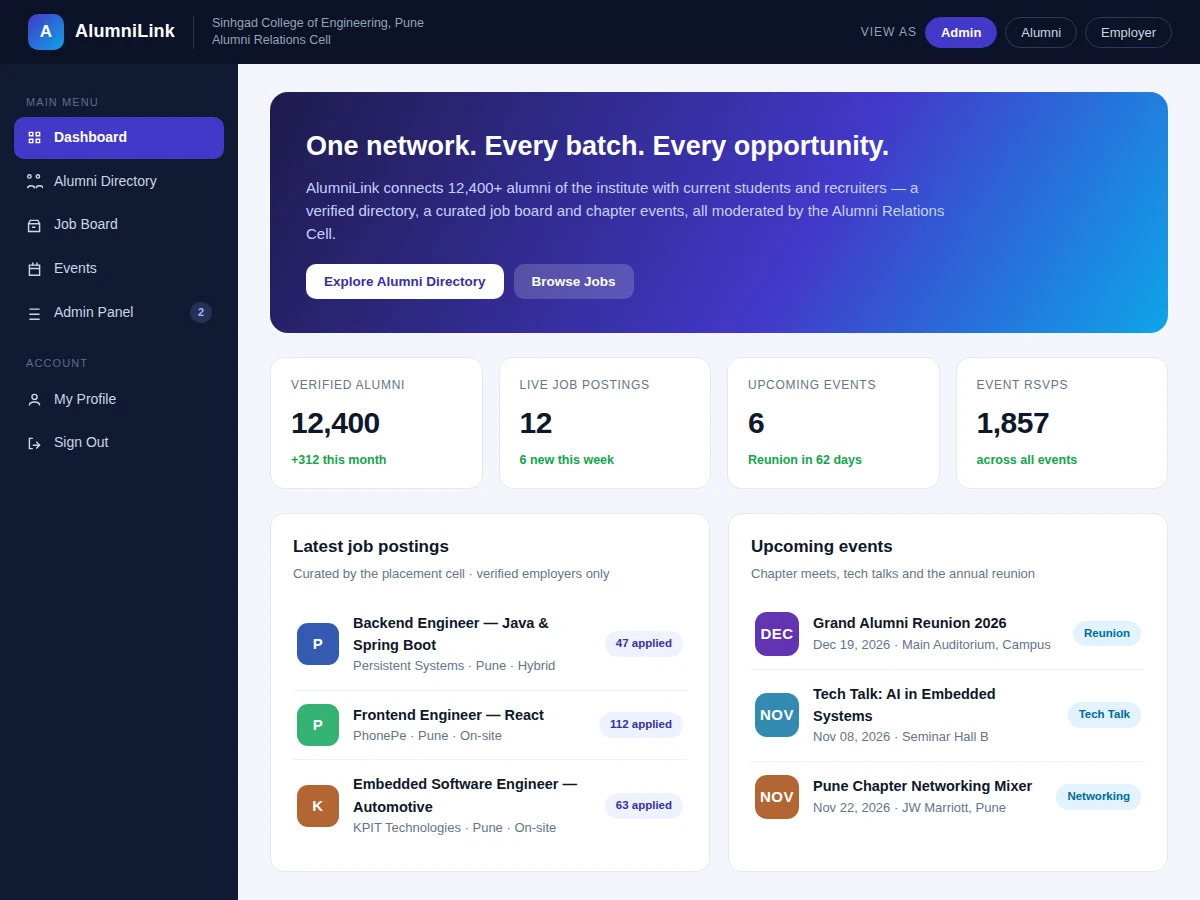
An alumni portal with job board and event management is a web platform that keeps a college's graduate network connected, searchable and useful long after students graduate. The core of the system is a verified alumni directory: each graduate's current role, company, city, batch and skills are stored in one place, replacing the spreadsheets and scattered chat groups that placement cells usually rely on. A job board sits on top of the directory, where verified employers and alumni post openings targeted at the institute's students and graduates, and every application moves through a visible pipeline from submission to shortlist. The event module manages reunions, tech talks, chapter meets and mentorship circles with one-click RSVP, capacity limits and reminders. Role-based access keeps the three worlds separate: alumni browse and apply, employers post and shortlist, and administrators verify profiles, moderate postings and read engagement reports.
Most colleges lose touch with graduates within two years of convocation because no single system owns the relationship. Placement cells maintain employer contacts on personal phones, alumni associations run on volunteer memory, and event invitations travel through forwarded messages that never reach the right batches. This project treats the alumni network as infrastructure: verified data, governed access and measurable engagement, built with the same stack choices a production startup would make.
Registers with name, batch, branch and current employment details.
Follow the working sequence
How it works
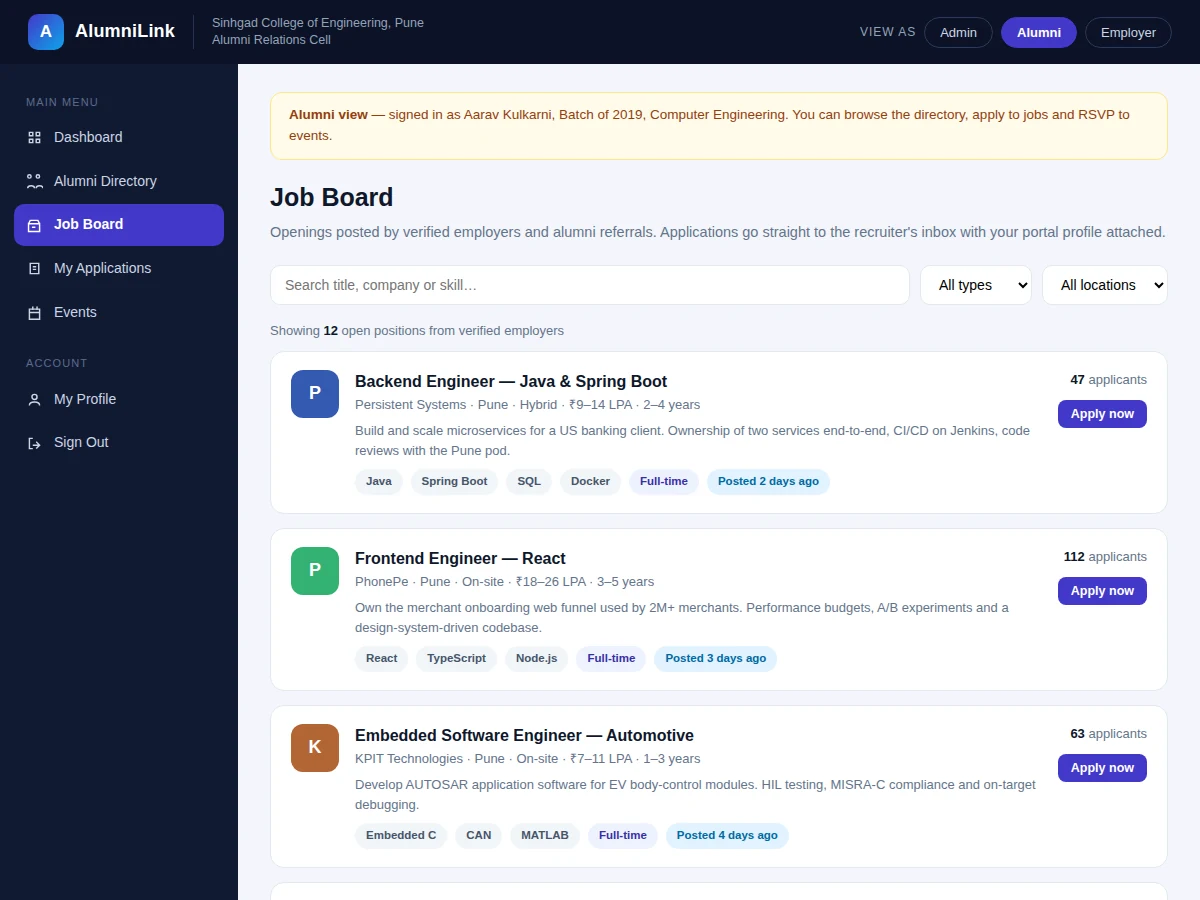
A visitor's journey starts at role selection: the same codebase renders an admin console, an alumni workspace or an employer dashboard depending on who signs in. An alumnus registers with batch and branch details, the admin team verifies the profile, and it enters the searchable directory indexed across seven fields. An employer submits a job posting through a form; the posting waits in the admin review queue and goes live only after approval, which keeps the board free of spam. Alumni apply in one click with their portal profile attached, and each application enters a four-stage pipeline — applied, under review, shortlisted, closed — visible to both applicant and recruiter. Events follow a parallel flow: the admin publishes an event with venue and capacity, alumni RSVP in one click, and capacity counts update automatically. Email notifications fire on application status changes and event reminders, and the admin console tracks registrations, approvals and engagement in one place.
- The alumnus registers with name, batch, branch and current employment details; the profile stays hidden until an admin verifies it.
- Verified profiles enter the searchable directory, indexed across name, company, role, city, batch, branch and skills — full-text search returns across 200 seeded records in about 1 ms, measured in the demo build.
- An employer submits a job posting through a structured form (title, company, location, salary, skills); it waits in the admin review queue and goes live only after approval.
- Alumni apply in one click with their portal profile attached; the recruiter sees each applicant with batch, branch and skills inline.
- Applications move through a four-stage pipeline — applied, under review, shortlisted, closed — and status changes trigger email notifications to the applicant.
- The admin publishes events with venue and capacity; alumni RSVP in one click, headcounts update live, and reminders go out before the event.
Tech stack:
- MongoDB (primary database)
- Express.js · Node.js (backend API)
- React (frontend)
- JWT authentication
- bcrypt password hashing
- Nodemailer · SMTP (email notifications)
- REST API architecture
- HTML · CSS · JavaScript (single-file UI demo build)
| Parameter | Value |
|---|---|
| User roles | 3 — admin, alumni, employer |
| Directory search | Approximately 1 ms across 200 seeded records (measured in the demo build) |
| Application pipeline | 4 stages: applied → under review → shortlisted → closed |
| Password storage | bcrypt hashing, cost factor 12 (design target) |
| Session tokens | JWT, 24-hour expiry (design target) |
| Email delivery | SMTP-based; typically within 1–2 minutes (expected) |
| Demo dataset | 200 fictional alumni, 12 jobs, 6 events |
| Supported browsers | Current Chrome, Edge, Firefox (expected) |
| Build timeline | Approximately 3–4 weeks from order confirmation (estimated) |
Project features
The portal is organized around three working modules plus the access layer that holds them together. The verified alumni directory is the foundation: 200 seeded profiles in the demo build are searchable across name, company, role, city, batch, branch and skills, with directory search measured at about 1 ms in the demo build, and every profile carries a verification badge applied by the admin team. The job board is the second pillar: employers submit postings through a review queue, alumni apply with their portal profile attached, and recruiters track applicants through a four-stage pipeline. The event module is the third: events ship with RSVP tracking, capacity bars and one-click attendance in the demo. Tying it together is role-based access — admin, alumni and employer views render different navigation and permissions from the same codebase — plus an admin moderation console for approvals and engagement statistics.
- [Verified alumni directory] 200 searchable alumni profiles across seven fields (name, company, role, city, batch, branch, skills), with a verification badge workflow — profiles go live only after admin approval.
- [Job board with apply pipeline] Employers submit postings through a moderation queue; approved jobs go live with skill tags and applicant counts, and alumni apply in one click with their portal profile attached.
- [Four-stage application tracking] Every application moves through applied → under review → shortlisted → closed, visible to both the applicant's dashboard and the recruiter.
- [Event management with RSVP] Events carry venue, capacity and category; alumni RSVP in one click, capacity bars update live, and the admin sees headcounts per event.
- [Role-based access control] Three distinct views — admin console, alumni workspace, employer dashboard — rendered from one codebase with route-level permission checks.
- [Admin moderation console] Pending job approvals with approve/reject actions, registration verification queue, and engagement statistics (registrations, live postings, RSVPs).
- [Email notifications] Status-change emails on applications and event reminders, sent through configurable SMTP.
- [Seeded demo dataset] 200 fictional alumni, 12 job postings and 6 events ship with the build so every screen is demonstrable from the first run.
Optional customizations (quoted separately, not in the base build): native Android/iOS apps, paid event ticketing with payment gateway, semantic search over profiles, in-portal messaging between alumni, and bulk alumni-data migration from college records.
What is included
- Complete source code (React frontend + Node.js/Express backend)
- MongoDB schema, models and seed scripts with 200 fictional alumni profiles, 12 job postings and 6 events
- REST API documentation for all endpoints
- Setup and deployment guide (local machine + cloud host)
- Project report PDF (problem, system design, database schema, API reference, testing)
- PPT presentation for final review
- Viva Q&A preparation document
- Working single-file UI demo for presentation walkthroughs
Build timeline
- The standard build completes in approximately 3–4 weeks from order confirmation (estimated), covering development, testing and documentation.
Support
- Setup assistance over call or screen-share until the project runs on the student's machine, plus bug fixes during the build window. Customizations beyond the base build are quoted separately.
Limitations & prerequisites
- The job board covers listing, application and shortlisting only — in-portal interviews, offer letters and onboarding stay outside the base build.
- Email notifications depend on the SMTP provider's quota (typical free tiers allow roughly 100–500 emails per day); reunion-scale mailouts need a paid tier.
- The build ships with 200 fictional alumni records; migrating a college's real alumni data is a separate data-entry exercise, not included.
- Directory search is keyword matching, not semantic search — "ML engineer" will not match a profile that only says "machine learning engineer".
- The base build is responsive web only; native Android/iOS apps are optional customization, not included.
- Paid event ticketing and payment gateway integration are future scope, not part of this build.
Frequently Asked Questions
Is this project suitable for a final-year project?
Yes — for Computer Science, IT and web-development programs. It demonstrates full-stack development: database design, REST APIs, authentication, role-based access and a three-module product (directory, jobs, events). The scope fits a team of 2–4, with each module assignable to one member, which maps cleanly onto project reports and viva questions.
What is the main technology used?
The MERN stack: MongoDB for the database, Express.js and Node.js for the backend API, and React for the frontend. Authentication uses JWT with bcrypt-hashed passwords, and Nodemailer handles email notifications. The presentation demo is a single-file HTML/CSS/JavaScript build of the same interface.
Does the job board include a real application flow?
Yes. Employers submit postings through a moderation queue, approved jobs go live on the board, and alumni apply with their portal profile attached. Recruiters move candidates through a four-stage pipeline — applied, under review, shortlisted, closed — and applicants track status on their dashboard.
Can the portal be hosted online?
Yes. The build targets standard cloud hosting: the Node.js API and React frontend deploy to a VPS or platform service, with MongoDB Atlas as the database. Deployment steps are included in the setup guide; domain and hosting charges are separate and borne by the buyer.
What will I receive with the project?
Complete source code, database schema with seed data, API documentation, setup and deployment guide, project report PDF, PPT presentation, viva Q&A document and a working UI demo. The report documents the real architecture: three roles, directory search, the apply pipeline and the moderation console.
Components & software requirements
- MongoDB (primary database)
- Express.js · Node.js (backend API)
- React (frontend)
- JWT authentication
- bcrypt password hashing
- Nodemailer · SMTP (email notifications)
- REST API architecture
- HTML · CSS · JavaScript (single-file UI demo build)
Delivery information
Built-to-order project. Delivery timeline is shared after order confirmation based on current queue.
Support terms
Complete documentation, setup guide, and viva preparation included. Support for setup and explanation provided.
Download free synopsis (PDF)
Enter your name and WhatsApp number — the synopsis PDF downloads immediately. We may send occasional project updates on WhatsApp; no spam.