
More project photos (3)

The problem
A multimodal large language model (MLLM) is a language model that also reads images, so it can reason about what it sees and answer in words.
vMLLM is a vision-enhanced multimodal large language model: a Multi-level Aggregation Module combines visual features from several layers of the vision encoder, and an Intra- and inter-modal Enhancement Module suppresses irrelevant visual detail while amplifying what matters for the question. This project implements that system for a student build, evaluated across public multimodal benchmarks.
| vMLLM vision-enhanced system (this project) | Standard MLLM (single-layer visual features) | Text-only LLM given an image caption | |
|---|---|---|---|
| Visual features used | Multi-layer features from the vision encoder, aggregated by the Multi-level Aggregation Module | Usually only the final layer of the vision encoder | No direct visual features — only a caption written by another model |
| How irrelevant detail is handled | Intra- and inter-modal Enhancement Module suppresses irrelevant visual information and amplifies task-relevant features | No dedicated enhancement step; the language model must sort signal from noise itself | Irrelevant detail is lost or kept entirely at the caption writer's discretion |
| Tasks evaluated | Visual question answering and related multimodal tasks across public benchmarks | Varies by model, usually the same benchmarks without the aggregation and enhancement steps | Question answering limited to whatever the caption happened to mention |
| Own addition here | Efficient on-device deployment layer with visual-token reduction, plus Indian-language visual question answering | No on-device layer | No on-device layer |
Most multimodal large language models use only the final layer of their vision encoder, which throws away the low-level spatial detail in the earlier layers and keeps only high-level semantics. The paper by Ma, Lin, Wang, Ji, Sun, Lin and Ji, published in IEEE Transactions on Pattern Analysis and Machine Intelligence in 2026, asks whether the full potential of visual features in MLLMs has been realised, and answers it with vMLLM, a vision-enhanced MLLM built from two components: the Multi-level Aggregation Module (MAM), which aggregates multi-layer features from the vision encoder, capturing both high-level semantic information and low-level spatial details; and the Intra- and inter-modal Enhancement Module (IEM), which enhances visual features through intra- and inter-modal interactions, suppressing irrelevant information while amplifying task-relevant features. The authors report that vMLLM consistently achieves significant performance improvements across multiple benchmarks, varying vision encoders, training dataset scales and LLM sizes — that is the paper's own qualitative claim, labelled as such, and no numeric figure from the paper is quoted here because the IEEE abstract reports none. This project implements that system for a student build, evaluated across the public multimodal benchmarks named in the authors' public code repository, and adds a clearly separate Indian contribution: an efficient on-device deployment layer that reduces visual tokens for low-resource inference, plus Indian-language visual question answering.
This is a built-to-order software project: the vision-enhanced multimodal system, demo consoles, report, presentation, and viva Q&A are prepared fresh for you. Starting price: Rs 28,000 (final price confirmed after topic, base paper and compute scope are locked).
Related built-to-order IEEE base-paper projects on this site: M4CXR multitask chest X-ray interpretation with multimodal LLMs (https://projectech.in/projects/m4cxr-multitask-chest-xray-interpretation-multimodal-llms/), 3UR-LLM end-to-end multimodal 3D scene understanding (https://projectech.in/projects/3ur-llm-end-to-end-multimodal-3d-scene-understanding/), and self-supervised vision transformers for low-label industrial defect detection (https://projectech.in/projects/self-supervised-vit-low-label-industrial-defect-detection/).
The Problem
A multimodal model that only reads the last layer of its vision encoder is looking at an image through a keyhole: it knows what the image is about, but it has lost where things are. Low-level spatial detail — edges, positions, small objects — lives in the earlier layers, and high-level meaning lives in the later ones, so using one layer means choosing between the two. Worse, once those features reach the language model, every patch of the image competes equally for attention, so background clutter can drown out the region the question is actually about. The paper's answer is to aggregate features across layers and then enhance them in two directions: within the visual modality itself, and between the visual features and the question text, so irrelevant regions are suppressed and task-relevant ones amplified. The student build reproduces that reasoning chain on public multimodal benchmarks, then faces the variant the paper does not cover: the same system must run on a low-resource device with far fewer visual tokens, and must answer questions about an Indian scene in English or Hindi, without presenting demo output as measured benchmark results.
Base paper at a glance
| Item | Detail |
|---|---|
| Paper | "Boosting Multi-Modal Large Language Model With Enhanced Visual Features", Yiwei Ma, Weihuang Lin, Zhibin Wang, Jiayi Ji, Xiaoshuai Sun, Chia-Wen Lin, Rongrong Ji, IEEE Transactions on Pattern Analysis and Machine Intelligence, 2026, vol. 48, no. 4, pp. 4524–4538, DOI https://doi.org/10.1109/TPAMI.2025.3644851 |
| Method | Vision-enhanced MLLM (vMLLM) with two components: Multi-level Aggregation Module (MAM) aggregating multi-layer features from the vision encoder, and Intra- and inter-modal Enhancement Module (IEM) enhancing visual features through intra- and inter-modal interactions |
| Dataset | Public multimodal benchmarks named in the authors' public code repository evaluation: MMBench, MM-Vet, MathVista, GQA, AI2D, ScienceQA-Image, SEED-Bench-Image, VizWiz. The paper's abstract refers to multiple benchmarks without naming them; training data in the public code comes from LLaVA, MG-LLaVA and MGM plus a merged annotation file. The student build's demo consoles use illustrated scenes, not benchmark images |
| Authors' reported results | The paper's own claim, labelled as such: vMLLM "consistently achieves significant performance improvements" across multiple benchmarks, varying vision encoders, training dataset scales and LLM sizes. No numeric score is quoted from the paper, because the IEEE abstract reports no numeric figure. The authors' public code repository reports its own scores, labelled as repo-reported and not the paper's figures: vMLLM with SigLIP-SO vision encoder and LLaMA3-8B at 384 resolution — MMBench 77.1, MM-Vet 43.4, MathVista 41.0, GQA 65.3, AI2D 77.1, ScienceQA-Image 75.6, SEED-Bench-Image 74.0, VizWiz 65.1 |
| What we implement | Multi-level Aggregation Module combining multi-layer vision-encoder features; Intra- and inter-modal Enhancement Module suppressing irrelevant visual information and amplifying task-relevant features; vision encoder plus projector into a large language model; evaluation across the public multimodal benchmarks above using the lmms-eval toolkit |
| Own features | An efficient on-device deployment layer with visual-token reduction for low-resource inference, plus Indian-language visual question answering (English and Hindi) over Indian scenes. Neither is the paper's focus, and both are demonstrated in the consoles on illustrated scenes, not claimed as benchmark results |
Base paper
- Paper: "Boosting Multi-Modal Large Language Model With Enhanced Visual Features", Yiwei Ma, Weihuang Lin, Zhibin Wang, Jiayi Ji, Xiaoshuai Sun, Chia-Wen Lin, Rongrong Ji, IEEE Transactions on Pattern Analysis and Machine Intelligence, 2026, vol. 48, no. 4, pp. 4524–4538.
- DOI: https://doi.org/10.1109/TPAMI.2025.3644851 (IEEE Xplore document 11301404; published 16 Dec 2025. Public code, separate from the DOI record: https://github.com/xmu-xiaoma666/vMLLM).
- Problem the paper tackles: the full potential of visual features in MLLMs has not been realised — current architectures use only limited visual features, missing low-level spatial detail and letting irrelevant visual information compete with task-relevant features.
- What is implemented from the paper: a Multi-level Aggregation Module that aggregates multi-layer features from the vision encoder, capturing high-level semantics and low-level spatial details; an Intra- and inter-modal Enhancement Module that enhances visual features through intra- and inter-modal interactions, suppressing irrelevant information while amplifying task-relevant features; a vision encoder plus projector into a large language model; and evaluation across public multimodal benchmarks with the lmms-eval toolkit.
- What is deliberately not claimed: no numeric accuracy or benchmark score is quoted as the paper's own figure, because the IEEE abstract reports none; the repository's performance table is quoted only where it is labelled as the public code repository's reported scores; and no demo output is presented as a benchmark result — the consoles use illustrated scenes.
- Paper-reported results (the paper's own findings, not this build's measured results): vMLLM "consistently achieves significant performance improvements" across multiple benchmarks, varying vision encoders, training dataset scales and LLM sizes. That is the paper's own qualitative claim. The student build's report records only the figures its own evaluation runs actually produce.
Own features
These are the student's own contribution, clearly distinct from the base paper:
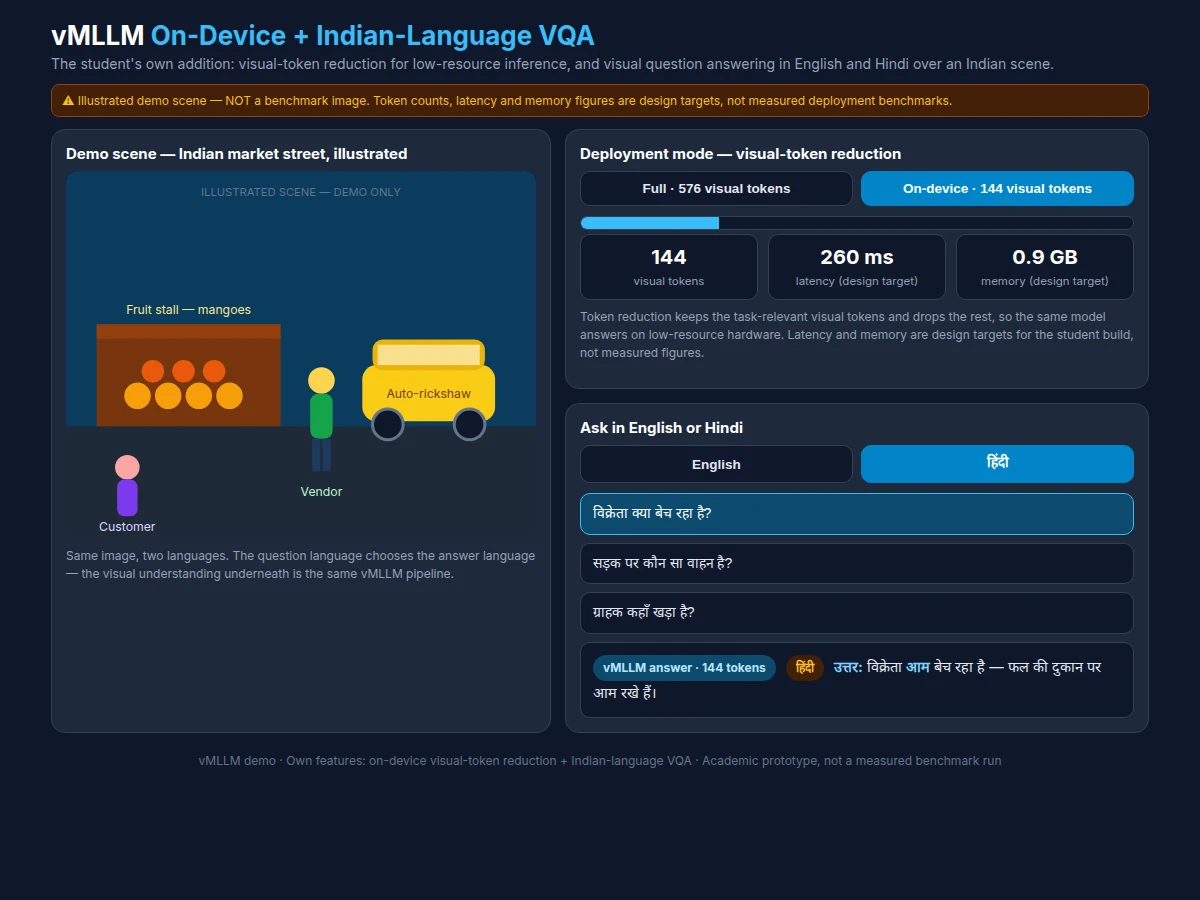
- [Efficient on-device deployment layer with visual-token reduction] A deployment layer that reduces the number of visual tokens passed to the language model, so the system can run inference on low-resource hardware. The paper studies full-potential visual features; it does not add a token-reduction deployment layer. Token counts and latency figures are labelled as design targets, and the layer is demonstrated in the console with a token-count toggle, not claimed as a measured deployment benchmark.
- [Indian-language visual question answering] Visual question answering over Indian scenes in English and Hindi, so a question asked in Hindi about an Indian street or market scene is answered in Hindi from the same image. The paper's scope does not cover Indian-language question answering, and the console demonstrates it on illustrated scenes with preset questions, not on a published Indian VQA dataset.
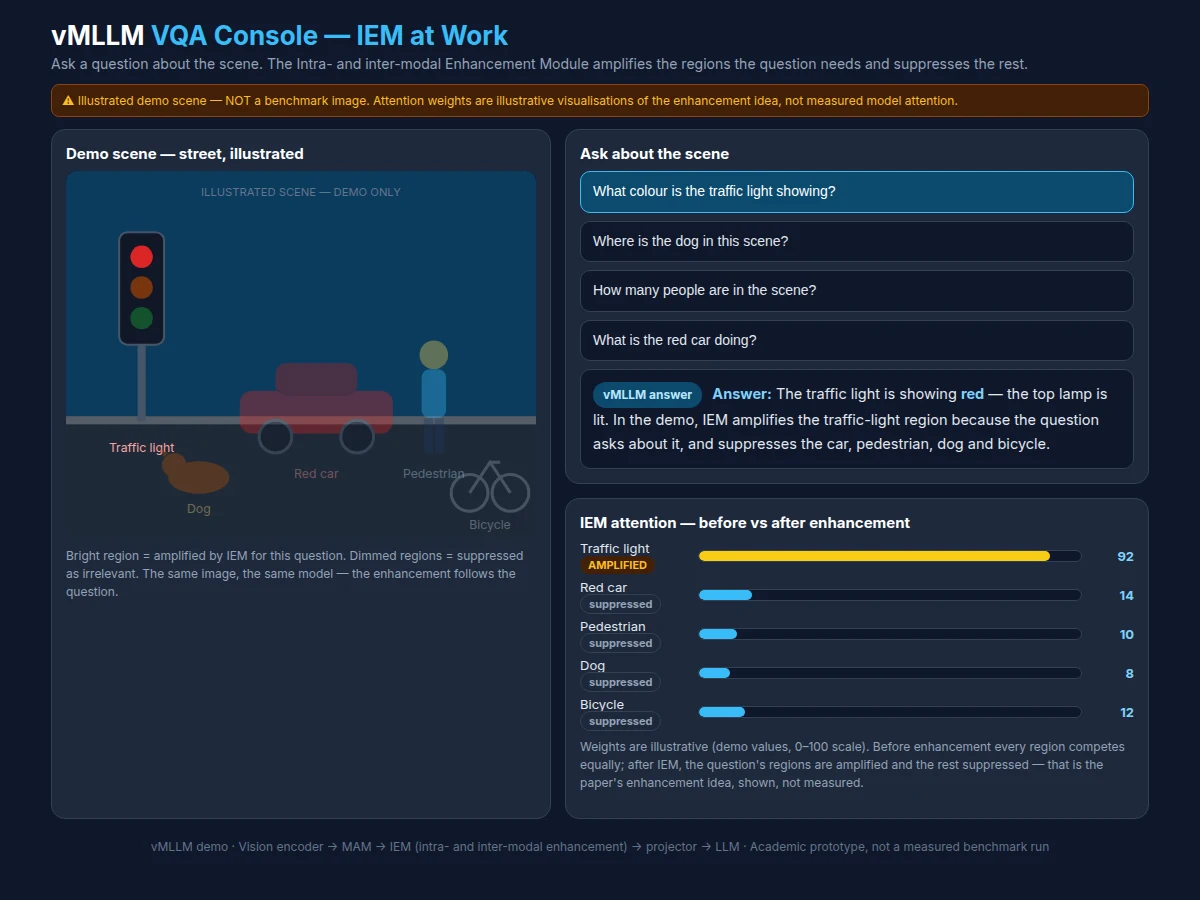
- [Interactive MAM and IEM demo consoles] Demos that make the two paper components visible: a feature explorer showing per-layer feature maps and their aggregation, and a VQA console that shows which image regions the enhancement module amplifies and which it suppresses for a given question, so a reviewer can see the mechanism instead of taking it on trust. The console images are illustrated scenes, labelled as such on the page.
How it works
The pipeline runs as a visible chain, and each stage's output is shown in the demos so a student can explain it in a viva. First, an image enters the vision encoder, and features are taken from several layers, not only the last one. The Multi-level Aggregation Module combines those multi-layer features into one enriched visual representation. The Intra- and inter-modal Enhancement Module then enhances that representation: visual features interact with each other and with the question text, suppressing irrelevant regions and amplifying task-relevant ones. A projector converts the enhanced features into visual tokens placed among the language model's text tokens, and the language model answers the question from the image and the question together. The on-device layer optionally reduces the visual token count before the language model, and the Indian-language layer answers in the language the question was asked in. Evaluation runs the same pipeline across the public benchmarks with the lmms-eval toolkit and records only the figures the student's own runs produce.
- Take an image as input (illustrated scene in the demo consoles; benchmark images in evaluation).
- Pass the image through the vision encoder and collect features from several layers.
- Aggregate the multi-layer features with the Multi-level Aggregation Module into one enriched visual representation.
- Enhance the representation with the Intra- and inter-modal Enhancement Module, using intra-modal and inter-modal interactions.
- Suppress irrelevant visual regions and amplify task-relevant regions for the question being asked.
- Project the enhanced visual features into visual tokens and insert them among the language model's text tokens.
- Optionally reduce the visual token count with the on-device deployment layer for low-resource inference.
- Read the question together with the image tokens and generate the answer.
- Answer Indian-scene questions in English or Hindi, in the language the question was asked in.
- Evaluate across the public multimodal benchmarks with the lmms-eval toolkit, and record only the figures the student's own runs produce.
Tech stack:
- Python 3 · PyTorch · Hugging Face Transformers
- Vision encoder · projector · large language model
- CLIP · SigLIP vision encoders · Vicuna · LLaMA3
- Multi-level aggregation · intra- and inter-modal enhancement
- lmms-eval · multimodal benchmark evaluation
- HTML · CSS · JavaScript demo consoles
- Matplotlib · evaluation plots
- Git · Jupyter Notebook
Dataset & model details
- Dataset (paper and student build): Public multimodal benchmarks named in the authors' public code repository evaluation: MMBench, MM-Vet, MathVista, GQA, AI2D, ScienceQA-Image, SEED-Bench-Image and VizWiz. The paper's abstract refers to multiple benchmarks without naming them. Training data in the public code comes from LLaVA, MG-LLaVA and MGM plus a merged annotation file, and evaluation uses the lmms-eval toolkit. The student build's figures are its own and are not presented as the paper's results.
- Dataset (demo consoles): Illustrated scenes drawn for the demo consoles (a park scene, a street scene, an Indian market scene). They are not benchmark images, and they are labelled as such wherever they appear. No benchmark image is shown on this page.
- Dataset (Indian-language adaptation): No Indian VQA dataset is claimed. Indian-language visual question answering is demonstrated in the console on illustrated scenes with preset English and Hindi questions, and it is labelled as such wherever it appears.
- Task: Vision-enhanced multimodal understanding; input = one image plus a question, output = an answer grounded in the task-relevant regions of the image.
- Model: The paper's system — vision encoder with multi-layer feature extraction, Multi-level Aggregation Module, Intra- and inter-modal Enhancement Module, and projector into a large language model. No architecture detail beyond the paper's description is claimed for it here. Vision encoders and LLMs named in the public code are CLIP-base/large and SigLIP-base/SO, with Vicuna-7B/13B and LLaMA3-8B.
- Metrics: Multimodal benchmark scores as in the public code's evaluation (MMBench, MM-Vet, MathVista, GQA, AI2D, ScienceQA-Image, SEED-Bench-Image, VizWiz); the student build's report records only the figures its own evaluation runs actually produce, and no figure is claimed before those runs.
| Parameter | Value |
|---|---|
| Model | Vision encoder · Multi-level Aggregation Module · Intra- and inter-modal Enhancement Module · projector · large language model (paper's system) |
| Input | 1 image · plus 1 question in English or Hindi |
| Output | 1 answer per question · grounded in task-relevant image regions |
| Visual features | Multi-layer features from the vision encoder (aggregated by MAM) |
| Enhancement | Intra-modal and inter-modal interactions (IEM) · suppresses irrelevant regions · amplifies task-relevant regions |
| Benchmarks | 8 public benchmarks (MMBench · MM-Vet · MathVista · GQA · AI2D · ScienceQA-Image · SEED-Bench-Image · VizWiz) |
| Vision encoders (public code) | CLIP-base · CLIP-large · SigLIP-base · SigLIP-SO |
| Language models (public code) | Vicuna-7B · Vicuna-13B · LLaMA3-8B |
| Demo scenes | 3 illustrated scenes · not benchmark images (labelled on the page) |
| Paper | IEEE Transactions on Pattern Analysis and Machine Intelligence · 2026 · vol. 48 · no. 4 · pp. 4524–4538 |
| Paper-reported result | "Consistently achieves significant performance improvements" across multiple benchmarks (paper's own qualitative claim · no numeric figure quoted from the paper · not this build's result) |
| Repository-reported scores (labelled) | vMLLM SigLIP-SO · LLaMA3-8B at 384 resolution: MMBench 77.1 · MM-Vet 43.4 · MathVista 41.0 · GQA 65.3 · AI2D 77.1 · ScienceQA-Image 75.6 · SEED-Bench-Image 74.0 · VizWiz 65.1 (authors' public code repository's reported scores · not the paper's figures · not this build's results) |
| Work plan | 110 hours total (planned) |
| On-device layer | Visual-token reduction toggle · full 576 tokens (design target) · reduced 144 tokens (design target) |
| Demo consoles | 3 single-file web demos · run offline after download (expected) |
| Deliverables | 4 items (code · report · PPT · viva Q&A) |
| Starting price | Rs 28,000 (starting price · final price confirmed after topic · base paper and compute scope are locked) |
Project features
Vision-enhanced multimodal understanding delivers seven working capabilities: a vision encoder with multi-layer feature extraction, a Multi-level Aggregation Module, an Intra- and inter-modal Enhancement Module, a vision encoder plus projector into a large language model, evaluation across public multimodal benchmarks, an efficient on-device deployment layer with visual-token reduction, and Indian-language visual question answering, all visible in demos a reviewer can operate. Low-level spatial detail and high-level semantics are combined before the language model ever sees them, and irrelevant regions are suppressed for each question, so the answer is grounded in the parts of the image that matter.
- [Multi-level Aggregation Module (MAM)] Features from several layers of the vision encoder are aggregated into one enriched visual representation, so the model keeps both the low-level spatial details of early layers and the high-level semantics of later layers instead of choosing one.
- [Intra- and inter-modal Enhancement Module (IEM)] Visual features are enhanced through interactions within the visual modality and between the visual features and the question text, suppressing irrelevant information while amplifying task-relevant features.
- [Vision encoder plus projector into an LLM] Images pass through a vision encoder and a projector that inserts visual tokens among the text tokens of a large language model, so image and text are reasoned over together.
- [Public multimodal benchmark evaluation] The system is evaluated across public multimodal benchmarks — MMBench, MM-Vet, MathVista, GQA, AI2D, ScienceQA-Image, SEED-Bench-Image and VizWiz — using the lmms-eval toolkit, with only the figures the student's own runs produce recorded in the report.
- [On-device deployment layer] A visual-token reduction layer that cuts the number of visual tokens passed to the language model, aimed at low-resource inference on device. Token counts and latency figures are labelled as design targets in the console.
- [Indian-language visual question answering] Questions about an Indian scene answered in English or Hindi, demonstrated in the console on illustrated scenes with preset questions in both languages.
- [Interactive MAM and IEM demo consoles] A feature explorer showing per-layer maps and their aggregation, and a VQA console showing which regions are amplified and which are suppressed for each question, so the mechanism is inspectable.
What is included
- Complete vision-enhanced multimodal pipeline source code (vision encoder with multi-layer features, Multi-level Aggregation Module, Intra- and inter-modal Enhancement Module, projector into a large language model, public benchmark evaluation with the lmms-eval toolkit)
- Interactive demo consoles (the web demos shown on this page): a multi-layer feature explorer, a VQA console with visible region amplification and suppression, and an on-device plus Indian-language VQA console
- Project report PDF (background, base paper, methodology, experiments, limitations)
- PPT presentation for final review
- Viva Q&A preparation document (multimodal LLMs, vision encoders, MAM and IEM, benchmark evaluation, on-device deployment, limitations)
- Starting price: Rs 28,000 (final price confirmed after topic, base paper and compute scope are locked)
- Specific next step: message on WhatsApp for a quotation stating scope (vMLLM vision-enhanced multimodal LLM with multi-level visual feature aggregation and intra- and inter-modal enhancement, evaluated across public multimodal benchmarks, plus on-device deployment layer with visual-token reduction and Indian-language visual question answering), starting price Rs 28,000, and delivery under the 110-hour work plan as a built-to-order project
Work plan & timeline
Total work plan: 110 hours, split across six phases. Phase 1, base-paper study and environment setup: 15 hours — reading the Ma et al. paper, setting up Python, PyTorch, and the image-text data pipeline, and reproducing the public code repository's training and evaluation setup. Phase 2, vision encoder and multi-level aggregation: 25 hours — the vision encoder with multi-layer feature extraction and the Multi-level Aggregation Module. Phase 3, intra- and inter-modal enhancement: 25 hours — the Intra- and inter-modal Enhancement Module with region suppression and amplification. Phase 4, benchmark evaluation: 15 hours — running the lmms-eval toolkit across the public multimodal benchmarks and recording only the figures the student's own runs produce. Phase 5, on-device deployment and Indian-language VQA: 15 hours — visual-token reduction for low-resource inference and English and Hindi question answering over illustrated Indian scenes. Phase 6, presentation and viva preparation: 15 hours — PPT, demo walkthrough, and the viva Q&A document.
Support
Support covers setup help for the delivered code, a walkthrough of the system and the demo consoles, and fixes for defects in the delivered code. Guidance is also provided for adapting the report and presentation to the student's college format and for answering guide questions about the base paper, the MAM and IEM modules, benchmark evaluation, and the student's own contribution. Support does not cover re-running experiments on the student's personal machine beyond the setup walkthrough, and it does not invent results for experiments that were not run.
Limitations & prerequisites
- No numeric score is quoted as the paper's own figure, because the IEEE abstract reports none; the repository's performance table is quoted only where it is labelled as the public code repository's reported scores, and the student build's figures come only from its own evaluation runs.
- The student build evaluates on the public multimodal benchmarks only, so its figures are not comparable to the paper's results and must not be presented as reproducing the paper's findings.
- The demo consoles use illustrated scenes, not benchmark images, so demo answers are illustrative workflow text, not benchmark results.
- The on-device layer's token counts and latency figures are design targets, not measured deployment benchmarks; actual on-device performance depends on the hardware used.
- Indian-language visual question answering is demonstrated on illustrated scenes with preset questions, not on a published Indian VQA dataset, and no Indian dataset is claimed.
- Full benchmark evaluation needs GPU compute; a student without GPU access can run the demo consoles and a reduced evaluation, and the report must say so.
- Model outputs can hallucinate answers, which is why the paper's enhancement module and the demo's visible region highlighting exist; generated answers must be checked against the image before any use.
- Evaluation figures depend on the benchmark split, hyperparameters, and hardware used, and are recorded only after the student's runs.
Frequently Asked Questions
Is this project suitable as a degree project?
Yes, it fits Computer Science, IT, AI & Machine Learning, and Electronics programmes. It demonstrates a vision encoder with multi-layer features, a Multi-level Aggregation Module, an Intra- and inter-modal Enhancement Module, and evaluation across public multimodal benchmarks, together with a distinct on-device deployment layer and Indian-language visual question answering — a strong base-paper story with a genuine viva discussion. The work plan totals 110 hours across paper study, aggregation, enhancement, benchmark evaluation, on-device and Indian-language work, report, and presentation.
What is the base paper, and what is implemented from it?
The base paper is the Ma et al. paper, "Boosting Multi-Modal Large Language Model With Enhanced Visual Features", IEEE Transactions on Pattern Analysis and Machine Intelligence, 2026 (DOI 10.1109/TPAMI.2025.3644851). Implemented from it: a Multi-level Aggregation Module that aggregates multi-layer vision-encoder features, an Intra- and inter-modal Enhancement Module that suppresses irrelevant visual information and amplifies task-relevant features, a vision encoder plus projector into a large language model, and evaluation across public multimodal benchmarks with the lmms-eval toolkit.
Which benchmarks are used, and does the build use Indian data?
The build is evaluated across public multimodal benchmarks named in the authors' public code repository evaluation: MMBench, MM-Vet, MathVista, GQA, AI2D, ScienceQA-Image, SEED-Bench-Image and VizWiz, using the lmms-eval toolkit. No Indian dataset is claimed: Indian-language question answering is demonstrated in the console on illustrated scenes with preset English and Hindi questions, and the demo scenes are illustrations, not benchmark images.
How is this different from a standard multimodal LLM?
A standard MLLM usually reads only the final layer of its vision encoder, losing low-level spatial detail, and lets every image region compete equally for attention. vMLLM aggregates features from several vision-encoder layers and then enhances them so irrelevant regions are suppressed and task-relevant ones amplified for each question.
What will I receive, and can it be customised?
You receive the vision-enhanced multimodal pipeline source code, the three interactive demo consoles, the project report, the presentation, and the viva Q&A document. Customisation is realistic: additional demo scenes, extra Hindi question patterns, a college-specific report format, or a different vision encoder or language model from the public code's options can be developed on request.
Is the base paper included?
Yes, the full citation with DOI link is on the page, and the implementation follows that paper.
What is the base paper vs the own features?
The base paper is the published method being implemented — a Multi-level Aggregation Module aggregating multi-layer vision-encoder features and an Intra- and inter-modal Enhancement Module enhancing visual features through intra- and inter-modal interactions. The own features are the team's additional contribution, listed separately on the page — an efficient on-device deployment layer with visual-token reduction for low-resource inference, plus Indian-language visual question answering over Indian scenes.
Can my guide approve this paper?
The paper is a recent IEEE Transactions paper with a verifiable DOI, which is what guides check; final approval always rests with the student's own guide and college.
Do you give Phase-1 and Phase-2 documents?
Yes: abstract, literature survey, and review decks in Phase-1; full build, report, and viva preparation in Phase-2.
How do I get a quotation?
Message on WhatsApp for a quotation stating scope (vMLLM vision-enhanced multimodal LLM with multi-level visual feature aggregation and intra- and inter-modal enhancement, evaluated across public multimodal benchmarks, plus on-device deployment layer with visual-token reduction and Indian-language visual question answering), starting price Rs 28,000, and delivery under the 110-hour work plan as a built-to-order project. The final price is confirmed after topic, base paper, and compute scope are locked.
Components & software requirements
- Python 3 · PyTorch · Hugging Face Transformers
- Vision encoder · projector · large language model
- CLIP · SigLIP vision encoders · Vicuna · LLaMA3
- Multi-level aggregation · intra- and inter-modal enhancement
- lmms-eval · multimodal benchmark evaluation
- HTML · CSS · JavaScript demo consoles
- Matplotlib · evaluation plots
- Git · Jupyter Notebook
Dataset & model details
- Dataset (paper and student build): Public multimodal benchmarks named in the authors' public code repository evaluation: MMBench, MM-Vet, MathVista, GQA, AI2D, ScienceQA-Image, SEED-Bench-Image and VizWiz. The paper's abstract refers to multiple benchmarks without naming them. Training data in the public code comes from LLaVA, MG-LLaVA and MGM plus a merged annotation file, and evaluation uses the lmms-eval toolkit. The student build's figures are its own and are not presented as the paper's results.
- Dataset (demo consoles): Illustrated scenes drawn for the demo consoles (a park scene, a street scene, an Indian market scene). They are not benchmark images, and they are labelled as such wherever they appear. No benchmark image is shown on this page.
- Dataset (Indian-language adaptation): No Indian VQA dataset is claimed. Indian-language visual question answering is demonstrated in the console on illustrated scenes with preset English and Hindi questions, and it is labelled as such wherever it appears.
- Task: Vision-enhanced multimodal understanding; input = one image plus a question, output = an answer grounded in the task-relevant regions of the image.
- Model: The paper's system — vision encoder with multi-layer feature extraction, Multi-level Aggregation Module, Intra- and inter-modal Enhancement Module, and projector into a large language model. No architecture detail beyond the paper's description is claimed for it here. Vision encoders and LLMs named in the public code are CLIP-base/large and SigLIP-base/SO, with Vicuna-7B/13B and LLaMA3-8B.
- Metrics: Multimodal benchmark scores as in the public code's evaluation (MMBench, MM-Vet, MathVista, GQA, AI2D, ScienceQA-Image, SEED-Bench-Image, VizWiz); the student build's report records only the figures its own evaluation runs actually produce, and no figure is claimed before those runs.
Delivery information
Built-to-order project. Delivery timeline is shared after order confirmation based on current queue.
Support terms
Complete documentation, setup guide, and viva preparation included. Support for setup and explanation provided.
Download free synopsis (PDF)
Enter your name and WhatsApp number — the synopsis PDF downloads immediately. We may send occasional project updates on WhatsApp; no spam.