
More project photos (2)
The problem
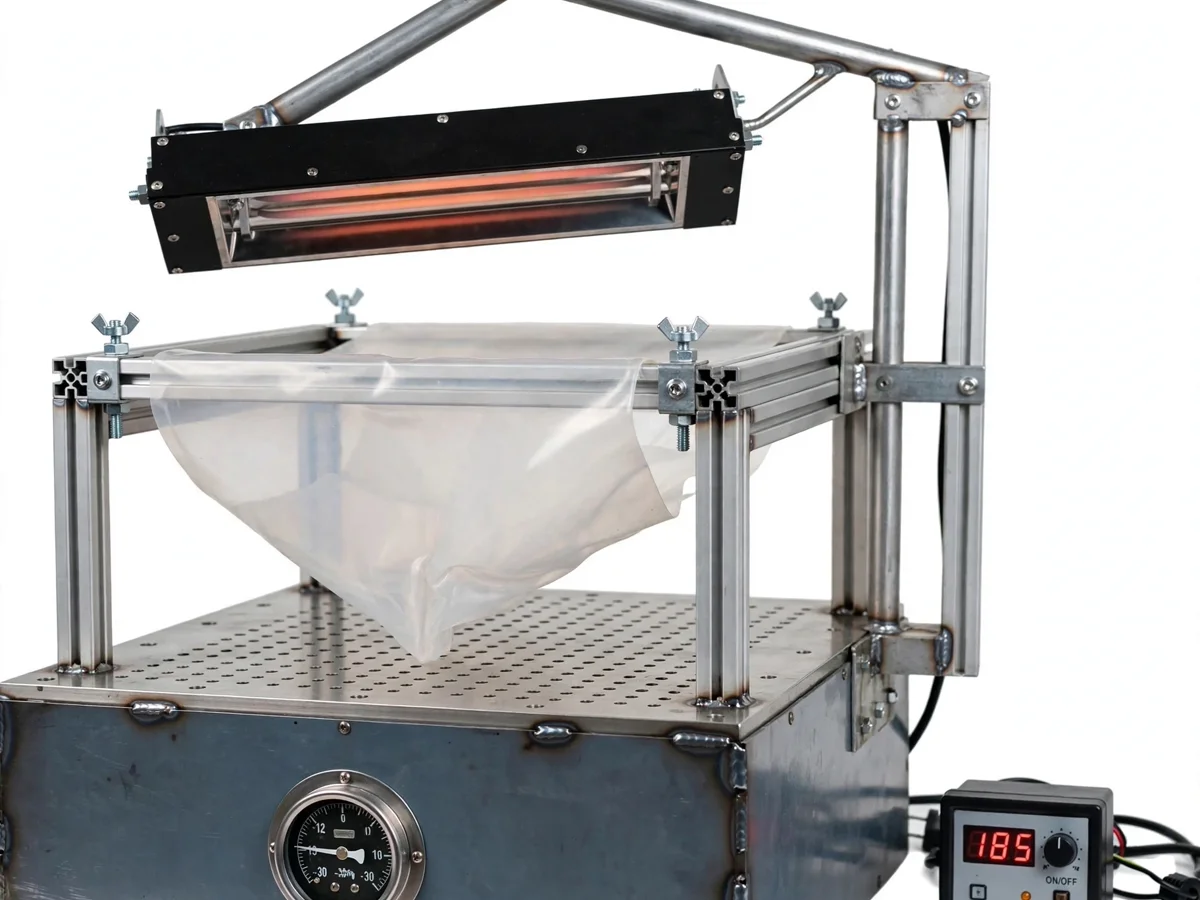
Thermoforming — heating a plastic sheet to its softening point and shaping it over a mold — is how countless trays, blister packs and equipment covers are made. But commercial vacuum forming machines are too expensive for most college labs and small workshops, so students learn the theory without ever running the process: heating to the right temperature, reading the sheet sag, applying vacuum before the sheet cools. This project builds a tabletop machine that runs the full cycle — clamp, heat, form, cool, release — letting students study forming parameters hands-on with common sheet materials and their own molds.
How it works
- A thermoplastic sheet (PETG/HIPS/ABS, approx 0.5–2 mm) is clamped in the frame.
- The heater lowers over the sheet; the controller holds the setpoint while the timer runs the heating cycle.
- The operator watches the sheet sag — the visual cue that it has reached forming temperature.
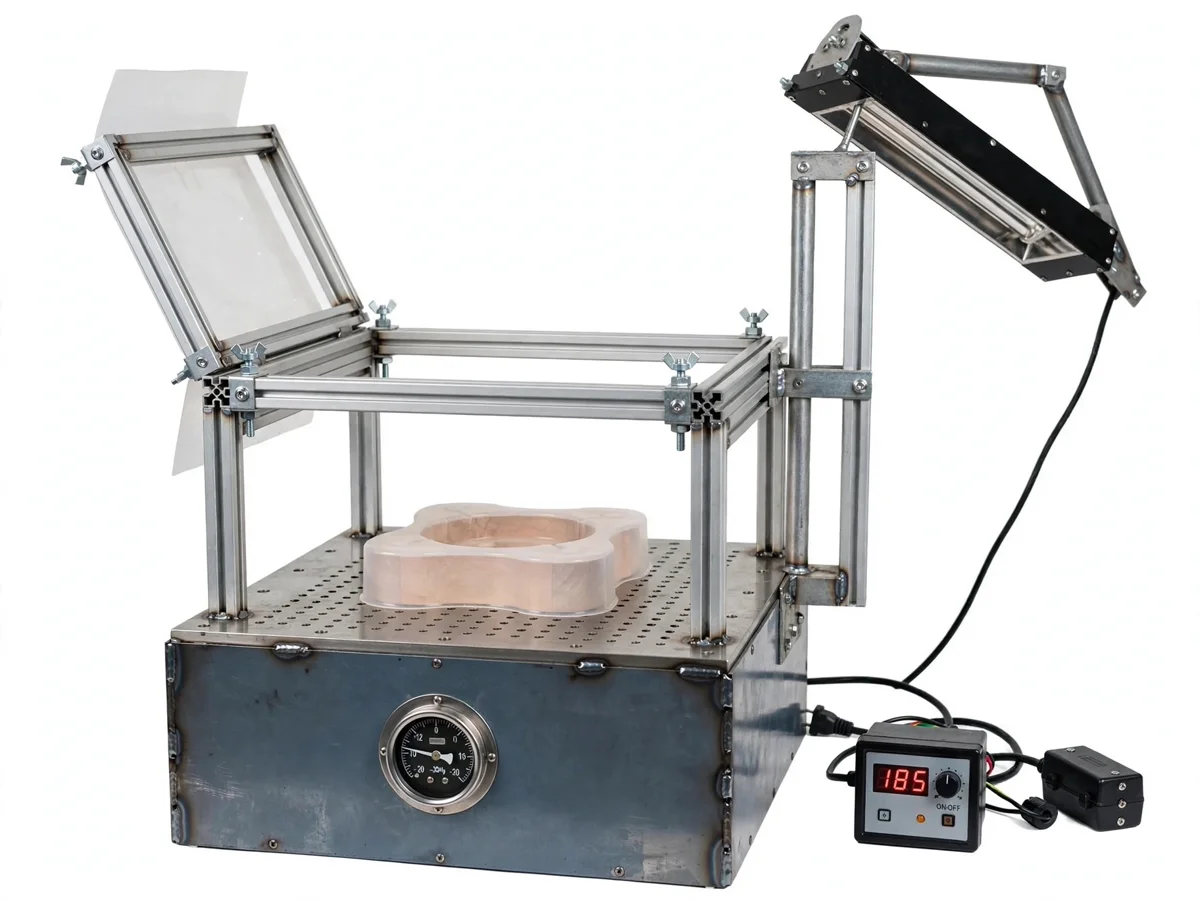
- The heater swings away, the platen with the mold rises into the softened sheet, and the vacuum valve opens.
- Atmospheric pressure forces the sheet onto the mold; it cools and takes the shape over a few minutes.
- Vacuum is released, the clamps open, and the formed part is trimmed from the sheet.
Tech stack:
- Quartz infrared heater with PID temperature controller
- K-type thermocouple for sheet-zone feedback
- Vacuum pump with gauge and valve
- MS/aluminium frame, clamping frame with toggle latches
- Perforated mold platen, MDF/wooden student molds
- Timer relay for heating cycle
- 230 V AC wiring with interlock and fusing
| Parameter | Value |
|---|---|
| Forming area | Approx 300 × 300 mm |
| Sheet materials | PETG · HIPS · ABS, approx 0.5–2 mm |
| Heater | Quartz infrared, approx 1500 W class |
| Temperature | Controller setpoint up to approx 200 °C (design target) |
| Vacuum | Single-stage pump, approx 1/4 HP class, with gauge |
| Heating time | Timer-adjustable; design target a few minutes per cycle |
| Cooling | Passive air cooling between cycles |
| Supply | 230 V AC, single phase |
| Safety | Heater interlock, hot-zone guard, fusing |
| Molds | Student-made MDF/wood with draft-angle guide |
Project features
- [Quartz heater with temperature control] Infrared quartz heater with a PID/thermostat controller and thermocouple feedback; the setpoint is configurable.
- [Sheet clamping frame] Hinged aluminium frame clamps the sheet on all four sides with toggle latches for a leak-free seal.
- [Vacuum chamber and pump] Sealed chamber under the platen with a vacuum pump and gauge; vacuum is applied through the mold base.
- [Quick-change mold platen] Molds bolt to a perforated platen in minutes, so different shapes can be formed in one session.
- [Heater timer] Adjustable timer controls heating duration for repeatable softening across runs.
- [Safety interlock] The heater circuit cuts out when the heater frame is raised, and a guard keeps hands clear of the hot zone.
- [Forming guides] Draft-angle and vent-hole guidelines for student-made MDF/wooden molds are included in the manual.
What is included
- Tabletop vacuum forming machine (frame, heater, chamber, platen)
- PID temperature controller with thermocouple
- Vacuum pump, gauge and valve set
- Starter mold set and sheet material samples
- Wiring diagram and operating manual with forming guide
- Project report PDF (thermoforming theory, machine design, process parameters)
- PPT presentation for final review
- Viva Q&A preparation document (thermoforming, heater control, vacuum systems)
- Setup and demonstration guide
Limitations & prerequisites
- Tabletop scale — forming area and depth suit trays, covers and small enclosures, not large parts.
- The heater runs hot by design: burn hazard during and after heating; the guard and interlock reduce but do not remove the risk.
- Vacuum strength is modest compared with industrial machines — deep draws and sharp details are limited.
- Cooling is passive, so cycle time between parts is longer than on industrial machines with cooled molds.
- Only thermoplastics in the specified thickness range; the machine is not for food-contact production.
- Student-made molds need draft angles and vent holes — the guide covers this; poor molds give poor parts.
Frequently Asked Questions
Which heater is used?
A quartz infrared heater with a PID temperature controller and K-type thermocouple — fast, even heating across the sheet, with a configurable setpoint.
Which plastic sheets can it form?
PETG, HIPS and ABS in approx 0.5–2 mm thickness. Each material has a recommended temperature and time starting point in the manual.
What size parts can it make?
The forming area is approx 300 × 300 mm — trays, blister packs, equipment covers and enclosures at demonstration scale.
Is it safe for students?
With discipline: the hot-zone guard, heater interlock and cool-down procedure are mandatory, and heating must never be left unattended.
What are the main limitations?
Tabletop scale, passive cooling (slower cycles), modest vacuum vs industrial machines, and hot-surface hazard.
Is this project suitable for a final-year project?
Yes — for Mechanical, Mechatronics and Manufacturing programs. It demonstrates thermoforming process engineering, heater control, vacuum systems and machine design. Suitable for B.E./B.Tech final-year projects in Mechanical and Mechatronics Engineering.
Components & software requirements
- Quartz infrared heater with PID temperature controller
- K-type thermocouple for sheet-zone feedback
- Vacuum pump with gauge and valve
- MS/aluminium frame, clamping frame with toggle latches
- Perforated mold platen, MDF/wooden student molds
- Timer relay for heating cycle
- 230 V AC wiring with interlock and fusing
Delivery information
Built-to-order project. Delivery timeline is shared after order confirmation based on current queue.
Support terms
Complete documentation, setup guide, and viva preparation included. Support for setup and explanation provided.