
More project photos (2)
The problem
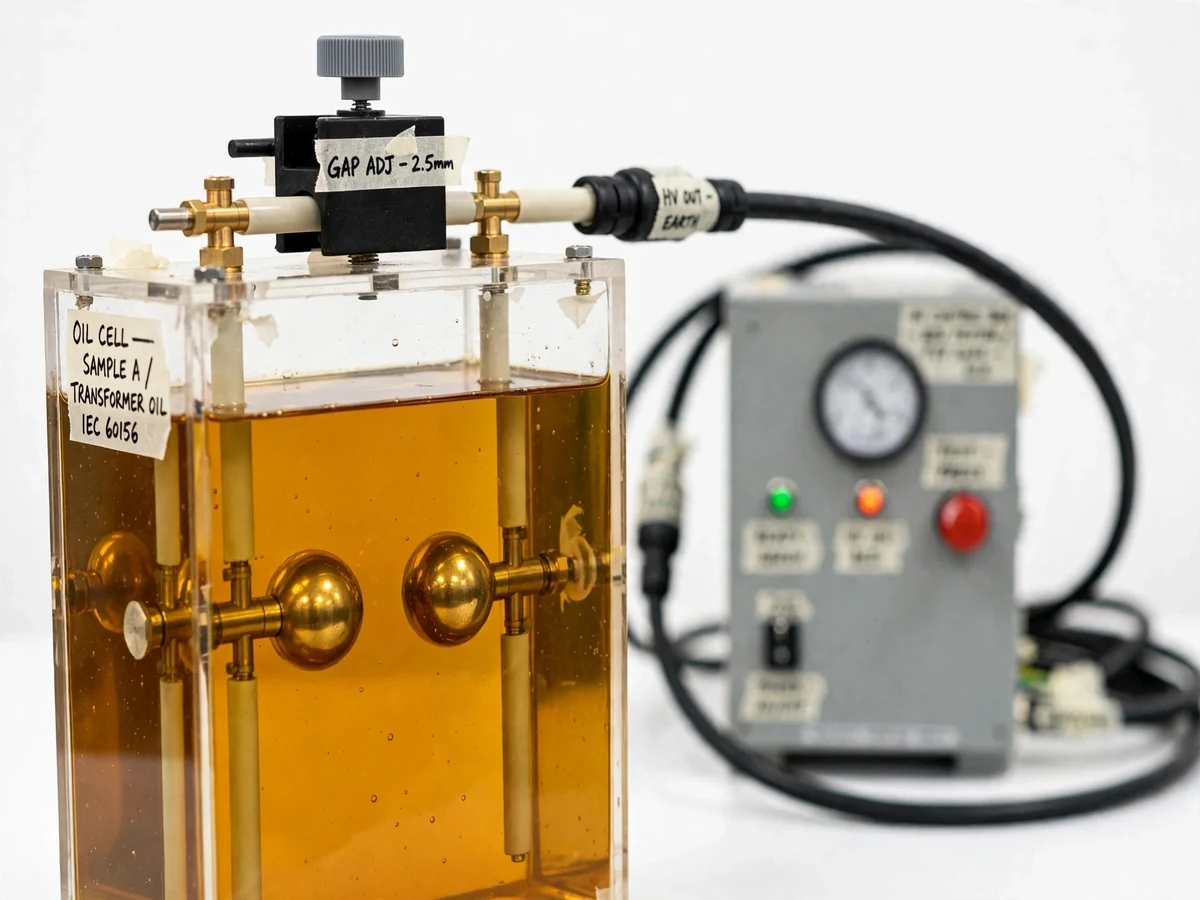
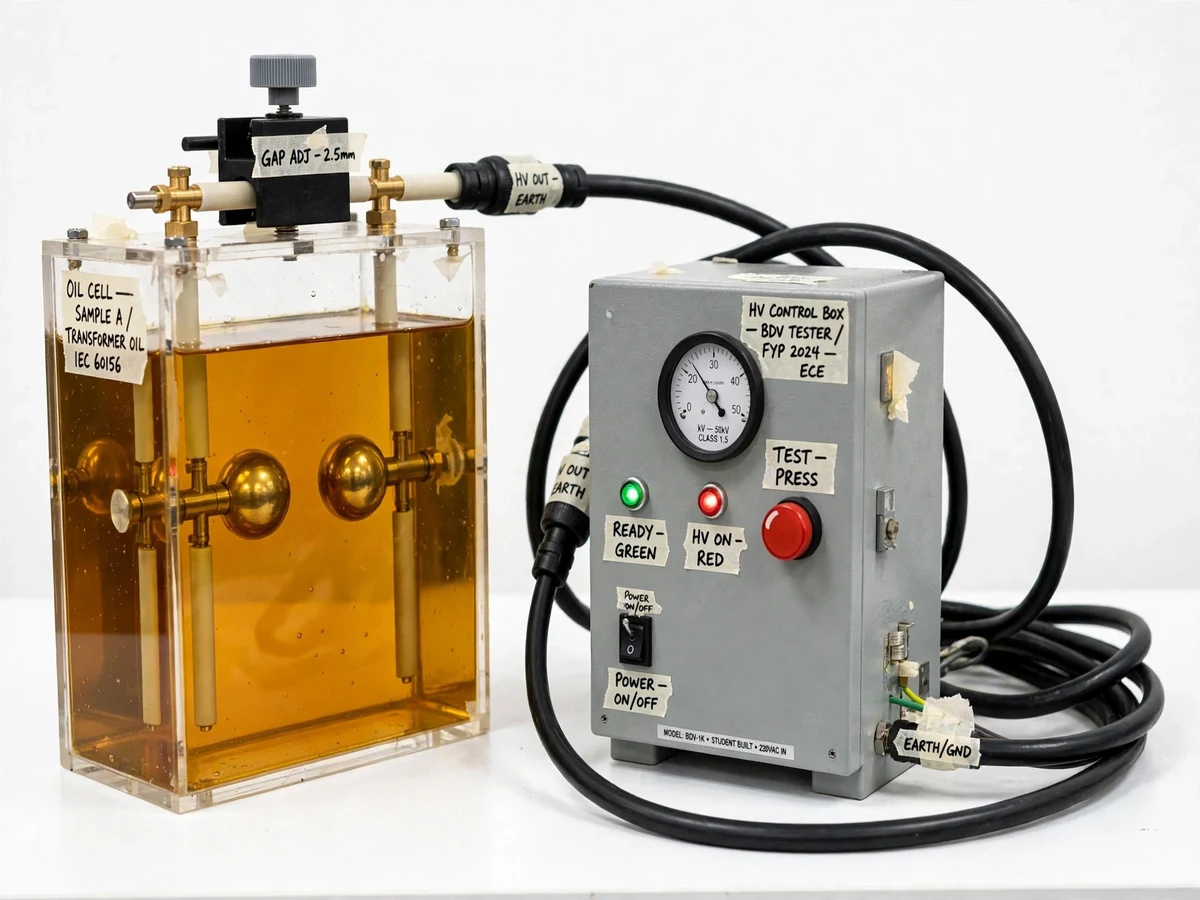
Transformer oil has two jobs — insulation and cooling — and both fail when the oil is contaminated with moisture or particles. The single number that certifies oil health is its breakdown voltage: the voltage at which a standard electrode gap in the oil sample sparks over. Utilities test this routinely to IEC 60156, yet electrical students usually meet the test only as a paragraph in a high-voltage engineering textbook. This project puts the test on the bench: a transparent perspex oil cell with two polished brass spherical electrodes on an adjustable gap screw, filled with the oil sample, connected to a control box that ramps the test voltage while an analog kV meter watches for breakdown. Students perform the standard six-breakdown sequence on each sample, average the results, and see for themselves how a contaminated sample breaks down far below a clean one.
How it works
- The oil sample is poured into the perspex cell, covering the brass electrodes completely, and the lid is closed to enable the safety interlock.
- The gap screw is set to 2.5 mm between the electrode spheres, verified with the supplied feeler gauge per the procedure.
- With the READY lamp lit, the operator presses TEST and the control box ramps the AC test voltage up smoothly across the gap.
- At the breakdown voltage the oil sparks over between the spheres; the operator notes the kV meter reading as that run's BDV value.
- After the settling interval, the test is repeated for a total of six breakdowns on the same sample fill, and the mean and spread are computed in the result sheet.
- The cell is cleaned, refilled with the second sample, and the sequence repeated — comparing mean BDV of clean versus contaminated oil.
Tech stack:
- Transparent perspex oil test cell
- Brass spherical electrodes · gap screw
- HV control box with voltage ramp
- Analog kV panel meter
- Safety interlock · READY/HV-ON lamps
- Feeler gauge (2.5 mm gap setting)
- Test procedure manual · result sheets
- Oil sample bottles (clean + contaminated)
| Parameter | Value |
|---|---|
| Test standard | IEC 60156 style procedure (design) |
| Electrode gap | 2.5 mm, adjustable screw (design) |
| Electrodes | Polished brass spheres (design) |
| Cell | Transparent perspex, sample volume approx. 400 ml (design) |
| Test voltage | AC ramp, kV meter 0–50 kV class (datasheet) |
| Procedure | Six breakdowns per sample, mean BDV (buyer-run procedure) |
| Safety | Lid interlock, READY/HV-ON lamps, earthed enclosure (design) |
| Samples | Clean and contaminated oil for comparison (design) |
Project features
- [Perspex oil test cell] A transparent cell holds the oil sample with the electrodes fully visible, so the breakdown arc itself can be observed safely through the wall.
- [Brass spherical electrodes] Two polished brass spheres on insulated rods form the standard test gap, adjustable with a gap screw set to 2.5 mm per the test standard.
- [HV control box] The control unit ramps the test voltage smoothly, with a test-press pushbutton, power switch and clearly labelled high-voltage terminals.
- [Analog kV meter] A panel kV meter reads the breakdown voltage directly at the moment of spark-over for each of the six test runs.
- [Safety interlock lamps] Green READY and red HV-ON lamps show the test state at a glance, and the cell lid must be closed before the test voltage can be applied.
- [Six-breakdown procedure] The manual implements the standard sequence: six breakdowns per sample with settling intervals, then the mean BDV and spread are computed.
- [Sample comparison study] The procedure includes testing a clean sample against a moisture-contaminated sample to demonstrate how contamination collapses dielectric strength.
What is included
- Perspex oil test cell with brass spherical electrodes and gap adjustment
- HV control box with kV meter, test pushbutton and safety interlock
- Feeler gauge and cell-cleaning accessories
- Step-by-step BDV test procedure manual with result sheets
- Sample comparison experiment guide (clean vs contaminated oil)
- Project report PDF (dielectric theory, IEC 60156 procedure, sample results format)
- PPT presentation for final review
- Viva Q&A preparation document (dielectric strength, breakdown mechanisms, moisture effect, electrode geometry)
Limitations & prerequisites
- This is a teaching-scale demonstration of the BDV test procedure; results are comparative between samples, and certified oil testing requires an accredited laboratory.
- The test uses high voltage by design — the interlock and procedure must be followed exactly, and the kit is for supervised lab use only.
- Oil samples supplied are for demonstration; disposal of used oil follows the manual's safe-handling and local-disposal guidance.
- The kit measures breakdown voltage only; dissolved-gas analysis and other oil diagnostics are separate tests described as complementary.
Frequently Asked Questions
What is breakdown voltage (BDV) of transformer oil?
The voltage at which a standard 2.5 mm gap between spherical electrodes immersed in the oil sample sparks over. It is the standard measure of the oil's insulating health — high BDV means clean, dry oil.
Why six breakdowns per sample?
A single spark-over is noisy: electrode conditioning, particles and micro-bubbles vary run to run. The standard takes six breakdowns with settling intervals and averages them, which is what this kit's procedure implements.
How does moisture affect the result?
Even small moisture contamination sharply lowers BDV — water droplets distort the field and trigger early breakdown. The sample-comparison experiment shows this dramatically: the contaminated sample breaks down far below the clean one.
Why spherical electrodes?
Spheres give a nearly uniform field in the gap, so the breakdown depends on the oil, not on field concentration at sharp points. The gap screw sets the standard 2.5 mm spacing used in IEC 60156.
Is the high voltage safe to use?
The kit is designed for supervised lab use: the cell lid interlock prevents energizing with the cell open, READY/HV-ON lamps show the state, and the enclosure is earthed. The manual's safety section is mandatory reading before the first test.
Is this project suitable for a final-year project?
Yes — for Electrical and Electronics engineering programs. It brings a real high-voltage-engineering lab test to the bench with a standards-based procedure, comparative results and strong viva material. Suitable for B.E./B.Tech final-year projects in Electrical and Electronics engineering.
Components & software requirements
- Transparent perspex oil test cell
- Brass spherical electrodes · gap screw
- HV control box with voltage ramp
- Analog kV panel meter
- Safety interlock · READY/HV-ON lamps
- Feeler gauge (2.5 mm gap setting)
- Test procedure manual · result sheets
- Oil sample bottles (clean + contaminated)
Delivery information
Built-to-order project. Delivery timeline is shared after order confirmation based on current queue.
Support terms
Complete documentation, setup guide, and viva preparation included. Support for setup and explanation provided.