
More project photos (2)
The problem
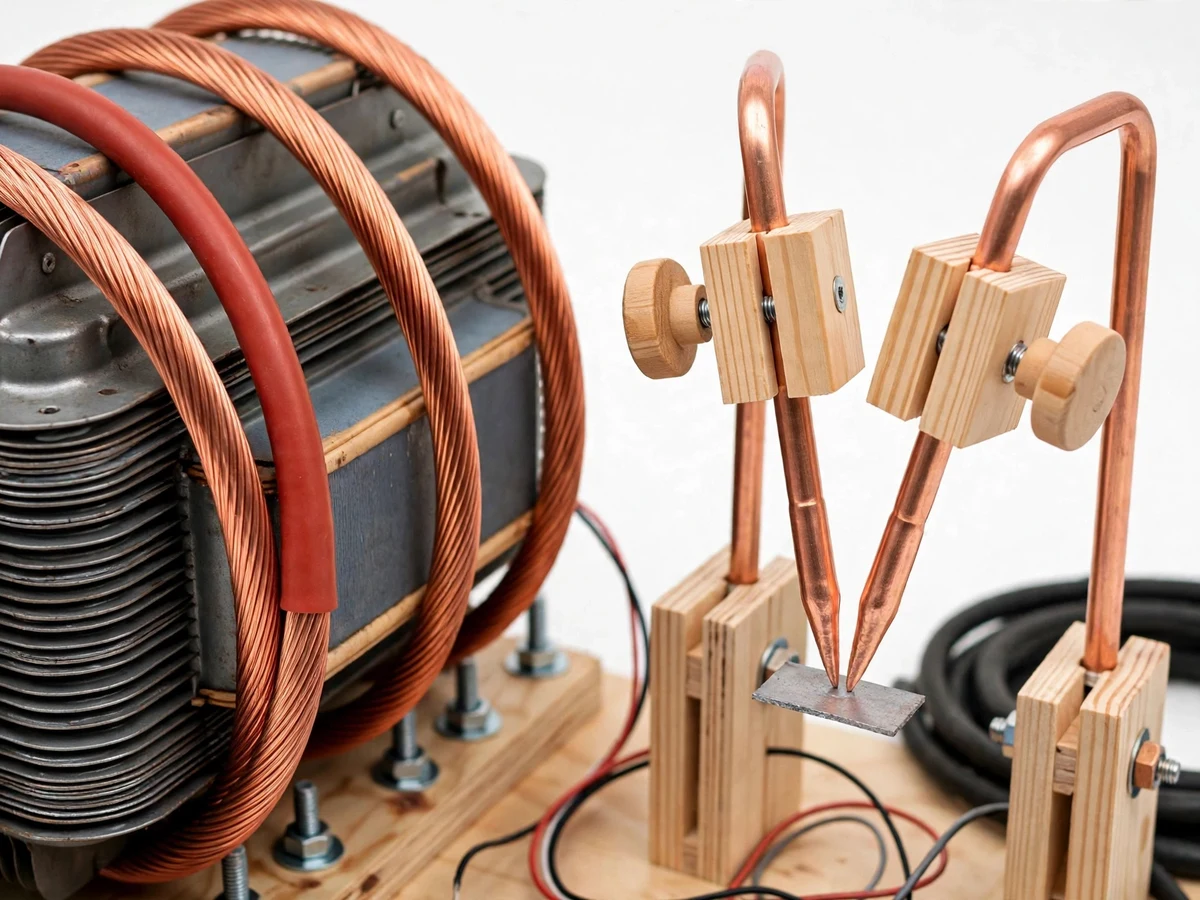
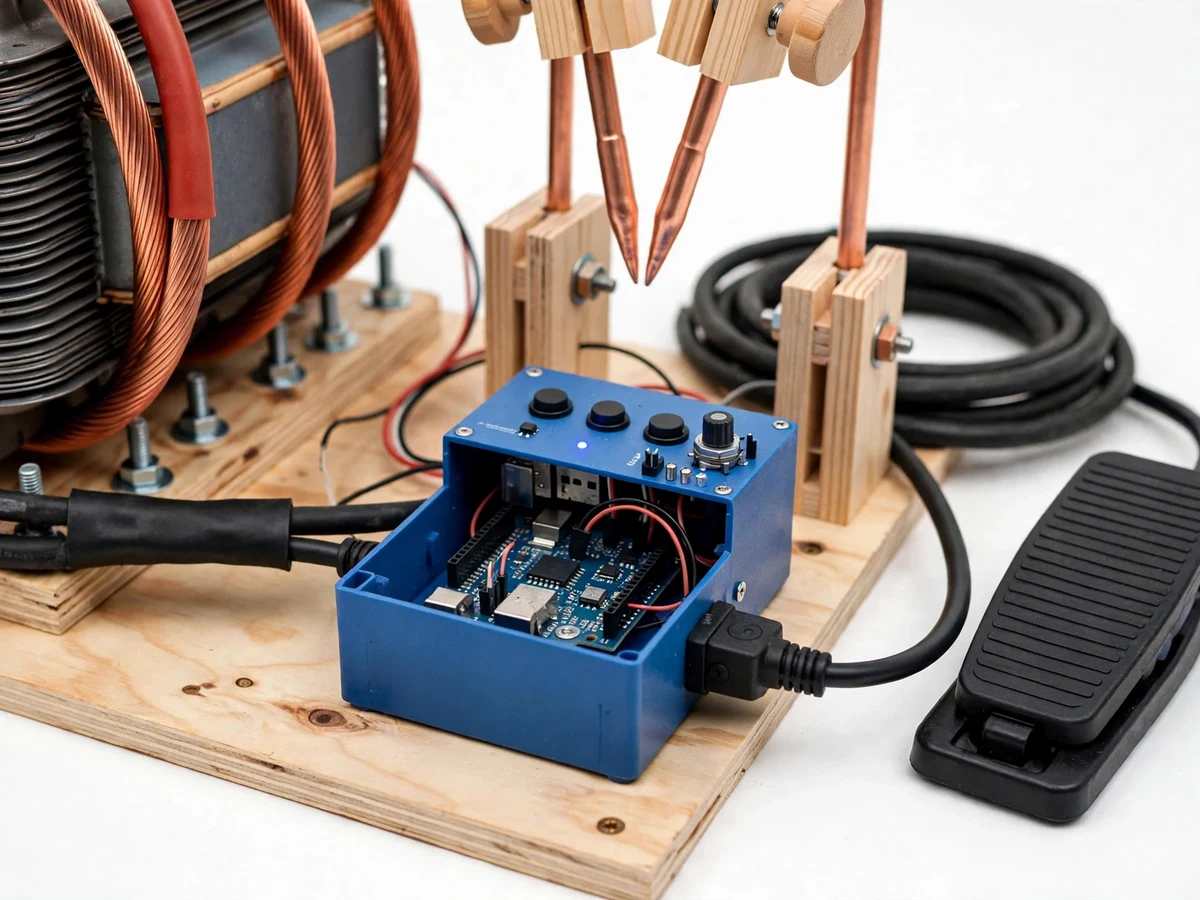
Spot welding joins thin sheet metal with a brief, intense pulse of current — the sheets are squeezed between copper electrodes and resistance heating fuses a nugget between them. Commercial spot welders cost far more than a student lab or small workshop can justify for occasional use. The microwave oven transformer, or MOT, offers a classic workaround: its core is built for high power, and rewinding the secondary with just two or three turns of heavy cable turns it into a low-voltage, very-high-current source — exactly what resistance welding needs. This project builds a working demo spot welder around a rewound MOT: copper electrode arms with pointed tips, a spring clamp for electrode pressure, an Arduino-based timer controlling weld duration, and a foot pedal so both hands stay on the workpiece. It welds thin mild-steel sheet — the design target is around half a millimetre, verified by the buyer with peel tests — and the report is upfront about mains safety, duty cycle and material limits.
How it works
- The operator sets the weld time on the timer and positions the sheet stack between the copper tips.
- The foot pedal is pressed; the Arduino closes the switching device for exactly the set duration.
- Mains feeds the MOT primary; the rewound secondary delivers a few volts at very high current to the electrodes.
- Current flowing through the contact resistance between the sheets heats the interface by resistance (I²R) heating.
- A weld nugget forms and solidifies after the pulse ends; the operator releases the pedal.
- Sample coupons can be peel-tested per the guide to verify nugget formation.
Tech stack:
- Microwave oven transformer (rewound secondary)
- Heavy copper cable (secondary winding)
- Copper electrodes with pointed tips
- Arduino Nano weld timer
- Contactor/SSR switching
- Foot-pedal switch
- Thermal cutout and mains fuse
- Plywood/steel frame and electrode arms
| Parameter | Value |
|---|---|
| Input | 230 V AC mains, fused and earthed |
| Transformer | Microwave oven transformer, secondary rewound 2–3 turns heavy cable |
| Secondary | Approx. 2 V at high current (design target: hundreds of amps; not pre-measured) |
| Weld time | 0.2–2 s, Arduino-timed |
| Electrodes | Copper, pointed tips, spring-clamp pressure |
| Material | Thin mild-steel sheet; design target up to 0.8 mm (buyer-verified by peel test) |
| Protection | Mains fuse, thermal cutout, documented duty cycle |
Project features
- [Rewound MOT power source] A microwave oven transformer with its secondary replaced by 2–3 turns of heavy copper cable delivers low-voltage, high-current output.
- [Copper electrode arms] Pointed copper tips on pivoted arms concentrate the current at the weld spot; the tip-dressing procedure is included.
- [Arduino weld timer] Weld duration is set from 0.2 to 2 seconds in firmware — repeatable pulses instead of guesswork.
- [Foot-pedal trigger] A foot switch fires the weld, leaving both hands free to position the sheets.
- [Spring clamp pressure] Adjustable clamping force on the electrode arms; pressure affects nugget quality and is part of the demo trials.
- [Thermal and fuse protection] Fused mains input, a thermal cutout on the transformer and a documented duty cycle guard against overheating.
- [Buyer-run weld trials] The build guide includes a peel-test procedure so weld strength can be checked on sample coupons.
What is included
- Rewound-MOT spot welder (assembled)
- Arduino timer firmware
- Wiring and safety diagram
- Component list
- Project report PDF (resistance welding background, MOT rewind procedure, weld trials)
- PPT presentation for final review
- Viva Q&A preparation document (resistance welding, transformers, timers, safety)
- Weld-trial and safety guide
Limitations & prerequisites
- Thin mild-steel sheet only; stainless steel and aluminium do not weld reliably with this setup and sit outside the scope.
- Strict duty cycle — the transformer must cool between welds; continuous production use will overheat it.
- Mains-voltage primary: the safety guide mandates enclosure, earthing and adult supervision; this is not a toy.
- Weld current is a design target, not a measured figure; strength is verified by the buyer's peel tests.
- MOTs hum and vibrate under load — normal for this core type, noted in the guide.
Frequently Asked Questions
Is it safe to build and use?
The secondary is only a few volts, but the primary is 230 V mains, so the safety guide mandates a fused and earthed input, an enclosed transformer, and adult supervision. Followed as documented, it is a controlled lab demo.
What thickness of metal can it weld?
The design target is thin mild-steel sheet up to about 0.8 mm. The buyer verifies real capability with the peel-test procedure on sample coupons — no thickness is pre-claimed.
How is the weld time controlled?
An Arduino timer switches the weld current for a set 0.2 to 2 seconds, triggered by the foot pedal. Consistent timing is what makes the welds repeatable.
Can it weld stainless steel or aluminium?
Not reliably. Both need much higher current control and different electrode practice than this demo rig provides; the report states this as an explicit limit.
Why use a microwave oven transformer?
MOT cores are designed for high power in a compact size, and with the high-voltage secondary removed there is room to wind a few turns of very heavy cable — the cheapest route to a high-current low-voltage source.
Is this project suitable for a final-year project?
Yes — for Mechanical Engineering. It demonstrates resistance welding, transformer practice, process parameters (time, current, pressure) and destructive testing, all strong manufacturing viva material. Suitable for B.E./B.Tech final-year projects in Mechanical Engineering.
Components & software requirements
- Microwave oven transformer (rewound secondary)
- Heavy copper cable (secondary winding)
- Copper electrodes with pointed tips
- Arduino Nano weld timer
- Contactor/SSR switching
- Foot-pedal switch
- Thermal cutout and mains fuse
- Plywood/steel frame and electrode arms
Delivery information
Built-to-order project. Delivery timeline is shared after order confirmation based on current queue.
Support terms
Complete documentation, setup guide, and viva preparation included. Support for setup and explanation provided.