
More project photos (2)
The problem
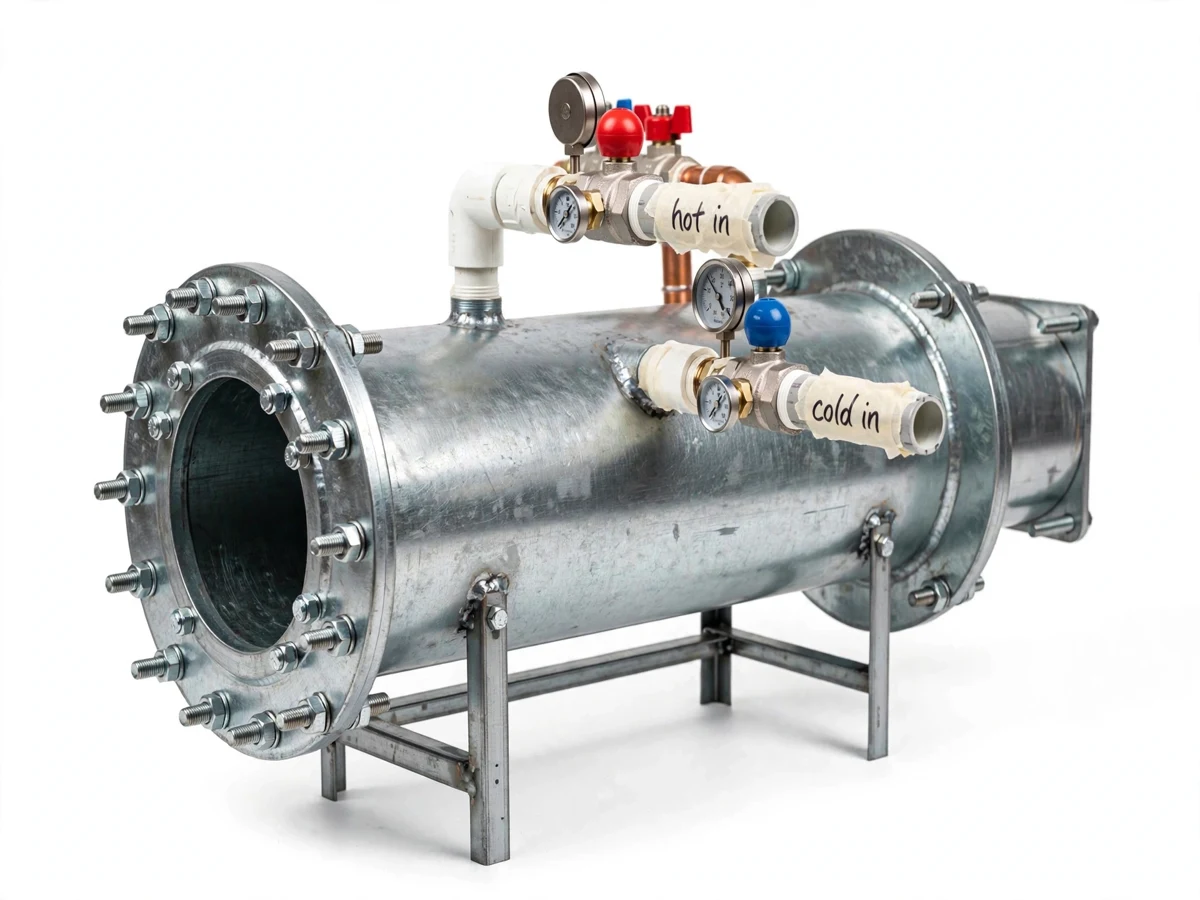
The shell and tube exchanger is the workhorse of process industry heat transfer, and the LMTD method is the calculation every heat-transfer course demands — yet students usually meet both only on paper. Lab-scale exchangers are expensive and shared, so the experiment that connects the log-mean temperature difference to real thermometer readings rarely happens hands-on. This project builds a student-scale unit: a horizontal steel shell housing a bundle of brass tubes, with a hot-water circuit (tank with immersion heater and pump) through the tubes and a cold-water circuit through the shell, thermometers at all four ports, and a valve arrangement that switches between counter-flow and parallel-flow. The student brings the unit to steady state, logs temperatures and flow rates, and computes LMTD, heat-transfer rate and effectiveness from their own measurements — for both configurations, on the same hardware.
How it works
- The hot-water tank is filled, the heater is switched on, and both circuits are started with the valves set for counter-flow; the unit is left until all four thermometers read steady.
- The student logs the four port temperatures and measures both flow rates by timed collection, recording everything on the experiment sheet.
- From the data, the student computes the log-mean temperature difference, the heat given up by the hot stream and gained by the cold stream, and the effectiveness — checking the heat balance as the manual describes.
- The valves are switched to parallel-flow, steady state is re-established, and the full measurement set is repeated on the identical hardware.
- The two configurations are compared: counter-flow should show the higher effectiveness, and the student quantifies the difference from their own numbers.
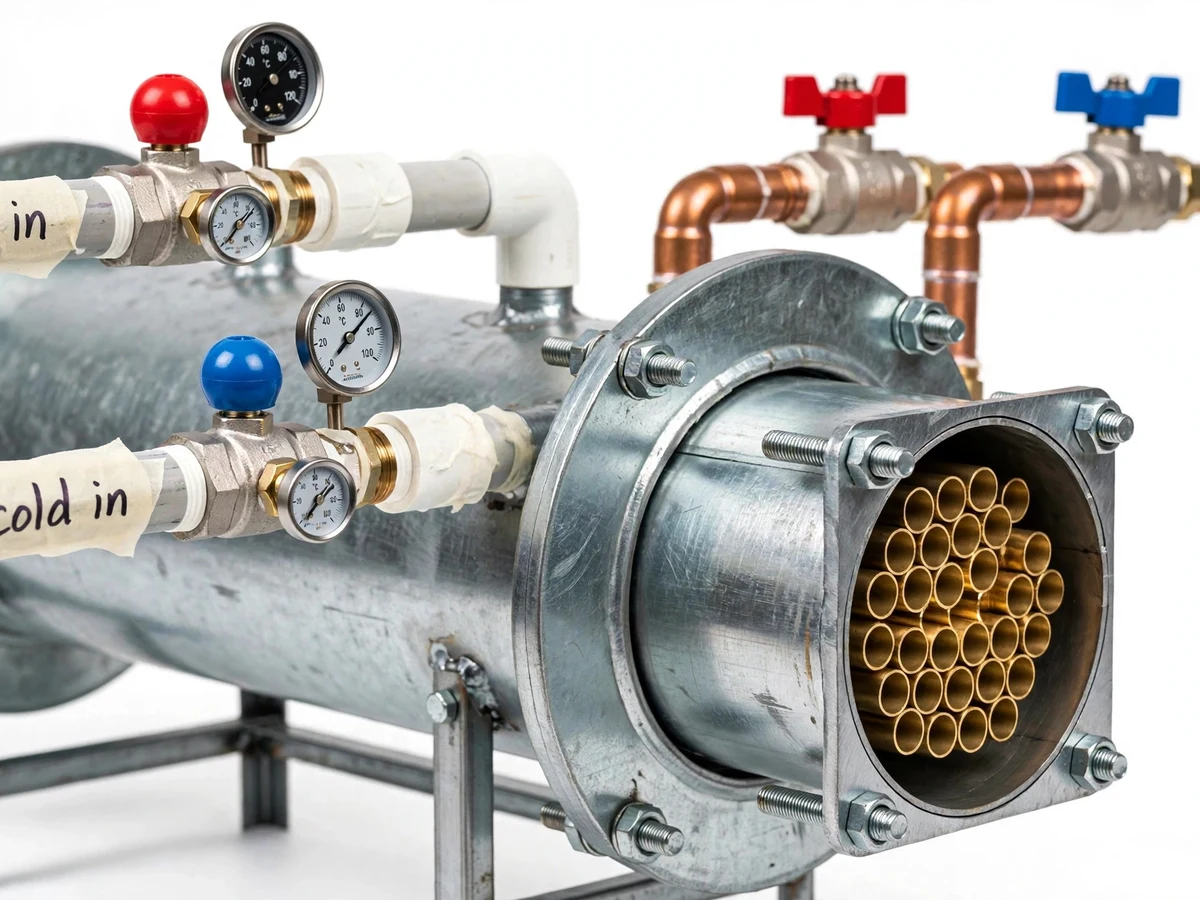
- The removable channel head is opened for the report photographs, showing the tube bundle the water flowed around.
Tech stack:
- Horizontal steel shell fabrication
- Brass tube bundle with tube sheets
- Hot-water tank with immersion heater
- Circulation pump and control valves
- Four dial thermometers
- Counter/parallel piping arrangement
- Timed-collection flow measurement
- LMTD experiment manual and worksheets
| Parameter | Value |
|---|---|
| Exchanger type | Shell and tube, single pass (design) |
| Shell | Mild-steel cylinder, approximately 500 mm long (design) |
| Tube bundle | Brass tubes, approximately 12 tubes (design) |
| Hot circuit | Tank with immersion heater, approximately 1 kW (design) |
| Cold circuit | Mains-fed with control valve (design) |
| Thermometers | 4 dial thermometers, 0–100 °C (design) |
| Configurations | Counter-flow and parallel-flow by valve selection (design) |
| Power | 230 V AC single phase for heater and pump (design) |
Project features
- [Steel shell] A horizontal cylindrical shell with flanged ends forms the shell-side passage for the cold water circuit.
- [Removable brass tube bundle] A bundle of brass tubes on tube sheets carries the hot water; one channel head removes so the class can see the bundle construction directly.
- [Hot-water circuit] A tank with an immersion heater and small pump supplies the tube-side hot flow, with a valve for flow control.
- [Cold-water circuit] A separate cold-water line feeds the shell side, with its own control valve — both circuits are independently adjustable.
- [Four thermometer points] Dial thermometers at the hot inlet/outlet and cold inlet/outlet capture every temperature the LMTD calculation needs.
- [Counter/parallel valve arrangement] The piping and valves let the student switch the cold stream between counter-flow and parallel-flow without re-plumbing.
- [Flow measurement] Both circuits include a simple timed-collection measurement point so flow rates are student-measured with a jug and stopwatch per the manual.
- [LMTD and effectiveness worksheets] The experiment manual walks through steady-state logging, LMTD computation, heat-balance check and effectiveness comparison for both configurations.
What is included
- Fabricated shell and tube heat exchanger with removable channel head
- Hot-water tank with immersion heater and circulation pump
- Cold-water circuit piping with control valves
- Four dial thermometers fitted at the ports
- Counter/parallel-flow valve arrangement
- Dimensioned fabrication and piping drawings
- Experiment manual with logging sheets, LMTD and effectiveness worksheets
- Project report PDF (background, heat-exchanger theory, fabrication, experiment methodology, results format)
- PPT presentation for final review
- Viva Q&A preparation document (LMTD, effectiveness, counter vs parallel flow, fouling)
Limitations & prerequisites
- A teaching demo, not an industrial exchanger — the shell is uninsulated, so ambient heat loss is present and the manual treats it as a documented part of the heat-balance discussion.
- Temperatures are read from dial thermometers by eye (typical uncertainty around ±1 °C); flow rates come from timed collection, with the usual stopwatch-and-jug uncertainty the student reports.
- Steady state takes time to reach; the manual specifies the stability criterion (readings unchanged over 5 minutes) the student must apply.
- No overall heat-transfer coefficient or effectiveness value is claimed for the unit; every number in the report is computed from the student's own logged data.
- Hot-water temperature is limited by the immersion heater and tank design — the procedure caps it at a safe operating point.
Frequently Asked Questions
What is LMTD and why does the experiment need it?
The log-mean temperature difference is the correct average driving temperature for a heat exchanger; the four thermometers give the end-point temperatures, and the worksheet turns them into the LMTD the theory chapter uses.
Why test both counter-flow and parallel-flow?
Because theory says counter-flow is more effective, and this rig lets the student prove it on the same hardware — same exchanger, same flows, only the valve positions change.
How are flow rates measured without flow meters?
By timed collection: divert each stream into a measuring jug for a timed interval, as the manual describes. It is the classic lab method and its uncertainty is part of the student's error analysis.
What does the heat-balance check show?
Heat lost by the hot stream should approximately equal heat gained by the cold stream; the gap between them reveals the uninsulated-shell losses, which the report discusses honestly.
Can the tube bundle be seen?
Yes — one channel head unbolts to expose the brass tube bundle for photographs and the report's construction chapter.
Is this project suitable for a final-year project?
Yes — for Mechanical Engineering programs. It combines pressure-vessel-style fabrication, thermal experimentation, and heat-transfer analysis, and the report is built on the student's own measured temperatures, flow rates and effectiveness values. Suitable for B.E./B.Tech final-year projects in Mechanical Engineering.
Components & software requirements
- Horizontal steel shell fabrication
- Brass tube bundle with tube sheets
- Hot-water tank with immersion heater
- Circulation pump and control valves
- Four dial thermometers
- Counter/parallel piping arrangement
- Timed-collection flow measurement
- LMTD experiment manual and worksheets
Delivery information
Built-to-order project. Delivery timeline is shared after order confirmation based on current queue.
Support terms
Complete documentation, setup guide, and viva preparation included. Support for setup and explanation provided.