
More project photos (2)
The problem
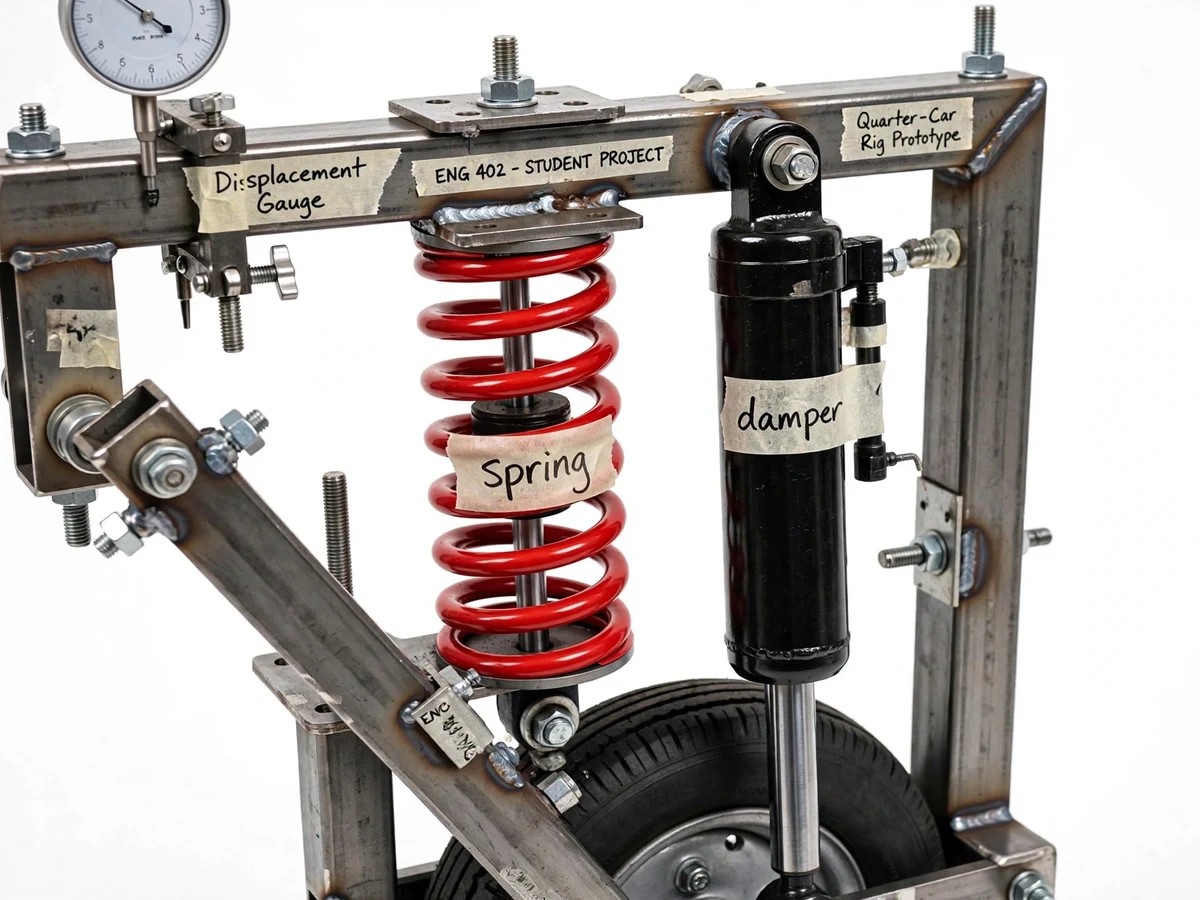
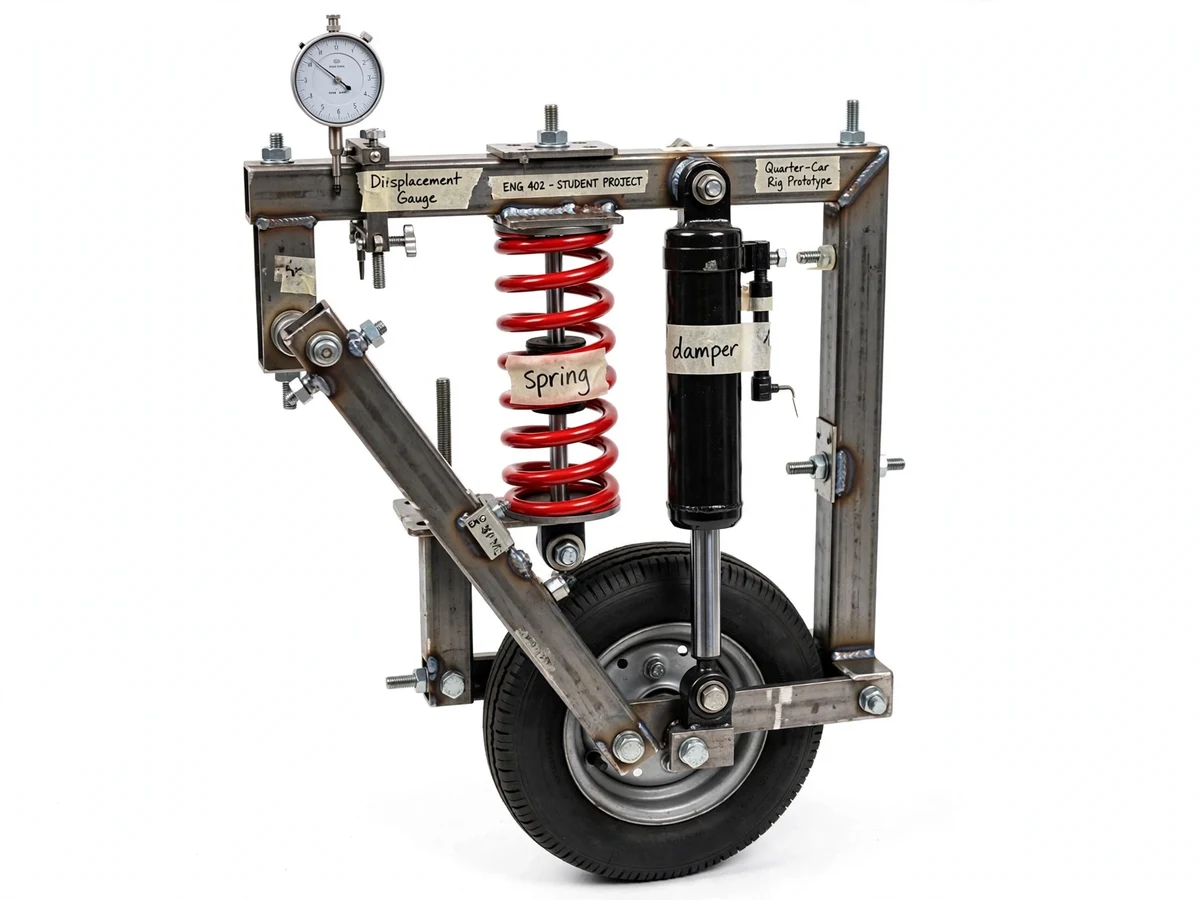
Vehicle dynamics is usually taught with the quarter-car model — a mass, a spring and a damper drawn on paper — but students rarely get to push down on a real one and watch it bounce. Full vehicle rigs are far beyond student budgets, while the quarter-car rig captures the essential physics in one corner: the unsprung wheel, the spring carrying the body mass, and the damper controlling the motion. This project fabricates that rig as a welded steel frame holding a real wheel-and-tyre, a coil spring, and a hydraulic damper, with a displacement gauge reading the body motion. The student performs static deflection tests, finds the spring stiffness from their own measurements, then runs drop tests and watches how the damper kills the oscillation — the paper model, made physical.
How it works
- Known masses are added to the sprung platform in steps and the displacement gauge reading is recorded at each step.
- The student plots load against deflection and finds the spring stiffness from the slope — the first measured parameter of the rig.
- The sprung mass is lifted to the marked drop height and released; the student watches the oscillation and notes how many visible bounces occur before it settles.
- The drop test is repeated with the damper bypassed (undamped) and connected (damped), and the two settling behaviours are compared side by side.
- Using the measured stiffness and the known masses, the student computes the undamped natural frequency from the worksheet formula and checks it against the bounce they observed.
- All results — stiffness plot, drop-test notes, damped vs undamped comparison — are written up with photographs of the gauge readings.
Tech stack:
- Welded steel frame fabrication
- Wheel and tyre assembly
- Coil spring suspension unit
- Hydraulic damper with bypass
- Dial displacement gauge
- Pivoted swing-arm carrier
- Calibrated-style mass set
- Suspension experiment worksheets
| Parameter | Value |
|---|---|
| Model | Quarter-car, single corner (design) |
| Spring | Coil spring, stiffness student-measured (design) |
| Damper | Hydraulic unit with bypass for undamped runs (design) |
| Displacement gauge | Dial type, 0.01 mm least count (design) |
| Drop height | Fixed release at marked height, approximately 50 mm (design) |
| Mass set | Known masses for static test, 5–25 kg total (design set) |
| Frame | Welded steel sections (design) |
| Footprint | Approximately 700 × 600 mm (expected) |
Project features
- [Real wheel and tyre] An actual small wheel-and-tyre forms the unsprung mass, so the rig looks and behaves like one corner of a vehicle.
- [Coil spring] A visible red coil spring carries the sprung mass — the stiffness element the student measures in the static test.
- [Hydraulic damper] A real damper unit in parallel with the spring, with a bypass arrangement so tests can run damped or undamped for comparison.
- [Displacement gauge] A dial displacement gauge on the frame reads the sprung-mass motion during static and drop tests.
- [Swing-arm guidance] The wheel carrier moves on a pivoted arm, keeping the motion vertical and the geometry consistent between runs.
- [Mass set for static tests] A set of known masses loads the sprung platform so spring stiffness is found from measured deflection.
- [Drop-test provision] The sprung mass can be lifted to a fixed height and released cleanly, giving a repeatable step input for every drop test.
- [Experiment worksheets] Procedures and tables for the static test, the drop test, and the damped-vs-undamped comparison the student completes.
What is included
- Fabricated quarter-car suspension rig (frame, arm, wheel, spring, damper)
- Dial displacement gauge with mounting
- Mass set for static deflection tests
- Damper bypass arrangement for undamped comparison runs
- Dimensioned fabrication drawings
- Step-by-step experiment procedures with worksheets
- Project report PDF (background, fabrication, test methodology, results format)
- PPT presentation for final review
- Viva Q&A preparation document (quarter-car model, natural frequency, damping, spring stiffness)
Limitations & prerequisites
- A single-corner teaching rig — it demonstrates the quarter-car model; it does not replicate full-vehicle handling or tyre dynamics.
- Motion is read from a dial gauge by eye (or photographed); there is no electronic data logging in the base build.
- The drop height and masses are fixed by the design — the rig is not a variable road-profile simulator.
- Damper behaviour is compared qualitatively (settling bounces) plus the student's own gauge readings; no damping-coefficient value is claimed for the unit.
- Pivot friction in the swing arm is small but present; the procedure notes it as a documented approximation.
Frequently Asked Questions
What is the quarter-car model?
The standard simplification of vehicle ride dynamics: one wheel (unsprung mass), one spring and one damper carrying a quarter of the body (sprung mass). Nearly all suspension theory starts here, and this rig is that diagram built in steel.
How is spring stiffness measured?
By loading the sprung platform with known masses and reading the deflection on the gauge — stiffness is the slope of the load-deflection plot, measured by the student, not printed on the spring.
What does the drop test show?
The rig's free response: lift and release the mass and watch it bounce. With the damper bypassed it keeps bouncing; connected, it settles quickly — the most direct demonstration of what a damper does.
How is natural frequency checked?
From the measured stiffness and the known sprung mass using the standard formula; the student compares the calculated frequency with the bounce rhythm they observe in the drop test.
Can the damper be tested separately?
The bypass arrangement lets every experiment run in damped and undamped configurations, so the comparison is built into the procedure.
Is this project suitable for a final-year project?
Yes — for Mechanical Engineering programs. It combines fabrication, experimental dynamics, and theory verification, and the report is built on the student's own measured stiffness and drop-test results. Suitable for B.E./B.Tech final-year projects in Mechanical Engineering.
Components & software requirements
- Welded steel frame fabrication
- Wheel and tyre assembly
- Coil spring suspension unit
- Hydraulic damper with bypass
- Dial displacement gauge
- Pivoted swing-arm carrier
- Calibrated-style mass set
- Suspension experiment worksheets
Delivery information
Built-to-order project. Delivery timeline is shared after order confirmation based on current queue.
Support terms
Complete documentation, setup guide, and viva preparation included. Support for setup and explanation provided.