
More project photos (2)
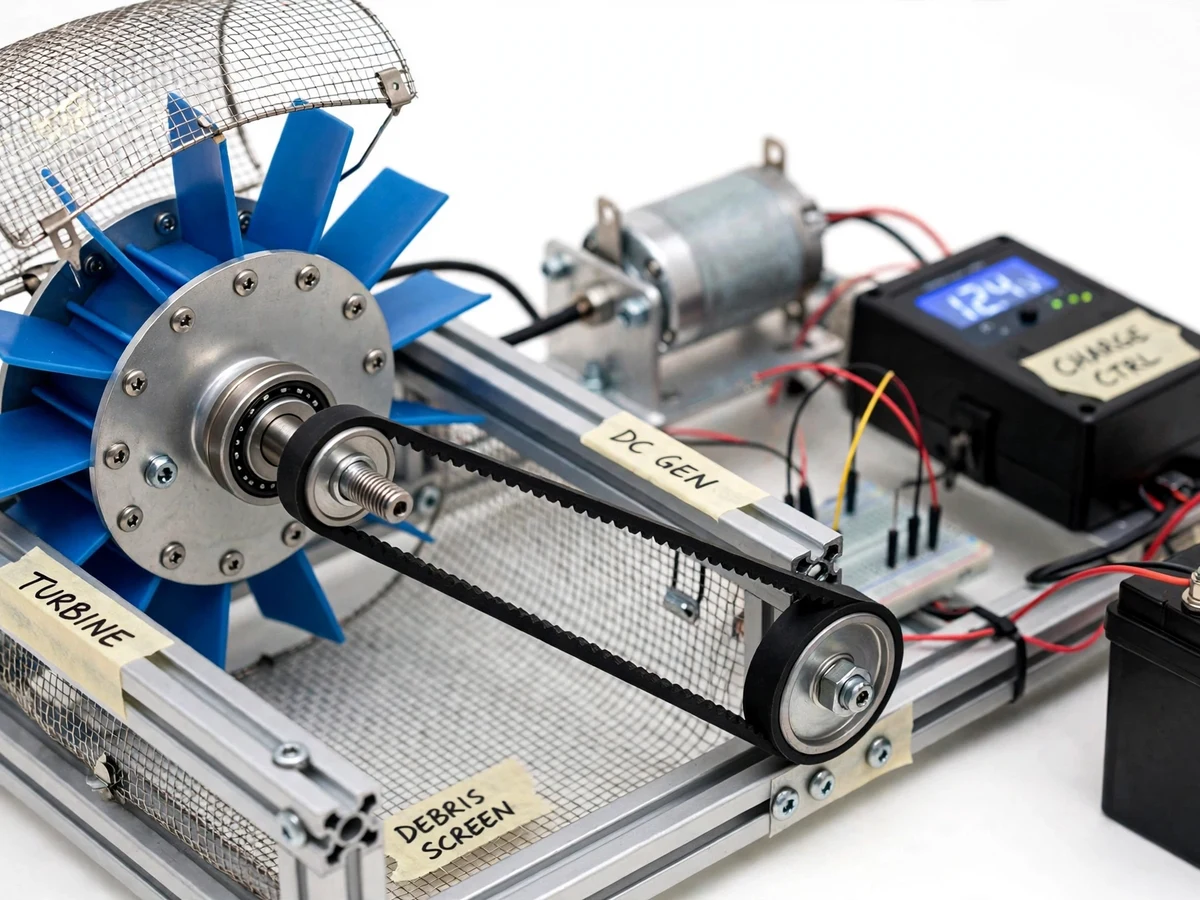
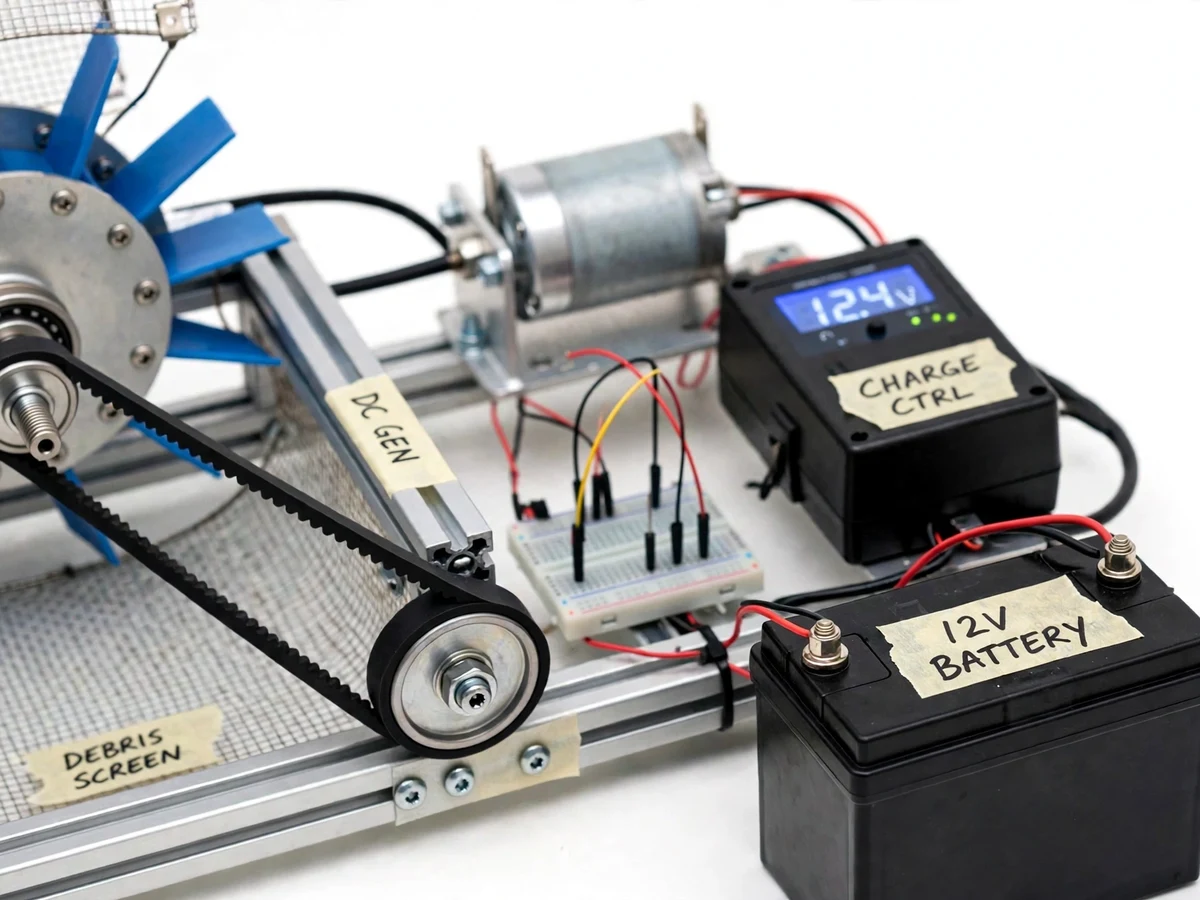
The problem
Off-grid stream sites have a charging problem that neither a wall socket nor a sunny day reliably solves. Field huts, farms beside irrigation channels, trekking camps, and riverside homes often sit near moving water day and night, yet still depend on trips to town for charging, on fuel for a generator, or on sunlight that disappears after sunset and under tree cover. Carrying charged batteries is slow, fuel costs add up, and a dead phone or lamp at night matters when navigation or light is needed. This project turns the stream itself into the charger. A compact turbine runner sits in the flow, a generator converts that motion into electricity, and a charge controller stores it safely in a battery, so the energy is ready whenever a device needs it. Because the stream keeps flowing, charging does not wait for sunshine, fuel, or the grid, and the display shows at a glance whether power is actually being produced.
| Approach | Works at night without fuel | Needs grid or fuel | Battery and power visibility |
|---|---|---|---|
| Solar phone charger | No, needs sunlight | No, but needs sun | Charge level only |
| Petrol or diesel generator | Yes, while running | Yes, fuel and servicing | Fuel gauge only, if fitted |
| Mains grid charging | Yes, where a socket exists | Yes, needs a grid connection | Charger light only |
| This portable micro-hydro unit | Yes, while the stream flows | No, stream flow only | Live voltage, current, and charging power plus battery state |
Flowing water drives the runner.
Follow the working sequence
How it works
From stream to stored charge, the system follows one continuous chain, and every stage exists to protect the next. Flowing water strikes the undershot runner and turns it, and that rotation is carried by a belt drive to the permanent-magnet DC generator, whose output voltage rises and falls with shaft speed. Because stream flow is never steady, the raw generator output is unsuitable for direct battery charging, so it passes through a charge controller that rectifies, limits, and regulates it to the battery's charging range. When the battery is full, the controller diverts surplus energy to a dump load instead of overcharging the cells, since the stream cannot be switched off like a solar panel. A display tapped into the battery circuit reports voltage, current, and power throughout, and a 5 V USB regulator draws from the stored battery to charge phones and small devices.
- Pick a stream site, check that the water is deep enough to cover the runner's lower paddles, measure the flow speed with a float-and-stopwatch check over a marked distance, anchor the frame, and fit the debris screen upstream of the runner.
- Flowing water strikes the undershot runner and turns it, and the belt drive carries that rotation to the permanent-magnet DC generator shaft.
- The spinning generator produces a DC voltage proportional to its shaft speed, so faster flow reads as higher voltage on the display.
- Generator output passes through the charge controller, which rectifies, limits, and regulates it into the battery's charging range.
- The controller charges the 12 V battery through its charging stages up to the float range, while the display shows battery voltage, charging current, and instantaneous power.
- Once the battery is full, the controller diverts surplus energy to the resistive dump load instead of overcharging the battery.
- Phones, lamps, and small DC loads draw from the stored battery through the 5 V USB regulator at any hour, and the unit is lifted out, rinsed, and dried after the demonstration.
Builder note: during bench checks, a jet or flow striking the runner's edge instead of the centre of the paddles wasted stream energy and shook the frame, so align the runner squarely into the flow and re-check the alignment after anchoring, before recording any readings.
Tech stack:
- Undershot paddle-wheel turbine runner
- Permanent-magnet DC generator
- PWM charge controller · dump load resistor
- 12 V sealed lead-acid battery
- Digital panel meter · voltage · current · power
- 5 V USB buck regulator
- Steel · aluminium portable frame
- Debris screen mesh
| Parameter | Value |
|---|---|
| Runner type | Undershot paddle-wheel (design choice) |
| Runner diameter | Approximately 200 mm (design dimension) |
| Generator | Permanent-magnet DC machine · 12 V nominal (datasheet class) |
| Battery | 12 V · 7 Ah sealed lead-acid · six 2 V cells in series (datasheet nominal) |
| Float voltage | 13.5–13.8 V (datasheet range for 12 V lead-acid) |
| Charge controller | 10 A PWM controller (design rating) |
| USB output | 5 V (design output) |
| Display | Battery voltage · charging current · instantaneous power (design scope) |
| Design-target stream speed | Approximately 0.8–1.5 m/s (design target) |
| Design-target charging power | Up to approximately 10 W (design target, stream-dependent) |
| Dump load | Resistive load switched by the controller at full charge (design behaviour) |
| Frame mass | Approximately 6 kg (design target) |
Project features
The build centres on four capabilities that make stream power usable rather than merely demonstrable. First, a low-head undershot runner and permanent-magnet DC generator convert flowing water into electricity without needing a dam or a large drop, so ordinary shallow streams can serve as the source. Second, a charge controller with overcharge and dump-load protection manages that unsteady input into a 12 V battery safely, because unlike a solar panel, a stream cannot simply be switched off when the battery fills. Third, a live display shows battery voltage, charging current, and instantaneous power, so the builder can prove the system is charging and diagnose a weak flow on the spot. Fourth, a portable frame with anchoring points and an upstream debris screen lets one person set the unit in a stream, keep leaves and twigs out of the runner, and remove it again without civil work.
- [Low-head undershot turbine runner] A paddle-wheel runner sits in the stream flow so moving water pushes the paddles directly, with no dam, penstock, or large vertical drop required for the demonstration.
- [Permanent-magnet DC generator] A permanent-magnet DC machine driven by the runner produces a voltage that rises and falls with shaft speed, giving a direct, measurable link between flow and electrical output.
- [Charge controller with dump-load protection] The controller regulates the unsteady generator output into the battery's charging range and diverts surplus energy to a resistive dump load once the battery is full, since flowing water cannot be switched off.
- [Live voltage, current, and power display] A panel display shows battery voltage, charging current, and instantaneous power together, so charging can be verified on site and different stream positions compared fairly.
- [12 V battery storage with 5 V USB output] A sealed 12 V battery stores stream energy for use at any hour, and a 5 V USB regulator supplies phones, lamps, and other small DC loads from that stored charge.
- [Debris screen and portable anchored frame] A mesh screen upstream of the runner keeps leaves and twigs out of the paddles, while anchor points hold the light frame against the current and allow removal without tools or civil work.
- [Fuse and reverse-polarity protection] A fuse on the battery circuit and reverse-polarity protection on the controller connections guard the wiring and electronics against short circuits and swapped battery leads.
What is included
- Working portable micro-hydro prototype with turbine runner, generator, charge controller, battery, and power display
- Firmware-free wiring and circuit documentation with component list
- Stream-site setup instructions including the float-and-stopwatch flow-speed check
- Test procedure with a blank table for open-circuit voltage against shaft speed and charging readings at the demo site
- Project report PDF covering energy conversion, generator behaviour, charge control, testing, and limitations
- Project abstract PDF
- PPT presentation for review
- Viva Q&A preparation document covering turbines, DC machines, battery charging, and dump-load protection
To request this project on a quotation basis, message on WhatsApp with the scope needed: turbine-and-charging unit only, or the full build with battery, display, and documentation. The quotation covers the agreed scope, the build is prepared to order, and delivery timing is discussed on WhatsApp once the scope and any customisation are confirmed. No fixed price is quoted on this page, and no delivery date is promised before that discussion.
Limitations & prerequisites
- Output depends entirely on the stream: a slow, shallow, or seasonal stream produces less power, and a dry streambed produces none.
- This is a small-load prototype for phones, lamps, and small DC devices; it is not a house supply and the base build has no mains inverter.
- Battery capacity limits use: a 12 V · 7 Ah battery stores approximately 84 Wh at nominal voltage, so heavy or continuous loads drain it faster than a weak stream refills it.
- The unit must be removed before floods or spate flows; strong currents can shift the frame, damage the runner, or wash the unit away.
- Display readings are panel-meter readings for demonstration, not calibrated laboratory measurements, and vary with flow, wiring, and battery state.
- Lead-acid batteries need care: avoid short circuits, deep discharge, and charging outside the controller's range, and keep the unit away from open flame.
- The prototype is an academic build, not a certified or grid-tied generating station, and it must not be connected to mains wiring.
Frequently Asked Questions
How much power does this project produce?
It depends on the stream, not on a fixed rating, so no single wattage is promised: the design target is up to approximately 10 W of charging power in a stream flowing at approximately 0.8–1.5 m/s, and a slower or shallower stream will produce less because generator voltage falls with shaft speed. The live display lets the builder record the actual voltage, current, and power at their own site, and the report's test table is filled from those site readings rather than from a claimed figure.
Does it work at night and without sunlight?
Yes, it works whenever the stream flows, including at night, under tree cover, and in cloudy weather, because its energy source is moving water rather than sunlight or fuel. That is the main difference from a solar charger, which stops when the sun goes down. The limit is the stream itself: if the flow drops in a dry season, charging slows, and if the streambed dries up, charging stops until water returns.
What battery does it use, and how long does charging take?
The build uses a 12 V · 7 Ah sealed lead-acid battery, which is six 2 V cells in series at nominal voltage, charged through a controller up to a float range of approximately 13.5–13.8 V. No charging time is promised, because charging time depends on stream speed, depth, runner alignment, and how empty the battery was at the start. The display shows whether charging is actually happening, so the builder can compare sites instead of trusting a quoted time.
Can it power a house or mains appliances?
No, the base build is sized for small DC loads such as phones, lamps, and USB devices, and it has no mains inverter or grid connection. Running mains appliances would need a larger turbine, a larger battery bank, and an inverter, which is a different design with different safety requirements. The report states this limit plainly so the project is never presented as a household power station.
Is this project suitable for a final-year project?
Yes, this project fits Electrical, Electronics, and Mechanical programmes, because it combines energy conversion, rotating machines, power electronics, and battery charging in one working prototype. The runner design, the generator's voltage-versus-speed behaviour, the charge controller with dump-load protection, and the site test results give concrete material for design discussion, testing, and demonstration. The report documents the mechanism, the design targets, and the limitations honestly.
Components & software requirements
- Undershot paddle-wheel turbine runner
- Permanent-magnet DC generator
- PWM charge controller · dump load resistor
- 12 V sealed lead-acid battery
- Digital panel meter · voltage · current · power
- 5 V USB buck regulator
- Steel · aluminium portable frame
- Debris screen mesh
Delivery information
Built-to-order project. Delivery timeline is shared after order confirmation based on current queue.
Support terms
Complete documentation, setup guide, and viva preparation included. Support for setup and explanation provided.
Download free synopsis (PDF)
Enter your name and WhatsApp number — the synopsis PDF downloads immediately. We may send occasional project updates on WhatsApp; no spam.