
More project photos (3)
The problem
Parkinson's disease impairs movement progressively, and long before the classic tremor it changes the voice: reduced loudness, breathiness and cycle-to-cycle instability that signal processing can quantify. Voice is non-invasive, costs nothing to record and can be repeated often, which makes it one of the most practical screening signals ever studied for the disease. The standard academic benchmark is the UCI Parkinson's dataset — 195 sustained vowel /a/ recordings, each described by 22 biomedical voice measures: fundamental-frequency statistics, five jitter variants, six shimmer variants, noise-to-harmonic ratios and nonlinear dynamics measures (RPDE, DFA, spread, PPE) from Little et al.'s 2007 work. This project builds the full pipeline on that data, but its real lesson is methodological: with only 31 subjects behind 195 recordings, a random train/test split leaks speakers across folds and inflates scores, so the build evaluates subject-wise and reports both protocols. The demo makes the features tangible — waveform, distributions, importance — while the documentation states the boundary: a screening-signal prototype, never a diagnosis.
Enters acoustic measurements or picks a preset in the analyzer.
Follow the working sequence
How it works
- The 22 acoustic features and the status label are loaded from the UCI dataset; the subject-name column is retained only for fold grouping.
- Features are standardized with StandardScaler fitted on training folds.
- RBF-SVM, XGBoost and logistic regression are tuned by grid search inside the cross-validation loop.
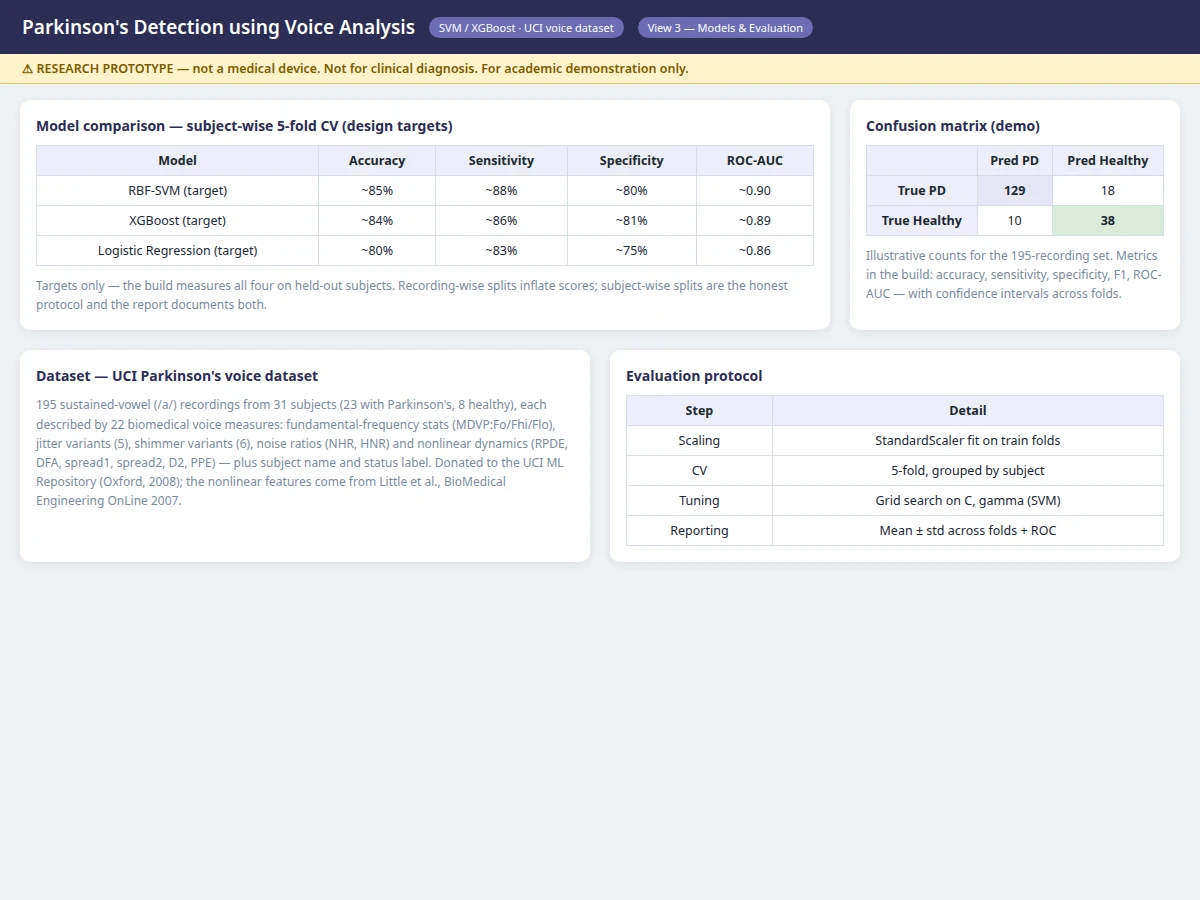
- Evaluation uses 5-fold cross-validation grouped by subject; accuracy, sensitivity, specificity, F1 and ROC-AUC are averaged across folds with standard deviations.
- The EDA notebook computes class distributions, a correlation heatmap and tree-based feature importance for the report.
- The winning pipeline (scaler + classifier) is serialized for the demo.
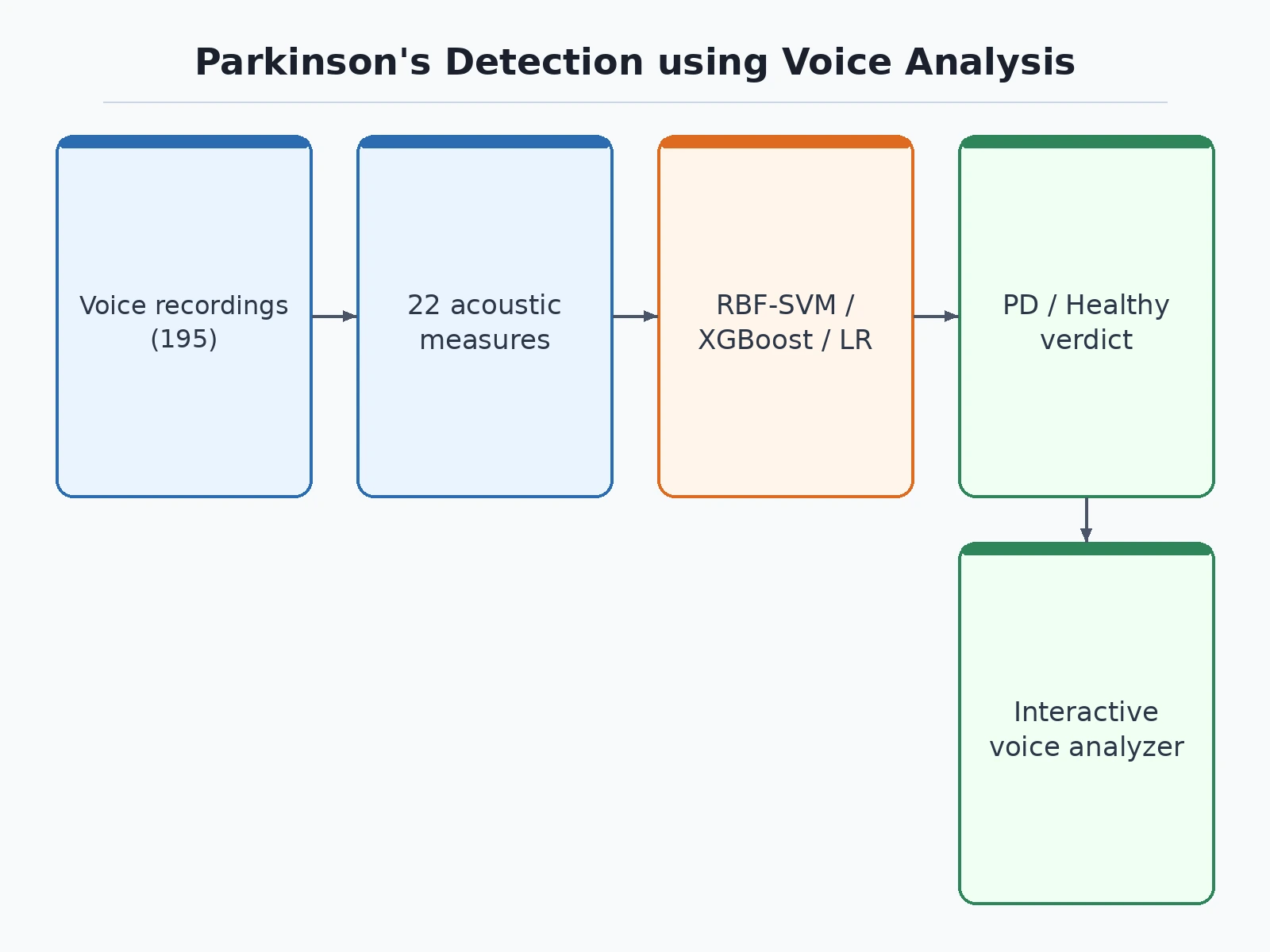
- The demo app accepts the acoustic measurements, renders the phonation waveform, runs the identical pipeline and displays the verdict with confidence.
Tech stack:
- Python 3.10, scikit-learn (SVM, logistic regression, pipelines, metrics)
- XGBoost (gradient boosting + gain-based importance)
- NumPy, pandas (data handling)
- Matplotlib, Seaborn (distributions, ROC curves, importance plots)
- Jupyter notebooks (EDA + training/evaluation)
- Flask demo app (voice analyzer + feature-analysis views)
- UCI Parkinson's voice dataset (195 recordings, 22 features, 31 subjects)
| Parameter | Value |
|---|---|
| Models | RBF-SVM, XGBoost, logistic regression (grid-searched) |
| Task | Binary classification: Parkinson's pattern vs healthy voice |
| Input | 22 acoustic features from sustained vowel phonation |
| Features | MDVP Fo/Fhi/Flo, jitter x5, shimmer x6, NHR, HNR, RPDE, DFA, spread1/2, D2, PPE |
| Dataset | UCI Parkinson's: 195 recordings from 31 subjects (23 PD, 8 healthy) |
| Evaluation | Subject-wise 5-fold CV; accuracy, sensitivity, specificity, F1, ROC-AUC |
| Output | Classification + confidence; EDA plots; feature-importance ranking |
| Design target | Approximately 85% accuracy / 0.90 ROC-AUC subject-wise (target, not a claimed result) |
| Demo | Flask app: analyzer, waveform, distribution and importance views |
Project features
- [Three-model comparison] RBF-SVM, XGBoost and logistic regression trained in scikit-learn Pipelines with grid-searched hyperparameters, compared on identical folds
- [Subject-wise cross-validation] 5-fold CV grouped by subject, so no person's recordings leak across folds — plus the naive recording-wise protocol reported for contrast
- [22-feature acoustic pipeline] Fundamental-frequency stats, jitter (5), shimmer (6), NHR/HNR and nonlinear dynamics (RPDE, DFA, spread1/2, D2, PPE) with StandardScaler normalization
- [Interactive voice analyzer] Feature-entry form with PD-like and healthy presets, synthetic phonation waveform visualization and classification with confidence bars
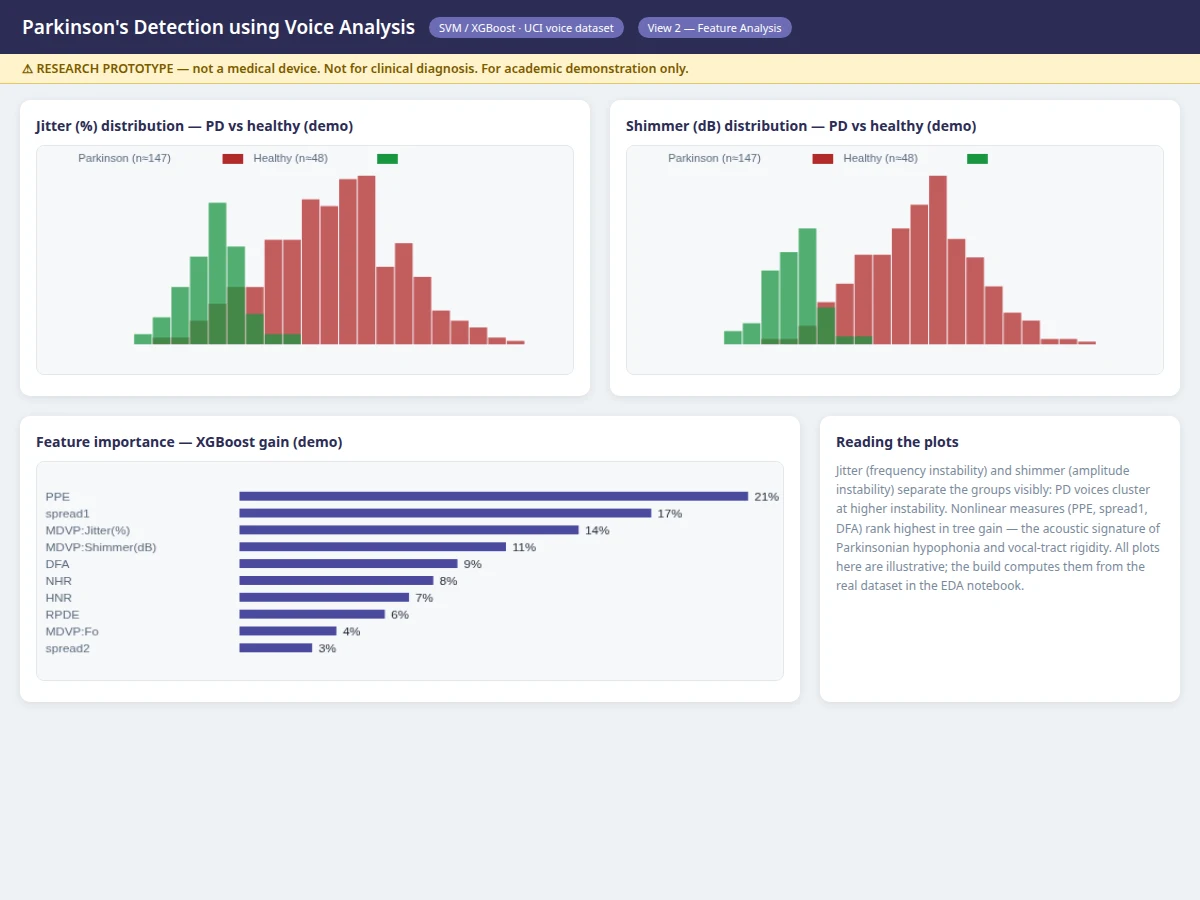
- [EDA views] Class distributions of jitter and shimmer, correlation analysis and XGBoost gain-based feature-importance ranking
- [Clinical-style metrics] Accuracy, sensitivity, specificity, F1 and ROC-AUC reported as mean and standard deviation across folds with confusion matrices
- [Leakage documentation] The report explicitly contrasts naive vs subject-wise scores, turning the dataset's biggest trap into the project's strongest viva material
- [Viva-ready documentation] Report with feature explanations, model comparison, error analysis and the medical-prototype disclaimer stated explicitly
What is included
- Complete source code (EDA notebook, training/evaluation notebook, demo app)
- Trained classifier pipelines (scaler + model) exported from the included run
- Jupyter notebooks (buyer-run procedure: explore, train, evaluate subject-wise)
- Project report PDF (background, feature analysis, methodology, leakage discussion, evaluation, medical-prototype disclaimer)
- PPT presentation for final review
- Viva Q&A preparation document (jitter/shimmer, SVM, cross-validation, leakage)
- Setup guide (environment, dataset download, running notebooks and demo)
Advantages
- RBF-SVM, XGBoost and logistic regression are trained in scikit-learn Pipelines with grid-searched hyperparameters and compared on identical folds.
- Subject-wise 5-fold cross-validation groups folds by subject, so no person's recordings leak across folds, and the naive recording-wise protocol is reported for contrast.
- The 22-feature acoustic pipeline covers fundamental-frequency stats, jitter (5), shimmer (6), NHR/HNR and nonlinear dynamics (RPDE, DFA, spread1/2, D2, PPE) with StandardScaler normalization.
- The interactive voice analyzer offers a feature-entry form with PD-like and healthy presets, a synthetic phonation waveform visualization and classification with confidence bars.
- EDA views show class distributions of jitter and shimmer, correlation analysis and XGBoost gain-based feature-importance ranking.
- Clinical-style metrics (accuracy, sensitivity, specificity, F1 and ROC-AUC) are reported as mean and standard deviation across folds with confusion matrices, built on 195 vowel recordings from 31 people.
Disadvantages
- This is an academic research prototype, not a medical device: it outputs a screening signal from acoustic features and cannot diagnose Parkinson's, which needs a neurologist.
- The dataset is small and clustered: 195 recordings from only 31 subjects, recorded under controlled conditions, so results do not generalize to phone recordings or noisy rooms without further work.
- No accuracy figure is promised: subject-wise scores are lower than naive recording-wise scores, and the report documents both honestly rather than cherry-picking.
- The model uses precomputed acoustic features; raw-audio recording and feature extraction on the user's own voice are documented as the extension path, not the base build.
- Class imbalance (147 PD versus 48 healthy recordings) is handled in evaluation but remains a property of the data the report discusses.
Limitations & prerequisites
- This is an academic research prototype, not a medical device: it outputs a screening signal from acoustic features and cannot diagnose Parkinson's; diagnosis needs a neurologist.
- The dataset is small and clustered: 195 recordings from only 31 subjects, recorded under controlled conditions — results do not generalize to phone recordings or noisy rooms without further work.
- No accuracy figure is promised: subject-wise scores are lower than naive recording-wise scores, and the report documents both honestly rather than cherry-picking.
- The model uses precomputed acoustic features; raw-audio recording and feature extraction on the user's own voice are documented as the extension path, not the base build.
- Class imbalance (147 PD vs 48 healthy recordings) is handled in evaluation but remains a property of the data the report discusses.
Frequently Asked Questions
Which dataset is used?
The UCI Parkinson's dataset: 195 sustained-vowel (/a/) recordings from 31 subjects (23 with Parkinson's, 8 healthy), each described by 22 biomedical voice measures — jitter, shimmer, noise ratios and nonlinear dynamics features. Donated to the UCI ML Repository (Oxford, 2008); the nonlinear features originate from Little et al., BioMedical Engineering OnLine 2007.
What is subject-wise cross-validation, and why does it matter here?
With ~6 recordings per person, a random split puts the same speaker's voice in both train and test, and the model can memorize speakers instead of disease patterns. Grouping folds by subject prevents this. The build reports both protocols so the difference is visible and discussable.
Is the accuracy guaranteed?
No. The design target is approximately 85% accuracy / 0.90 ROC-AUC under subject-wise CV, but the actual figures — with standard deviations across folds — are computed by the training notebook during the build. The report never presents naive-split scores as the headline result.
Is this a medical device? Can it diagnose Parkinson's?
No. This is an educational research prototype producing a screening signal from acoustic features. Diagnosis requires neurological examination; this system is never a substitute.
Can I record my own voice and test it?
The base build classifies the 22 precomputed features (the demo includes presets). Recording a vowel and extracting the features with the documented pipeline is listed as the extension path and can be developed on request.
Which features matter most?
Tree-based importance consistently ranks the nonlinear measures (PPE, spread1) and perturbation features (jitter, shimmer) highest — the acoustic signature of Parkinsonian vocal instability. The EDA notebook recomputes this ranking from the real data during the build. Suitable for B.E./B.Tech final-year projects in Computer Science, AI/ML and Biomedical streams.
Components & software requirements
- Python 3.10, scikit-learn (SVM, logistic regression, pipelines, metrics)
- XGBoost (gradient boosting + gain-based importance)
- NumPy, pandas (data handling)
- Matplotlib, Seaborn (distributions, ROC curves, importance plots)
- Jupyter notebooks (EDA + training/evaluation)
- Flask demo app (voice analyzer + feature-analysis views)
- UCI Parkinson's voice dataset (195 recordings, 22 features, 31 subjects)
Delivery information
Built-to-order project. Delivery timeline is shared after order confirmation based on current queue.
Support terms
Complete documentation, setup guide, and viva preparation included. Support for setup and explanation provided.
Download free synopsis (PDF)
Enter your name and WhatsApp number — the synopsis PDF downloads immediately. We may send occasional project updates on WhatsApp; no spam.