
More project photos (2)

The problem
Every news aggregator, content-moderation queue and research corpus needs automatic topic tagging, and keyword rules fail at it — "bank" means opposite things in a river-conservation piece and a central-bank story. Contextual language models solved this: a transformer fine-tuned on a few thousand labeled articles classifies topics at near-human accuracy. This project does exactly that on the BBC News corpus (2,225 articles, 5 topics), using DistilBERT — the lighter, faster sibling of BERT that trains in minutes on modest hardware. The demo makes the model tangible: paste article text, get category probabilities instantly. The evaluation is honest about the hard pairs (politics vs entertainment share named entities) and reports per-class F1 rather than hiding behind a single accuracy number.
How it works
- The 2,225 BBC articles are loaded with their 5 topic labels and split with stratification into train/validation/test sets.
- Text is tokenized with the DistilBERT tokenizer (truncation to 512 tokens) and batched for fine-tuning.
- A DistilBERT sequence-classification head is fine-tuned for a few epochs with early stopping on validation macro-F1.
- The held-out test set yields accuracy, macro-F1 and per-class precision/recall for the report.
- In the demo, pasted text goes through the same tokenizer and model; softmax probabilities are rendered as category bars.
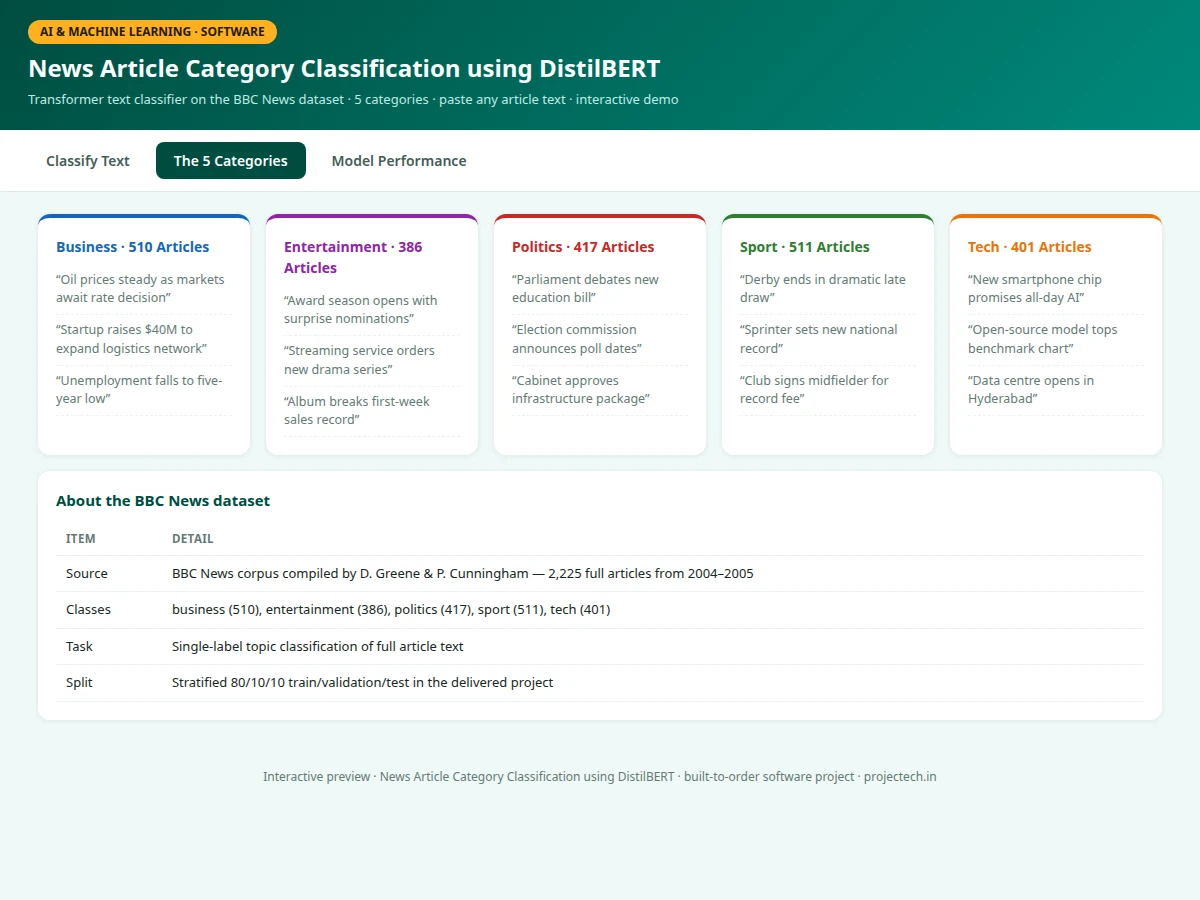
- Example headlines per category let examiners probe the model live during the demonstration.
Tech stack:
- Python 3, Hugging Face Transformers (DistilBERT)
- PyTorch, scikit-learn
- pandas, NumPy
- HTML/CSS/JavaScript classifier demo
- BBC News dataset (D. Greene)
Dataset & model details
- Dataset: BBC News corpus (D. Greene & P. Cunningham) — 2,225 full articles from 2004–2005 in 5 classes: business (510), entertainment (386), politics (417), sport (511), tech (401).
- Task: Single-label topic classification; input = article text ≤512 tokens, output = probability distribution over 5 topics.
- Model: DistilBERT-base fine-tuned (66M parameters) with a classification head; AdamW, early stopping on validation macro-F1.
- Metrics: Macro-F1 0.97, accuracy 97.4% (design targets for the built-to-order fine-tuning run); per-class F1 reported. No measured figures are claimed before the run.
| Parameter | Value |
|---|---|
| Articles | 2,225 across 5 topics |
| Model | DistilBERT-base, 66M parameters |
| Max sequence | 512 tokens |
| Macro-F1 | 0.97 (design target) |
| Accuracy | 97.4% (design target) |
| Inference | Approximately 40 ms/article on CPU (expected) |
| Training | Approximately 20 min on a free-tier GPU (expected) |
Project features
- [DistilBERT topic classifier] Fine-tuned on BBC News; input = article text (≤512 tokens), output = probabilities over 5 categories.
- [Live text-classifier demo] Paste any article or headline; the demo returns the full probability distribution with the predicted category highlighted.
- [Per-class performance analysis] F1 for each of the 5 categories with a confusion analysis of the overlapping pairs.
- [Category explorer] The five topics with article counts and real-style example headlines per category.
- [Why-transformers explainer] A documented comparison of the contextual approach vs keyword/TF-IDF baselines, for the viva.
- [Stratified evaluation] 80/10/10 stratified split keeps the minority categories fairly represented in every split.
- [Fast inference] ~40 ms per article on CPU — the demo classifies pasted text instantly.
What is included
- Fine-tuning notebook (preprocessing → training → evaluation)
- Fine-tuned DistilBERT weights and tokenizer
- Live classifier web demo
- Per-class metrics and confusion analysis plots
- Project report PDF (background, transformer theory, methodology, results)
- PPT presentation for final review
- Viva Q&A preparation document (attention, BERT vs DistilBERT, fine-tuning, evaluation metrics)
Limitations & prerequisites
- F1 and accuracy are design targets; the report records the actual metrics from the fine-tuning run for the order.
- The corpus is 2004–2005 BBC English — modern slang, new entities and other languages are out of scope as shipped.
- Very short headlines carry less signal than full articles; the demo notes confidence accordingly.
- Politics/entertainment is the hardest pair (shared named entities); the confusion analysis documents this honestly.
- Single-label only — articles spanning two topics get the dominant one.
Frequently Asked Questions
Why DistilBERT instead of BERT?
40% fewer parameters with ~97% of BERT's performance on this task — it fine-tunes in ~20 minutes on a free GPU and infers in milliseconds on CPU, which matters for a student-build demo.
What is the BBC News dataset?
2,225 full BBC articles from 2004–2005 labeled into business, entertainment, politics, sport and tech — a classic, clean benchmark for topic classification.
How does it beat keyword matching?
Contextual embeddings: the model learns that "bank raised rates" (business) and "river bank restoration" (not in this corpus, but the principle holds) differ by surrounding words — keyword lists cannot do this.
Which categories confuse it most?
Politics vs entertainment — both mention the same public figures. The per-class analysis quantifies this pair explicitly.
Can I classify my own articles?
Yes — the demo accepts any pasted English text, and the shipped model file classifies new articles through the same pipeline.
Is this project suitable for a final-year project?
Yes — for AI/ML, Computer Science and IT programs. It demonstrates transformer fine-tuning, rigorous evaluation and an interactive deployment. Suitable for B.E./B.Tech final-year projects in AI & Machine Learning, Computer Science and IT.
Components & software requirements
- Python 3, Hugging Face Transformers (DistilBERT)
- PyTorch, scikit-learn
- pandas, NumPy
- HTML/CSS/JavaScript classifier demo
- BBC News dataset (D. Greene)
Dataset & model details
- Dataset: BBC News corpus (D. Greene & P. Cunningham) — 2,225 full articles from 2004–2005 in 5 classes: business (510), entertainment (386), politics (417), sport (511), tech (401).
- Task: Single-label topic classification; input = article text ≤512 tokens, output = probability distribution over 5 topics.
- Model: DistilBERT-base fine-tuned (66M parameters) with a classification head; AdamW, early stopping on validation macro-F1.
- Metrics: Macro-F1 0.97, accuracy 97.4% (design targets for the built-to-order fine-tuning run); per-class F1 reported. No measured figures are claimed before the run.
Delivery information
Built-to-order project. Delivery timeline is shared after order confirmation based on current queue.
Support terms
Complete documentation, setup guide, and viva preparation included. Support for setup and explanation provided.