
More project photos (2)
The problem
An Edge AI Wildlife Camera using ESP32-S3 and TinyML Species Recognition is a solar-powered camera trap that photographs animals and identifies the species on the device itself, without cloud uploads. A passive infrared (PIR) motion sensor wakes the ESP32-S3 from deep sleep, the camera captures a frame, and a small quantized neural network on the chip classifies the animal in under a second. Wildlife researchers currently rely on camera traps that fill memory cards with thousands of images, most of them empty frames triggered by wind or moving vegetation, and a person must then sort every image by hand. That manual review is slow, delays population counts by weeks, and wastes battery and storage on frames with nothing in them. This project cuts that work at the source: empty frames are discarded on the device, only labelled sightings are uploaded, and a dashboard shows the sightings log, battery and solar status.
Motion wakes the camera from deep sleep.
Follow the working sequence
How it works
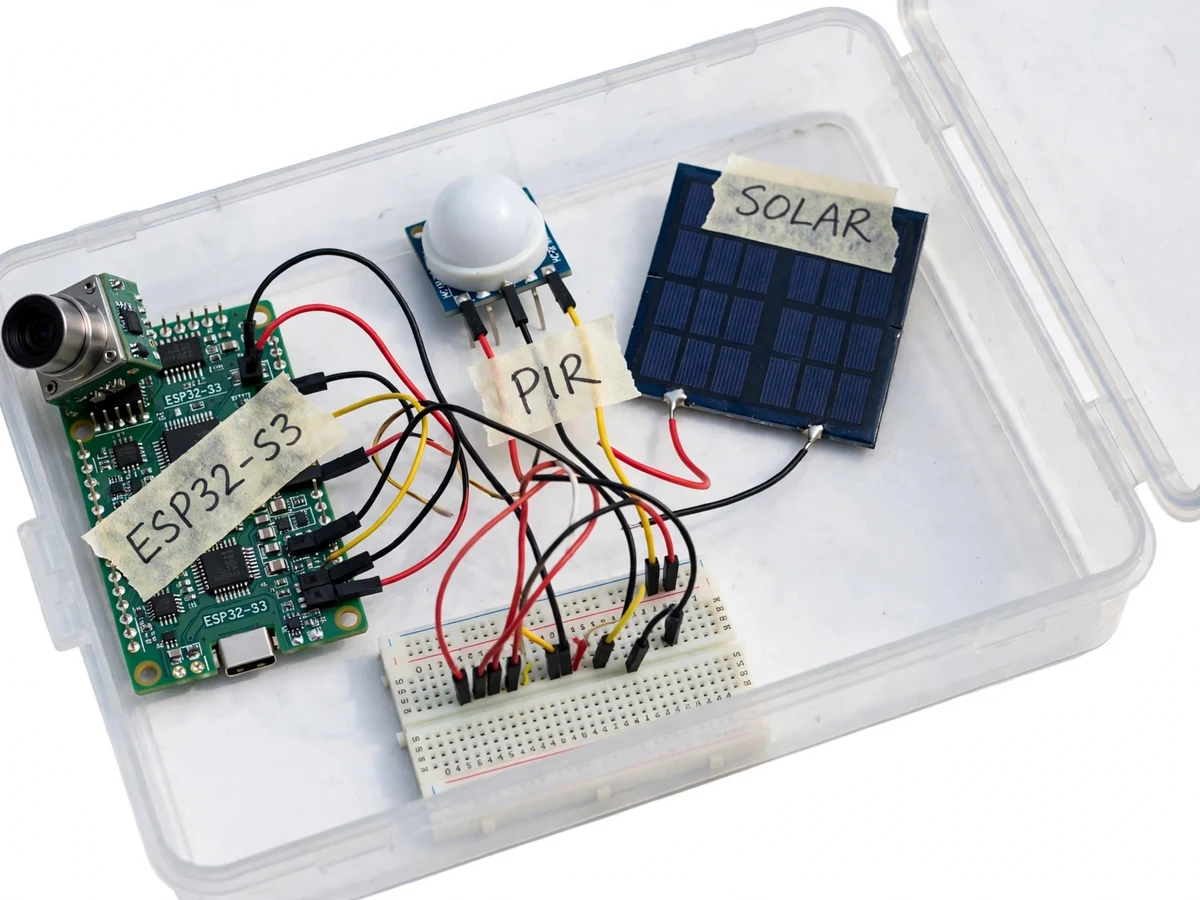
The Edge AI wildlife camera works as a complete sense, decide and report loop that runs without a person in the forest. The PIR motion sensor watches the trail while the ESP32-S3 sleeps; when a warm body moves through the detection zone, the controller wakes, powers the OV2640 camera and captures a frame. The frame is resized and passed to the quantized TinyML classifier running on the chip, which returns a species label and a confidence score in a fraction of a second. If the frame is empty or the confidence is too low, it is discarded on the device; if a species is confirmed, the label, score, timestamp and a thumbnail are uploaded over Wi-Fi or LoRa to the dashboard. The dashboard logs the sighting, updates the detections-by-hour chart and the battery and solar cards, while the full-resolution image is saved to the microSD card for later study.
- The HC-SR501 PIR sensor monitors the trail while the ESP32-S3 stays in deep sleep, drawing only microwatts of standby current (datasheet value).
- Warm movement in the detection zone wakes the controller, which powers the OV2640 camera and captures a 1600 × 1200 px frame.
- The frame is resized to the model input size and passed to the int8-quantized MobileNetV2-style classifier running on-device with TensorFlow Lite Micro.
- The ESP32-S3 vector (SIMD) instructions accelerate the quantized convolution maths, which is what makes on-chip inference fast enough to run before the animal leaves the frame.
- The classifier returns a species label and confidence score; empty frames and below-threshold results are discarded on the device and never uploaded.
- Confirmed sightings — label, confidence, timestamp and thumbnail — are uploaded over Wi-Fi near base camp, or over LoRa from remote sites.
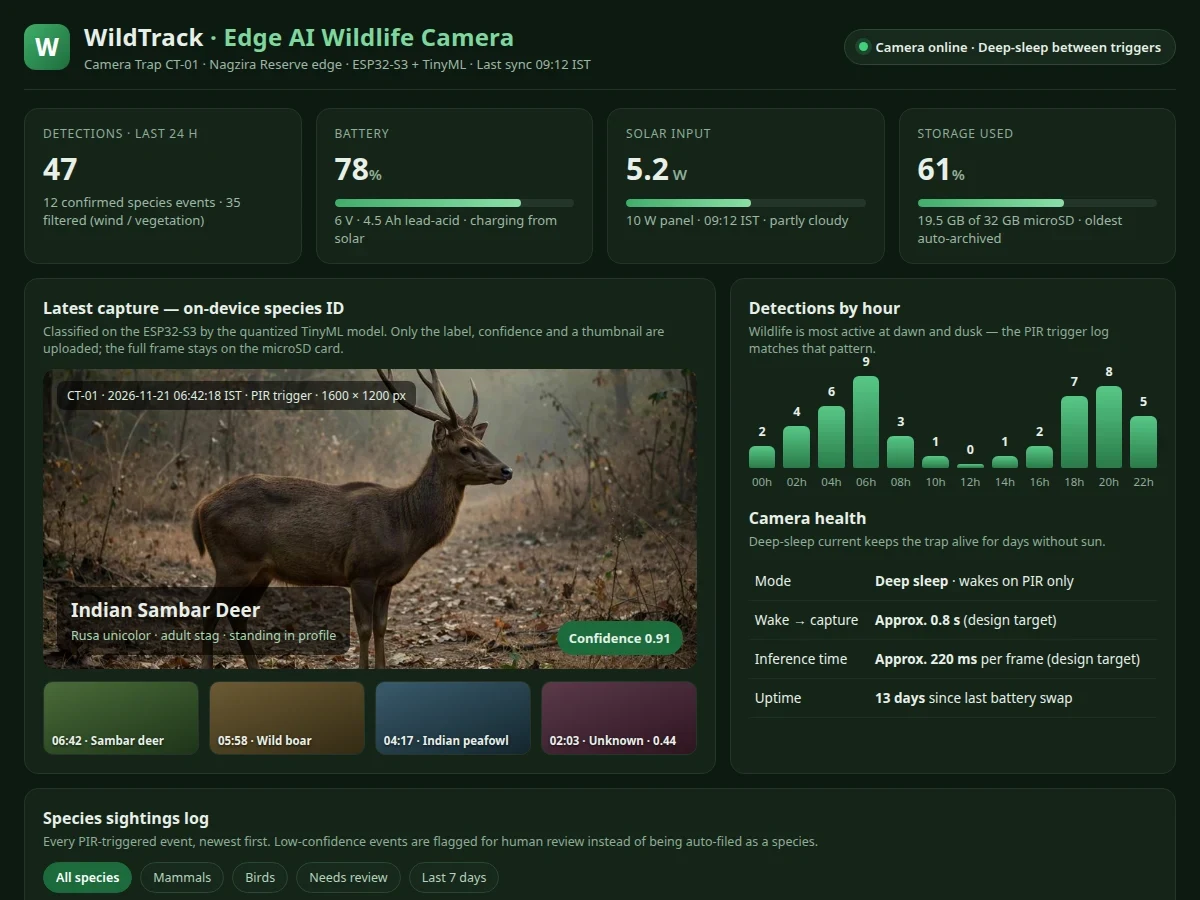
- The dashboard logs the sighting, updates the detections-by-hour chart, and shows live battery percentage and solar input power.
- The full-resolution frame is written to the 32 GB microSD card, and the system returns to deep sleep until the next trigger.
Tech stack:
- ESP32-S3 camera board
- OV2640 camera module
- TensorFlow Lite Micro
- HC-SR501 PIR motion sensor
- LoRa module (SX1278 class)
- 10 W solar panel + 6 V battery
- Arduino IDE / ESP-IDF firmware
- HTML, CSS and JavaScript dashboard
Dataset & model details
- Dataset: Custom camera-trap image set assembled for this build from the student's own field captures for the 5 Indian species — sambar deer, chital deer, wild boar, Indian peafowl, Indian hare — plus empty-frame and unknown classes, with a design target of at least 200 labelled images per class; the public Caltech Camera Traps benchmark (243,187 images from 140 camera locations, Beery et al., ECCV 2018) is the reference for camera-trap labelling and train/validation/test practice. A selected subset is used for this implementation.
- Task: Image classification; input = resized camera frame (96 × 96 px), output = species label with confidence score, or empty frame.
- Model: MobileNetV2-style convolutional classifier, post-training int8 quantized for TensorFlow Lite Micro on the ESP32-S3; FOMO-style detection is an optional alternative for multi-animal frames.
- Metrics: Top-1 validation accuracy, per-class precision and recall, confusion matrix, and on-device inference time. Development target: approximately 85% top-1 validation accuracy on the held-out set. Final performance depends on the dataset, training set size, image quality, lighting and field conditions — no accuracy is claimed as measured.
| Parameter | Value |
|---|---|
| Controller | ESP32-S3 (datasheet value: dual-core Xtensa LX7, up to 240 MHz, 512 KB SRAM, 384 KB ROM) |
| Camera | OV2640, 2 MP, up to 1600 × 1200 px |
| PIR sensor | HC-SR501, detection range up to 7 m (datasheet value), detection angle approximately 110° (datasheet value) |
| Model | MobileNetV2-style classifier, int8 quantized, TensorFlow Lite Micro |
| Model input | 96 × 96 px resized frame |
| Inference time | Approximately 220 ms per frame (design target) |
| Wake-to-capture time | Approximately 0.8 s (design target) |
| Connectivity | Wi-Fi 2.4 GHz (802.11 b/g/n) + optional LoRa (SX1278 class) |
| Storage | 32 GB microSD card |
| Power | 10 W solar panel, 6 V 4.5 Ah battery, charge controller |
| Standby current | Approximately 8 µA in deep sleep (datasheet value for the ESP32-S3 chip) |
| Enclosure | Weatherproof sealed enclosure, outdoor mount |
| Dashboard | Single-file web app: sightings log, latest capture, hourly chart, battery/solar status |
Project features
The strongest capabilities of this Edge AI wildlife camera are on-device species recognition, solar-powered field operation, and a dashboard that turns raw triggers into a readable sightings log. The quantized TinyML classifier runs entirely on the ESP32-S3, so the camera decides what it saw before anything leaves the forest. A PIR sensor keeps the system in deep sleep until an animal actually moves through the detection zone, which stretches battery life across days without sunlight. A 10 W solar panel and a 6 V battery keep the trap running unattended, and every confirmed sighting arrives on the dashboard with its species label, confidence score and timestamp, so population patterns and active hours are visible without opening a single memory card. The sealed enclosure, the LoRa option for sites beyond Wi-Fi range, and a review queue for low-confidence captures complete a trap that is meant to be left in the forest, not babysat beside a laptop.
- [On-device TinyML species recognition] A quantized MobileNetV2-style classifier runs on the ESP32-S3 with TensorFlow Lite Micro and labels each captured frame with a species name and confidence score, without any cloud inference.
- [PIR-triggered capture] An HC-SR501 PIR sensor wakes the camera from deep sleep only when warm movement crosses the detection zone, so the trap records animals instead of empty forest.
- [Empty-frame filtering on device] Frames the model classifies as empty or below the confidence threshold are discarded locally and never uploaded, saving storage, battery and upload bandwidth.
- [Solar-powered field operation] A 10 W solar panel charges a 6 V battery through a charge controller, and deep sleep between triggers keeps the trap running unattended in the field.
- [Sightings dashboard] A companion web dashboard shows the species sightings log, the latest capture with its label and confidence, detections by hour, and live battery and solar status.
- [Wi-Fi and LoRa upload] Labelled sightings are uploaded over Wi-Fi near base camp, with a LoRa link available for sites beyond Wi-Fi range; full-resolution frames stay on the microSD card.
- [Weatherproof enclosure] The camera, PIR sensor and solar panel sit in a sealed, rain-resistant enclosure with a camouflage-friendly mount, built for outdoor deployment.
- [Low-confidence review queue] Captures below the confidence threshold are flagged as unknown for human review instead of being filed as a wrong species.
What is included
- Working weatherproof camera-trap prototype (ESP32-S3 camera board, OV2640, PIR sensor, solar panel, battery, enclosure)
- Firmware source code (capture, PIR wake, TinyML inference, Wi-Fi/LoRa upload, deep-sleep power management)
- Trained quantized TinyML model with the training notebook and dataset notes
- Companion sightings dashboard (single-file web app)
- Wiring diagram, component list and enclosure assembly guide
- Project report PDF (background, TinyML approach, methodology, results)
- PPT presentation for final review
- Viva Q&A preparation document (ESP32-S3, quantization, PIR sensing, LoRa vs Wi-Fi)
Limitations & prerequisites
- Species recognition is limited to the trained classes (5 species plus empty/unknown); animals outside the training set are reported as unknown.
- Night captures depend on the infrared illumination range, approximately 5–8 m (design target), and image quality drops in total darkness.
- PIR detection is affected by direct sunlight, heavy rain and wind-blown vegetation, which can cause false triggers; the on-device filter discards the resulting empty frames.
- LoRa upload carries only the label, confidence and timestamp, not full images; full frames need Wi-Fi sync or physical microSD access.
- 85% is a development target for the validation set, stated honestly — the report documents the actual achieved figure after training.
- The prototype is an academic field unit, not a certified wildlife-monitoring or anti-poaching system, and it must not be deployed where it could disturb protected wildlife without forest-department permission.
- Battery runtime depends on trigger frequency and sunlight; long cloudy spells reduce the solar recharge rate.
Frequently Asked Questions
Is this project suitable for a final-year project?
Yes — for Electronics & Telecommunication, IoT & Embedded and AI & Machine Learning programs. It combines embedded hardware, a real TinyML model running on-device, wireless telemetry and a working dashboard, so the viva can cover sensing, quantization, power management and IoT in one build. The project is scoped for a B.E./B.Tech final-year team with a clear hardware-plus-software split.
Which controller and camera are used?
The ESP32-S3 camera board with an OV2640 camera module. The ESP32-S3 is a dual-core Xtensa LX7 chip running at up to 240 MHz with 512 KB of SRAM (datasheet values), and its vector instructions substantially accelerate the quantized neural-network maths. The OV2640 captures up to 1600 × 1200 px frames, which are resized to 96 × 96 px for the classifier.
Does the species recognition need the internet?
No — recognition runs entirely on the ESP32-S3 with TensorFlow Lite Micro, so the camera identifies animals with no connectivity at all. Internet is only needed to upload sightings to the dashboard: Wi-Fi near base camp, or LoRa for the label and timestamp from remote sites. Full-resolution photos stay on the microSD card regardless.
How accurate is the species recognition?
No accuracy figure is claimed as measured, because the result depends on the training set, the number of images per species, lighting and field conditions. The development target is approximately 85% top-1 validation accuracy on the held-out set, and the report documents the actual figure achieved after training. Low-confidence captures are flagged as unknown for human review instead of being filed as a wrong species.
How long does the battery last in the field?
That depends on how often animals trigger the camera and how much sun the panel gets, so no fixed runtime is promised. The design keeps the ESP32-S3 in deep sleep between triggers at approximately 8 µA standby current (datasheet value), and a 10 W solar panel recharges the 6 V 4.5 Ah battery during daylight. The dashboard shows live battery percentage and solar input so the team can see the energy balance.
Can new animal species be added?
Yes — the classifier is retrained with labelled images of the new species added to the dataset, and the quantized model is reflashed to the ESP32-S3. Adding a species needs enough clear images of that animal from similar camera angles and lighting; the training notebook documents the full retraining steps. The dashboard species list updates with the new class label.
Components & software requirements
- ESP32-S3 camera board
- OV2640 camera module
- TensorFlow Lite Micro
- HC-SR501 PIR motion sensor
- LoRa module (SX1278 class)
- 10 W solar panel + 6 V battery
- Arduino IDE / ESP-IDF firmware
- HTML, CSS and JavaScript dashboard
Dataset & model details
- Dataset: Custom camera-trap image set assembled for this build from the student's own field captures for the 5 Indian species — sambar deer, chital deer, wild boar, Indian peafowl, Indian hare — plus empty-frame and unknown classes, with a design target of at least 200 labelled images per class; the public Caltech Camera Traps benchmark (243,187 images from 140 camera locations, Beery et al., ECCV 2018) is the reference for camera-trap labelling and train/validation/test practice. A selected subset is used for this implementation.
- Task: Image classification; input = resized camera frame (96 × 96 px), output = species label with confidence score, or empty frame.
- Model: MobileNetV2-style convolutional classifier, post-training int8 quantized for TensorFlow Lite Micro on the ESP32-S3; FOMO-style detection is an optional alternative for multi-animal frames.
- Metrics: Top-1 validation accuracy, per-class precision and recall, confusion matrix, and on-device inference time. Development target: approximately 85% top-1 validation accuracy on the held-out set. Final performance depends on the dataset, training set size, image quality, lighting and field conditions — no accuracy is claimed as measured.
Delivery information
Built-to-order project. Delivery timeline is shared after order confirmation based on current queue.
Support terms
Complete documentation, setup guide, and viva preparation included. Support for setup and explanation provided.
Download free synopsis (PDF)
Enter your name and WhatsApp number — the synopsis PDF downloads immediately. We may send occasional project updates on WhatsApp; no spam.