
More project photos (2)
The problem
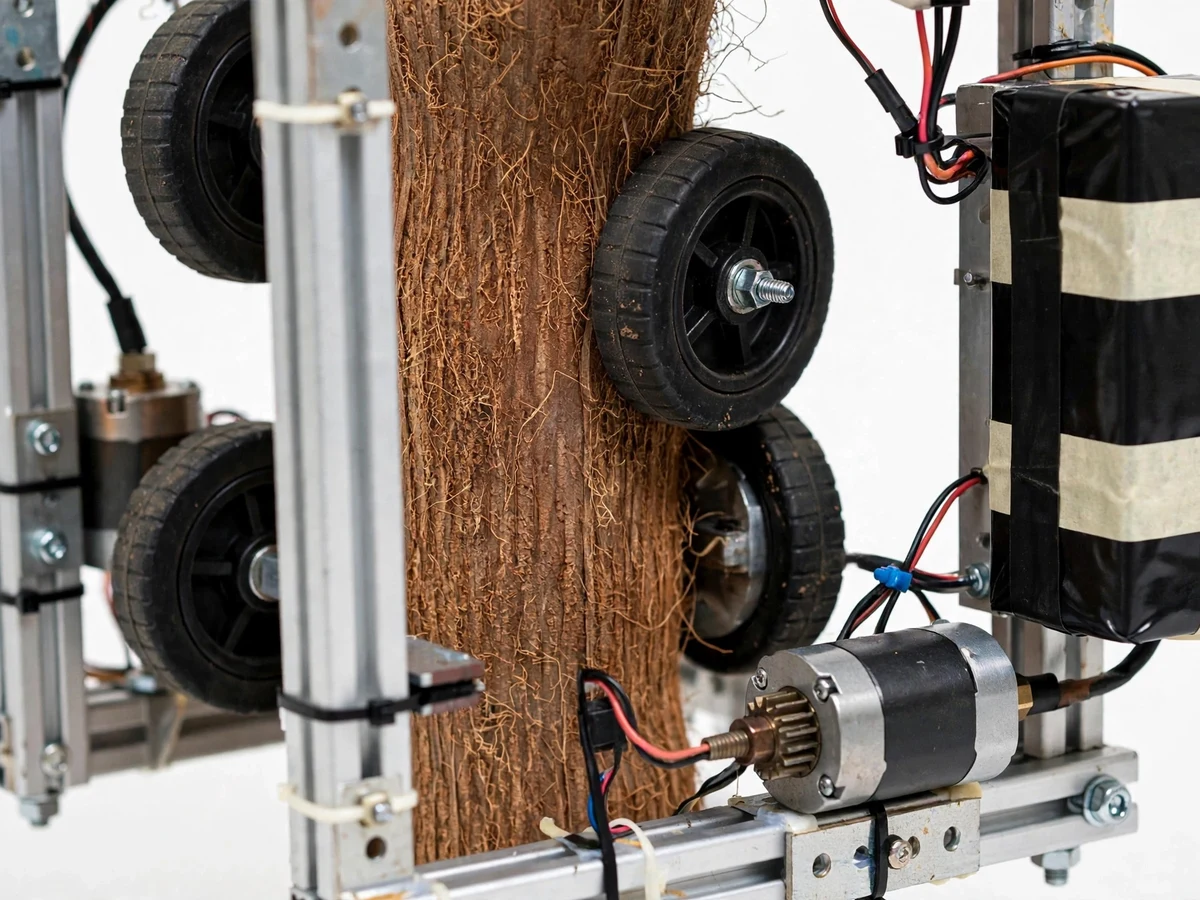
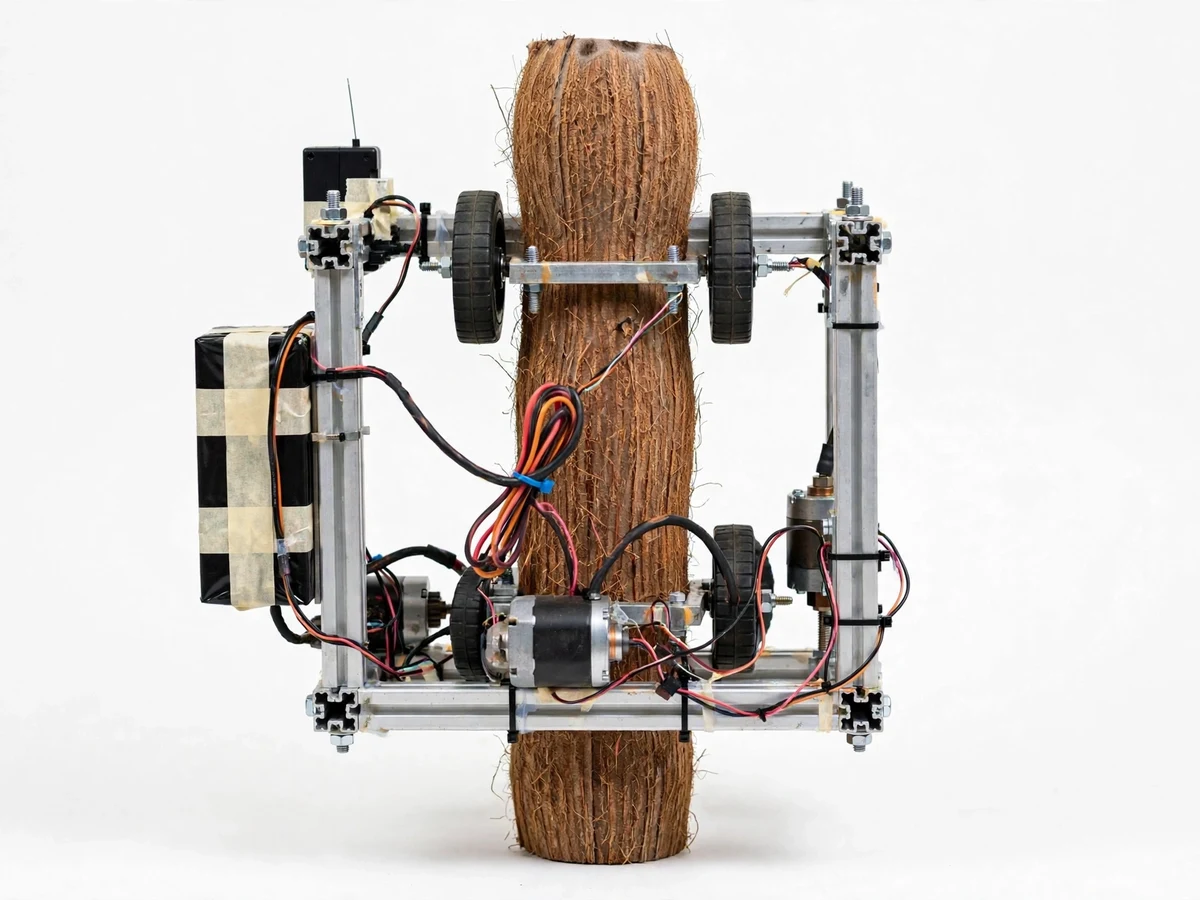
Harvesting coconuts means climbing 15-meter palms by hand — skilled, dangerous work with a real injury record. A climbing robot that can grip the trunk and carry a cutting tool or camera up the tree is a classic mechatronics challenge: it must generate enough normal force to grip without slipping, enough torque to lift its own weight, and stay stable on an irregular, fibrous trunk surface. This project builds that machine at model scale: an adjustable frame with three spring-loaded gripper wheels clamps a coconut trunk model, DC gear motors drive the wheels, and an RF remote commands climb, descend and stop. Students size the motors from first principles (weight vs traction vs torque), design the compliant frame, and demonstrate controlled climbing — a mechanism design project with a real agricultural motivation.
How it works
- The frame is opened, placed around the trunk model, and the spring-loaded gripper arms are tensioned so all three rubber wheels press firmly against the bark.
- The operator powers the robot; the controller runs a grip check, confirming the wheels hold position under the robot's own weight.
- The RF remote's climb command drives the DC gear motors; the wheels roll up the trunk, carrying the frame vertically.
- Spring compliance keeps wheel pressure constant as the trunk diameter varies slightly along its length.
- Firmware monitors wheel rotation against actual climb progress; if the wheels spin without climbing (slip), the drive stops and alerts.
- Descend reverses the motors with controlled speed; the stop command brakes the wheels, and the grip holds the robot parked on the trunk.
- The payload bracket can carry a camera mock-up to demonstrate the harvesting-assistance use case during the demo.
Tech stack:
- DC gear motors + rubber gripper wheels
- Spring-loaded aluminium frame
- RF remote control link
- Arduino-class motor controller
- Motor driver (H-bridge)
- Slip-detection logic
- Li-ion battery pack
- Coconut trunk model
| Parameter | Value |
|---|---|
| Controller | Arduino-class board — datasheet |
| Drive | 3x DC gear motors, torque sized by calculation (design) |
| Grip | Spring-loaded, adjustable for approximately 20–35 cm trunks (prototype) |
| Remote | RF link, approximately 30 m (design) |
| Climb speed | Approximately 0.1–0.2 m/s (expected) |
| Payload bracket | Approximately 500 g capacity (design target) |
| Power | Li-ion pack, approximately 20 min climb time (expected) |
| Safety | Slip detection + remote stop (implemented) |
Project features
- [Spring-loaded grip frame] Three gripper arms with adjustable spring tension clamp trunks of different diameters, demonstrating compliant mechanism design.
- [Gripper-wheel drive] Rubber wheels driven by DC gear motors generate climbing traction; wheel pressure is tuned so grip holds without stalling the motors.
- [RF remote control] Climb, descend, stop and speed control from a handheld RF remote with approximately 30 m range — no tether to snag.
- [Torque-sized drive] Motor and gearbox selection documented from the weight-vs-traction calculation, so the sizing is engineering, not guesswork.
- [Slip detection] A simple wheel-rotation vs frame-movement check flags slipping and stops the climb, demonstrating closed-loop safety on a budget.
- [Modular tool mount] A payload bracket on the frame accepts a camera or cutter mock-up, showing the path to a real harvesting tool.
- [Trunk model included] A realistic coconut trunk section is supplied for demonstration where a real palm is unavailable.
What is included
- Tree-climbing robot (assembled: frame, wheels, motors, springs)
- Coconut trunk model section for demonstration
- RF remote control (paired)
- Complete firmware source code with slip-detection logic
- Motor sizing calculation document
- Wiring diagram and mechanical assembly guide
- Operating and safety procedure document
- Project report PDF (background, mechanism design, control, results)
- PPT presentation for final review
- Viva Q&A preparation document (traction, torque sizing, compliance)
Limitations & prerequisites
- This is a model-scale demonstrator; a full-size palm climber needs far more torque, weatherproofing and safety certification — the report states the scaling gap honestly.
- Climb speed is modest (approximately 0.1–0.2 m/s); it demonstrates the mechanism, not production harvesting rates.
- The grip is tuned for the supplied trunk model; real bark varies and would need re-tuning of spring tension.
- Slip detection is a simple rotation-vs-progress check, not a precision traction-control system.
- Battery life limits continuous climbing to approximately 20 minutes (expected); spare packs or tethered power are demo options.
- RF range is approximately 30 m in the open; dense foliage shortens it.
Frequently Asked Questions
How does it grip the tree without falling?
Three spring-loaded arms press rubber wheels against the trunk with tuned normal force. Friction between rubber and bark holds the robot's weight; the springs keep pressure constant as trunk diameter changes. The motor sizing document shows the force and torque calculations.
What stops it slipping down the trunk?
Two layers: the spring grip is sized with a safety margin over the robot's weight, and firmware watches for slip (wheels turning without climbing) and stops the drive if it happens.
How is it controlled?
A handheld RF remote: climb, descend, stop and speed. No tether, so nothing snags on branches during the demo.
Can it carry a cutting tool?
The frame has a payload bracket rated for approximately 500 g that accepts a camera or cutter mock-up, demonstrating the harvesting-assistance concept. A real cutting head is future scope.
Why is this useful in real life?
Manual coconut climbing is dangerous — falls cause serious injuries. A robot that climbs and carries tools or cameras assists harvesters and reduces the need for risky climbs, which is the project's real-world motivation.
Is this project suitable for a final-year project?
Yes — for Mechanical, Electronics and Electrical programs. It combines mechanism design, traction engineering, motor sizing and wireless control in a novel build. Suitable for B.E./B.Tech final-year projects in Mechanical, Electronics and Electrical.
Components & software requirements
- DC gear motors + rubber gripper wheels
- Spring-loaded aluminium frame
- RF remote control link
- Arduino-class motor controller
- Motor driver (H-bridge)
- Slip-detection logic
- Li-ion battery pack
- Coconut trunk model
Delivery information
Built-to-order project. Delivery timeline is shared after order confirmation based on current queue.
Support terms
Complete documentation, setup guide, and viva preparation included. Support for setup and explanation provided.