
More project photos (3)


The problem
The Android App for Vehicle PUC Renewal Reminders with Nearby Test Centre Search is a PUC-only Android app that watches the Pollution Under Control certificate of each vehicle and warns the owner before it lapses. A PUC certificate proves a vehicle's exhaust emissions are within the limits set under Rule 115 of the Central Motor Vehicles Rules, 1989, and driving without a valid one can attract a fine. In India a new vehicle's PUC is generally valid for 1 year from registration, then renewable every 6 months after a fresh test at an authorised centre. That date is easy to forget: it comes around only twice a year and differs per vehicle, so expiry is usually discovered only at a police check or insurance renewal. This app removes both failure points: it stores each expiry date, sends reminders at 30, 7 and 1 day before expiry, and lists nearby authorised centres with distance and fee.
Adds a vehicle with its PUC expiry date.
Follow the working sequence
How it works
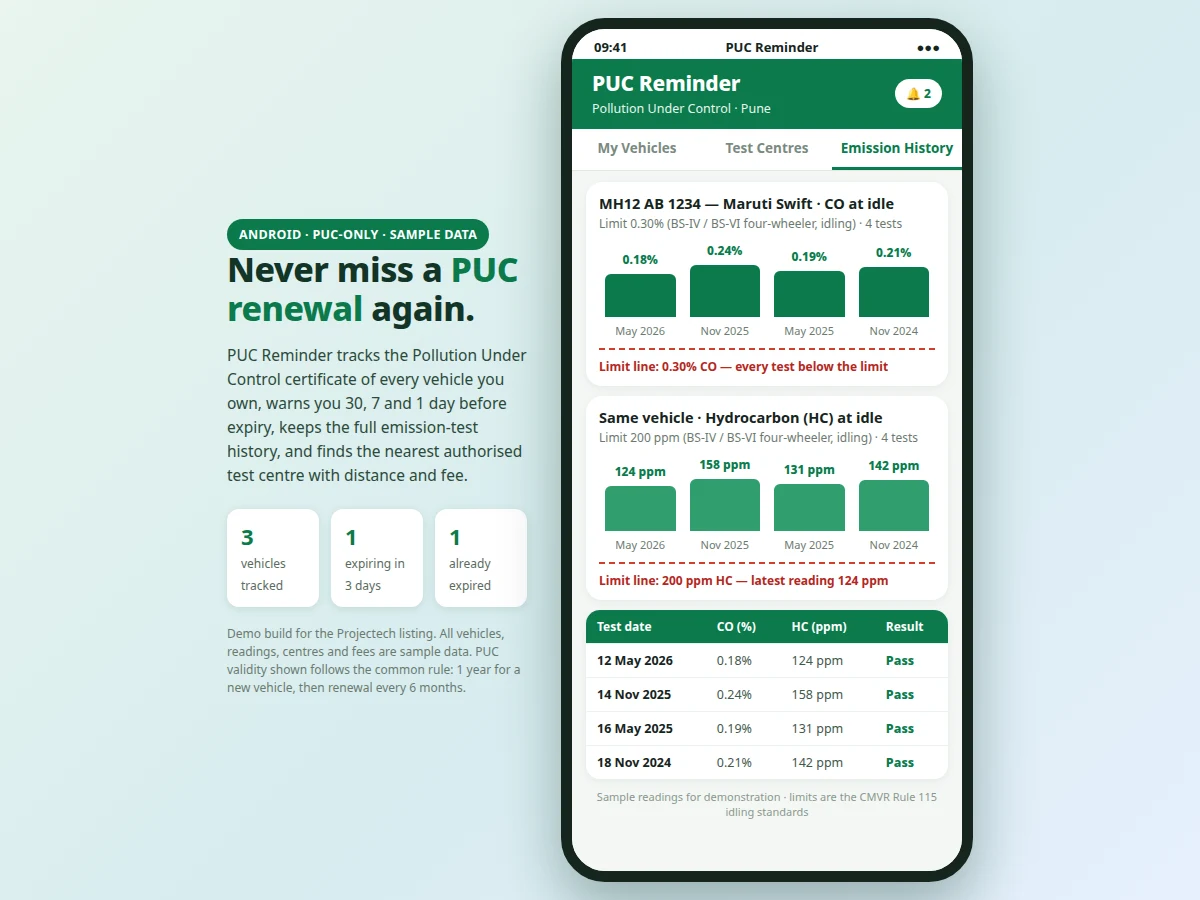
The Android App for Vehicle PUC Renewal Reminders with Nearby Test Centre Search works as a closed loop from expiry date to renewal visit. The user adds each vehicle once with its registration number, fuel type and the expiry date from its PUC certificate, and the app computes the days left and schedules the reminder ladder. Once a day at 08:00, a WorkManager worker re-checks every expiry date and posts any reminder that has fallen due; the check is local and the data lives in Room, so it runs with no internet and survives reboots. The home screen shows each vehicle with its days-left count and latest CO and HC readings, and the history screen charts those readings against the CMVR Rule 115 limits. When a renewal is due, the centre search lists authorised test centres by distance with typical fee and hours, and after the test the user records the new expiry date and readings, resetting the ladder.
- The user adds a vehicle with its registration number, fuel type, emission norm and the PUC expiry date from the certificate.
- The app computes the days left for each vehicle and schedules reminders at 30 days, 7 days and 1 day before expiry, plus on the expiry day.
- A WorkManager worker runs a daily check at 08:00, compares every expiry date with the current date, and posts any reminder that has fallen due.
- The home screen shows each vehicle with a colour-coded status (valid, expiring soon, expired) and its latest CO and HC readings.
- The history screen lists every past test and charts CO and HC against the CMVR Rule 115 idling limits, so trends toward the limit are visible.
- The centre search takes the user's location, lists authorised test centres by distance with typical fee, hours and rating, and offers directions and a call action.
- After the emission test, the user enters the new expiry date and the new CO/HC readings, and the reminder ladder resets for the next cycle.
Tech stack:
- Kotlin
- Android Jetpack · Room Database
- WorkManager · AlarmManager
- Retrofit · REST APIs
- Google Maps SDK · Places API
- Material Design 3
- MPAndroidChart · emission history charts
- Android Studio · Gradle
| Parameter | Value |
|---|---|
| Platform | Android 8.0 (API level 26) and above (design target) |
| Vehicles per user | Up to 10 vehicles (design target) |
| Reminder schedule | 30 days, 7 days and 1 day before expiry, plus on the expiry day |
| Background check | Daily at 08:00 via WorkManager, 24-hour interval (WorkManager minimum interval: 15 minutes) |
| PUC validity tracked | 1 year for new vehicles, then every 6 months (common rule; state rules may vary) |
| Emission limits shown | CO 0.30% and HC 200 ppm at idle for BS-IV/BS-VI petrol four-wheelers (CMVR Rule 115) |
| Centre search radius | Up to 10 km from the user's location (design target) |
| Sample centres in demo | 4 centres, 1.2–5.1 km away, typical fees ₹80–₹110 (sample data) |
| Emission history | 4 past tests shown for the sample vehicle in the demo build (sample data) |
| Reminder computation | Under 50 ms for 3 vehicles in the demo build (measured 16–42 ms across runs) |
Project features
The Android App for Vehicle PUC Renewal Reminders with Nearby Test Centre Search is built around four capabilities: per-vehicle PUC tracking with a 30/7/1-day reminder ladder, a full emission-value history for every vehicle, a nearby authorised test-centre search with distance and typical fee, and offline-first storage so reminders work without internet. The reminder ladder warns early enough to plan a visit, again a week before expiry, and once more the day before, with an overdue alert if the date passes. The emission history turns each past test into a trend: CO and HC readings are plotted against the CMVR Rule 115 limits, so a vehicle creeping toward the limit is visible before it fails. The centre search closes the loop by showing authorised centres near the user's location, sorted by distance, with typical fee, opening hours and ratings, so the renewal visit can be booked in the same session.
- [Per-vehicle PUC tracking] Each vehicle is stored with its registration number, fuel type, emission norm and PUC expiry date, with a days-left count and a colour-coded status (valid, expiring soon, expired) on the home screen.
- [30/7/1-day reminder ladder] Reminders fire 30 days, 7 days and 1 day before expiry, plus on the expiry day and daily while overdue, delivered as local notifications scheduled by WorkManager.
- [Emission-value history] Every past PUC test is logged with its CO and HC readings, shown in a table and in bar charts against the CMVR Rule 115 idling limits (CO 0.30%, HC 200 ppm for BS-IV/BS-VI petrol four-wheelers).
- [Nearby authorised test-centre search] Centres near the user's location are listed with distance in kilometres, typical fee, opening hours and rating, sorted nearest first, with directions and call actions.
- [Expiry-date entry with validation] Expiry dates are entered from the PUC certificate or typed in manually, with checks that reject impossible dates and a photo note field for the certificate number.
- [Offline-first storage] All vehicles, tests and reminders are stored locally in Room, so the home screen, history and reminder schedule work with no internet at all.
- [Renewal checklist] After a renewal, the user enters the new expiry date and the latest CO/HC readings in one flow, and the reminder ladder resets automatically for the new cycle.
Optional add-ons available separately (not in the base build): live centre data from the Parivahan portal, SMS reminders, and multi-user family sharing. Future scope (not included): OBD-based emission estimates, online payment at centres, and automatic expiry lookup from the registration number.
What is included
- Complete Android app source code in Kotlin (Room, WorkManager, Retrofit, Maps)
- Working demo build with 3 sample vehicles, 4 sample test centres and 4 past emission tests
- Project report PDF (background, PUC rules, architecture, methodology, results)
- PPT presentation for final review
- Viva Q&A preparation document (WorkManager, Room, notifications, PUC rules)
- Setup instructions for Android Studio and the demo build
Limitations & prerequisites
- The app reminds the user to renew; it cannot issue a PUC certificate — the emission test must still be done in person at an authorised centre.
- Centre listings in the demo are sample data for Pune; live centre data depends on the Parivahan portal or a maintained centre list, which is an optional add-on.
- PUC validity rules vary by state (for example, Delhi has a 3-month cycle), so the 1-year then 6-month rule in the app is the common national pattern, not a rule for every state.
- Reminders are local notifications; if the user disables notifications or battery optimisation kills background work, a reminder can be delayed.
- WorkManager periodic work has a 15-minute minimum interval and is batched by the system, so the daily 08:00 check is approximate, not exact to the minute.
- Emission readings must be typed in from the certificate; the app does not measure exhaust gases itself and has no OBD or sensor connection in the base build.
- The demo's CO/HC limits cover BS-IV/BS-VI petrol four-wheelers at idle; limits for other vehicle classes and fuels differ and must be looked up for that vehicle.
Frequently Asked Questions
How is this different from a vehicle document wallet app?
A document wallet stores many documents — RC, insurance, PUC, licence and FASTag — and PUC reminders are only one small feature inside it. This app is PUC-only and goes deep instead: it tracks PUC validity per vehicle, keeps a full CO/HC history against the CMVR Rule 115 limits, and adds a nearby authorised test-centre search with distance and fee, which a wallet app does not offer. If the goal is never missing a PUC renewal, the dedicated app covers the whole job.
How do the PUC reminders work?
When you add a vehicle, the app stores its PUC expiry date and schedules reminders at 30 days, 7 days and 1 day before expiry, plus one on the expiry day and daily alerts while it is overdue. A WorkManager worker runs a daily check at 08:00, compares each expiry date with the current date, and posts any reminder that has fallen due as a local notification. Because the data lives in Room on the phone, the check runs with no internet and survives reboots.
Does the app issue the PUC certificate itself?
No — no app can issue a PUC certificate, because the certificate is issued only after a physical exhaust test at an authorised emission testing centre. The certificate itself is generated through the Parivahan system once the vehicle passes that test. What this app does is make sure you never miss the date: it tracks the expiry, reminds you in time, shows you the nearest authorised centre with its fee and hours, and records the new expiry date and readings after the test.
Where does the test-centre information come from?
The demo build ships with a sample list of 4 authorised-style centres around Pune with distance, typical fee, opening hours and rating, so the search and sorting can be demonstrated end to end. For a production build, centre data would come from the Parivahan portal's authorised-centre list or a maintained local list, wired through a REST API. Centre authorisation should always be verified on puc.parivahan.gov.in before visiting.
Does the app work without internet?
Yes, for everything except the centre map. Vehicle tracking, the reminder ladder, the emission history and the charts all run entirely on data stored locally in Room on the phone, and the daily WorkManager check needs no connectivity at all. Only the nearby-centre search needs internet, because it fetches centre locations and distance from the Maps and Places APIs. If the phone is offline, the app still shows the last fetched centre list.
Is this project suitable for a final-year project?
Yes — for Computer Science, IT and Electronics & Communication programmes. It demonstrates Android app development in Kotlin, local databases with Room, background work with WorkManager, location and Maps integration, and a real civic problem with verified rules from the Central Motor Vehicles Rules, 1989. The emission-history charts and the reminder engine give concrete material for the report and the viva.
Components & software requirements
- Kotlin
- Android Jetpack · Room Database
- WorkManager · AlarmManager
- Retrofit · REST APIs
- Google Maps SDK · Places API
- Material Design 3
- MPAndroidChart · emission history charts
- Android Studio · Gradle
Delivery information
Built-to-order project. Delivery timeline is shared after order confirmation based on current queue.
Support terms
Complete documentation, setup guide, and viva preparation included. Support for setup and explanation provided.
Download free synopsis (PDF)
Enter your name and WhatsApp number — the synopsis PDF downloads immediately. We may send occasional project updates on WhatsApp; no spam.