
More project photos (2)
The problem
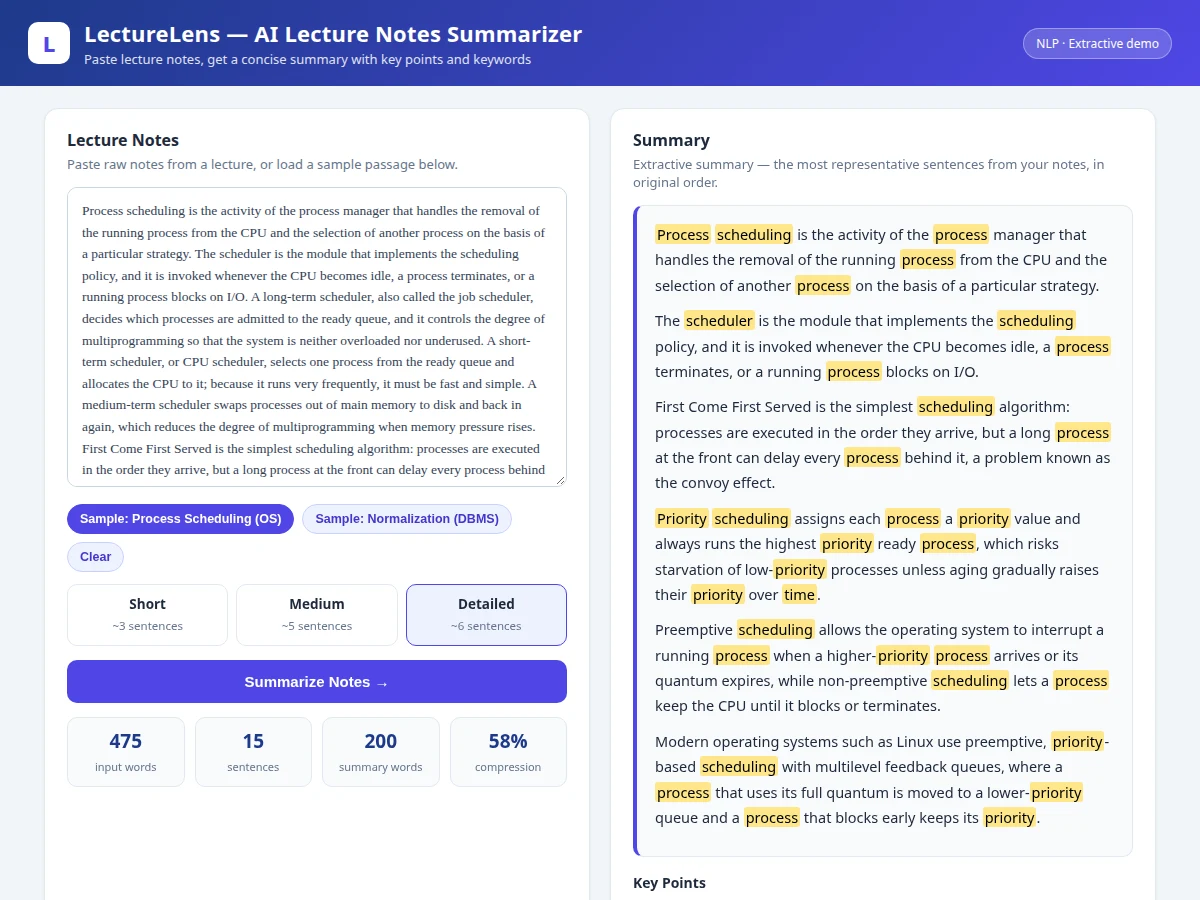
The AI Lecture Notes Summarizer using NLP takes the long, unstructured notes students write during lectures and turns them into short summaries that keep the meaning and drop the repetition. An hour of lecture produces several pages of notes, and revising from them means re-reading everything to find the few ideas that matter. Students usually cope by skipping sections, copying a classmate's notes, or reading only headings — all of which lose detail exactly when it is needed most. This project solves the problem by combining a fine-tuned transformer model with a simple web app: paste the notes, pick a length, and get a summary with key points and highlighted keywords. The approach is honest about what each part does — the browser demo selects representative sentences extractively, while the built-to-order backend rewrites notes abstractively with the trained model. Because the pipeline is built from standard NLP tools, the student can explain every stage from tokenization to ROUGE evaluation.
Pastes lecture notes into the web app and picks a summary length.
Follow the working sequence
How it works
The AI Lecture Notes Summarizer using NLP works end to end in six stages: the student pastes lecture notes into the web app, the text is cleaned and split into sentences, the extractive demo scores each sentence by keyword frequency, the three most representative sentences form the short summary, key points and keywords are derived from the same scores, and the built-to-order backend replaces the extractive step with a fine-tuned T5-small model that writes a fresh abstractive summary. Training happens once, before delivery: the T5-small model is fine-tuned on CNN/DailyMail article-summary pairs, evaluated with ROUGE on the held-out test split, and then served behind the web app for inference. At revision time nothing is retrained — the model only reads new notes and writes a summary — so results are repeatable and the same notes always produce the same summary at the same length setting.
- The student pastes lecture notes into the web app or loads one of the built-in sample passages (operating-systems process scheduling or DBMS normalization).
- The text is cleaned (extra whitespace removed) and split into sentences with a sentence tokenizer.
- In the browser demo, each sentence is scored by the frequency of its content words, with a small boost for sentences containing cue words such as "first" or "key".
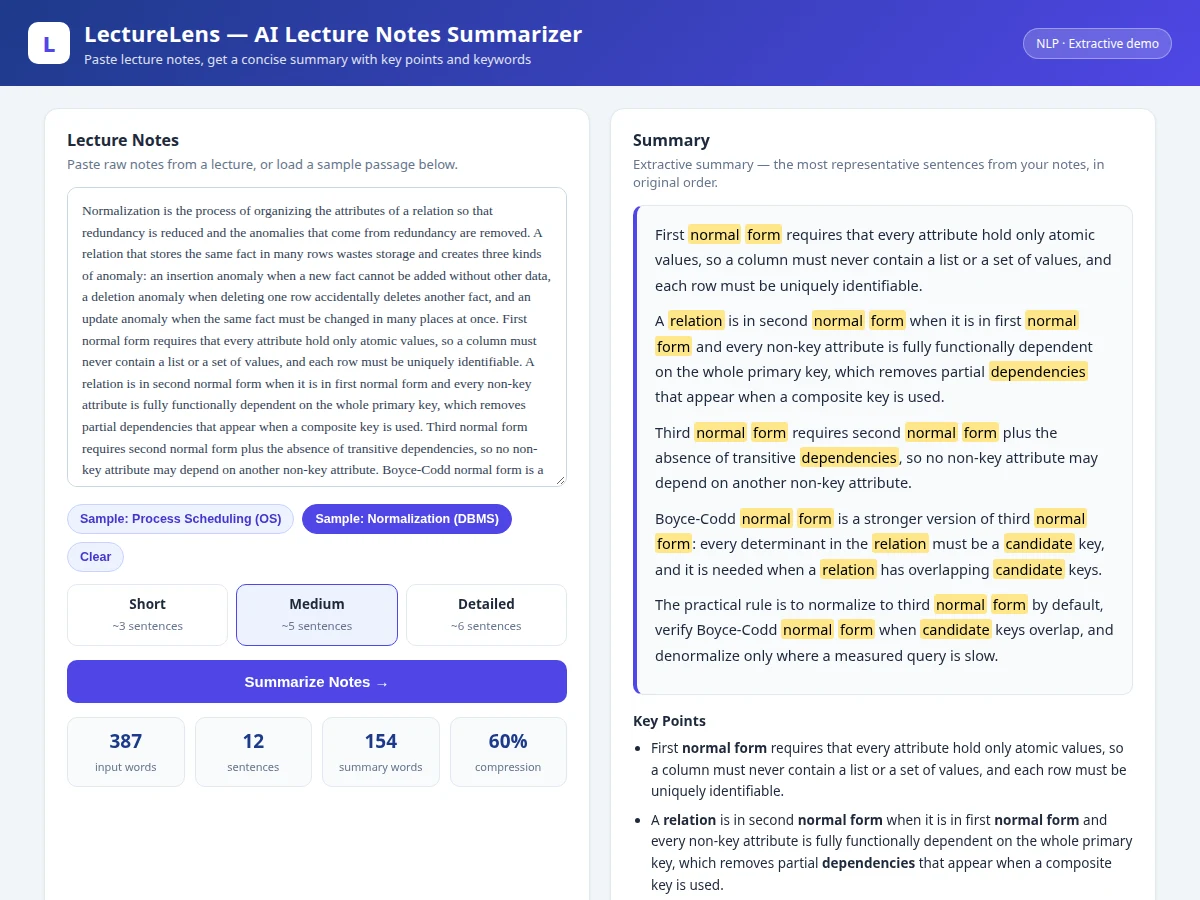
- The top-ranked sentences are selected for the chosen length (3, 5 or 6 sentences) and returned in their original order, with the top keywords highlighted.
- In the built-to-order backend, the same cleaned text is tokenized and passed to the fine-tuned T5-small model, which generates an abstractive summary instead of selecting sentences.
- The app displays the summary with key points, keyword chips and compression statistics, and the student can copy it or download it as a text file.
Tech stack:
- Python 3, PyTorch, Hugging Face Transformers
- T5-small (fine-tuned abstractive model)
- CNN/DailyMail dataset (training data)
- Flask backend API (model serving)
- HTML, CSS, JavaScript (web app + extractive demo)
- NLTK sentence tokenizer
- ROUGE scoring (evaluation)
- Git
Dataset & model details
- Dataset: CNN/DailyMail (version 3.0.0) — 287,113 training, 13,368 validation and 11,490 test article-summary pairs, built from about 312,000 CNN and Daily Mail articles by Hermann et al. (2015); each article's bullet-point highlights form its reference summary. Source: Hugging Face datasets (ccdv/cnn_dailymail) and the original DeepMind release.
- Task: Abstractive text summarization; input = lecture-note text (up to 512 tokens, design target), output = a fluent summary in new sentences, plus extractive key points and keywords in the demo.
- Model: T5-small (approximately 60 million parameters, design value), fine-tuned on CNN/DailyMail for summarization; input is tokenized lecture text with a "summarize:" prefix, output is generated summary text decoded with beam search. The browser demo uses a separate client-side extractive scorer, not the transformer.
- Metrics: ROUGE-1, ROUGE-2 and ROUGE-L on the CNN/DailyMail test split, plus compression ratio and summary length in sentences. ROUGE scores are reported from the actual training run after it is executed for the order; no ROUGE score is claimed here because no training run has been executed yet. Lecture notes differ from news text, so a small set of lecture passages is also summarized and checked by hand for factual fidelity.
| Parameter | Value |
|---|---|
| Input length | Up to 512 tokens per summary request (design target) |
| Model | T5-small, approximately 60 million parameters (design value) |
| Training pairs | 287,113 article-summary pairs (CNN/DailyMail train split) |
| Summary lengths | 3, 5 or 6 sentences (demo lengths) |
| Demo compression | 80% word reduction, measured on the 475-word OS sample passage |
| Inference time | Under 5 seconds per summary on CPU (design target) |
| Output formats | On-screen summary, plain-text download, clipboard copy |
| Demo | Single-file web app, runs offline after download |
Project features
The AI Lecture Notes Summarizer using NLP combines four capabilities that work together: abstractive summarization from a fine-tuned T5-small model, an extractive browser demo that runs instantly without a server, adjustable summary lengths with live compression statistics, and key-point plus keyword extraction that makes revision faster. Around those four, the app adds a notes library for saving past summaries, copy and download options for the output, and an optional PDF upload path for students who keep notes as documents. Every capability is demonstrated in the working demo on real operating-systems and database lecture passages, so the viva discussion can point at a running system rather than a mockup. In the demo build, the 475-word operating-systems passage compressed to a 97-word short summary — an 80% word reduction — while the 387-word normalization passage compressed by 76% at the same setting, so the numbers on the page come from the actual demo rather than a claim.
- [Abstractive summarization (T5-small)] A fine-tuned T5-small model rewrites pasted lecture notes into new, fluent summary sentences instead of copying lines from the input. Training uses the CNN/DailyMail dataset, and inference runs on the backend as a text-in, summary-out service.
- [Extractive browser demo] The demo app runs a client-side extractive summarizer that scores every sentence by keyword frequency and selects the most representative ones in their original order. It works fully offline after download and shows exactly how sentence scoring works.
- [Three summary lengths] Short (3 sentences), Medium (5 sentences) and Detailed (6 sentences) lengths let the student choose between a quick revision card and a fuller recap. The app reports input words, summary words and compression for every run.
- [Key points extraction] The top-ranked sentences are listed separately as key points, so the student can revise from a short bullet list and expand to the full summary only where needed.
- [Keyword highlights] The most frequent content words in the notes are highlighted inside the summary and listed as keyword chips, giving a fast visual map of what the lecture was about.
- [Notes library and history] Pasted notes and their summaries are kept in a session library, so a student can return to an earlier lecture's summary without pasting the notes again.
- [Copy and download] Any generated summary can be copied to the clipboard or downloaded as a plain-text file for revision notes or printing.
- [PDF upload (optional customization)] Uploading notes as a PDF or DOCX file is not part of the base build; it can be added on request with text extraction and the same summarization pipeline.
What is included
- Fine-tuned T5-small summarization model with training and evaluation scripts
- Web app (paste notes, three summary lengths, key points, keyword highlights, notes library)
- Working extractive browser demo with two realistic lecture passages (OS and DBMS)
- Training notebook (dataset loading, fine-tuning, ROUGE evaluation)
- Project report PDF (background, NLP theory, model rationale, methodology, results)
- PPT presentation for final review
- Viva Q&A preparation document (tokenization, transformers, extractive vs abstractive summarization, ROUGE)
Limitations & prerequisites
- The T5-small model is trained on news articles, so lecture notes with heavy mathematical notation or code may summarize less fluently than plain prose.
- ROUGE scores are reported only after the training run for the order; no score is promised in advance.
- The browser demo is extractive — it selects sentences, it does not rewrite them — and must not be presented as the transformer output.
- Very short notes (under 2 sentences) cannot be summarized; the app asks for more input instead.
- Handwritten or scanned notes need typing or OCR first; OCR is an optional add-on, not in the base build.
- Summary quality depends on note quality — garbled or fragmentary notes produce a garbled summary.
- The model is a teaching build, not a production writing tool — summaries should be checked against the original notes before use in study material.
Frequently Asked Questions
Which dataset is used and why?
CNN/DailyMail version 3.0.0 is used: 287,113 training pairs of news articles with their bullet-point highlights as reference summaries. It is the standard benchmark for abstractive summarization, large enough to fine-tune T5-small properly, and every result can be compared against published ROUGE figures.
Which model is used?
T5-small, a text-to-text transformer with approximately 60 million parameters, is fine-tuned on CNN/DailyMail for summarization and can be further fine-tuned on lecture notes. Input is tokenized lecture-note text with a "summarize:" prefix, and the output is a newly generated summary produced by beam-search decoding.
Does the browser demo run the transformer model?
No — the browser demo does not run the transformer model; it runs a client-side extractive summarizer that scores and selects the most representative sentences from the notes you paste. The transformer model runs on the backend in the built-to-order version, and the demo page states this distinction explicitly so the result is never misrepresented.
Can it summarize handwritten or scanned notes?
Not as shipped — the base build accepts typed or pasted text, so handwritten or scanned notes must be typed out before they can be summarized. PDF upload with text extraction, and OCR for scanned pages, can be added as an optional customization on request.
Can the summary length and subjects be customized?
Yes — three lengths are built in: Short (3 sentences), Medium (5 sentences) and Detailed (6 sentences), and the demo ships with operating-systems and DBMS sample passages. Additional subjects, a custom lecture-notes dataset for fine-tuning, or a different model size can be added on request.
Is this project suitable for a final-year project?
Yes — for Computer Science, IT and AI/ML programs, because it demonstrates NLP preprocessing, transformer fine-tuning, ROUGE evaluation and a working web deployment in one build. The extractive-versus-abstractive comparison in the demo also gives the viva a clear technical discussion point.
Components & software requirements
- Python 3, PyTorch, Hugging Face Transformers
- T5-small (fine-tuned abstractive model)
- CNN/DailyMail dataset (training data)
- Flask backend API (model serving)
- HTML, CSS, JavaScript (web app + extractive demo)
- NLTK sentence tokenizer
- ROUGE scoring (evaluation)
- Git
Dataset & model details
- Dataset: CNN/DailyMail (version 3.0.0) — 287,113 training, 13,368 validation and 11,490 test article-summary pairs, built from about 312,000 CNN and Daily Mail articles by Hermann et al. (2015); each article's bullet-point highlights form its reference summary. Source: Hugging Face datasets (ccdv/cnn_dailymail) and the original DeepMind release.
- Task: Abstractive text summarization; input = lecture-note text (up to 512 tokens, design target), output = a fluent summary in new sentences, plus extractive key points and keywords in the demo.
- Model: T5-small (approximately 60 million parameters, design value), fine-tuned on CNN/DailyMail for summarization; input is tokenized lecture text with a "summarize:" prefix, output is generated summary text decoded with beam search. The browser demo uses a separate client-side extractive scorer, not the transformer.
- Metrics: ROUGE-1, ROUGE-2 and ROUGE-L on the CNN/DailyMail test split, plus compression ratio and summary length in sentences. ROUGE scores are reported from the actual training run after it is executed for the order; no ROUGE score is claimed here because no training run has been executed yet. Lecture notes differ from news text, so a small set of lecture passages is also summarized and checked by hand for factual fidelity.
Delivery information
Built-to-order project. Delivery timeline is shared after order confirmation based on current queue.
Support terms
Complete documentation, setup guide, and viva preparation included. Support for setup and explanation provided.
Download free synopsis (PDF)
Enter your name and WhatsApp number — the synopsis PDF downloads immediately. We may send occasional project updates on WhatsApp; no spam.