
More project photos (2)
The problem
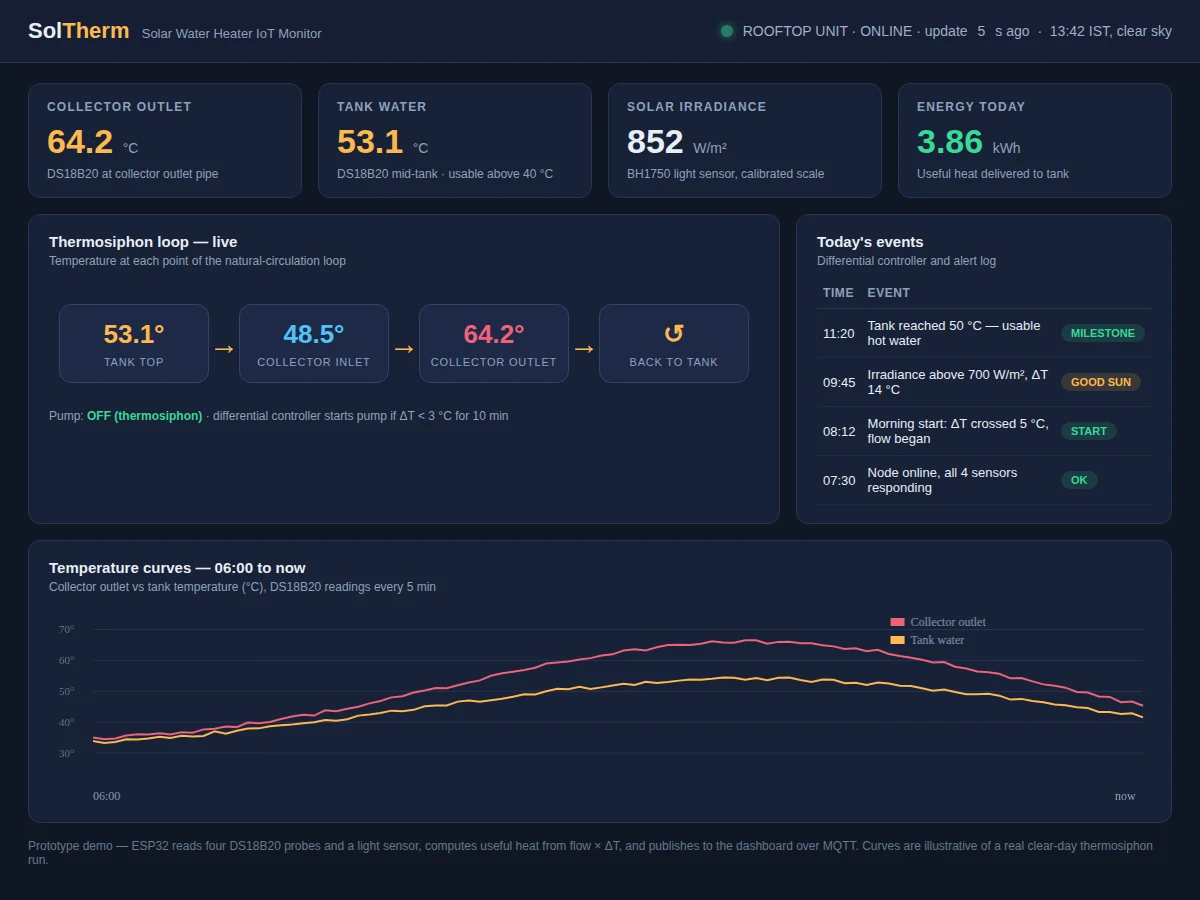
Solar water heating is the oldest practical solar technology — a black plate in a glass box, water, and the sun — yet most students know it only as a rooftop rectangle. The interesting engineering is in the loop: cold water sinks, hot water rises, and the thermosiphon circulation runs with no pump as long as the tank sits above the collector. And the interesting question is measurable: how much useful heat did today actually deliver? This project builds a complete small system — flat-plate collector with copper coil, insulated tank on a stand, four DS18B20 probes at the loop points, a light sensor, and an ESP32 publishing to a dashboard. The dashboard renders the live loop temperatures, the day's curves, and the computed energy delivered from flow and temperature difference. The student fabricates the collector, plumbs the loop, instruments it, and runs the clear-day experiment that turns sunshine into a number.
How it works
- Sunlight passes through the collector glazing and heats the black absorber plate; the copper coil bonded to it heats the water inside.
- Hot water in the collector becomes less dense and rises through the outlet pipe to the tank top; cooler tank water sinks to the collector inlet — thermosiphon circulation.
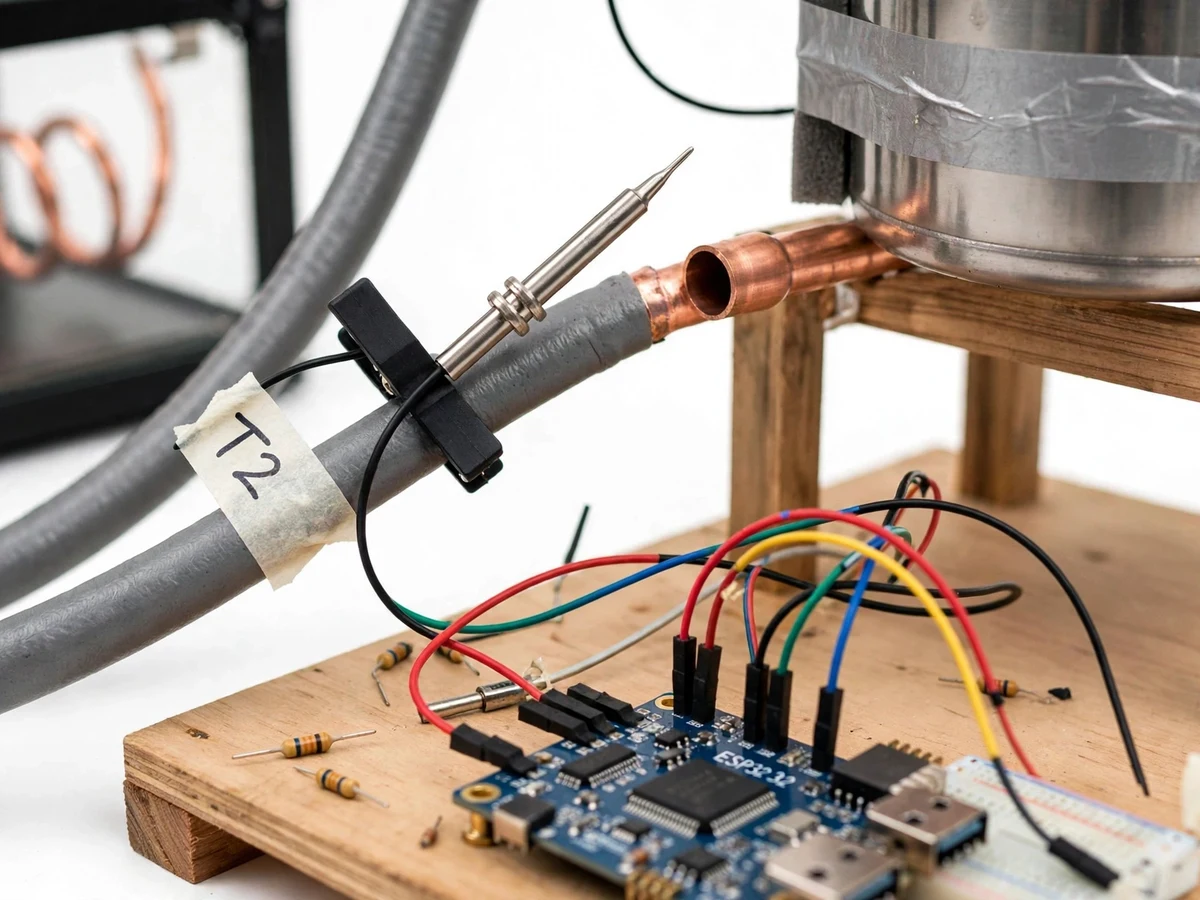
- The four DS18B20 probes read tank-top, collector-inlet, collector-outlet and ambient temperatures every few seconds.
- The ESP32 publishes the readings plus the light-sensor irradiance over Wi-Fi (MQTT/HTTP) to the dashboard.
- The dashboard draws the live loop diagram, appends to the day's temperature curves, and integrates temperature difference over time into delivered energy (kWh).
- If the collector-tank delta-T stays below the threshold for the set time, the differential controller starts the backup pump; it stops when circulation recovers.
- The student runs the clear-day experiment: log from morning start to afternoon, then report the heating curve and total energy from their own data.
Tech stack:
- Flat-plate collector (glazed box, black absorber, copper coil)
- Insulated water tank on stand
- 4x DS18B20 temperature probes
- Light sensor (BH1750 class) for irradiance
- ESP32 development board (Wi-Fi)
- Small DC pump (differential-controller backup)
- Copper/plastic plumbing with insulation
- MQTT broker + web dashboard (HTML/JS)
- Arduino IDE (C/C++ firmware)
| Parameter | Value |
|---|---|
| Collector (design) | Approx. 0.5 sq m flat plate, glazed, insulated |
| Circulation | Thermosiphon (tank above collector); pump backup on low delta-T |
| Sensing | 4x DS18B20 (tank top, collector in/out, ambient) + light sensor |
| Update rate | Every few seconds over Wi-Fi (design) |
| Computed metric | Useful heat delivered (kWh), from delta-T integration |
| Controller | Differential controller for backup pump |
| Experiment | Clear-day heating run; curves and energy from student data |
Project features
- [Flat-plate collector] Glazed insulated box with black absorber plate and copper coil — the standard solar-thermal collector, student-built.
- [Thermosiphon circulation] Tank mounted above the collector drives natural circulation with no pump — the core physics of the system.
- [Four-point temperature sensing] DS18B20 probes at tank top, collector inlet, collector outlet and ambient; the loop's temperature story in full.
- [Live IoT dashboard] Loop diagram with live temperatures, day temperature curves, irradiance and computed daily energy, updated over Wi-Fi.
- [Useful-heat computation] The firmware/dashboard computes delivered energy from temperature difference — the experiment's headline number.
- [Differential pump backup] If thermosiphon stalls (low delta-T), a differential controller starts a small pump — demonstrable control logic.
- [Clear-day experiment] A documented procedure runs the system through a sunny day and records the heating curve — the student's own dataset.
What is included
- Working solar water heater with IoT monitoring (collector, tank, plumbing, sensor node, dashboard)
- Complete ESP32 firmware source code (sensing, MQTT, differential control)
- Dashboard web app (loop diagram, curves, energy total, event log)
- Collector fabrication and plumbing documentation
- Clear-day experiment procedure and data sheet template
- Project report PDF (solar-thermal theory, thermosiphon, instrumentation, experiment)
- PPT presentation for final review
- Viva Q&A preparation document (flat-plate collectors, thermosiphon, heat computation, MQTT)
- Setup and demonstration guide
Limitations & prerequisites
- Demo scale (approx. 0.5 sq m) — it heats a small tank for demonstration; household sizing and payback claims are out of scope.
- Needs clear sun; cloudy days give flat curves — the experiment procedure specifies clear-day conditions.
- Delivered-energy computation uses the design flow assumption; the report documents the method and its limits rather than claiming lab-grade calorimetry.
- The system is a demonstration rig, not a plumbed household installation — no mains-pressure plumbing or certified components.
- Overnight heat loss and cloudy-day performance are observed qualitatively, not characterized.
Frequently Asked Questions
What is thermosiphon circulation?
Hot water is less dense than cold, so heated water in the collector rises to the tank while cooler water sinks back down — a natural circulation loop with no pump, as long as the tank sits above the collector.
How is "useful heat delivered" computed?
From the temperature difference across the loop integrated over time with the design flow assumption. The method and its limits are documented in the report — it is the experiment's headline number, computed from the student's own data.
What does the backup pump do?
If the collector-tank temperature difference stays too low for circulation (weak sun, morning start), the differential controller starts a small pump to keep water moving, and stops it when thermosiphon recovers.
How big a tank can it heat?
Demo scale — a small insulated tank for demonstration. It proves the principle and the measurement method, not household capacity.
What are the main limitations?
Demo scale, needs clear sun, energy computation uses design assumptions, not a household installation, and cloudy/overnight behavior is qualitative.
Is this project suitable for a final-year project?
Yes — for Mechanical, Energy and IoT programs. It demonstrates solar-thermal engineering, natural circulation, instrumentation and IoT dashboards, all strong viva material. Suitable for B.E./B.Tech final-year projects in Mechanical, Energy and IoT engineering.
Components & software requirements
- Flat-plate collector (glazed box, black absorber, copper coil)
- Insulated water tank on stand
- 4x DS18B20 temperature probes
- Light sensor (BH1750 class) for irradiance
- ESP32 development board (Wi-Fi)
- Small DC pump (differential-controller backup)
- Copper/plastic plumbing with insulation
- MQTT broker + web dashboard (HTML/JS)
- Arduino IDE (C/C++ firmware)
Delivery information
Built-to-order project. Delivery timeline is shared after order confirmation based on current queue.
Support terms
Complete documentation, setup guide, and viva preparation included. Support for setup and explanation provided.