
More project photos (2)
The problem
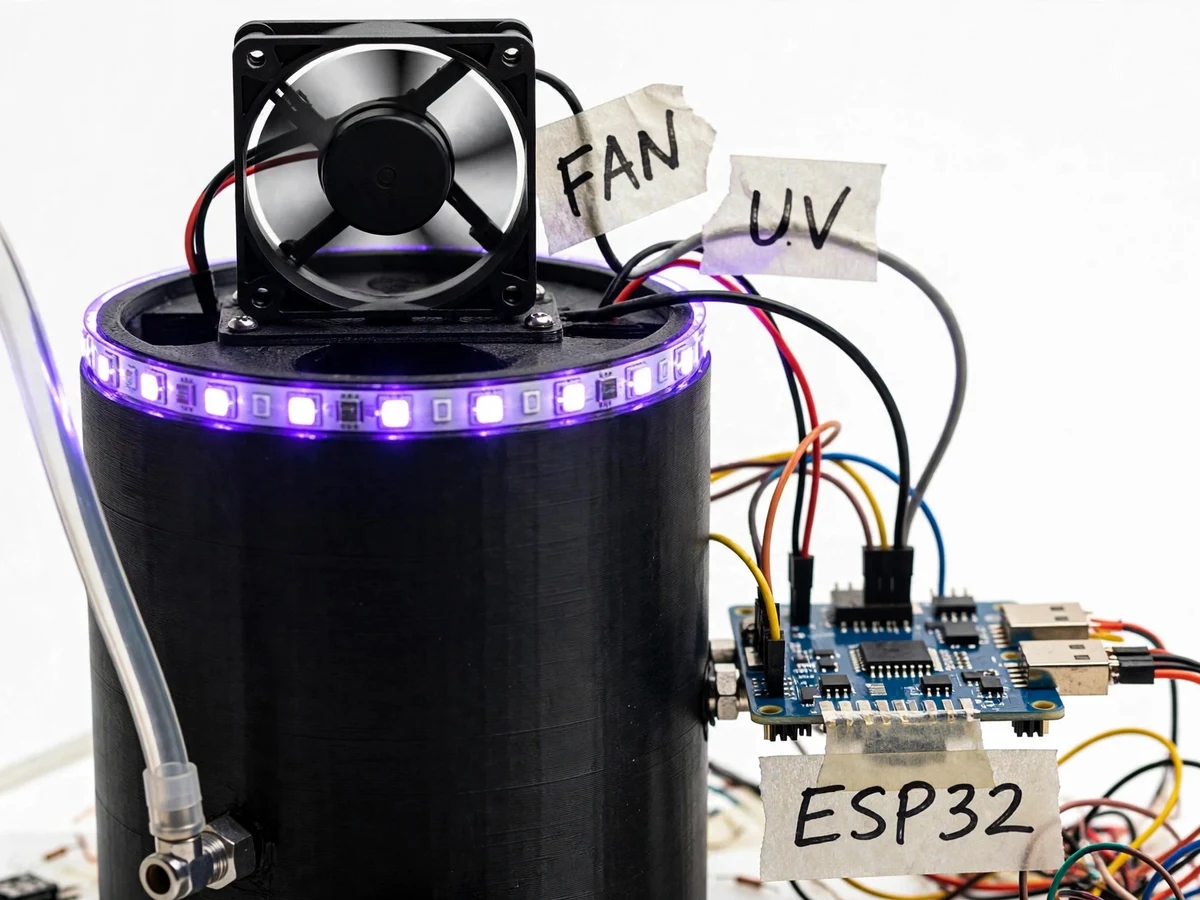
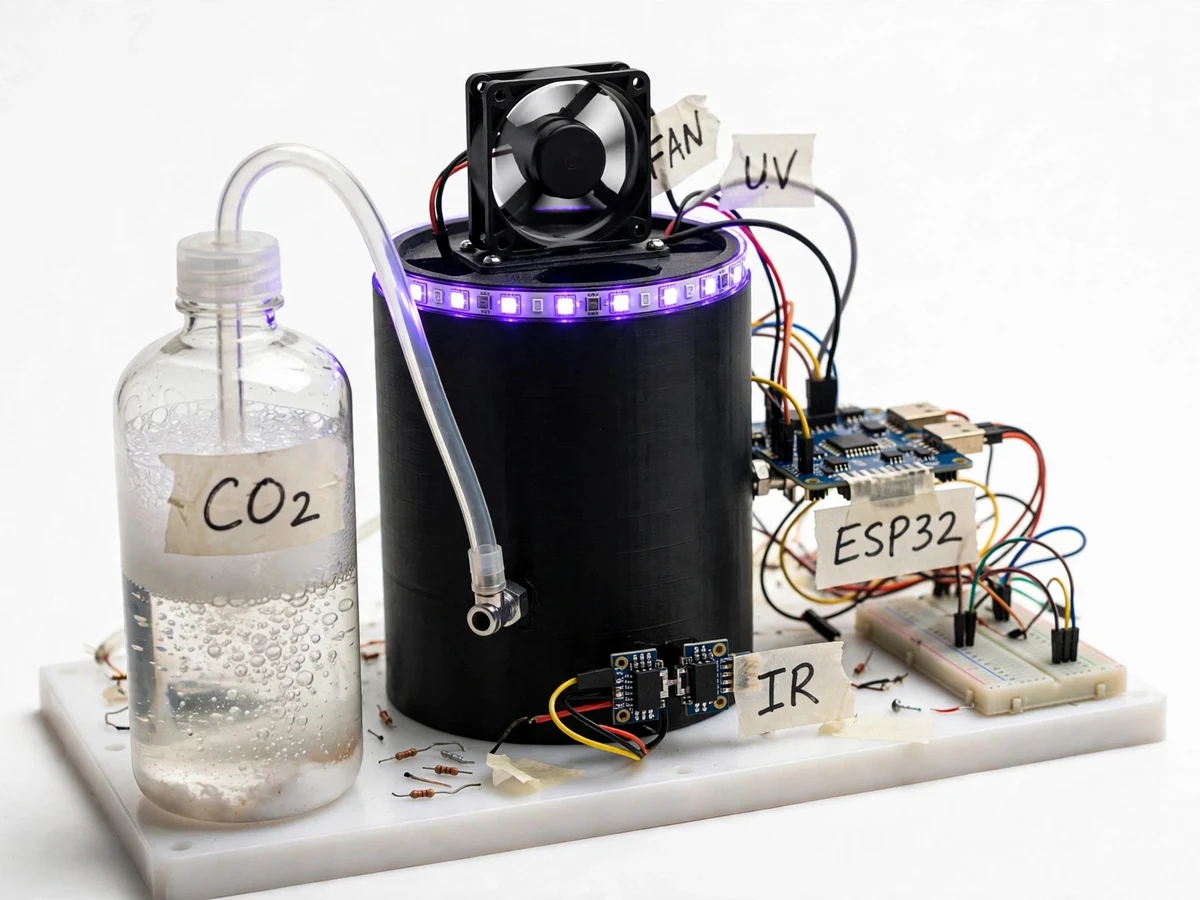
Mosquitoes find people largely by sensing exhaled carbon dioxide, which is why CO2-baited traps outperform simple UV zappers — but commercial CO2 traps are expensive imports. This project builds an affordable smart version from student parts: a drip-fed baking-soda and vinegar chamber generates a steady CO2 plume, a violet UV LED ring adds the visual lure, and a low-noise 12 V fan creates the suction that pulls approaching mosquitoes into a mesh catch chamber they cannot escape. An IR beam-break sensor across the intake counts each capture, and the ESP32 logs hourly counts to flash memory, shown live on an OLED with a daily total. An LDR enables the trap automatically at dusk and parks it at dawn, and a bait-low estimate reminds the user to refill the chamber. It is a complete embedded system — chemistry, airflow, sensing and logging — in one demonstrator.
How it works
- At dusk the LDR crosses its threshold; the ESP32 wakes the trap, starts the fan and powers the UV ring.
- The drip valve meters vinegar into the baking-soda chamber at a set rate, releasing a continuous CO2 plume from the outlet tube.
- Mosquitoes following the CO2 gradient reach the intake, where the UV ring and fan airflow pull them into the mesh catch chamber.
- Each insect crossing the intake breaks the IR beam; firmware debounces the signal and increments the capture count.
- Counts accumulate per hour in flash memory; the OLED shows live count, nightly total and system status.
- At dawn the LDR parks the system — fan and UV off, drip valve closed — and the bait estimator updates remaining charge.
Tech stack:
- ESP32 dev board
- 12 V DC fan · 395 nm UV LED strip
- IR beam-break sensor module
- LDR light sensor · 0.96 inch OLED (I2C)
- Baking-soda/vinegar CO2 chamber + drip valve
- Arduino IDE · C/C++ firmware
| Parameter | Value |
|---|---|
| Attractants | CO2 plume + 395 nm UV ring |
| Capture | Suction fan into mesh chamber |
| Counter | IR beam-break, firmware debounced |
| Automation | LDR dusk-to-dawn, adjustable threshold |
| Display | Live count, nightly total, bait estimate |
| CO2 charge | Approx. 200 g baking soda + 500 mL vinegar per fill (expected, ~8–10 h plume) |
| Power | 12 V DC 2 A adapter |
| Logging | Hourly counts in flash, 30-day ring buffer |
Project features
- [CO2 bait generation] Drip-fed baking-soda + vinegar reaction chamber produces a steady CO2 plume mimicking human breath — the primary long-range mosquito attractant.
- [UV lure ring] 395 nm UV LED strip around the intake adds the short-range visual cue that draws mosquitoes into the suction zone.
- [Suction capture] 12 V DC fan creates intake airflow into a mesh catch chamber; captured insects cannot fly back out against the airflow.
- [IR catch counter] Beam-break sensor across the intake throat counts each capture; the ESP32 debounces and logs hourly totals to flash.
- [Dusk-to-dawn automation] LDR light sensing runs the trap only when ambient light falls below threshold — bait and battery last through the nights that matter.
- [OLED dashboard] Live catch count, tonight's total, fan status and bait-level estimate on a 0.96-inch display.
- [Bait refill reminder] Firmware estimates CO2 charge depletion from runtime and flags refill on the display before the plume fades.
What is included
- Working smart mosquito trap prototype (trap chamber, fan, UV ring, CO2 generator, ESP32, sensors)
- Complete firmware source with counter, automation and logging
- Assembly diagram and airflow path documentation
- Bait mixing and drip-rate setup procedure
- Project report PDF (background, mosquito behavior basis, system design, testing)
- PPT presentation for final review
- Viva Q&A preparation document (IR sensing, LDR, debouncing, embedded logging)
Limitations & prerequisites
- Capture effectiveness is placement- and species-dependent; no catch-rate figure is claimed — the report provides a buyer-run field-test procedure (count vs. a control location over 7 nights) instead of invented results.
- The CO2 charge lasts roughly one night per fill (expected); it is a consumable the user refills, not a fit-and-forget device.
- UV LEDs attract some non-target night insects too; the catch chamber is non-selective by design.
- Indoor bedroom use is discouraged — the trap is designed for verandas, courtyards and outdoor seating areas.
- The vinegar/baking-soda reaction is mild but the chamber must stay upright and away from children and pets.
Frequently Asked Questions
Why CO2 instead of just a UV zapper?
Mosquitoes hunt primarily by CO2 plumes from breath; UV alone mostly catches moths. The CO2 brings mosquitoes in from metres away, and the UV + fan finish the job at the intake.
Is it safe?
Yes — no high-voltage zapper grid, no pesticides. The bait is kitchen chemistry (baking soda + vinegar) and everything runs on 12 V DC.
How often must the bait be refilled?
Roughly every night of use (one charge ≈ 8–10 hours of plume, expected). The display's bait estimator flags refill time based on runtime.
Does it need Wi-Fi or an app?
No — counting, logging and automation all run locally on the ESP32 with the OLED as the interface.
Will it work indoors?
It is designed for semi-outdoor spaces (veranda, courtyard). Indoors, competing CO2 from people in the room overwhelms the trap's plume.
Is this project suitable for a final-year project?
Yes — for Electronics and IoT & Embedded programs. It is a genuinely multidisciplinary build: chemistry, airflow, optics, sensing and embedded logging in one system. Suitable for B.E./B.Tech final-year projects in Electronics and IoT & Embedded.
Components & software requirements
- ESP32 dev board
- 12 V DC fan · 395 nm UV LED strip
- IR beam-break sensor module
- LDR light sensor · 0.96 inch OLED (I2C)
- Baking-soda/vinegar CO2 chamber + drip valve
- Arduino IDE · C/C++ firmware
Delivery information
Built-to-order project. Delivery timeline is shared after order confirmation based on current queue.
Support terms
Complete documentation, setup guide, and viva preparation included. Support for setup and explanation provided.