
More project photos (2)
The problem
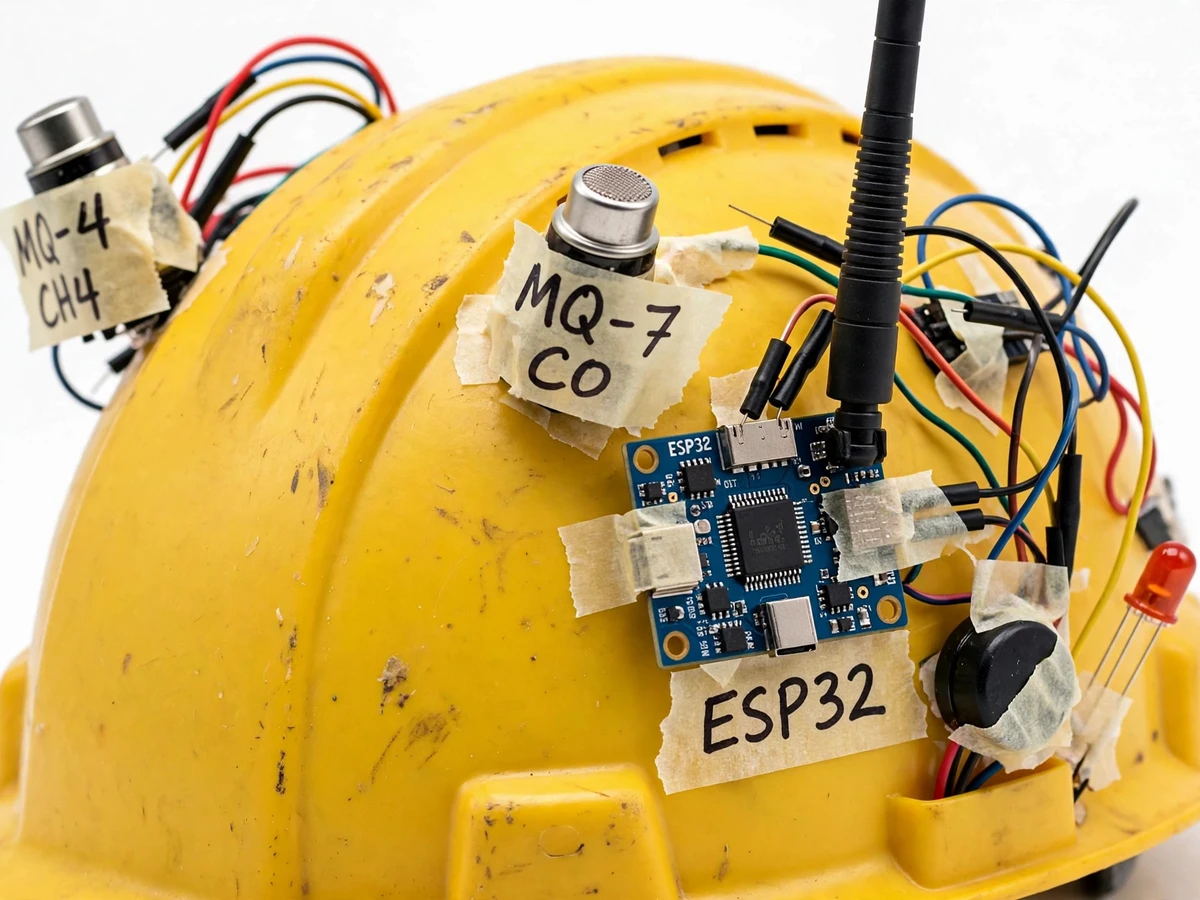
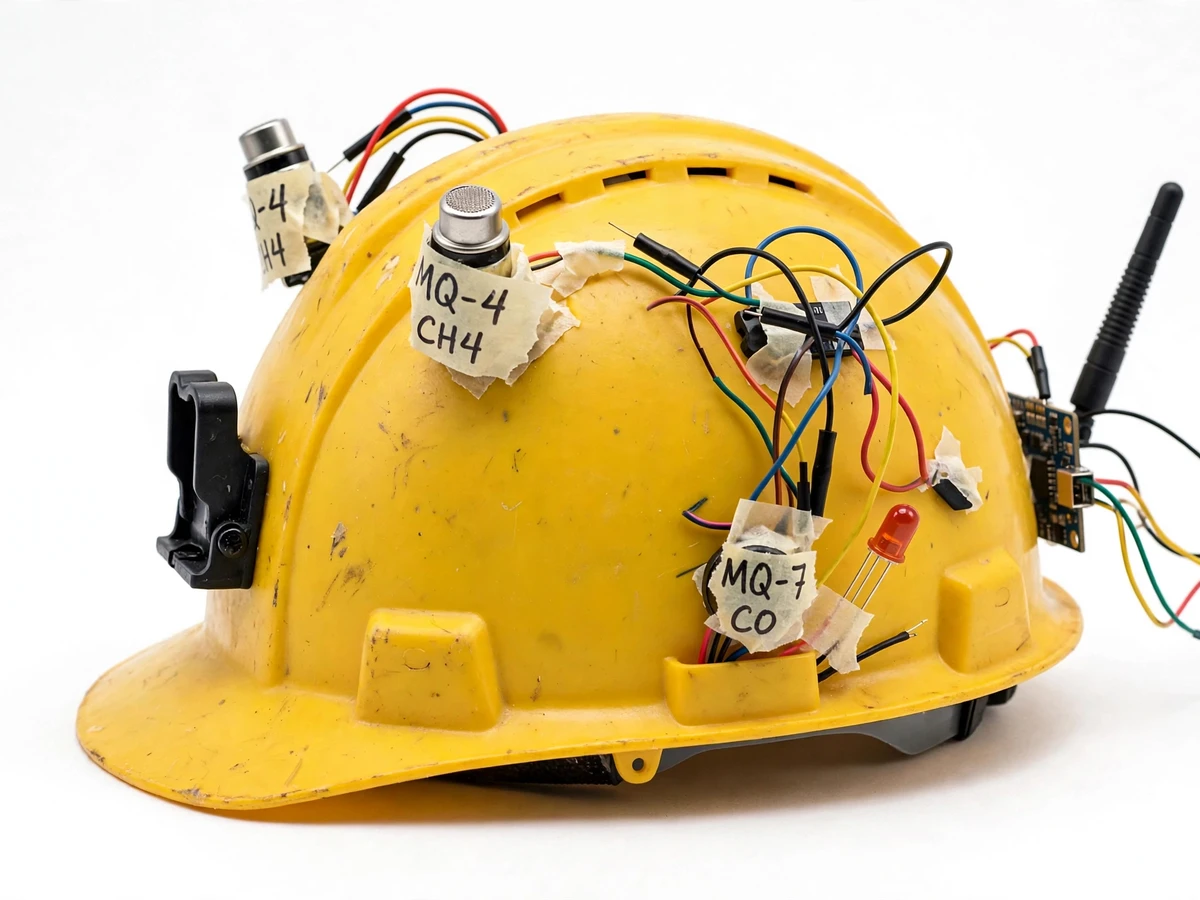
Underground miners work where the air itself is the danger: methane can accumulate to explosive concentrations, carbon monoxide from machinery and blasting can poison without warning, and rock falls or slips can injure a worker beyond anyone's sight or hearing. Certified mine-safety systems exist but are expensive, complex and out of reach for a college lab. This project builds a working educational prototype of an IoT miner safety helmet — a standard safety-helmet shell carrying an MQ-4 methane sensor, an MQ-7 carbon monoxide sensor, a DHT22 temperature-humidity sensor, an ADXL345 impact sensor, an ESP32 controller and a LoRa radio. On board, a buzzer, flashing LED beacon and the helmet cap-lamp give immediate local warnings; remotely, a LoRa SOS packet carrying the miner's programmed ID reaches a base-station receiver at the surface side of the tunnel. Because cellular networks do not penetrate rock, LoRa's long-range sub-GHz link is the right wireless choice for this environment. This is strictly an educational prototype for demonstrating sensing, threshold logic, low-power wireless and embedded safety design — it is not a certified life-safety device.
How it works
- The buyer runs the documented burn-in and clean-air calibration for the MQ-4 and MQ-7, storing baseline voltages and alarm thresholds in ESP32 flash via the calibration mode.
- On power-up, the ESP32 initializes the sensors, starts the MQ-7 pulsed high/low heater cycle per its datasheet, and registers the miner ID programmed for that helmet.
- Gas sampling runs continuously: MQ-4 and MQ-7 readings are converted to ppm with the calibration curve and compared against methane and CO alarm thresholds.
- The ADXL345 is polled for acceleration spikes; a spike exceeding the impact threshold is treated as a fall or strike event, with a short confirmation window to reject ordinary bumps.
- On a gas or impact event, the firmware drives the buzzer, flashes the LED beacon and ramps the cap-lamp brightness for local warning.
- Simultaneously, the ESP32 builds a LoRa packet (miner ID, event type, latest gas values) and transmits it to the base-station receiver, which logs it over USB serial with a timestamp.
- The DHT22 is sampled periodically; if temperature and humidity stay above the heat-stress setpoints for the configured duration, a separate heat alert is raised on the helmet and the radio.
Tech stack:
- ESP32
- MQ-4 methane sensor · 200–10000 ppm datasheet range
- MQ-7 CO sensor · pulsed heater cycle
- DHT22 temperature · humidity sensor
- ADXL345 3-axis accelerometer
- LoRa SX1278 · 433 MHz
- Arduino framework
- 18650 Li-ion · TP4056 charger
| Parameter | Value |
|---|---|
| Controller | ESP32, 240 MHz dual-core (datasheet) |
| Methane sensor | MQ-4, 200–10000 ppm detection range (datasheet) |
| Carbon monoxide sensor | MQ-7, 10–500 ppm detection range (datasheet) |
| Temperature / humidity | DHT22, ±0.5°C / ±2% RH (datasheet) |
| Impact sensor | ADXL345, ±16g full-scale range (datasheet) |
| Radio | LoRa SX1278, 433 MHz; tunnel reach a few hundred metres — design target, site-dependent |
| Alarm thresholds | User-configurable in firmware; buyer-calibrated, not pre-set |
| Power | 18650 cell with TP4056 charging; expected runtime ~8–12 h per charge (depends on lamp brightness) |
| Helmet base | Standard safety-helmet shell; modules mounted with non-invasive brackets |
| Base station | Matching LoRa receiver board with USB-serial logging to PC |
Project features
- [Methane and carbon monoxide sensing] An MQ-4 sensor watches for methane (datasheet detection range 200–10000 ppm) and an MQ-7 watches for carbon monoxide (datasheet range 10–500 ppm), both mounted on the helmet shell near breathing height. When readings cross the buyer-calibrated alarm thresholds, the buzzer and red LED fire immediately.
- [Impact detection with automatic SOS] The ADXL345 accelerometer (±16g full-scale range, per datasheet) monitors for falls and hard impacts. A spike past the firmware threshold raises the local alert and automatically transmits a LoRa SOS packet carrying the miner's programmed ID to the base station.
- [LoRa emergency link for underground use] A 433 MHz LoRa module (SX1278) carries short SOS packets to a base-station receiver — no cellular or Wi-Fi needed. Usable tunnel range is a design target of a few hundred metres, site-dependent; rock and tunnel bends reduce it, and repeaters are listed as future scope.
- [Heat-stress monitoring] A DHT22 tracks temperature and humidity around the helmet (±0.5°C and ±2% RH, per datasheet). Sustained high heat-humidity readings raise an alert, flagging ventilation checks before heat exhaustion sets in.
- [Cap-lamp, buzzer and LED beacon outputs] The ESP32 drives the helmet cap-lamp with PWM dimming, a loud buzzer and a flashing LED beacon, so warnings remain visible and audible in dark, noisy tunnel conditions.
- [Documented gas-sensor calibration procedure] MQ sensors need burn-in and clean-air calibration before their readings mean anything. The firmware exposes a calibration mode and the kit documents the full procedure — the buyer runs it on receipt; nothing ships pre-calibrated and no accuracy is claimed without it.
- [Base-station receiver with serial dashboard] A matching LoRa receiver board (included) forwards SOS and status packets to a PC over USB serial, logging miner ID, gas values, impact events and timestamps for the surface operator's display.
What is included
- Sensor-fitted miner safety helmet prototype (MQ-4, MQ-7, DHT22, ADXL345, ESP32, LoRa module, buzzer, LED beacon, cap-lamp, battery)
- Matching LoRa base-station receiver board with USB-serial logging
- ESP32 firmware with gas calibration mode (Arduino framework source)
- Wiring diagram and sensor mounting guide
- Gas-sensor burn-in and calibration procedure document
- Project report PDF (background, design, methodology, honest scope notes)
- PPT presentation for final review
- Viva Q&A preparation document (gas sensors, LoRa, impact detection, calibration)
Limitations & prerequisites
- This is an educational prototype, NOT a certified mine-safety device — it must never be used in a real mine or relied on for actual worker safety.
- MQ-4 and MQ-7 are semiconductor gas sensors with cross-sensitivity (alcohol vapour, smoke, other hydrocarbons shift readings); their readings are indicative, never life-safety measurements.
- LoRa reach underground is a design target of a few hundred metres; rock composition, bends and conductive ore cut it sharply — on-site range testing is part of the build, not an assumption.
- The MQ-7 needs its datasheet's alternating high/low heater-voltage cycle for CO sensing; the firmware implements it, but readings remain indicative, not analytical-grade.
- Alarm thresholds ship unset — the buyer must run the documented calibration procedure; detection claims only hold after that procedure is completed.
- Dropping the helmet itself can exceed the impact threshold and trigger a false SOS; the confirmation window reduces but does not eliminate this.
- Expected battery runtime is ~8–12 h; full-brightness cap-lamp use pulls it toward the lower end, and 18650 capacity varies by cell.
Frequently Asked Questions
Is this the same as a road-safety smart helmet?
No. Road-safety helmets watch for two-wheeler crashes over cellular or Bluetooth on open roads. This project is built for underground mining: methane and carbon-monoxide sensing, an impact-triggered LoRa beacon because cellular cannot reach underground, and cap-lamp control — a different environment and a different engineering stack.
How does the LoRa SOS work underground?
The helmet's 433 MHz LoRa module transmits short packets — miner ID, event type, latest gas values — to a base-station receiver at the tunnel mouth or surface. No cellular or Wi-Fi is needed. Usable range is a design target of a few hundred metres in tunnels; rock and layout dominate it, so on-site testing is part of the delivered build.
How accurate are the gas readings?
Indicative, not certified. The datasheets quote detection ranges of 200–10000 ppm for the MQ-4 (methane) and 10–500 ppm for the MQ-7 (CO), but these are semiconductor sensors with cross-sensitivity and drift. The kit ships with a burn-in and calibration procedure the buyer runs; no accuracy is claimed without it.
Why does the MQ-7 need a special heater cycle?
Its datasheet specifies alternating high and low heater voltages — the high phase cleans the sensing layer, the low phase senses CO. The firmware drives this cycle automatically, and the report explains the timing so the student can defend it in the viva.
What happens when an impact is detected?
The ADXL345 watches for acceleration spikes past a firmware threshold; after a short confirmation window rejects ordinary bumps, a severe spike raises the buzzer and LED beacon and transmits a LoRa SOS carrying the miner's programmed ID to the base station.
Is this project suitable for a final-year project?
Yes — for IoT & Embedded, Electronics and Electrical programs. It combines sensor interfacing, embedded C firmware, sub-GHz wireless communication, power design and a genuine safety problem, with a live demo in which gas and impact alerts can be triggered and shown end to end. Suitable for B.E./B.Tech final-year projects in IoT & Embedded, Electronics and Electrical.
Components & software requirements
- ESP32
- MQ-4 methane sensor · 200–10000 ppm datasheet range
- MQ-7 CO sensor · pulsed heater cycle
- DHT22 temperature · humidity sensor
- ADXL345 3-axis accelerometer
- LoRa SX1278 · 433 MHz
- Arduino framework
- 18650 Li-ion · TP4056 charger
Delivery information
Built-to-order project. Delivery timeline is shared after order confirmation based on current queue.
Support terms
Complete documentation, setup guide, and viva preparation included. Support for setup and explanation provided.