
More project photos (2)
The problem
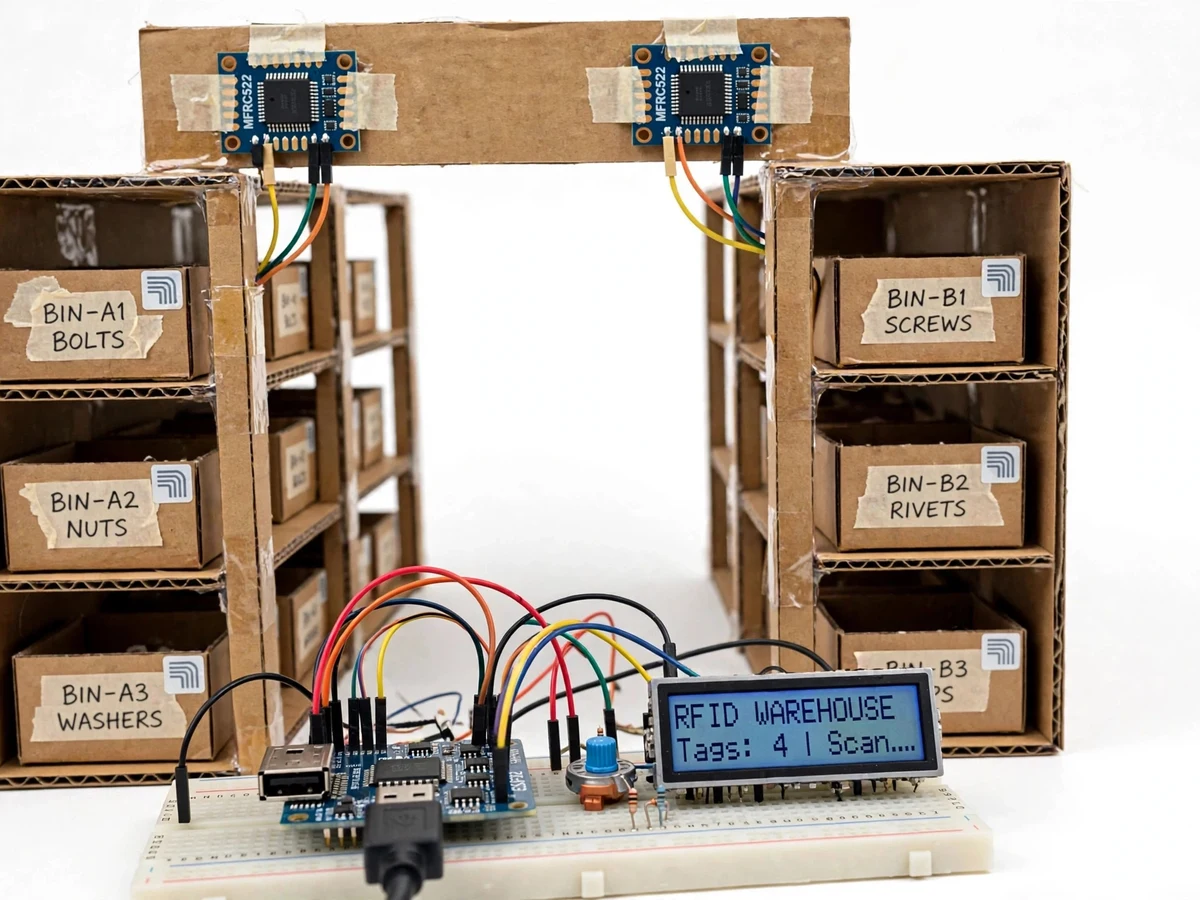
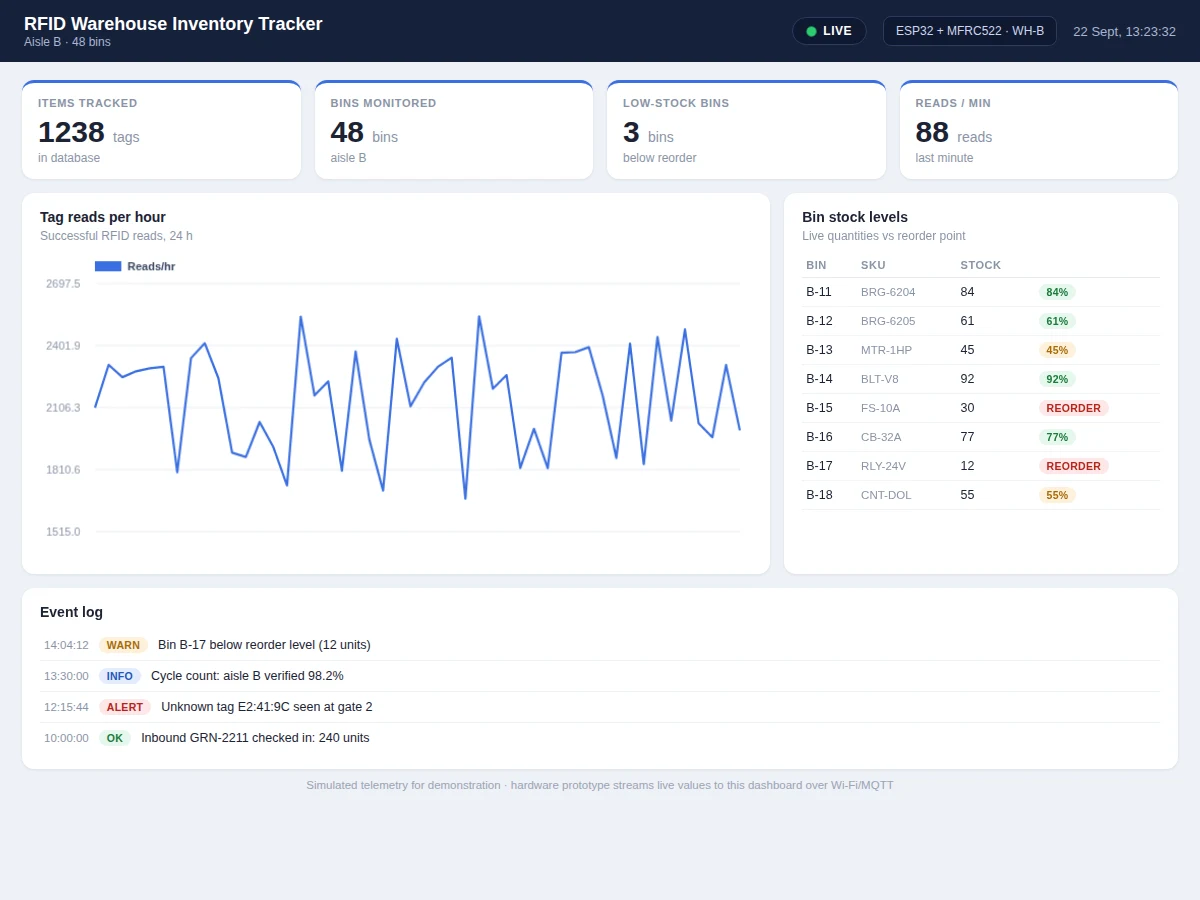
Small warehouses still count stock by hand — slow, error-prone, and blind between counts. RFID changes the economics: a tag on every bin and a reader at the gate turns material movement into data automatically. This project demonstrates that on a model warehouse aisle: 48 tagged bins, an MFRC522 reader at the gate, and a handheld reader point, all feeding an ESP32. Firmware resolves tag reads to bin identities, tracks check-in/check-out events, and publishes stock levels over Wi-Fi via MQTT. The dashboard shows a live bin stock table with reorder flags, reads-per-hour graphs and unknown-tag alerts. The project is honest about the technology: 13.56 MHz HF RFID reads at centimetres, not metres — the report explains the range physics and why UHF would be needed for dock-door portals, keeping the claims inside what the hardware actually does.
How it works
- RFID tags are attached to the model's bins and registered in the database with SKU, quantity and reorder level.
- The gate MFRC522 reader continuously polls its field; firmware runs the anti-collision sequence and resolves each tag's UID.
- On each read, the ESP32 looks up the bin, updates its last-seen timestamp and movement direction, and publishes the event over Wi-Fi via MQTT.
- The dashboard updates the bin stock table, increments reads-per-hour, and evaluates reorder levels on every event.
- Presenting a bin at the handheld reader shows its recorded stock on the dashboard's verify panel for cycle counts.
- Unknown UIDs raise an alert — an untagged or foreign item at the gate — logged with timestamp.
- The buyer runs the tag registration procedure for all 48 bins, documented with expected read ranges in the manual.
Tech stack:
- ESP32 development board
- MFRC522 RFID reader modules x2
- RFID tags x48 (13.56 MHz)
- Model warehouse aisle with 48 bins
- MQTT broker + web dashboard
- Arduino IDE (C/C++ firmware)
- Tag registration utility
- 16x2 LCD (gate status display)
| Parameter | Value |
|---|---|
| Controller | ESP32, Wi-Fi MQTT telemetry (JSON events) |
| RFID | MFRC522, 13.56 MHz HF; read range approximately 3-5 cm (datasheet) |
| Tags | 48 tagged bins with SKU binding |
| Readers | Gate reader + handheld/cycle-count reader |
| Event latency | Immediate publish on read (design target under 2 s) |
| Dashboard | Bin stock table, reorder flags, reads/hour, unknown-tag alerts |
| Anti-collision | MFRC522 cascade handling for multiple tags in field |
| Power | 5 V DC, approximately 0.6 A (expected) |
Project features
- [Tagged-bin inventory] Every bin carries an RFID tag bound to its SKU; the database holds bin, SKU, quantity and reorder level.
- [Gate reader point] An MFRC522 reader at the aisle gate logs bins passing in and out with timestamps — movement becomes data.
- [Handheld reader point] A second reader acts as the cycle-count station: present a bin to verify its recorded stock instantly.
- [Live stock dashboard] Bin stock table with reorder flags, reads-per-hour graphs, and unknown-tag alerts, all from live telemetry.
- [Low-stock alerts] When a bin's quantity falls below its reorder level, the dashboard flags it and logs the event.
- [MQTT telemetry] The ESP32 publishes read events and stock updates as JSON over Wi-Fi via MQTT with immediate event delivery.
- [Anti-collision handling] Firmware implements the MFRC522 anti-collision sequence so multiple tags in the field are read in turn, not garbled.
What is included
- Working model warehouse aisle (48 tagged bins, 2 RFID readers, ESP32, gate display)
- Complete firmware source (MFRC522 driver, anti-collision, MQTT, inventory logic)
- Live web dashboard (stock table, graphs, alerts) demonstrated with the aisle
- Circuit and wiring documentation
- Tag registration procedure with expected read ranges
- Component list with ratings
- Project report PDF (RFID background, HF vs UHF, anti-collision, inventory systems, methodology)
- PPT presentation for final review
- Viva Q&A preparation document (RFID physics, MFRC522, anti-collision, MQTT)
- Setup and demonstration guide
Limitations & prerequisites
- 13.56 MHz HF RFID reads at approximately 3-5 cm (datasheet) — bins are presented to readers, not read at dock-door distance; UHF for that is discussed as future scope.
- Metal bins detune HF tags; the model uses non-metallic bins and the manual notes the limitation.
- Tag UID is the identity — cloning or secure authentication is out of scope for the demonstration.
- Stock quantities are updated by configured check-in/out events; the system tracks identity and movement, it does not weigh bins.
- Telemetry needs Wi-Fi; the gate LCD shows last-read status locally without network.
Frequently Asked Questions
How does the RFID reading work?
The MFRC522 reader energizes its 13.56 MHz field; tags in range backscatter their UID. Firmware runs the anti-collision sequence to read multiple tags in turn, looks up each UID in the bin database, and publishes the event — identity, timestamp and direction — over MQTT.
What is the read range?
Approximately 3-5 cm (datasheet) for HF tags — bins are presented to the gate or handheld reader. The report explains honestly why dock-door portals need UHF instead, keeping the claims inside the hardware's real capability.
What does the dashboard show?
A live bin stock table with SKU, quantity and reorder flags, reads-per-hour graphs, the gate's recent read log, unknown-tag alerts and a verify panel for cycle counts.
How are low-stock situations handled?
Each bin has a reorder level; when quantity falls below it, the dashboard flags the bin and logs the event. Quantities update on check-in/check-out reads.
Can it handle many tags at once?
Yes, within reason — the MFRC522 anti-collision cascade reads tags in the field sequentially. A bin-full presented together resolves correctly; the demo covers typical handfuls, not hundreds.
Is this project suitable for a final-year project?
Yes — for Electronics and Telecommunication programs. It covers RFID physics, embedded reader drivers, anti-collision, MQTT telemetry and inventory logic with honest range claims, all strong viva material. Suitable for B.E./B.Tech final-year projects in Electronics and Telecommunication.
Components & software requirements
- ESP32 development board
- MFRC522 RFID reader modules x2
- RFID tags x48 (13.56 MHz)
- Model warehouse aisle with 48 bins
- MQTT broker + web dashboard
- Arduino IDE (C/C++ firmware)
- Tag registration utility
- 16x2 LCD (gate status display)
Delivery information
Built-to-order project. Delivery timeline is shared after order confirmation based on current queue.
Support terms
Complete documentation, setup guide, and viva preparation included. Support for setup and explanation provided.