
More project photos (2)
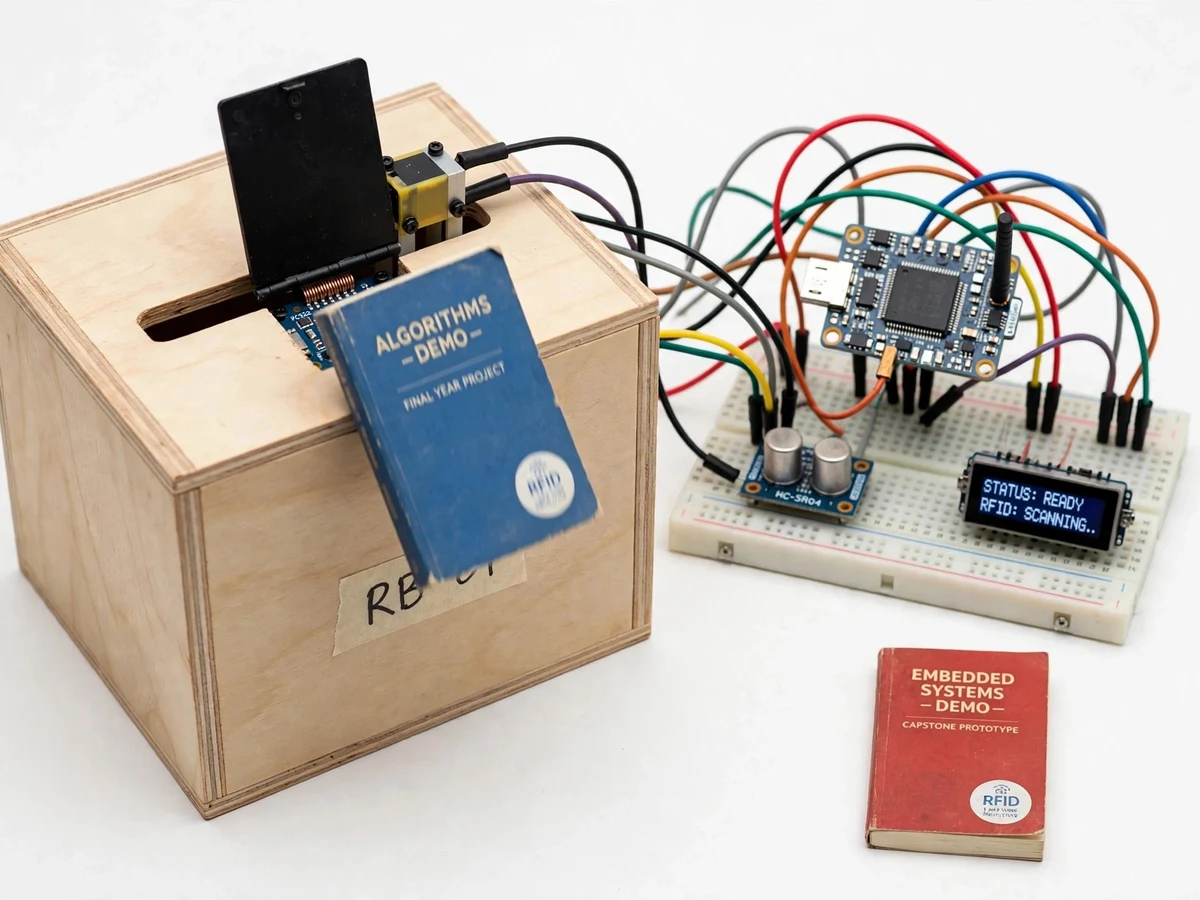

The problem
College libraries lose staff hours to manual book check-ins: every returned book is scanned one by one at the counter, queues build up at peak hours, and after-hours returns pile up unsorted. RFID self check-in kiosks exist commercially but are priced for large libraries, and they rarely show students how the tag-to-database loop actually works. This project builds a working return bin around an ESP32 and an RC522 reader: a book dropped through the slot passes the reader, its tag UID is matched against the demo catalogue, and the return is logged instantly with a timestamp — no staff touch needed. A servo-driven flap keeps the slot closed between drops, an ultrasonic sensor tracks how full the bin is, and the librarian dashboard shows the live returns feed, fill gauge and overdue flags. Because the catalogue, firmware and dashboard are all built in the open, the student can explain every step from RF field to database row.
How it works
- A student drops a tagged book through the slot; the IR break-beam wakes the reader and opens the servo flap momentarily.
- The RC522 energizes its RF field and reads the tag UID as the book falls past the antenna zone.
- The ESP32 matches the UID against the demo catalogue over Wi-Fi and records the return with a timestamp; unmatched tags are logged as unknown.
- The flap closes, the green LED and buzzer confirm the check-in, and the OLED updates the last-return display.
- The ultrasonic sensor re-measures the bin fill after each drop; crossing the collection threshold raises a dashboard and LED alert.
- The dashboard appends every event to the live returns feed, updates the fill gauge and daily counts, and flags returns whose due dates had passed.
Tech stack:
- ESP32 development board (Wi-Fi)
- RC522 RFID reader (13.56 MHz, ISO14443A)
- SG90 servo (slot flap) + IR break-beam sensor
- Ultrasonic fill-level sensor
- 0.96-inch OLED + LEDs + buzzer
- Demo catalogue backend (Wi-Fi API)
- HTML/CSS/JS librarian dashboard
- Arduino IDE (C/C++ firmware)
| Parameter | Value |
|---|---|
| RFID standard | 13.56 MHz, ISO14443A tags (RC522) |
| Read range | Approximately 3–5 cm at the slot (design target) |
| Bin capacity | Approximately 25–30 demo books (design target) |
| Fill sensing | Ultrasonic, approximately ±1 cm (design target) |
| Check-in latency | Under 2 s from drop to dashboard entry (design target) |
| Catalogue | Demo set of tagged books with due-date records |
| Dashboard | Single-file web app; live feed, fill gauge, overdue flags |
| Power | 5 V adapter (mains) |
Project features
- [RFID self check-in] An RC522 reader identifies each book's tag as it drops through the slot and the ESP32 logs the return instantly against the demo catalogue.
- [Servo-controlled slot flap] The entry flap opens for each drop and closes after, keeping dust out and preventing books from being fished back out.
- [Bin-fill monitoring] An ultrasonic sensor measures the fill level continuously; the dashboard gauge and a local LED warn staff before the bin overflows.
- [Live librarian dashboard] Returns feed with timestamps, per-book check-in log, fill gauge, daily return counts and overdue flags from the demo catalogue data.
- [Instant user feedback] A green LED and buzzer confirm each successful check-in; a red LED flags an unrecognized tag.
- [On-device display] A 0.96-inch OLED shows the last returned title, today's return count and the fill level at the bin itself.
- [Demo catalogue] A small tagged book set with catalogue records (title, member, due date) ships with the build so the full loop is demonstrable out of the box.
What is included
- Working hardware prototype (return bin with reader, flap servo and sensors fitted)
- ESP32 firmware source with RFID, servo and fill-level logic
- Companion dashboard demo (single-file HTML librarian dashboard)
- Demo catalogue with pre-tagged books and due-date records
- Wiring diagram and bin fabrication guide
- Project report PDF (background, RFID principles, architecture, methodology)
- PPT presentation for final review
- Viva Q&A preparation document (RFID, anti-collision, servo control, UID matching)
Limitations & prerequisites
- RC522 reads one tag at a time at short range — a stack of books dropped together will not all register; single-book drops are the designed workflow.
- Metal covers and foil-lined books detune the 13.56 MHz field; the demo book set avoids these, and the report documents the limitation.
- Tag UIDs are identifiers, not security — UIDs can be cloned, so this is a workflow demo, not an anti-theft system.
- The demo catalogue is a small local dataset, not a full library ILS integration; connecting a real ILS is future scope.
- Bin capacity is demo-scale (25–30 books); a production unit needs a larger, fire-safe enclosure.
- Wi-Fi is required for catalogue matching; the bin queues returns locally if the network drops.
Frequently Asked Questions
How does the bin know which book was returned?
Each demo book carries an RFID tag with a unique UID. As the book falls past the RC522 antenna, the reader captures the UID, the ESP32 looks it up in the catalogue over Wi-Fi, and the matching title is checked in with a timestamp.
What if two books are dropped together?
The reader handles one tag per drop — that is the designed workflow, enforced by the slot size. If a second tag is detected in the same window, the firmware logs a multi-tag warning and asks for the books to be dropped singly.
Why does the flap need a servo?
The flap keeps the slot closed between drops (dust, tampering) and its brief open-close cycle gives the reader a clean single-book window. It also demonstrates actuation alongside sensing.
How does the librarian know when to empty it?
The ultrasonic fill sensor updates the dashboard gauge after every drop; at the collection threshold the dashboard flags it and the bin's amber LED lights. No more surprise overflows.
Can it connect to our college's real library software?
The build uses a demo catalogue over a simple Wi-Fi API, which mirrors how an ILS lookup works. Wiring it to a real system (e.g. Koha) is documented as future scope, not claimed.
Is this project suitable for a final-year project?
Yes — for Electronics, IoT and Embedded Systems programs. It combines RFID interfacing, actuation, a real workflow and a genuinely useful dashboard. Suitable for B.E./B.Tech final-year projects in Electronics, IoT and Embedded Systems.
Components & software requirements
- ESP32 development board (Wi-Fi)
- RC522 RFID reader (13.56 MHz, ISO14443A)
- SG90 servo (slot flap) + IR break-beam sensor
- Ultrasonic fill-level sensor
- 0.96-inch OLED + LEDs + buzzer
- Demo catalogue backend (Wi-Fi API)
- HTML/CSS/JS librarian dashboard
- Arduino IDE (C/C++ firmware)
Delivery information
Built-to-order project. Delivery timeline is shared after order confirmation based on current queue.
Support terms
Complete documentation, setup guide, and viva preparation included. Support for setup and explanation provided.