
More project photos (2)

The problem
Recommender systems decide what billions of people watch, buy and read, yet most students meet collaborative filtering only as a library call on a toy 5x5 matrix. The real problem is messier: the MovieLens 100K matrix is 93.7% empty, new users arrive with zero ratings, blockbusters drown out niche tastes, and a low RMSE does not guarantee a good top-10 list. Matrix factorization — the approach that won the Netflix Prize — handles the sparsity by compressing users and movies into shared latent factors, but the leap from textbook SVD to a trained, evaluated, explainable system is exactly what coursework skips. This project makes that leap concrete: real SVD training on MovieLens 100K with a logged optimization curve, ranking-metric evaluation under a leave-one-out protocol, and a demo that opens the black box — latent taste factors, nearest users, and a plain-language reason attached to every recommendation.
How it works
- MovieLens 100K ratings (1-5 stars, every user has 20+ ratings) are loaded and split into train/test sets; global, user and item bias terms are computed.
- SVD factorizes the sparse matrix into 50-dimensional user factors, item factors and biases, optimized with SGD (learning rate 0.005, regularization 0.02) for 30 epochs with RMSE logged each epoch.
- The test split yields the final RMSE; a leave-one-out protocol (hide each user's latest rating, predict it back, rank all unseen items) yields Precision@K, Recall@K and nDCG@K.
- At serving time a predicted rating is computed as user-factor dot item-factor plus the bias terms, for every movie the user has not rated.
- Unseen movies are ranked by predicted rating; the top-N are rendered as cards with predicted stars.
- Each card's explanation is generated from the rated movie with the highest latent-space overlap, and the demo's model view shows the user's factor bars and nearest users.
Tech stack:
- Python 3.10, scikit-surprise (SVD matrix factorization)
- pandas, NumPy (rating matrix handling, evaluation protocol)
- scikit-learn (train/test splits, similarity utilities)
- Matplotlib (training RMSE curve, metric charts)
- Flask demo app (recommend, model-inspection and evaluation views)
- MovieLens 100K dataset (943 users, 1,682 movies, 100,000 ratings)
| Parameter | Value |
|---|---|
| Algorithm | SVD matrix factorization (Surprise), 50 latent factors |
| Dataset | MovieLens 100K: 943 users, 1,682 movies, 100,000 ratings (1-5 stars, 20+ ratings per user) |
| Sparsity | 93.7% of the user-item matrix is empty |
| Training | SGD, 30 epochs, learning rate 0.005, regularization 0.02; RMSE logged per epoch |
| Prediction | rating = user_factor . item_factor + user_bias + item_bias + global_mean |
| Rating evaluation | Test RMSE — computed by the notebook on the held-out split during your build |
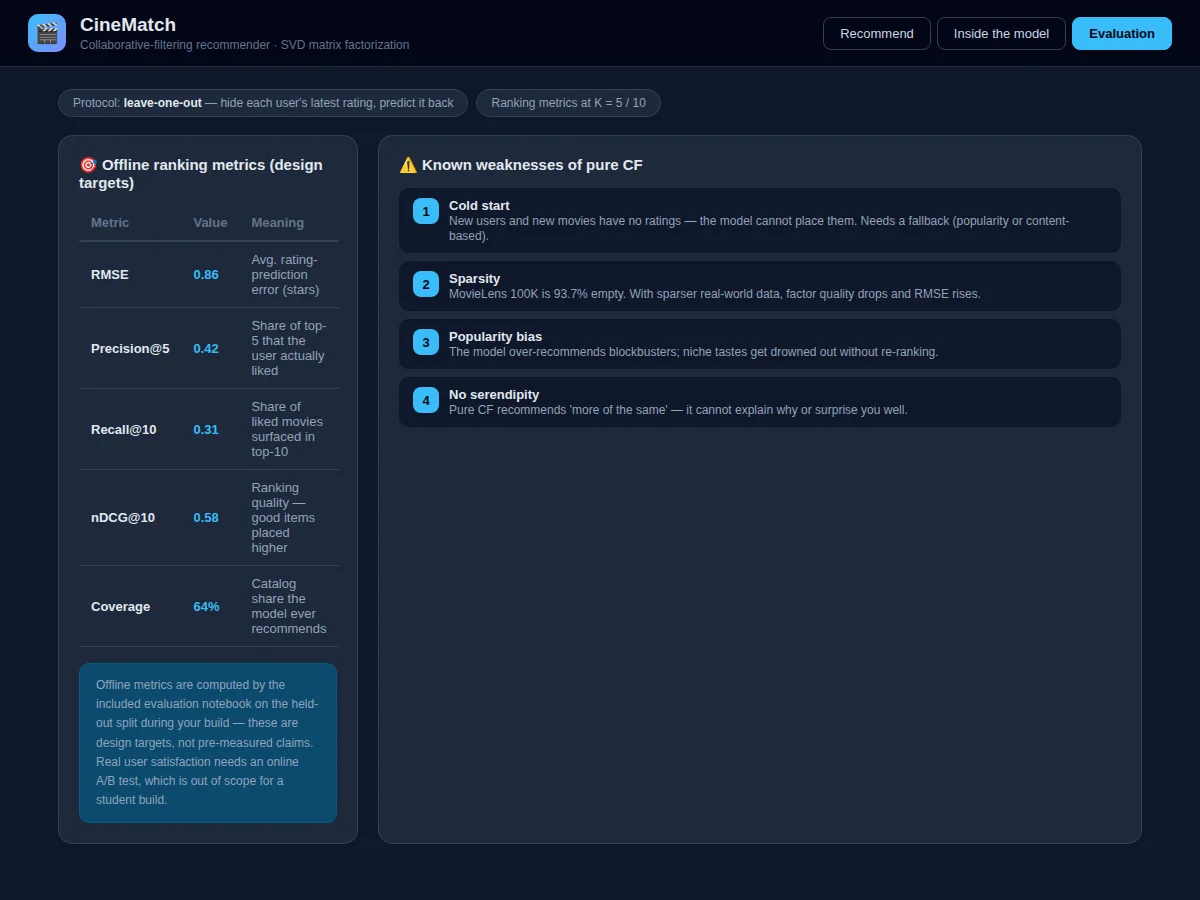
| Ranking evaluation | Precision@5, Recall@10, nDCG@10, catalog coverage via leave-one-out protocol |
| Design target | Approximately 0.86-0.90 test RMSE (final numbers from your own training run) |
| Explanations | Nearest users (cosine similarity) + highest-overlap rated movie per recommendation |
| Demo profiles | 3 built-in taste profiles for comparison |
Project features
- [SVD matrix factorization] The 943 x 1,682 rating matrix is factorized into 50-dimensional user and item latent factors plus bias terms, trained with SGD (30 epochs, regularization 0.02) using the Surprise library.
- [Predicted ratings with explanations] Every recommendation shows its predicted star rating alongside a "because you liked X" line drawn from the highest-overlap movie in the user's own profile.
- [Latent taste profile viewer] The demo renders the active user's factor vector as labeled bars (action intensity, drama depth, sci-fi affinity and more), making the abstract math visible.
- [Nearest-user panel] The three most similar users by cosine similarity in latent space are shown per profile, exposing the neighborhood intuition behind factorization.
- [Training curve visualization] Per-epoch RMSE is logged during training and plotted in the demo, so the optimization story is part of the deliverable.
- [Ranking-metric evaluation] Beyond RMSE, the notebook computes Precision@5, Recall@10, nDCG@10 and catalog coverage under a leave-one-out protocol.
- [Multiple user profiles] Three built-in profiles (action/sci-fi fan, drama/romance lover, thriller/crime buff) let examiners compare how recommendations change with taste.
What is included
- Complete source code (data loading, SVD training, leave-one-out evaluation, Flask demo)
- Jupyter training notebook (buyer-run procedure: train, log the RMSE curve, evaluate)
- Evaluation report with RMSE, ranking metrics and coverage from your build
- Project report PDF (background, matrix factorization theory, methodology, evaluation, limitations)
- PPT presentation for final review
- Viva Q&A preparation document (SVD, latent factors, SGD, RMSE vs ranking metrics, cold start)
- Setup guide (environment, MovieLens download, running training and the demo)
Limitations & prerequisites
- Cold start is unsolved: new users and new movies have no ratings, so the model cannot place them — the report documents the popularity/content-based fallbacks instead of pretending otherwise.
- MovieLens 100K is 93.7% empty; on sparser real-world data factor quality drops and RMSE rises, which the report states explicitly.
- Popularity bias: the model over-recommends blockbusters, and niche tastes get drowned out without a re-ranking step (listed as future scope, not implemented).
- Offline metrics are computed on held-out ratings; real user satisfaction needs an online A/B test, which is out of scope for a student build.
- Pure CF recommends "more of the same" and cannot explain recommendations beyond neighborhood overlap — serendipity and content-aware explanations need the hybrid follow-up.
Frequently Asked Questions
Which dataset is used?
MovieLens 100K from GroupLens Research: 100,000 ratings (1-5 stars) from 943 users on 1,682 movies, with every user having rated at least 20 movies. It is the classic small, clean benchmark that trains in minutes on a CPU.
Which algorithm is used and why SVD?
Singular Value Decomposition-based matrix factorization via the Surprise library. SVD compresses the sparse rating matrix into latent taste factors — the Netflix Prize-winning idea — and trains far faster than deep models while remaining fully explainable in a viva.
Is the RMSE guaranteed?
No. The design target is approximately 0.86-0.90 test RMSE; the training notebook computes RMSE on your held-out split plus Precision@5, Recall@10, nDCG@10 and coverage under the leave-one-out protocol during your build, and the report presents your build's measured numbers.
How is this different from just sorting by average rating?
Average-rating lists are identical for everyone and ignore personal taste. SVD learns a per-user taste vector, so two users get completely different top-10 lists — the demo's three profiles make this visible side by side.
Can it recommend for a brand-new user?
Not on its own — that is the cold-start problem, and the report is honest about it. The documented fallback is a popularity or content-based list until the user rates a few items; the hybrid extension (separate project) solves it properly.
Can I use a bigger dataset?
Yes — the pipeline accepts MovieLens 1M/25M with a one-line path change, though training time and RAM grow; the setup guide notes the trade-off. Suitable for B.E./B.Tech final-year projects in Computer Science, AI/ML and Data Science.
Components & software requirements
- Python 3.10, scikit-surprise (SVD matrix factorization)
- pandas, NumPy (rating matrix handling, evaluation protocol)
- scikit-learn (train/test splits, similarity utilities)
- Matplotlib (training RMSE curve, metric charts)
- Flask demo app (recommend, model-inspection and evaluation views)
- MovieLens 100K dataset (943 users, 1,682 movies, 100,000 ratings)
Delivery information
Built-to-order project. Delivery timeline is shared after order confirmation based on current queue.
Support terms
Complete documentation, setup guide, and viva preparation included. Support for setup and explanation provided.