
More project photos (2)
The problem
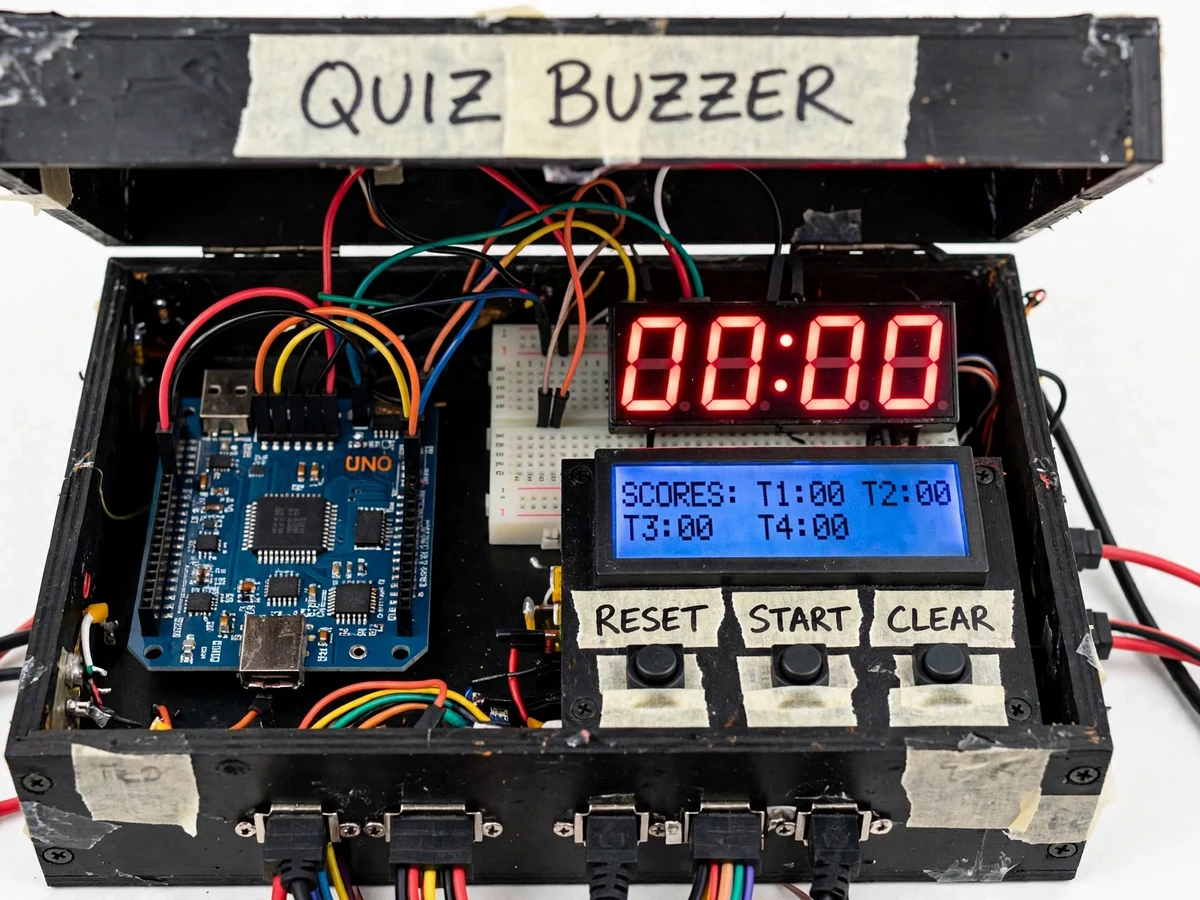
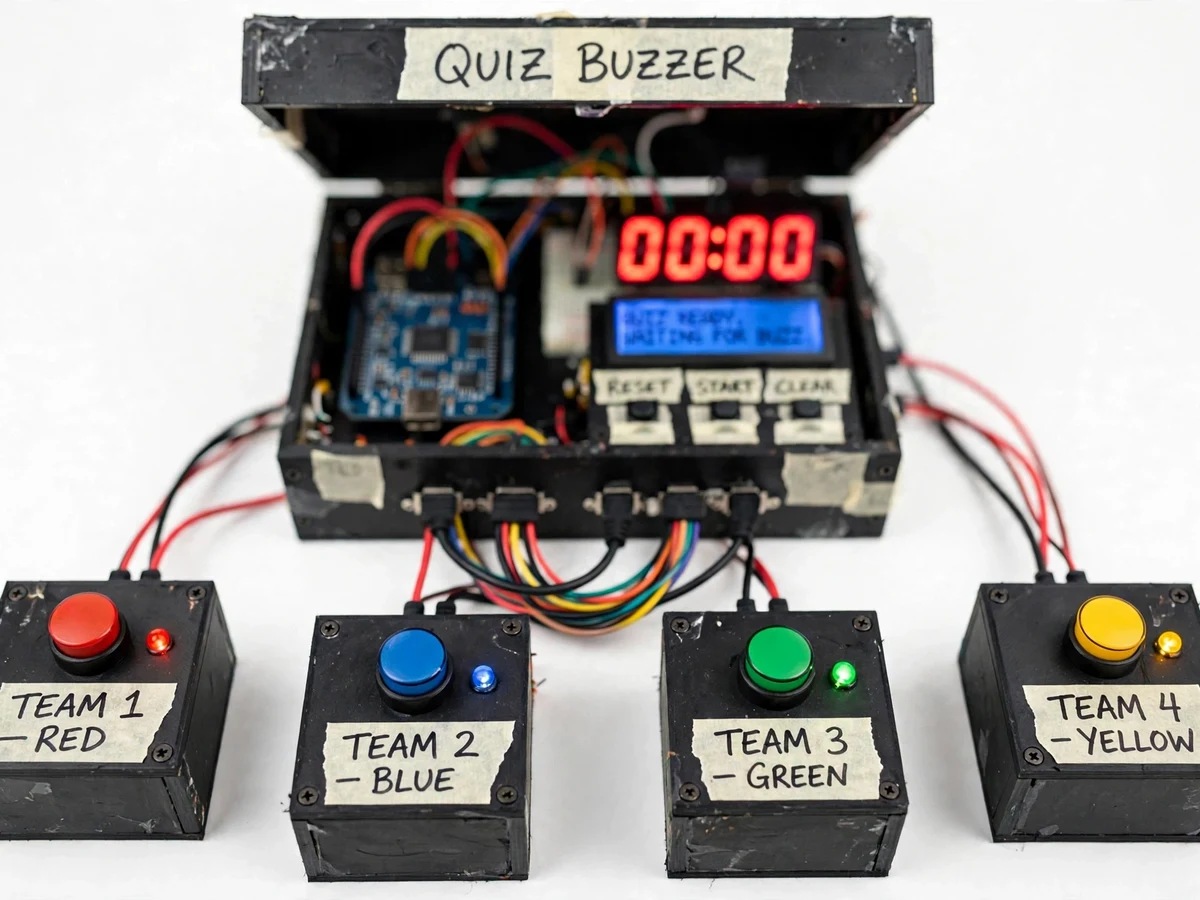
Quiz competitions in colleges still run on shouting, raised hands or a single bell, and every close call between two teams ends in an argument about who pressed first. Commercial quiz buzzer sets exist but are expensive black boxes that teach nothing. This project builds the system from scratch as an embedded product: four team stations with big push-buttons, a central controller that arbitrates the fastest press with a hardware-fair lockout, team indicator lamps, a countdown timer display for answering, and a scoreboard the host updates from a control panel. The interesting engineering is all visible — contact debouncing, race-free press arbitration, multiplexed seven-segment driving, and a firmware state machine (idle → buzzed → answering → scored → reset) that the student can explain line by line.
How it works
- Four team stations, each with a large push-button and an indicator LED, wire back to the central Arduino-based controller.
- In the idle state the firmware polls all team inputs continuously with debouncing; the host arms the round from the control panel.
- The first clean press wins: firmware latches the winning team, lights its lamp and LED, sounds the buzz-in tone, and locks out the other three stations.
- The answer timer starts counting down on the multiplexed seven-segment/LCD display from the host-set value.
- The host marks the answer right or wrong on the control panel: correct adds the configured points to the team's score, wrong can pass the question or deduct.
- The timer expiring without an answer forfeits the question with a time-up tone; the host then resets for the next question.
- Scores are shown on the scoreboard display throughout; a long-press resets all scores for a new game.
Tech stack:
- Arduino Uno/Nano (ATmega328P)
- 4 team stations: push-buttons + indicator LEDs/lamps
- Multiplexed seven-segment displays + 16x2 LCD (scoreboard/status)
- Buzzer/speaker for game tones
- Host control panel (reset, score, timer buttons)
- Arduino IDE (C/C++ state-machine firmware)
- Wired station cabling with labelled connectors
| Parameter | Value |
|---|---|
| Teams supported | 4 (design) |
| Lockout arbitration | Under 100 ms from press to lockout (design target) |
| Answer timer | 5–60 s, host-settable (design target) |
| Displays | Multiplexed 7-segment (timer/team) + 16x2 LCD (scores/status) |
| Input handling | Debounced polling, held-button rejection (firmware) |
| Audio | Distinct tones: buzz-in, warning, time-up (design) |
| Station cable length | Approximately 3 m per station (design) |
| Power | 5 V DC regulated supply (design) |
Project features
- [Fastest-finger lockout] The controller samples all four team buttons on a tight poll loop; the first valid press wins and all other inputs are ignored until reset, with arbitration in well under 100 ms (design target) so ties are genuinely decided.
- [Team indicator lamps] The winning team's lamp and station LED light instantly while the others stay dark, giving the audience an unambiguous visual verdict.
- [Configurable answer timer] Once a team buzzes, a countdown (5–60 s, host-settable) runs on the display with an audible warning in the last seconds; expiry forfeits the question.
- [Scoreboard tracking] The host adds or subtracts points per team from the control panel; scores persist on the display through the rounds.
- [Host control panel] Dedicated reset, score +/−, timer set and pass-question buttons keep game flow in the host's hands without touching the team stations.
- [Debounced, cheat-resistant inputs] Firmware debouncing plus a press-validity window reject contact bounce and held-down buttons, so a team cannot win by leaning on its buzzer.
- [Distinct audio feedback] Different tones for buzz-in, timer warning and time-up make the game state audible across a hall.
What is included
- Central quiz buzzer controller console with displays and host panel
- 4 wired team stations with push-buttons and indicator LEDs
- Arduino firmware (lockout arbitration, timer, scoring state machine)
- Wiring diagram and station cabling layout
- Project report PDF (debouncing, arbitration design, methodology)
- PPT presentation for final review
- Viva Q&A preparation document (polling vs interrupts, debouncing, multiplexing, state machines)
Limitations & prerequisites
- Wired stations: teams must sit within cable reach of the controller (approximately 3 m); there is no wireless version in this build.
- The lockout decides the fastest press at the controller's poll resolution — genuinely simultaneous presses within microseconds are not distinguished.
- Scoring rules (points per question, negative marking) are host-operated; there is no automatic question bank or quiz content included.
- The timer and scores reset on power loss; there is no battery-backed memory in this build.
- Designed for classroom and auditorium quiz events, not for broadcast-grade game-show production use.
Frequently Asked Questions
How does the fastest-finger lockout work?
The controller polls all four team buttons in a tight loop with debouncing. The first clean press latches the winner, lights only that team's lamp, and disables the other inputs in firmware until the host resets — arbitration completes in under 100 ms (design target).
What stops a team from cheating by holding the button down?
Firmware rejects held-down buttons: a press only counts if it arrives after the round is armed and the button was previously released, so leaning on the buzzer never wins.
How is the answer timer set?
From the host control panel, between 5 and 60 seconds. The countdown shows on the display with warning beeps near expiry and a time-up tone on forfeit.
How are scores tracked?
The host adds or deducts points per team from the control panel; the scoreboard display keeps all four totals visible through the rounds, with a long-press full reset for a new game.
Is there a wireless version?
Not in this build — stations are wired for reliability and zero pairing hassle. A wireless extension using RF modules is listed as future scope in the report.
Is this project suitable for a final-year project?
Yes — for Electronics, Computer and Instrumentation programs. It demonstrates input arbitration, debouncing, display multiplexing and state-machine firmware in a complete, demonstrable product. Suitable for B.E./B.Tech final-year projects in Electronics, Computer and Instrumentation engineering.
Components & software requirements
- Arduino Uno/Nano (ATmega328P)
- 4 team stations: push-buttons + indicator LEDs/lamps
- Multiplexed seven-segment displays + 16x2 LCD (scoreboard/status)
- Buzzer/speaker for game tones
- Host control panel (reset, score, timer buttons)
- Arduino IDE (C/C++ state-machine firmware)
- Wired station cabling with labelled connectors
Delivery information
Built-to-order project. Delivery timeline is shared after order confirmation based on current queue.
Support terms
Complete documentation, setup guide, and viva preparation included. Support for setup and explanation provided.