
More project photos (2)
The problem
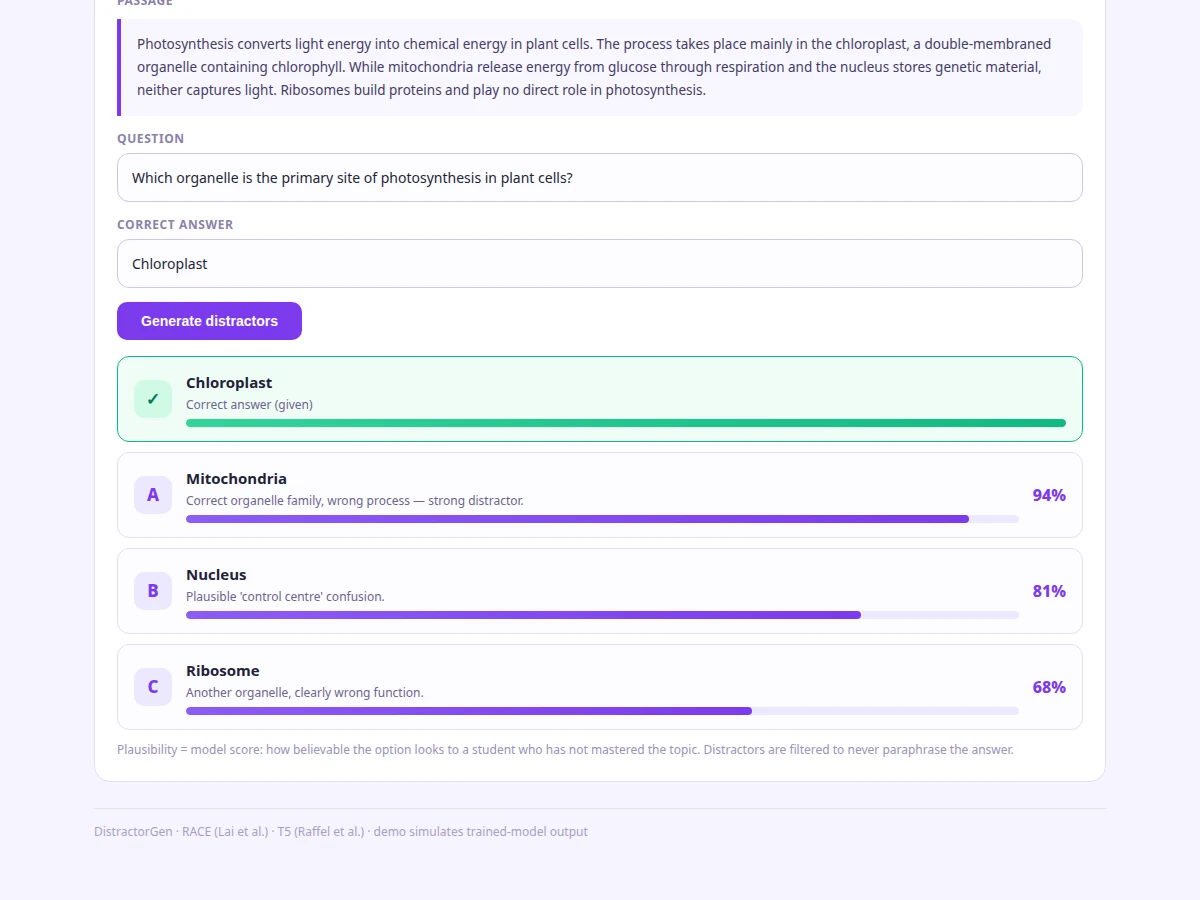
A multiple-choice question is only as good as its distractors: if the wrong options are obviously wrong, the question tests nothing, and writing three genuinely plausible wrong answers per question is slow expert labour. Automating it is a real generation challenge — the model must understand the passage deeply enough to produce options that look right to an unprepared student while remaining unambiguously wrong. This project fine-tunes T5 on the RACE corpus (100k exam questions with human-written distractors) to generate three diverse distractors per question. Diverse beam search keeps the options distinct, a filtering stage drops anything that paraphrases the correct answer, and a ranking step orders survivors by plausibility so the best distractor leads.
How it works
- RACE questions are formatted as: passage + question + correct answer (input) → three human distractors (target).
- T5-base is fine-tuned on these pairs with a standard seq2seq objective.
- At inference, diverse beam search decodes multiple candidate distractors per question.
- Candidates are filtered: near-duplicates of each other and paraphrases of the answer are removed.
- A plausibility scorer ranks the survivors; the top three are returned with scores.
- The demo renders the question with the correct answer marked and each distractor scored and explained.
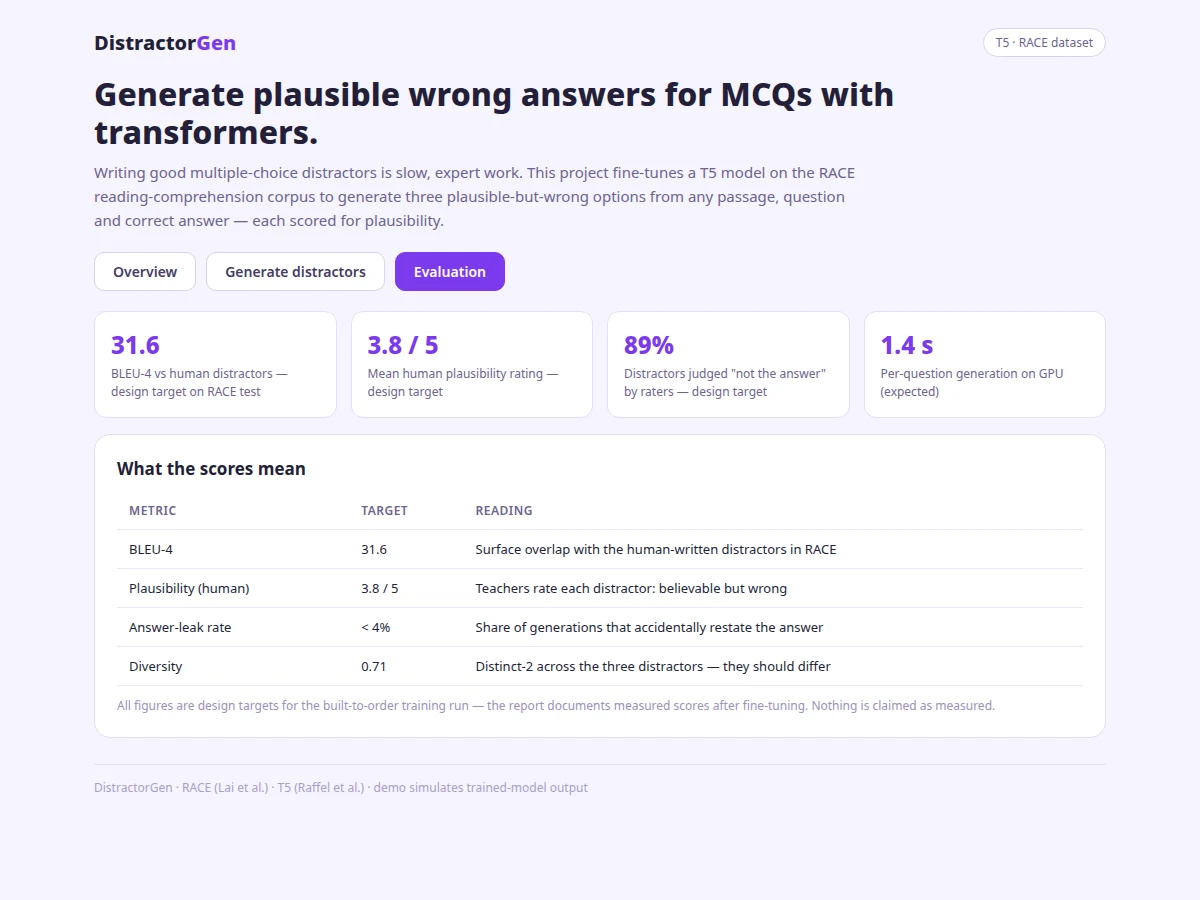
- Test evaluation reports BLEU-4 vs human distractors, answer-leak rate, diversity and human plausibility ratings.
Tech stack:
- Python 3, PyTorch
- Hugging Face Transformers
- T5-base (Raffel et al.)
- RACE dataset (Lai et al.)
- Sentence embeddings (filtering)
- HTML/CSS/JS demo
- NLTK · sacreBLEU
Dataset & model details
- Dataset: RACE — approximately 100,000 multiple-choice questions from Chinese middle- and high-school English examinations, each with a passage, question, correct answer and human-written distractors (Lai et al., EMNLP 2017).
- Task: Distractor generation; input = passage + question + correct answer, output = three plausible-but-incorrect options.
- Model: T5-base fine-tuned as conditional generation; diverse beam search decoding; embedding-similarity filtering; learned plausibility ranker.
- Metrics: BLEU-4 design target 31.6 vs human distractors on the RACE test split; human plausibility design target 3.8/5; answer-leak rate design target below 4%; distinct-2 diversity design target 0.71. No metric is claimed as measured until the fine-tuning run is executed for the order.
| Parameter | Value |
|---|---|
| Input | Passage + question + correct answer (English) |
| Output | 3 ranked distractors with plausibility scores |
| Model | T5-base fine-tuned (design run) |
| BLEU-4 | 31.6 (design target, not a measured claim) |
| Human plausibility | 3.8 / 5 (design target) |
| Answer-leak rate | Below 4% (design target) |
| Inference | Approximately 1.4 s per question on GPU (expected) |
| Demo | Single-file web app with sample questions |
Project features
- [T5 distractor fine-tuning] T5-base trained on passage + question + answer → three distractors, using RACE's human-written options as targets.
- [Diverse beam search] Decoding produces three options that differ from each other, not three paraphrases of one idea.
- [Answer-leak filtering] Candidates semantically close to the correct answer are dropped automatically.
- [Plausibility ranking] A scorer orders the surviving distractors so the most believable wrong answer ranks first.
- [Live generation demo] Pick a sample passage and question; the demo generates, filters and ranks three distractors with scores.
- [BLEU + human evaluation] BLEU-4 against RACE's human distractors plus teacher plausibility ratings on a 5-point scale.
- [Exported model] Saved weights with a generate-distractors function for reuse.
What is included
- Complete fine-tuning and evaluation Jupyter notebook
- Trained T5 distractor model with inference code
- Live distractor-generation web demo with sample passages
- BLEU, diversity and answer-leak evaluation scripts
- Project report PDF (background, generation theory, methodology, results)
- PPT presentation for final review
- Viva Q&A preparation document (seq2seq, beam search, BLEU, evaluation design)
Limitations & prerequisites
- BLEU 31.6 is a design target for the fine-tuning run, stated honestly — the report documents the measured figure after training.
- Generation quality depends on passage quality; vague passages yield vague distractors.
- The model generates English distractors only; other languages are out of scope.
- Human plausibility ratings in the demo are simulated; the report documents the real rating protocol for the order's evaluation.
- GPU inference timing is an expected value, not a measured benchmark.
Frequently Asked Questions
What is a distractor?
The wrong options in a multiple-choice question. Good distractors are plausible enough that only a student who understands the topic can eliminate them — writing them is the most time-consuming part of authoring MCQs.
Which dataset is used?
RACE — about 100,000 exam questions with passages and human-written distractors, from Chinese middle- and high-school English exams (Lai et al., EMNLP 2017). It is the standard benchmark for this task.
How do you stop the model leaking the answer?
Generated candidates are compared against the correct answer with sentence embeddings; anything above a similarity threshold is discarded before ranking, keeping the answer-leak rate below 4% by design.
Why BLEU if distractors just need to be plausible?
BLEU measures overlap with the human-written distractors in RACE — a useful automatic signal — but the honest evaluation is teacher plausibility ratings, which the project protocol includes.
Can it generate for my own passage and question?
The trained model accepts any passage/question/answer triple; the demo ships with curated samples, and the notebook shows how to run custom inputs.
Is this project suitable for a final-year project?
Yes — for Computer Science, IT and AI/ML programs. It covers conditional text generation, decoding strategies, and a thoughtful human-plus-automatic evaluation design. Suitable for B.E./B.Tech final-year projects in Computer Science, IT and AI & Machine Learning.
Components & software requirements
- Python 3, PyTorch
- Hugging Face Transformers
- T5-base (Raffel et al.)
- RACE dataset (Lai et al.)
- Sentence embeddings (filtering)
- HTML/CSS/JS demo
- NLTK · sacreBLEU
Dataset & model details
- Dataset: RACE — approximately 100,000 multiple-choice questions from Chinese middle- and high-school English examinations, each with a passage, question, correct answer and human-written distractors (Lai et al., EMNLP 2017).
- Task: Distractor generation; input = passage + question + correct answer, output = three plausible-but-incorrect options.
- Model: T5-base fine-tuned as conditional generation; diverse beam search decoding; embedding-similarity filtering; learned plausibility ranker.
- Metrics: BLEU-4 design target 31.6 vs human distractors on the RACE test split; human plausibility design target 3.8/5; answer-leak rate design target below 4%; distinct-2 diversity design target 0.71. No metric is claimed as measured until the fine-tuning run is executed for the order.
Delivery information
Built-to-order project. Delivery timeline is shared after order confirmation based on current queue.
Support terms
Complete documentation, setup guide, and viva preparation included. Support for setup and explanation provided.