
More project photos (2)
The problem
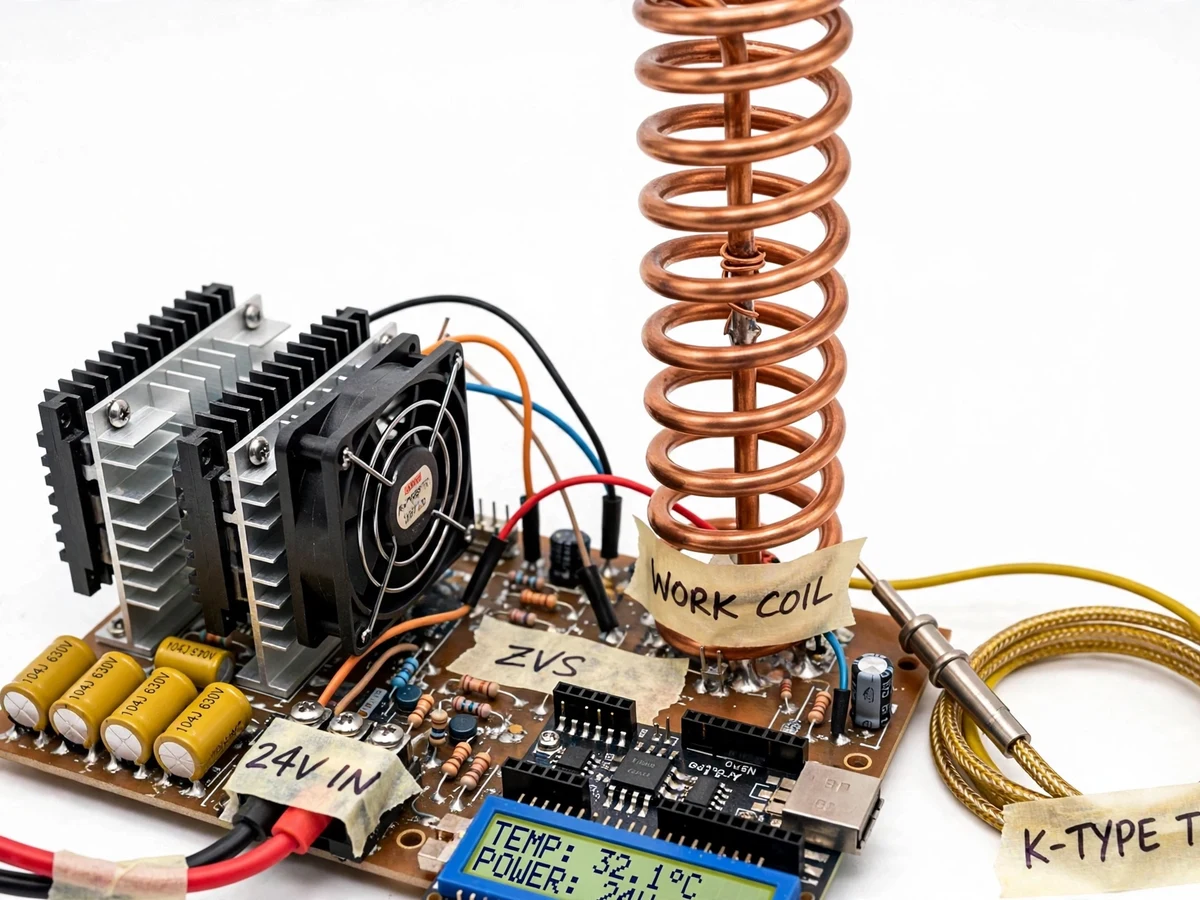
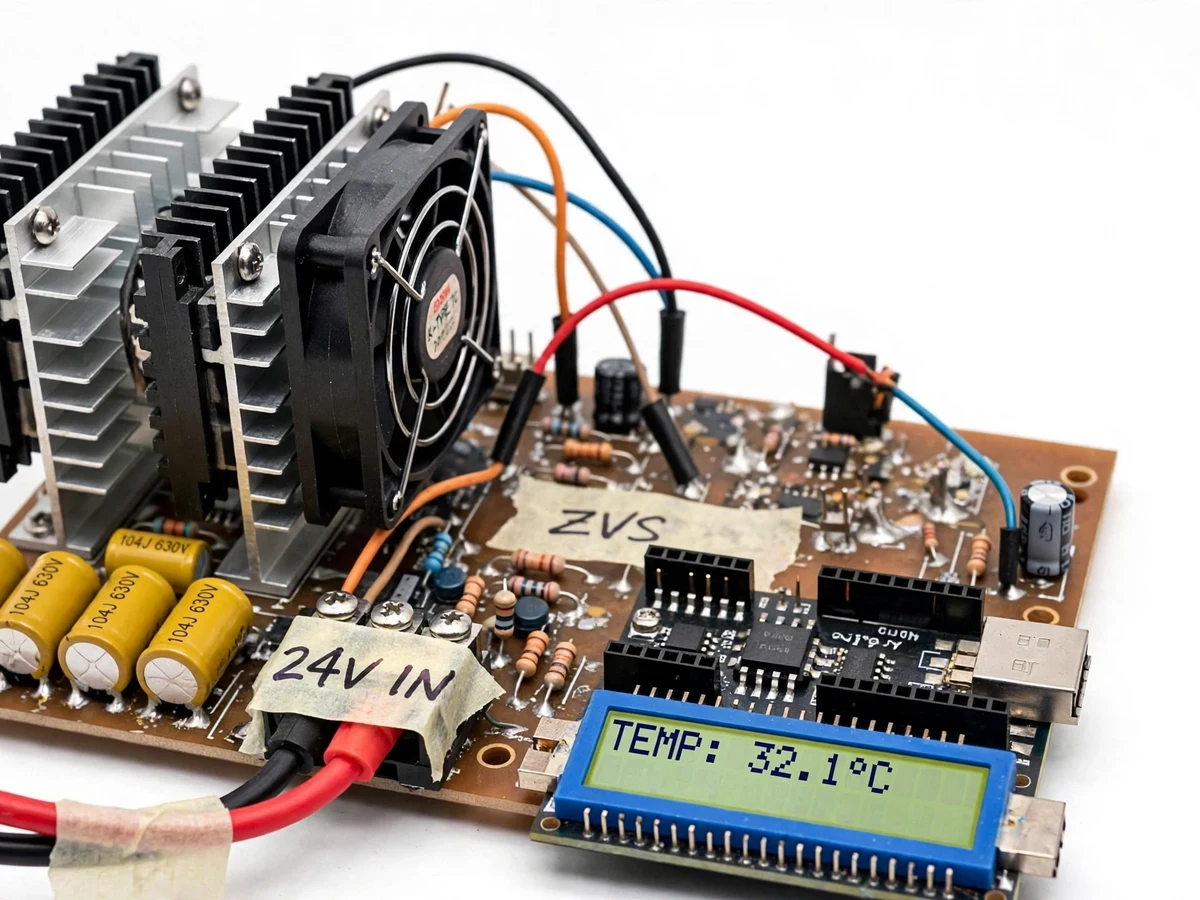
Induction heating is how industry hardens gears and solders without flame: a high-frequency magnetic field induces eddy currents in the metal, and the metal's own resistance turns those currents into heat. The ZVS oscillator is the hobbyist-grade route to the same physics — a self-resonating push-pull stage that switches its MOSFETs at zero voltage, keeping switching losses low enough for a student build. This project constructs one: a center-tapped copper work coil, two power MOSFETs with heatsinks, resonant tank capacitors, and a 12–24 V supply. A K-type thermocouple with a MAX6675 module and LCD show the workpiece temperature climbing, so the demo is quantitative, not just "it glows". The report works through resonance, skin effect and eddy-current heating, and the safety section is treated as first-class content, not a footnote.
How it works
- The 12–24 V DC supply powers the ZVS stage; on switch-on the oscillator self-starts, alternately driving the two MOSFETs.
- The MOSFETs drive the center-tapped work coil in push-pull; the tank capacitors and coil inductance set the resonant frequency (tens of kHz, design target).
- The high-frequency alternating magnetic field inside the coil induces eddy currents in the inserted steel workpiece.
- The workpiece's own resistance converts the eddy currents to heat — the metal temperature climbs with no contact and no flame.
- The K-type thermocouple pressed near the workpiece feeds the MAX6675; the Arduino displays live temperature on the LCD.
- The student varies the tank capacitance and supply voltage (within ratings) and records the heating rate for the report's resonance study.
Tech stack:
- ZVS oscillator (2x IRFP250-class N-MOSFETs)
- Hand-wound copper-tube work coil, center-tapped
- Resonant tank capacitors (selectable)
- K-type thermocouple + MAX6675 module
- Arduino Nano + 16x2 LCD (temperature display)
- 12–24 V DC supply, input fuse, heatsinks + fan
| Parameter | Value |
|---|---|
| Topology | ZVS push-pull resonant oscillator |
| Resonant frequency | Approximately 30–80 kHz depending on tank selection (design target) |
| Input | 12–24 V DC, up to approximately 10 A fused (expected) |
| Workpiece | Small steel items (bolt/nut class), approximately <50 g (design target) |
| Temperature sense | K-type thermocouple, 0–400 °C range via MAX6675 (datasheet) |
| Display | 16x2 LCD: workpiece temperature, supply voltage |
| MOSFETs | IRFP250-class with heatsinks + cooling fan |
| Demo duty | Intermittent supervised demo with cool-down (safety requirement) |
Project features
- [ZVS resonant driver] Classic zero-voltage-switching push-pull oscillator (two IRFP250-class MOSFETs) self-resonates with the tank capacitors — efficient switching the student can probe on a scope.
- [Hand-wound work coil] Copper-tube work coil, center-tapped, sized for the tank resonance — the student winds it and learns the inductance-capacitance relationship firsthand.
- [Contactless heating demo] A steel bolt or similar workpiece placed inside the coil heats via eddy currents with no electrical contact and no flame.
- [Live temperature display] K-type thermocouple + MAX6675 module and 16x2 LCD show the workpiece temperature in real time during the heating demo.
- [Resonance tuning] Tank capacitors are selectable so the student tunes the resonant frequency and observes the effect on heating rate.
- [Over-current protection] Input fuse and MOSFET heatsinks with a fan; firmware-free analog design keeps the protection simple and visible.
- [Safety-first documentation] Rated as a supervised lab demo: workpiece handling procedure, burn and EMI precautions, and a mandatory cool-down routine.
What is included
- Working ZVS induction-heater prototype (driver board, work coil, thermocouple, display)
- Arduino temperature-display firmware
- Wiring diagram, coil-winding guide and tank-capacitor selection table
- Resonance-tuning and heating-rate test procedure
- Safety guide (burn, EMI, supervision, cool-down routine)
- Project report PDF (resonance, skin effect, eddy currents, test results template)
- PPT presentation for final review
- Viva Q&A preparation document
Limitations & prerequisites
- Low-power educational demo only — it heats small steel items; it is not a hardening furnace and cannot melt metal.
- Runs on 12–24 V DC at up to ~10 A: high-current wiring must be respected, and the demo is strictly supervised with the cool-down routine.
- The work coil and workpiece get hot enough to burn — handling procedure in the safety guide is mandatory.
- Generates strong high-frequency EMI near the coil; keep sensitive electronics and magnetic media away during the demo.
- Only ferromagnetic workpieces heat efficiently; aluminum and copper barely respond at this power.
- Heating rate figures are buyer-measured during their own test — no heating performance is claimed in advance.
Frequently Asked Questions
How does it heat metal without touching it?
The coil's high-frequency magnetic field induces circulating eddy currents inside the metal. The metal's electrical resistance turns those currents into heat — the same principle as an induction cooktop.
What is ZVS and why does it matter?
Zero-voltage switching: the MOSFETs switch when the voltage across them is near zero, which keeps switching losses and heat low. It is what makes this simple two-transistor circuit practical at tens of kilohertz.
Why does only steel heat well?
Heating depends on the material's resistivity and magnetic properties. Ferromagnetic steel couples strongly to the field; aluminum and copper have low resistance and no magnetism, so they barely heat at this power.
Is it safe for a student demo?
It is a supervised lab demo with a written safety routine: fused high-current input, cool-down procedure, burn precautions and EMI awareness. It is not a toy and is never left running unattended.
What will I measure for the report?
Workpiece temperature vs time at different tank-capacitor settings and supply voltages — a genuine resonance-vs-heating-rate study from your own data.
Is this project suitable for a final-year project?
Yes — for Electronics, Electrical and Power Electronics programs. It demonstrates resonant power electronics, electromagnetic induction and instrumentation with serious safety engineering. Suitable for B.E./B.Tech final-year projects in Electronics and Communication, Electrical and Power Electronics.
Components & software requirements
- ZVS oscillator (2x IRFP250-class N-MOSFETs)
- Hand-wound copper-tube work coil, center-tapped
- Resonant tank capacitors (selectable)
- K-type thermocouple + MAX6675 module
- Arduino Nano + 16x2 LCD (temperature display)
- 12–24 V DC supply, input fuse, heatsinks + fan
Delivery information
Built-to-order project. Delivery timeline is shared after order confirmation based on current queue.
Support terms
Complete documentation, setup guide, and viva preparation included. Support for setup and explanation provided.