
More project photos (2)
The problem
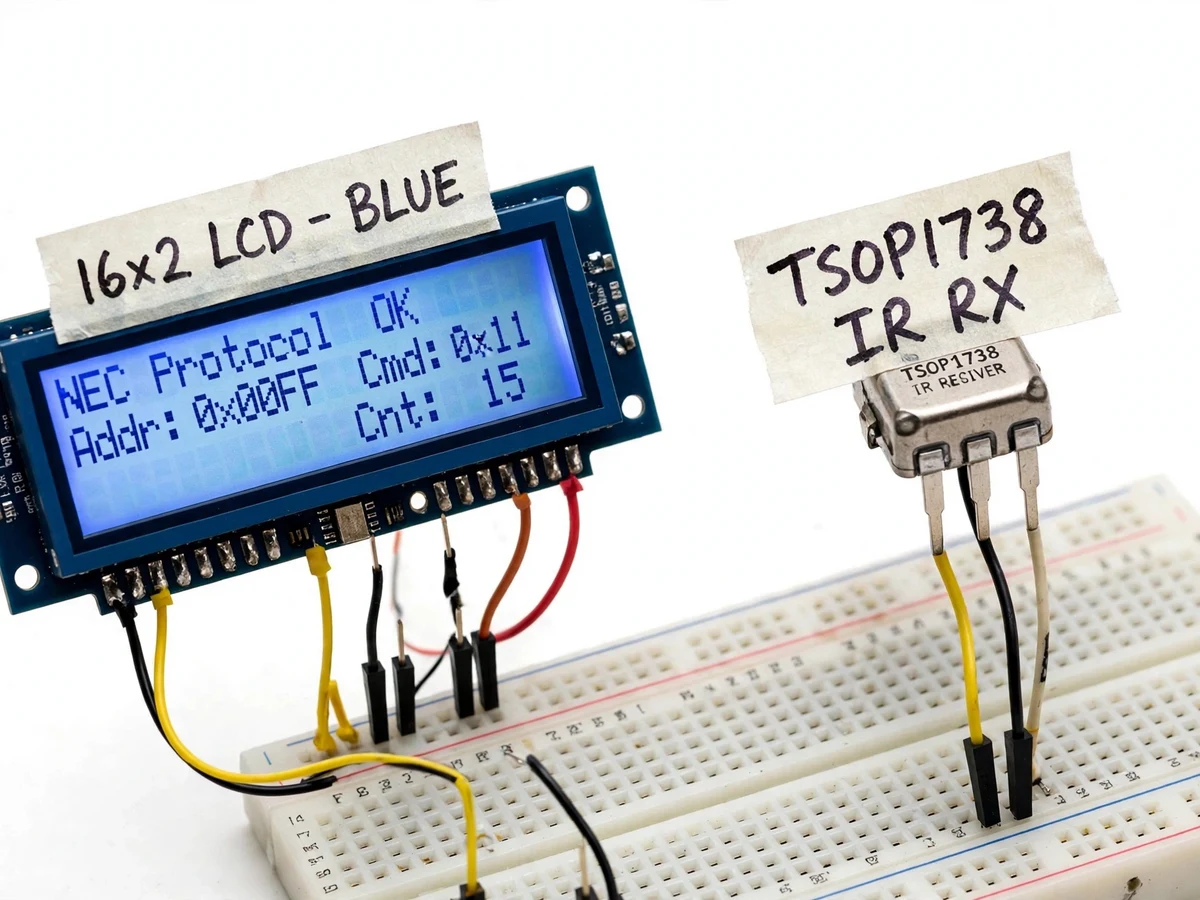
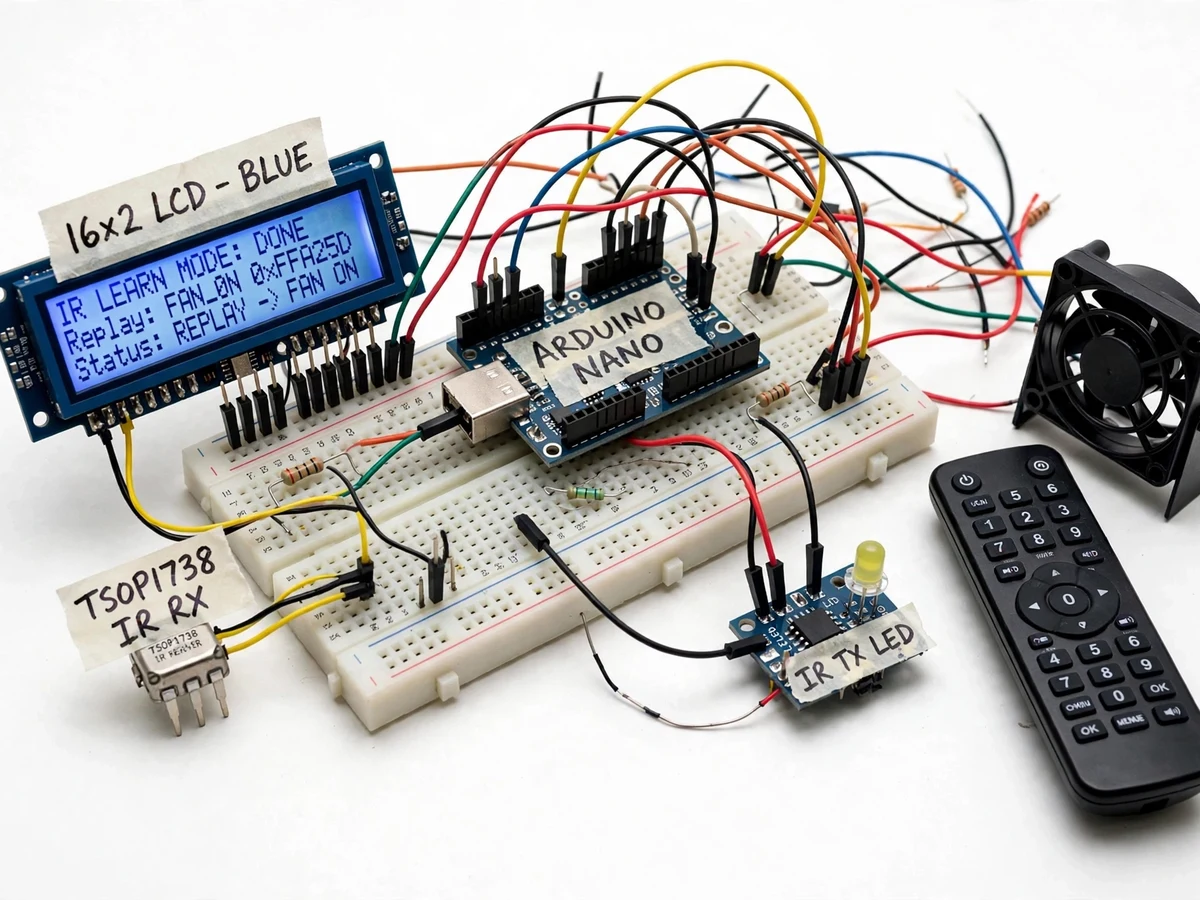
Every TV remote talks in infrared, yet the conversation is invisible — a 38 kHz carrier blinking in patterns defined by protocols like NEC and RC5. Students press buttons daily without ever seeing what the remote actually transmits. This project makes that link tangible: a TSOP1738 receiver module feeds the raw pulse train into an Arduino, firmware decodes the protocol, address and command, and an LCD displays each press in plain text. The second half of the build is the payoff — learning mode. Point any remote at the receiver, press its buttons, and the Arduino stores each code in EEPROM; an IR LED then replays the recorded patterns, so the prototype becomes a universal remote that genuinely controls the original device.
How it works
- The remote's IR LED blinks a 38 kHz carrier in a protocol-defined pattern; the TSOP1738 demodulates it to a logic-level pulse train.
- The Arduino captures the pulse train with interrupt-driven timing and matches it against known protocol decoders.
- On a match, the protocol, address and command bytes are shown on the 16x2 LCD.
- In learning mode, the decoded value for the currently selected slot is written to EEPROM with its label.
- In replay mode, the Arduino regenerates the exact carrier-modulated pattern through the IR LED driver, mimicking the original remote.
- Unknown protocols fall back to raw timing capture, which can be replayed verbatim without understanding the format.
Tech stack:
- Arduino Nano (ATmega328P)
- TSOP1738 38 kHz IR receiver
- High-power IR LED with transistor driver
- 16x2 character LCD
- EEPROM learning storage
- IRremote-style protocol decoding
- 9V battery handheld build
| Parameter | Value |
|---|---|
| Receiver | TSOP1738, 38 kHz carrier (datasheet) |
| Decoded protocols | NEC, RC5, RC6 + raw timing fallback |
| Learn capacity | 12 buttons with labels (EEPROM, design) |
| Decode display | Protocol, address, command on 16x2 LCD |
| Replay range | Approximately 5–8 m line-of-sight (expected) |
| Carrier regeneration | 38 kHz PWM-modulated replay |
| Power | 9V battery, approximately 45 mA draw (expected) |
| Response latency | Code displayed within ~100 ms of button press (expected) |
Project features
- [Protocol decoding on LCD] Decodes NEC, RC5/RC6 and common raw timings, showing protocol name, address and command for every button press.
- [TSOP1738 receiver] 38 kHz band-pass IR receiver module rejects ambient light and passes only the modulated remote signal (datasheet).
- [Learning mode] Records any remote's button codes into EEPROM — up to 12 learned buttons in the base build.
- [IR replay] A high-current IR LED driven through a transistor replays learned codes at the original timing, controlling the real device.
- [Raw timing view] Displays pulse timings for unknown protocols, letting the student analyze formats the library does not know.
- [Button-label display] Each learned button gets a short label ("TV PWR", "VOL+") shown on the LCD when replayed.
- [Battery handheld build] Self-contained unit with push buttons, ready for viva demonstrations on any IR-controlled appliance.
What is included
- Working IR decoder + learning universal remote prototype
- Arduino firmware (protocol decoding, learning, EEPROM storage, replay)
- Full wiring diagram and receiver/LED placement notes
- Learning procedure and unknown-protocol raw-capture guide
- Project report PDF (IR communication theory, NEC/RC5 frame formats, carrier modulation, build notes)
- PPT presentation for final review
- Viva Q&A preparation document (IR vs RF, 38 kHz carrier purpose, protocol frames, EEPROM)
Limitations & prerequisites
- Infrared needs line of sight — walls, bright sunlight and some fluorescent lights interfere, which is inherent to the medium.
- Replay range of 5–8 m is an expected figure that varies with the LED current and room lighting; it is not a guaranteed specification.
- Bluetooth/RF remotes (many smart-TV remotes) cannot be decoded or learned — IR only.
- Some proprietary protocols decode as raw timings; replay still works, but the report labels them as uncoded rather than pretending to understand them.
- Learned codes are tied to the original device's protocol quirks — a code learned from one TV model may not work on another brand.
Frequently Asked Questions
Why does IR use a 38 kHz carrier?
The receiver is a band-pass device tuned to 38 kHz. Modulating the data onto that carrier lets the receiver reject steady ambient light (sunlight, bulbs) and pass only remote signals — it is a noise-rejection trick, not part of the data.
What do NEC protocol frames look like?
A 9 ms leader burst, 4.5 ms space, then 32 bits (address, inverted address, command, inverted command) sent as pulse-distance coded bits. The report walks through a real captured frame.
How does learning mode store a code?
The decoded protocol+address+command (or raw timings for unknown formats) is written to EEPROM under the selected slot, with a short label. EEPROM survives power-off, so learned remotes persist.
Can it control my TV?
If your TV uses an IR remote, yes — point the original remote at the learner, record its buttons, and the prototype replays them. RF/Bluetooth remotes are out of scope.
What is the raw timing view for?
For remotes using formats the decoder library does not know, it shows the actual pulse/space durations so the student can analyze and replay the pattern verbatim.
Is this project suitable for a final-year project?
Yes — for Electronics and Communication programs. It demonstrates wireless protocol decoding, carrier modulation, embedded timing and a genuinely useful end product. Suitable for B.E./B.Tech final-year projects in Electronics and Communication.
Components & software requirements
- Arduino Nano (ATmega328P)
- TSOP1738 38 kHz IR receiver
- High-power IR LED with transistor driver
- 16x2 character LCD
- EEPROM learning storage
- IRremote-style protocol decoding
- 9V battery handheld build
Delivery information
Built-to-order project. Delivery timeline is shared after order confirmation based on current queue.
Support terms
Complete documentation, setup guide, and viva preparation included. Support for setup and explanation provided.