
More project photos (2)
The problem
A slow leak under a kitchen sink or behind a washing machine can run for weeks unnoticed, rotting cabinets, seeping into walls and wasting thousands of litres — and the first sign is often a stained ceiling in the flat below. Standalone leak alarms exist but only beep locally, useless in an empty house. This project builds the complete response chain: conductive probes in up to four zones detect water the moment it bridges their contacts, an ESP32 judges the event, a buzzer alarms locally, a solenoid valve shuts the water line automatically to stop the damage at its source, and Wi-Fi telemetry pushes the zone name to the owner's phone and a cloud event log. Battery backup keeps protection alive through power cuts, which is exactly when unattended leaks do their worst.
How it works
- Conductive probes are placed at floor level in up to four leak-prone zones and wired back to the ESP32 node.
- The firmware scans each probe continuously; water bridging a probe's contacts pulls its reading past the wet threshold.
- A detection must persist for the configured confirmation time (design: ~5 s) to filter out splashes and mopping.
- On confirmation the node sounds the buzzer, lights the zone LED, and energizes the solenoid valve to close the water line.
- The event — zone name, timestamp, valve state — publishes over Wi-Fi to the cloud dashboard and triggers a phone push alert.
- The dashboard event log records every detection and valve action; the on-device display shows the wet zone until acknowledged.
- The owner inspects the zone, presses the acknowledge/reset button, and the valve re-opens only on manual reset.
Tech stack:
- ESP32 development board (Wi-Fi)
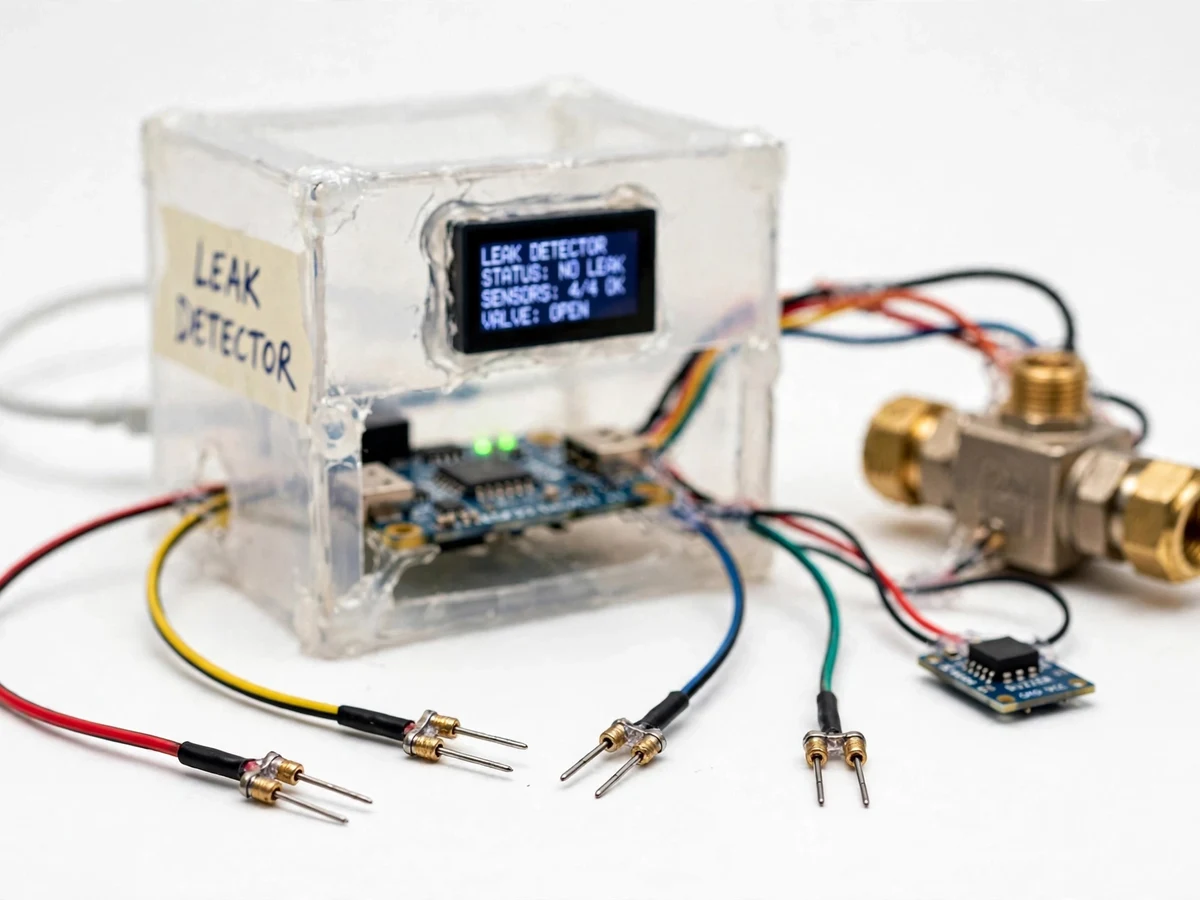
- Conductive water-leak probes x4 (zones)
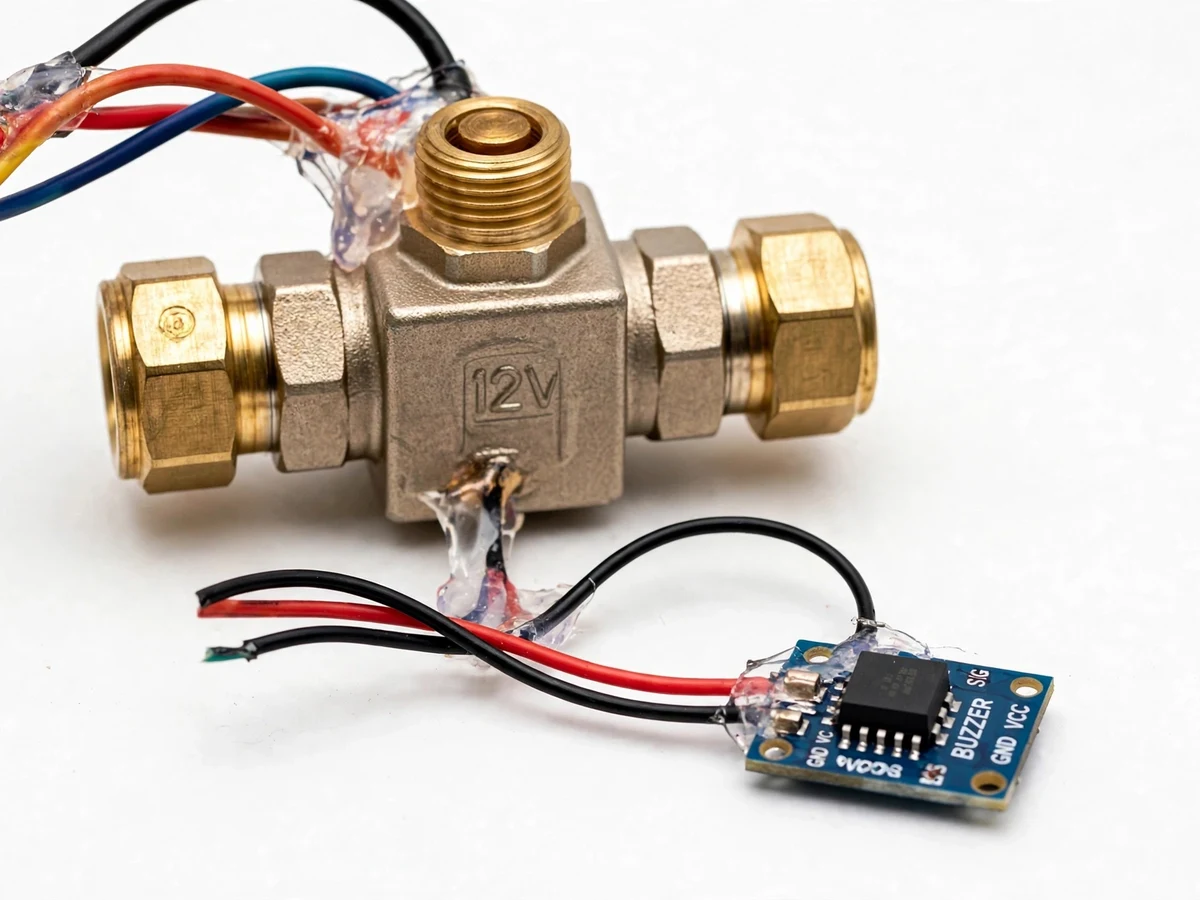
- 12 V normally-open solenoid valve + driver
- Buzzer + zone indicator LEDs
- 0.96-inch OLED / 16x2 LCD zone display
- Rechargeable battery backup pack
- Cloud dashboard + push alerts (Blynk/ThingSpeak class)
- Arduino IDE (C/C++ firmware)
| Parameter | Value |
|---|---|
| Zones | Up to 4 probe zones, named in firmware (design) |
| Detection | Conductive probe, wet confirmation ~5 s (design target) |
| Shutoff | 12 V solenoid valve, closes on confirmed detection (design) |
| Local alarm | Buzzer + per-zone LEDs (design) |
| Alerts | Wi-Fi push + cloud event log with timestamps (design) |
| Backup | Rechargeable pack, several hours protection (design target) |
| Reset | Manual acknowledge; valve re-opens only on reset (design) |
| Display | Zone DRY/WET status on OLED/LCD (design) |
Project features
- [Multi-zone probe sensing] Up to four conductive water probes (under sink, washing machine, geyser, tank outlet) are scanned continuously; each zone is named in firmware so alerts identify exactly where the water is.
- [Automatic shutoff valve] On a confirmed detection the ESP32 drives a normally-open solenoid valve on the water line closed, stopping the inflow at its source without human intervention.
- [Local alarm] A loud buzzer plus a zone LED panel at the node alarms immediately for anyone at home, even if the internet is down.
- [Phone and cloud alerts] The zone name, timestamp and valve state publish over Wi-Fi; the owner gets a push alert and the dashboard keeps a timestamped event log.
- [Battery backup] A rechargeable pack keeps sensing, alarm and valve drive alive during mains power cuts (design target: several hours of protection).
- [False-alarm filtering] Firmware requires the probe to stay wet for a configurable confirmation time, so a mopped floor or a splash does not shut the house water off.
- [On-device zone display] A small LCD/OLED shows each zone's DRY/WET status at a glance for installation checks and demos.
What is included
- ESP32 leak-detector node with 4 zone inputs and zone display
- 4 conductive water probes with cabling
- Solenoid shutoff valve with driver circuit
- Buzzer, zone LEDs and battery backup pack
- Firmware with confirmation filtering and Wi-Fi telemetry
- Cloud dashboard + alert setup guide
- Project report PDF (sensing principle, valve sizing, methodology)
- PPT presentation for final review
- Viva Q&A preparation document (conductive sensing, solenoid drive, IoT alerting)
Limitations & prerequisites
- Probes detect water that reaches them — placement at the lowest point of each zone matters; water pooling elsewhere in the room is not sensed.
- The solenoid valve must be sized to the home's pipe diameter and pressure; the included guide covers selection but the valve is matched at build time.
- The valve closes the monitored line only; leaks from sources upstream of the valve or from drainage are outside its control.
- Battery backup covers hours, not days — extended outages need a larger pack (listed as an option).
- Push alerts need working Wi-Fi and internet; the local buzzer and valve work regardless.
Frequently Asked Questions
How does the probe detect water?
Each probe has two exposed conductors; dry air keeps the resistance high, and water bridging them drops it sharply. The ESP32 reads this change and, after a confirmation delay, declares the zone wet.
Won't mopping the floor trigger a false shutoff?
No — firmware requires the probe to stay wet for about 5 seconds (configurable), so splashes and mopping do not count; only standing water does.
What does the auto-shutoff valve do?
On a confirmed leak the ESP32 closes a solenoid valve on the water line, stopping inflow at the source. It re-opens only when you manually acknowledge and reset after inspection.
Does it work during a power cut?
Yes — a rechargeable battery backup keeps sensing, the buzzer and the valve drive alive for several hours (design target), which is when unattended leaks are most dangerous.
How will I know which zone leaked?
Every zone is named in firmware (e.g. "Kitchen Sink", "Washing Machine"); the phone alert, dashboard log and on-device display all identify the exact zone.
Is this project suitable for a final-year project?
Yes — for IoT, Embedded and Electronics programs. It demonstrates multi-zone sensing, actuator control, false-alarm filtering and a full cloud alerting pipeline in a genuinely useful device. Suitable for B.E./B.Tech final-year projects in IoT, Embedded Systems and Electronics engineering.
Components & software requirements
- ESP32 development board (Wi-Fi)
- Conductive water-leak probes x4 (zones)
- 12 V normally-open solenoid valve + driver
- Buzzer + zone indicator LEDs
- 0.96-inch OLED / 16x2 LCD zone display
- Rechargeable battery backup pack
- Cloud dashboard + push alerts (Blynk/ThingSpeak class)
- Arduino IDE (C/C++ firmware)
Delivery information
Built-to-order project. Delivery timeline is shared after order confirmation based on current queue.
Support terms
Complete documentation, setup guide, and viva preparation included. Support for setup and explanation provided.