
More project photos (2)
The problem
Pool water that looks clear can still be unsafe: pH drift makes chlorine ineffective and irritates eyes and skin, while low ORP means disinfection is failing even when chlorine was added. Most small pools are still checked with test strips once a day — a snapshot that misses everything in between. This project replaces the strip with continuous instrumentation: pH, ORP and temperature probes sit in the water permanently, an ESP32 reads them through proper signal-conditioning modules, and a cloud dashboard shows live water quality with alerts when pH or ORP leave the safe band. The key learning is that ORP, not chlorine test strips, is the direct measure of disinfection power — a concept straight from water-treatment engineering. A dosing advisory tells the operator how much chemical correction the readings call for.
How it works
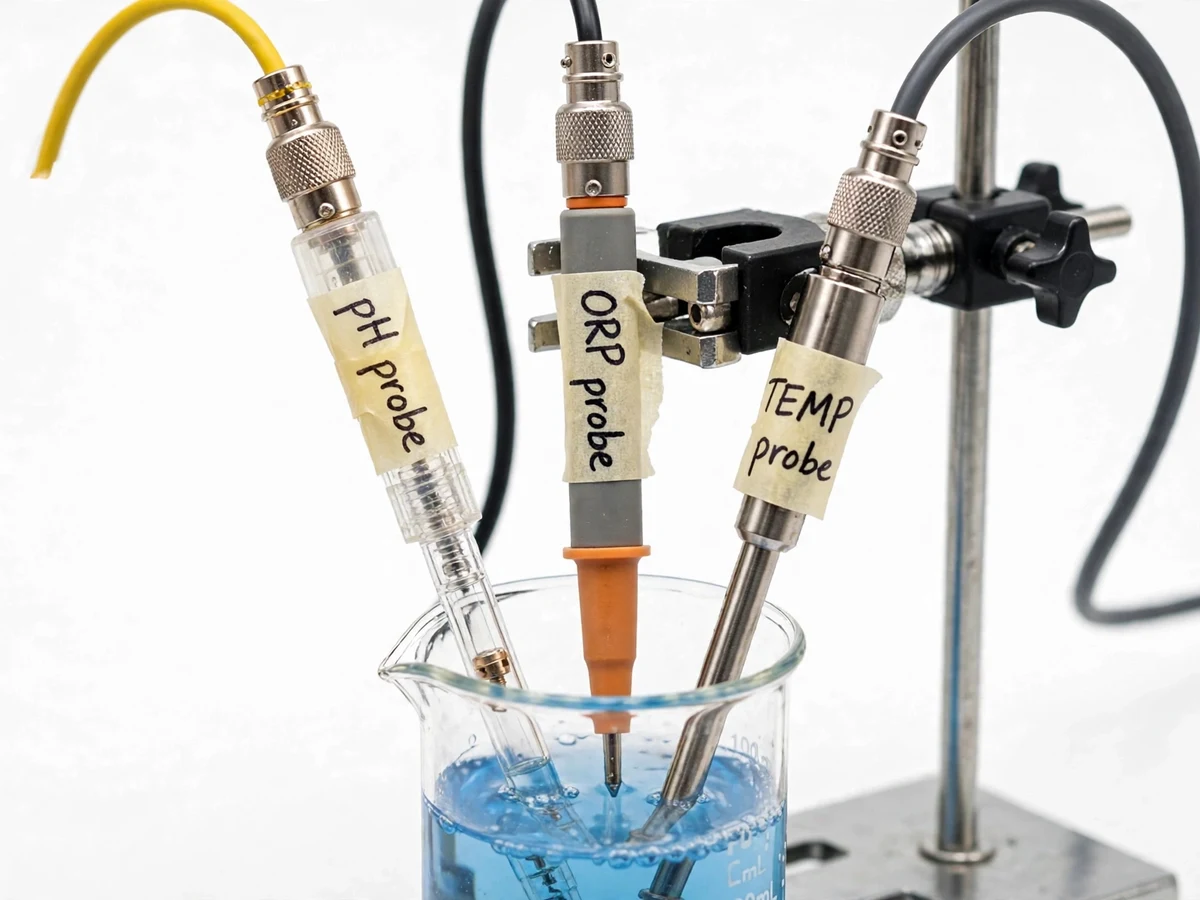
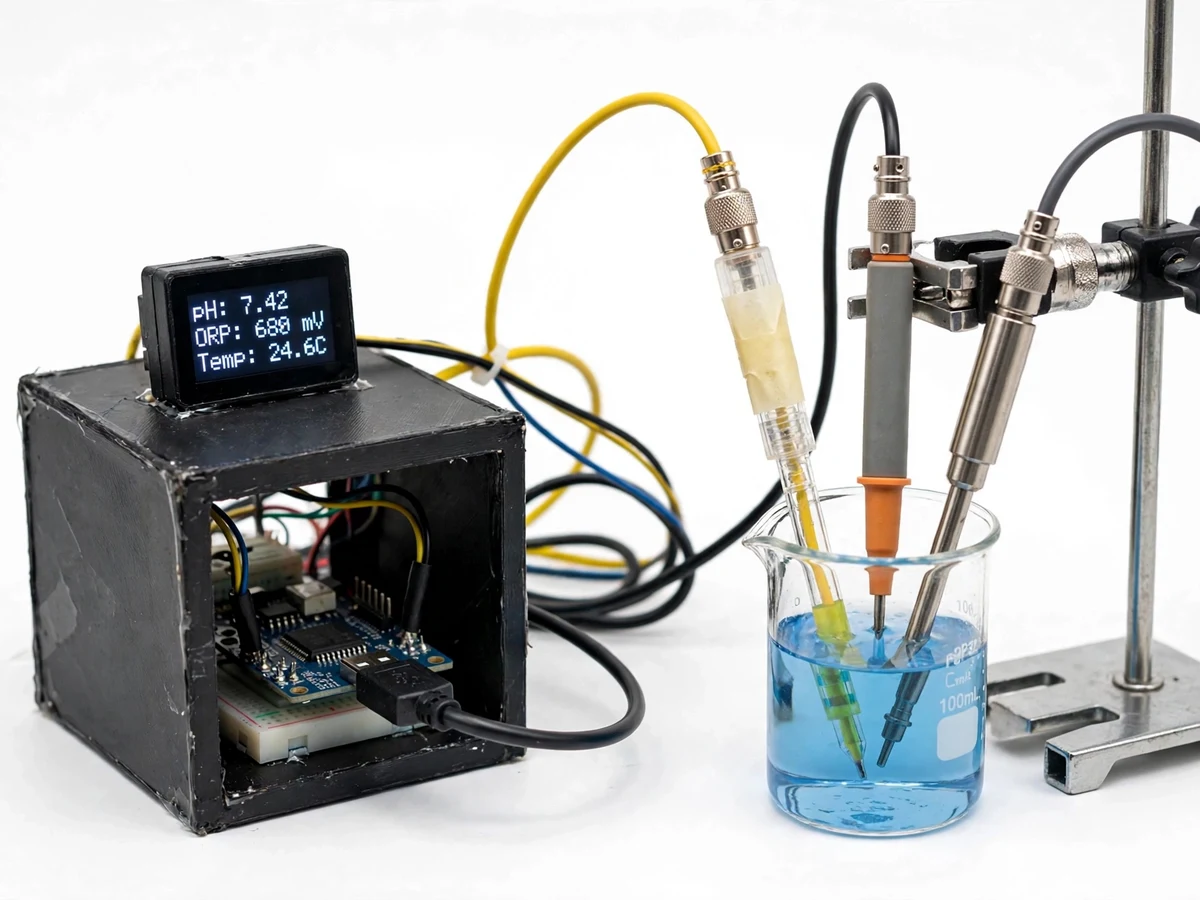
- The pH, ORP and temperature probes are mounted in the pool's circulation line (or a sample beaker for the demo) and wired to their conditioning modules.
- The ESP32 samples all three channels on a schedule, applies the stored calibration coefficients, and computes pH, ORP in mV and temperature.
- Live values appear on the OLED display at the poolside and publish over Wi-Fi to the cloud dashboard.
- Firmware checks each reading against the configured safe bands (pH approximately 7.2–7.8, ORP approximately 650–750 mV — standard pool practice).
- When a reading leaves its band beyond the hysteresis margin, the system pushes an alert with the dosing advisory for that condition.
- The operator doses the advised chemical, and the dashboard trend shows the parameter recovering into the safe band.
- All readings are logged historically, so the report shows multi-day water-quality trends from the student's own test runs.
Tech stack:
- ESP32 (Wi-Fi microcontroller)
- pH probe + BNC conditioning module
- ORP probe + BNC conditioning module
- DS18B20 temperature probe
- OLED display
- Arduino IDE (C++ firmware)
- Cloud dashboard (MQTT/HTTP)
- pH buffer solutions (calibration)
| Parameter | Value |
|---|---|
| Controller | ESP32 DevKit (dual-core, Wi-Fi) — datasheet |
| pH range | 0–14 pH, ±0.1 pH after two-point calibration (expected) |
| ORP range | ±2000 mV (conditioning module datasheet) |
| Temperature | -55 to +125 °C, ±0.5 °C (DS18B20 datasheet) |
| Safe bands | pH 7.2–7.8, ORP 650–750 mV (standard pool practice) |
| Sampling | Configurable; default 60 s (firmware) |
| Alerts | Push notification + OLED + buzzer (implemented) |
| Dashboard | Live charts with safe-band overlays (MQTT) |
| Power | 5 V DC regulated (design) |
Project features
- [pH, ORP and temperature sensing] Industrial-style pH probe, ORP probe and DS18B20 temperature probe read through proper BNC conditioning modules — real instrumentation, not toy sensors.
- [Two-point pH calibration] Firmware supports buffer-solution calibration (pH 4.0 / 7.0 / 10.0) with the procedure documented, so readings are traceable and the viva discussion is solid.
- [Dosing advisory] When pH or ORP leave the safe band, the dashboard advises the corrective action (add acid/alkali, shock dose) based on standard pool-chemistry practice.
- [Cloud water-quality dashboard] Live pH, ORP and temperature charts with safe-band overlays, so the pool operator sees trends instead of single snapshots.
- [Out-of-range alerts] Push notifications fire when any parameter leaves its configured safe band, with hysteresis to avoid alert flapping.
- [On-device OLED display] Live pH, ORP and temperature at the poolside without needing a phone.
- [Probe care documentation] Storage, cleaning and recalibration schedules for the probes are documented — the part of real instrumentation projects students usually miss.
What is included
- pH, ORP and temperature probe kit with conditioning modules
- ESP32 controller box with OLED display (assembled, programmed)
- Cloud dashboard setup with safe-band overlays and alerts
- Complete firmware source code with calibration routine
- Wiring diagram and probe mounting guide
- Two-point calibration procedure with buffer solutions
- Probe care, storage and cleaning schedule document
- Project report PDF (background, water-chemistry theory, instrumentation, results)
- PPT presentation for final review
- Viva Q&A preparation document (pH/ORP theory, calibration, IoT telemetry)
Limitations & prerequisites
- Probes need regular calibration and proper storage in buffer solution; neglected probes drift — the care schedule is mandatory, not optional.
- ORP indicates disinfection strength but does not measure chlorine concentration directly; the report explains this distinction honestly.
- The demo runs in a sample beaker; a real pool installation needs the probes in the circulation line with proper flow and weatherproofing.
- pH readings are temperature-dependent; the firmware applies DS18B20-based compensation, documented as approximate.
- Wi-Fi is required for cloud charts and phone alerts; the OLED and buzzer work locally without it.
- This is a monitoring and advisory system — it does not auto-dose chemicals; automated dosing pumps are listed as future scope.
Frequently Asked Questions
What is ORP and why measure it?
Oxidation-reduction potential (in mV) measures the water's actual disinfection strength — how effectively it kills pathogens. It is the direct indicator water-treatment engineers use; chlorine test strips only estimate one input to it.
How is the pH probe calibrated?
With a two-point buffer calibration: the probe is placed in pH 7.0 then pH 4.0 (or 10.0) buffer solutions, and the firmware computes the offset and slope. The full procedure with buffer solutions is included.
Does it add chemicals automatically?
No — this build monitors and advises. When readings leave the safe band, the dashboard tells the operator what to dose. Automated dosing pumps are documented as future scope in the report.
How often do the probes need attention?
pH probes need recalibration every few weeks and storage in buffer solution between uses; the included care schedule covers cleaning, storage and replacement intervals honestly.
Can it work without Wi-Fi?
Yes, locally: the OLED shows live readings and the buzzer sounds on out-of-range conditions. Cloud charts and phone alerts need connectivity.
Is this project suitable for a final-year project?
Yes — for Electronics, Electrical and IoT programs. It teaches real instrumentation (probe conditioning, calibration), water chemistry and cloud telemetry in one build. Suitable for B.E./B.Tech final-year projects in Electronics, Electrical and IoT.
Components & software requirements
- ESP32 (Wi-Fi microcontroller)
- pH probe + BNC conditioning module
- ORP probe + BNC conditioning module
- DS18B20 temperature probe
- OLED display
- Arduino IDE (C++ firmware)
- Cloud dashboard (MQTT/HTTP)
- pH buffer solutions (calibration)
Delivery information
Built-to-order project. Delivery timeline is shared after order confirmation based on current queue.
Support terms
Complete documentation, setup guide, and viva preparation included. Support for setup and explanation provided.