
More project photos (2)
The problem
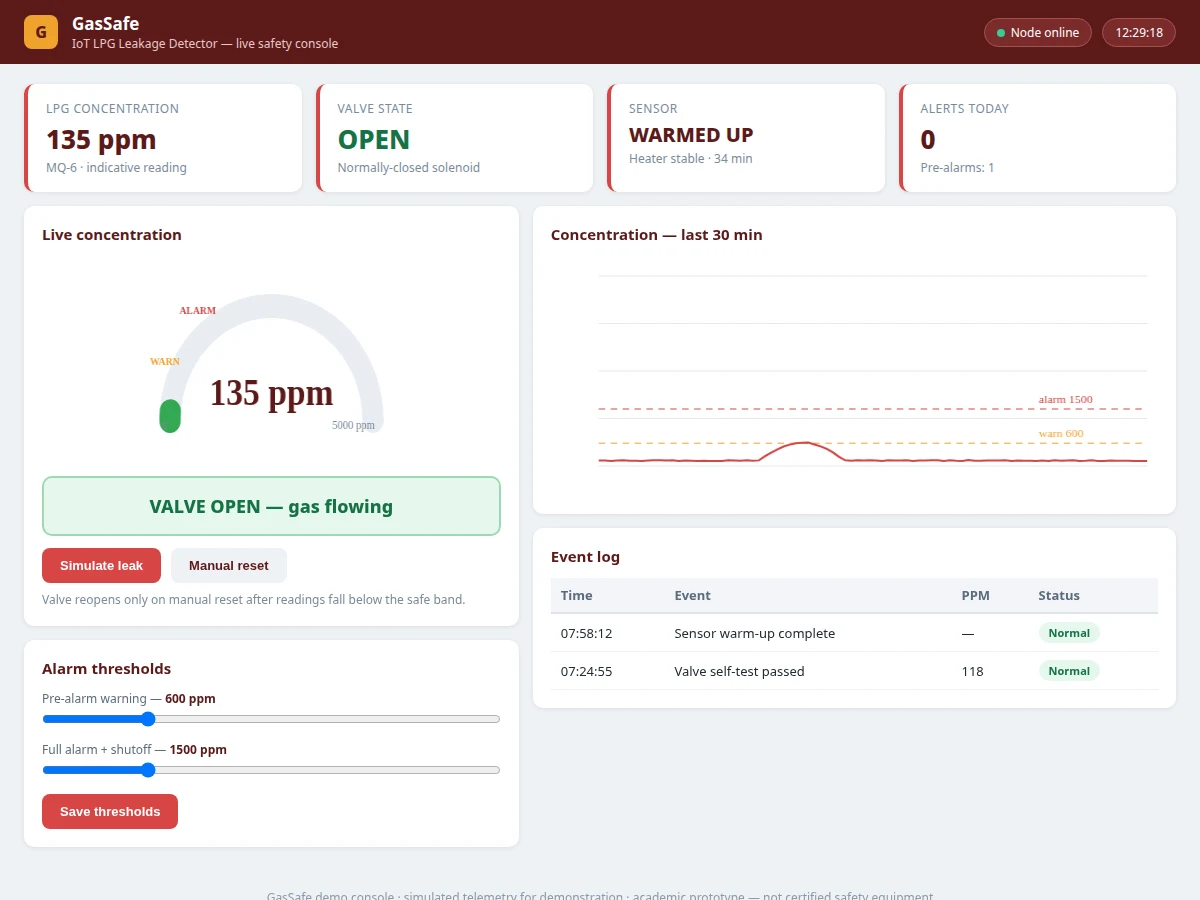
LPG leaks are dangerous precisely because the gas is invisible and the failure mode is binary: either someone smells it in time or they don't. Standalone gas alarms only beep — if nobody is home, the beep protects nothing, and none of them can stop the leak. The engineering gap is a node that both senses and acts: detect the leak, cut the supply automatically, and notify someone who can respond, with the whole event visible remotely. This project builds that node on an ESP32: an MQ-6 semiconductor gas sensor (sensitive to LPG in the 200–10000 ppm band per its datasheet) feeds the controller; on crossing the alarm threshold the firmware sounds a buzzer, drives a normally-closed solenoid valve shut on the gas line, and publishes the event plus live PPM readings to a cloud dashboard. The dashboard renders a live concentration gauge, valve status and a timestamped event log, and sends the alert to the user's phone. A manual reset and valve self-test routine complete the safety logic.
How it works
- The MQ-6 sensor heats its sensing element; after the documented warm-up/burn-in period the ESP32 samples the divider voltage.
- The firmware converts the reading to an approximate LPG concentration using the sensor's characteristic curve (documented as indicative, not laboratory-grade).
- Crossing the pre-alarm threshold starts intermittent buzzing and a dashboard warning; crossing the alarm threshold escalates.
- On full alarm the ESP32 de-energizes the normally-closed solenoid valve (spring shut), sounds the continuous buzzer, and publishes the event with PPM and timestamp.
- The dashboard raises the alert on the user's phone; the event log records the full sequence for the report.
- Once readings fall below the safe band, a manual reset re-energizes the valve; the self-test routine verifies valve movement on schedule.
Tech stack:
- ESP32 development board (Wi-Fi)
- MQ-6 LPG gas sensor module
- Normally-closed solenoid valve (gas-line rated) with driver relay/MOSFET
- Buzzer and status LEDs
- 12 V power supply for valve + 5 V logic supply
- Cloud dashboard (Blynk/ThingSpeak class) with live gauge and event log
- Arduino IDE (C/C++ firmware)
- Demo gas-test chamber accessories for calibration
| Parameter | Value |
|---|---|
| Controller | ESP32 (Wi-Fi for dashboard telemetry) |
| Sensor | MQ-6 semiconductor; datasheet LPG sensitivity band 200–10000 ppm |
| Alarm stages | Pre-alarm warning threshold + full-alarm threshold; both student-calibrated |
| Shutoff | Normally-closed solenoid valve; fail-safe (closes on power loss); manual-reset reopen |
| Indication | Buzzer (intermittent/continuous), status LEDs, dashboard gauge |
| Dashboard | Live PPM gauge, valve state, warm-up status, timestamped event log, phone alert |
| Power | 12 V DC for solenoid + regulated 5 V/3.3 V for logic |
| Calibration | Burn-in + threshold-setting procedure run by the buyer; no detection figures claimed at build |
Project features
- [MQ-6 LPG sensing] Semiconductor sensor with datasheet sensitivity to LPG in the 200–10000 ppm band; the load-resistor divider and burn-in procedure are documented.
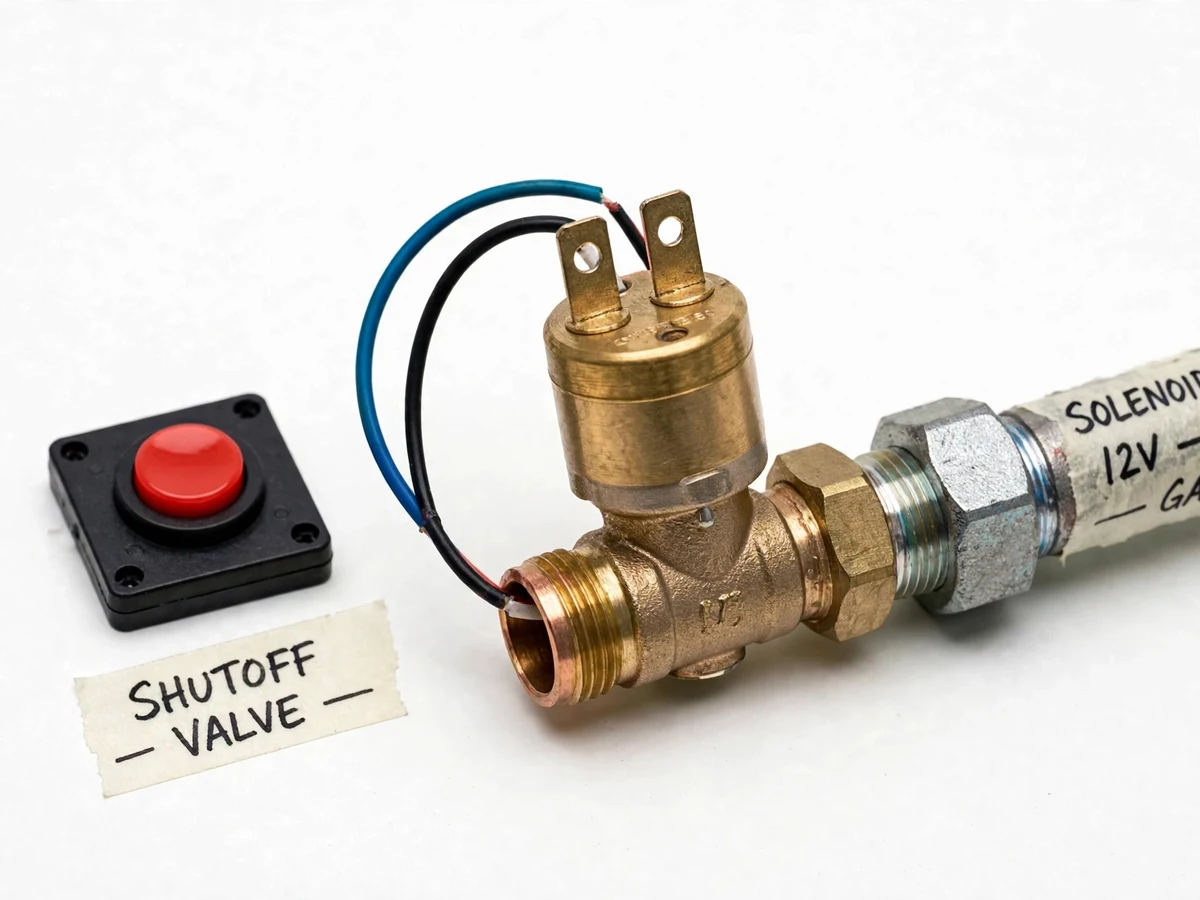
- [Automatic shutoff valve] A normally-closed solenoid valve on the gas line is held open during normal operation and released shut on alarm — fail-safe by design, since power loss also closes it.
- [Two-stage alerting] A pre-alarm warning stage (buzzer intermittent) escalates to full alarm (continuous buzzer + valve shut + dashboard/phone alert) at the higher threshold.
- [Live PPM dashboard] The cloud dashboard shows a real-time concentration gauge, valve open/closed state, sensor warm-up status and a timestamped event log.
- [Student-run calibration] The alarm thresholds ship as starting values; the student sets final values with the included calibration procedure and documents the process — no claimed detection figures at build.
- [Valve self-test] A scheduled self-test pulses the valve to confirm it moves freely, with the result logged on the dashboard — stuck valves are the classic silent failure.
- [Manual reset with interlock] After an alarm, the valve reopens only on a deliberate manual reset after the concentration falls below the safe band.
What is included
- Working gas-leak detector prototype (ESP32, MQ-6, solenoid valve, buzzer, power supplies)
- Complete firmware source code (sensing, staging, valve control, dashboard sync)
- Live PPM dashboard setup with gauge, valve panel and event log
- Circuit and wiring documentation (including valve driver sizing)
- Burn-in and calibration procedure for threshold setting
- Component list with ratings
- Project report PDF (gas-sensor theory, safety logic, methodology, calibration results)
- PPT presentation for final review
- Viva Q&A preparation document (semiconductor sensors, fail-safe design, IoT alerting)
- Setup and demonstration guide
Limitations & prerequisites
- This is an academic demonstration of leak detection and shutoff logic, not a certified gas-safety device; it must not be presented or installed as life-safety equipment — real installations need certified detectors fitted by qualified personnel.
- MQ-6 is a broad-spectrum semiconductor sensor: it responds to LPG but also to alcohol vapors, smoke and cooking fumes; cross-sensitivity is documented and the report must acknowledge it.
- Concentration readings are indicative (characteristic-curve estimates), not laboratory measurements; thresholds are relative trip points set by the student's own calibration.
- The sensor needs a warm-up/burn-in period before readings stabilize; cold-start readings are not valid and the firmware flags this state.
- The solenoid valve must be gas-line rated for the demo line used; the kit specifies the rating and the student must not substitute an unrated valve.
Frequently Asked Questions
Which sensor is used and what does it detect?
An MQ-6 semiconductor sensor, sensitive to LPG in the 200–10000 ppm band per its datasheet. It is broad-spectrum, so alcohol vapor and smoke can also move the reading — the report documents this honestly.
How does the auto shutoff work?
A normally-closed solenoid valve is held open electrically during normal operation; on alarm (or power loss) it springs shut, cutting the gas line. It reopens only on manual reset.
What shows on the dashboard?
A live PPM gauge, valve open/closed state, sensor warm-up status, a timestamped event log, and phone alerts on alarm.
Is it a certified safety device?
No. It is an academic prototype demonstrating detection-to-shutoff logic. Real kitchens need certified detectors installed by qualified personnel.
How are thresholds set?
With the included burn-in and calibration procedure — you expose the sensor to controlled test conditions, set the pre-alarm and alarm points, and document the process. No detection figures are pre-claimed.
Is this project suitable for a final-year project?
Yes — for Electronics, IoT and Embedded programs. It combines sensor interfacing, fail-safe actuation design, and a live IoT dashboard with genuinely testable behavior. Suitable for B.E./B.Tech final-year projects in Electronics, IoT and Embedded Systems.
Components & software requirements
- ESP32 development board (Wi-Fi)
- MQ-6 LPG gas sensor module
- Normally-closed solenoid valve (gas-line rated) with driver relay/MOSFET
- Buzzer and status LEDs
- 12 V power supply for valve + 5 V logic supply
- Cloud dashboard (Blynk/ThingSpeak class) with live gauge and event log
- Arduino IDE (C/C++ firmware)
- Demo gas-test chamber accessories for calibration
Delivery information
Built-to-order project. Delivery timeline is shared after order confirmation based on current queue.
Support terms
Complete documentation, setup guide, and viva preparation included. Support for setup and explanation provided.