
More project photos (2)
The problem
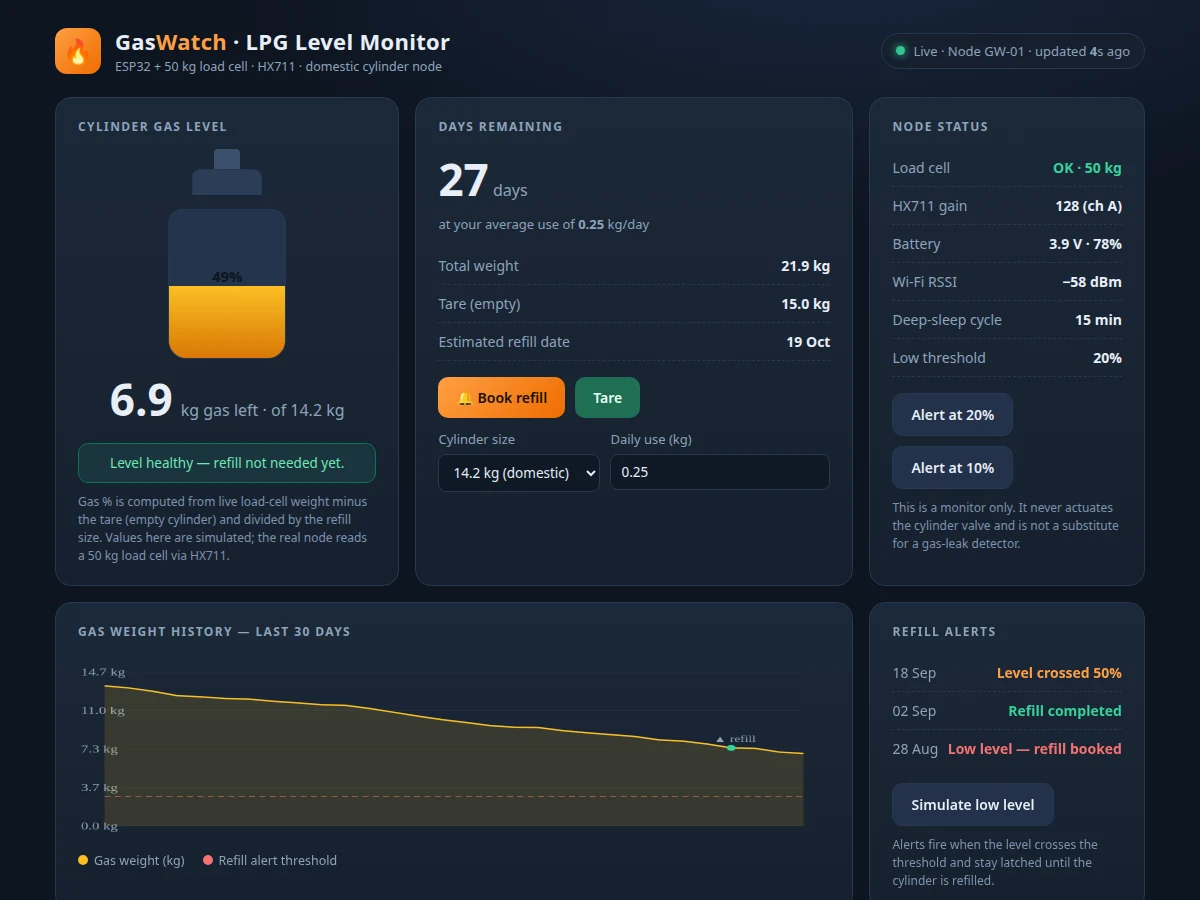
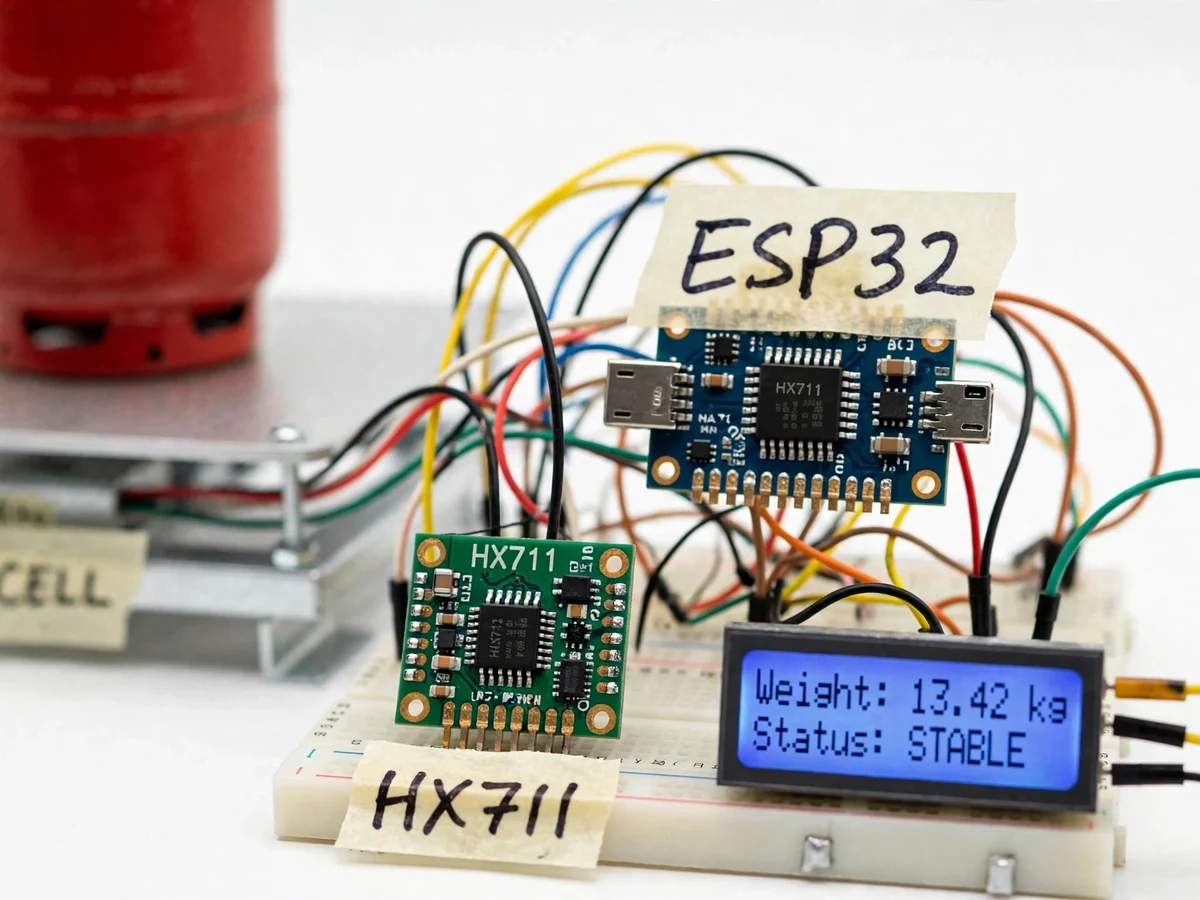
Most households discover the cylinder is empty the moment the burner dies mid-cooking. Lifting the cylinder to guess the gas left is the common workaround, and it is unreliable — a 14.2 kg domestic cylinder's steel body weighs roughly 15 kg on its own, so "feels half" is mostly imagination. This project solves the problem the engineering way: it weighs the cylinder. A 50 kg single-point load cell sits under a steel weighing platform; an HX711 24-bit ADC digitises the tiny strain-gauge signal; an ESP32 turns raw weight into gas remaining by subtracting the stored tare, and estimates days remaining from the household's rolling average consumption. When the level crosses the alert threshold (20% default, configurable to 10%), the dashboard fires a low-level alert and a one-tap button sets a refill-booking reminder. A local 16x2 LCD shows live weight and status on the rig itself, so the sensing chain is demonstrable without a phone or browser.
How it works
- The LPG cylinder stands on a steel platform supported by a 50 kg single-point load cell; the load cell's four wires feed the HX711 amplifier module.
- The ESP32 reads the HX711 at gain 128 (channel A), applies moving-average filtering, and converts counts to kilograms using the two-point calibration factor from the buyer's calibration run.
- On first use the buyer stores the tare (empty cylinder weight, typically ~15 kg for a 14.2 kg domestic cylinder) in flash; gas remaining = total weight − tare.
- Gas percentage = gas remaining ÷ refill size; the firmware tracks the daily weight drop as a rolling average and computes days remaining = gas remaining ÷ average daily use.
- The ESP32 wakes from deep sleep every 15 minutes, takes a reading, serves the local dashboard over Wi-Fi, updates the 16x2 LCD, and sleeps again.
- When the level crosses the alert threshold, the dashboard banner fires and latches the event into the refill-alert log until a refill (weight jump) clears it.
- The "Book refill" button sets a booking reminder with the distributor details; a weight jump back near full marks the refill as completed in the log.
Tech stack:
- ESP32 (Arduino framework)
- 50 kg single-point load cell · HX711 24-bit ADC module
- Steel weighing platform (fabricated)
- 16x2 LCD (I2C)
- HTML/CSS/JavaScript companion dashboard (single-file)
- Deep-sleep power cycling · moving-average filtering
- Wi-Fi (dashboard + optional MQTT)
| Parameter | Value |
|---|---|
| Load cell | 50 kg single-point, strain gauge (datasheet) |
| ADC | HX711 24-bit, gain 128 (channel A), ~10 SPS (datasheet) |
| Microcontroller | ESP32, Arduino framework |
| Cylinder sizes | 14.2 kg domestic / 5 kg / 19 kg (configurable) |
| Typical tare | Approximately 15 kg for a 14.2 kg domestic cylinder (expected) |
| Weight resolution | Approximately 10 g after filtering (design target) |
| Reading cycle | Every 15 min, deep sleep between (expected) |
| Alert thresholds | 20% default, 10% option (configurable) |
| Local display | 16x2 LCD (I2C), weight + status |
Project features
- [Weight-based gas level] A 50 kg single-point load cell under a steel platform measures total cylinder weight; firmware subtracts the tare (empty cylinder weight) and divides by the refill size (14.2 / 5 / 19 kg) to report gas percentage.
- [Days-remaining estimate] Daily consumption is learned as a rolling average of the weight drop, and the dashboard converts remaining gas into an estimated days-left figure with a predicted refill date.
- [Low-level alerts] When the level crosses the configured threshold (20% default, 10% option), the dashboard banner turns critical and the event is logged to the refill-alert history until the cylinder is refilled.
- [One-tap refill reminder] A "Book refill" button sets a refill-booking reminder and records it in the alert log, so the workflow from low gas to booked refill is demonstrable in one click.
- [HX711 + ESP32 firmware] 24-bit ADC at gain 128 on channel A, moving-average filtering for stability, deep-sleep wake every 15 minutes, tare stored in flash, two-point calibration through the buyer's own weight procedure.
- [Live web dashboard] Cylinder fill graphic, gas remaining in kg, days-left counter, total/tare weights, 30-day usage chart with alert-threshold line, node status (battery, Wi-Fi RSSI, load-cell state) and configurable alert thresholds.
- [16x2 LCD readout] Live weight and STABLE/ALERT status on the hardware itself, so the prototype is demonstrable standalone.
What is included
- Weighing platform prototype (load cell, steel plate, HX711, ESP32, 16x2 LCD, wiring)
- ESP32 firmware source (tare, two-point calibration, filtering, deep-sleep cycle, dashboard server)
- Companion web dashboard (single-file HTML/CSS/JS, the GasWatch demo)
- Load-cell calibration procedure for the buyer
- Project report PDF (background, load-cell/HX711 theory, methodology, circuit diagrams)
- PPT presentation for final review
- Viva Q&A preparation document (strain gauges, HX711, ADC resolution, calibration, deep sleep)
Limitations & prerequisites
- This is a MONITOR only: it never actuates the cylinder valve and cannot shut off gas — no valve-control hardware or firmware is included.
- It is NOT a gas-leak detector and does not replace one; it measures weight, not gas concentration in air.
- Weight resolution of ~10 g is a design target achieved after filtering and the buyer's own two-point calibration — it is not a measured claim until the calibration run is done on the built unit.
- Accuracy depends on the cylinder standing undisturbed on the platform; moving or leaning the cylinder during a reading skews that sample.
- The days-remaining estimate assumes consumption near the recent average; a sudden change (festival cooking, guests) makes the estimate drift until the average relearns.
- Wi-Fi range limits where the dashboard is reachable; there is no GSM/SMS fallback in the standard build.
- Deep-sleep cycle means readings are 15 minutes apart by design — this is not a real-time safety system.
Frequently Asked Questions
How does it know how much gas is left without opening the cylinder?
It doesn't measure gas directly — it weighs the cylinder. Gas remaining = total weight minus the tare (empty cylinder weight). Since only the gas is consumed, the weight drop equals gas used.
What does the calibration involve?
A two-point procedure: place a known weight on the platform (a water bottle of known mass works) and enter the reading, repeat at a second weight, and the firmware computes the scale factor. It takes about ten minutes.
Can it work with a 5 kg or 19 kg cylinder?
Yes — the cylinder size is a dashboard setting (14.2 / 5 / 19 kg) and the tare is re-stored for whichever cylinder sits on the platform.
Does it actually book the refill with the gas agency?
No. The "Book refill" button sets a booking reminder and logs the event; completing the booking on the agency's app or IVR is the user's step. Direct agency API integration is listed as future scope.
Is it safe to put electronics under a gas cylinder?
The rig is a passive weighing platform — no sparking relays, no mains voltage near the cylinder, and the ESP32 runs on low-voltage DC. The unit never touches the valve or regulator.
Is this project suitable for a final-year project?
Yes — for Electronics, Electrical and IoT & Embedded programs. It combines sensor interfacing (strain gauge + 24-bit ADC), embedded firmware, calibration methodology and a companion dashboard in one demonstrable system. Suitable for B.E./B.Tech final-year projects in Electronics, Electrical and IoT & Embedded.
Components & software requirements
- ESP32 (Arduino framework)
- 50 kg single-point load cell · HX711 24-bit ADC module
- Steel weighing platform (fabricated)
- 16x2 LCD (I2C)
- HTML/CSS/JavaScript companion dashboard (single-file)
- Deep-sleep power cycling · moving-average filtering
- Wi-Fi (dashboard + optional MQTT)
Delivery information
Built-to-order project. Delivery timeline is shared after order confirmation based on current queue.
Support terms
Complete documentation, setup guide, and viva preparation included. Support for setup and explanation provided.